Your shop has run diesel for twenty years, and now a row of gasoline school buses just joined the fleet. Good news: they're simpler and cheaper to service. The catch is the rhythm is different — shorter oil intervals, spark plugs instead of injectors — and a diesel schedule won't catch it. Book a demo of gasoline PM scheduling to set the right cadence from day one.
GASOLINE SCHOOL BUS MAINTENANCE
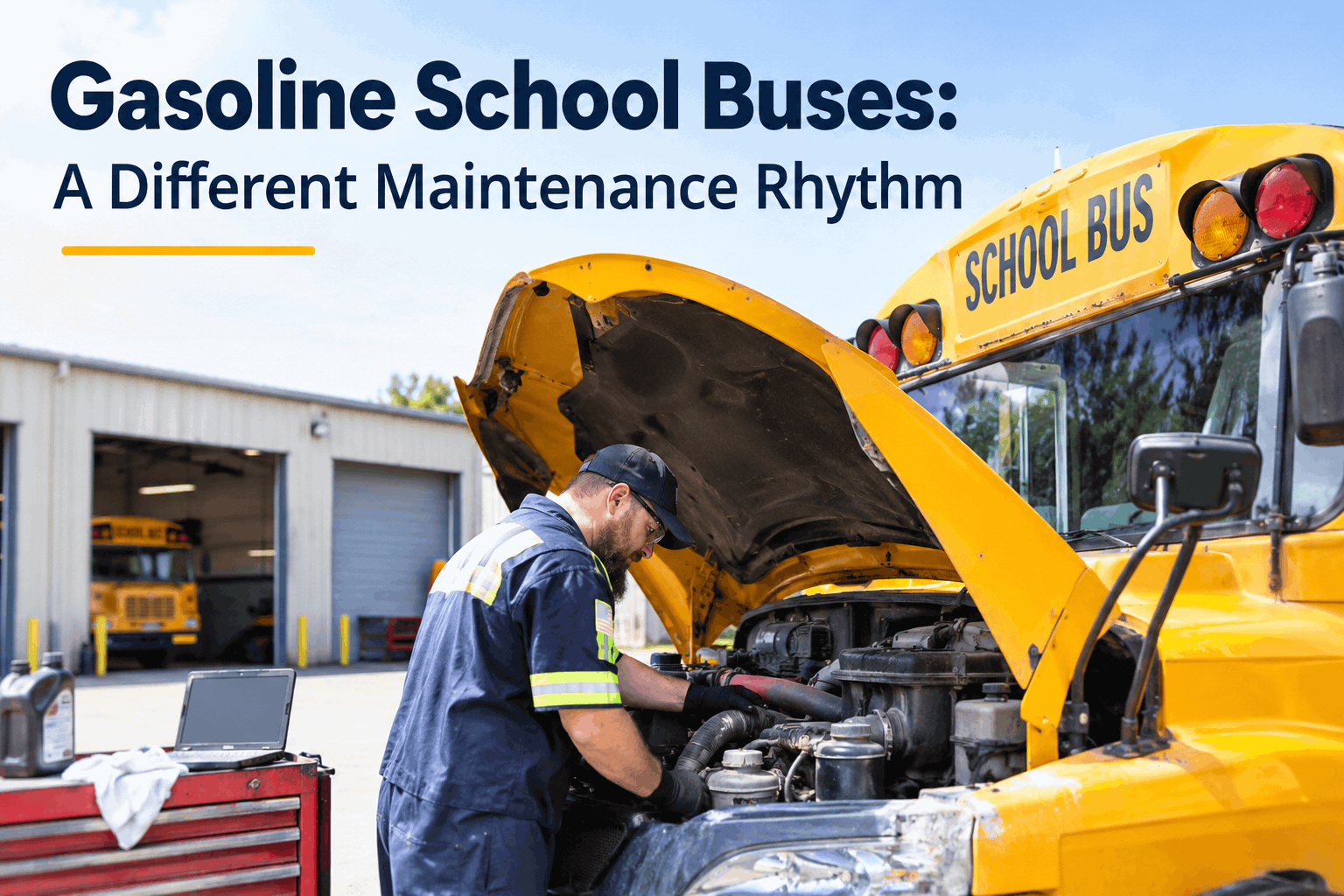
Gasoline School Buses: A Different Maintenance Rhythm
Gasoline school bus maintenance is lighter than diesel, but it runs on its own beat. Here is the PM tier structure, what spark-ignition changes about your routine, and how to keep every oil, ignition, fuel, and cooling task on schedule.
~6,000 mia common oil-change interval benchmark (TRB)
Sparkignition — plugs and coils, not injectors
Lowerupfront and service cost than diesel (reported)
01 · THE SHIFT
What gasoline changes for a diesel shop
Most of your chassis work carries straight over — brakes, tires, suspension, body, the eight-light system, the wheelchair lift. The engine and fuel side is where the rhythm shifts, and it shifts toward simpler, not harder.
Diesel habit
Compression ignition — injectors, no plugs to replace
DEF, DPF regen, and aftertreatment service
Fuel/water separator and winter anti-gel
Longer, costlier engine service intervals
Gasoline reality
Spark ignition — spark plugs and coils on a service interval
No DEF, no DPF, no regen cycle to manage
EVAP system and a simpler fuel pump and filter
Shorter oil rhythm, but cheaper parts and faster service
The one task a diesel crew forgets: spark plugs. On a spark-ignition engine they're a scheduled wear item — add them to the PM-C tier so they don't get skipped.
02 · THE SYSTEMS
The gasoline school bus PM schedule by system
Four systems carry the gasoline-specific maintenance: the engine, the ignition, the fuel system, and cooling. Here is what each needs and roughly when — confirm the exact intervals against your OEM manual and operating conditions.
SystemPM taskTypical rhythm
Engine oilOil and filter change; oil analysis to tune the intervalPM-B — mileage, hours, or fuel-used based
IgnitionSpark plugs and coils inspected and replaced on intervalPM-C — often around every few oil changes
Fuel systemFuel filter change, pump check, EVAP system inspectionPM-B / PM-C per OEM
CoolingCoolant level and test, hoses, fan and clutch, flushPM-A level check; PM-C flush
Air intakeAir filter inspection and replacementPM-B or by condition
Swipe sideways to see all columns.
Intervals vary by route severity and OEM spec — a punishing stop-and-go route shortens them. Set them per bus in a free PM schedule so each service triggers on time, by whichever basis fits your fleet.
03 · THE CHECKLIST
The gasoline school bus maintenance checklist
Run this as a digital inspection and a failed item becomes a work order. These are the gasoline-specific lines that keep a bus safe for a load of students and out of the reactive-repair cycle.
Oil pressure builds on start-upOil pressure should come up to normal within seconds of starting. A slow build or a warning light is a stop-now signal before a route.
CRITICAL
No fluid leaks — fuel, oil, coolantWalk the engine compartment for fuel, oil, coolant, and power-steering leaks. A gasoline fuel leak is a fire risk, not just a drip.
CRITICAL
Coolant level and condition checkedConfirm level, test the coolant, and check hoses and the fan clutch. Overheating ends a route fast on a gasoline engine.
CRITICAL
Oil and filter on the PM-B intervalGasoline runs a shorter oil rhythm than diesel. Keep the interval honest — oil analysis can tune it to your routes.
PLAN
Spark plugs and coils on the PM-C intervalThe task a diesel shop forgets. Plugs are a scheduled wear item on a spark-ignition engine — put them on the annual tier.
PLAN
Service logged with a dated recordA dated record per bus proves the PM happened — and incomplete records are treated as missed maintenance in an audit.
PLAN
On paper the spark-plug interval is the one that slips. As a demo of PM scheduling shows, each tier triggers on its own interval and a failed check becomes a tracked work order.
04 · THE CASE
Why districts are adding gasoline buses
This rhythm is worth learning because more districts are making the switch — and the reasons are practical, not green-branding. Lower cost to buy and service, and an engine techs already know, in a market with a tech shortage.
Lower upfront & fuel costDistricts report spending less to acquire a gasoline bus and less on fuel than comparable alternatives.
Simpler serviceNo DEF, DPF, or regen cycle to manage — the engine and aftertreatment side is lighter than diesel.
Easier to staffA gasoline-qualified technician is easier to recruit and retain than a diesel specialist in a tight labor market.
Benefits are as reported by districts adopting gasoline buses (e.g. Cobb County, GA); the trade-off cited is long-term durability and resale versus diesel. Weigh both — a demo of cost-per-bus tracking shows how the numbers play out across your fleet.
Spark plugsthe one line a diesel crew forgets to schedule
"My techs took to the gasoline buses fast — they're just easier. The only thing I had to drill in was spark plugs on a schedule; a diesel guy's whole career has no plug to change, so it's not a reflex. Once it was on the PM-C list, done."
— School transportation director, mixed diesel and gasoline fleet
05 · THE SYSTEM
How BusCMMS keeps your gasoline buses on rhythm
BusCMMS is built for bus fleets, not adapted from trucking software. It runs your gasoline buses on their own PM tiers alongside any diesel or alt-fuel units, assigns the work, and keeps the service history that proves it happened.
Tiered PM schedulingPM-A, PM-B, and PM-C intervals set per bus and triggered by mileage, hours, or fuel used — so each tier lands on time.
Inspections & work ordersA failed pre-trip or PM check becomes a work order with an owner, so a flagged item is tracked to done, not lost on a sheet.
Gasoline-specific tasksSpark-plug and ignition intervals sit on the right tier, so the one task a diesel schedule misses can't slip through.
Audit-ready service historyEvery PM and repair timestamped per bus — because incomplete records are treated as missed maintenance in a review.
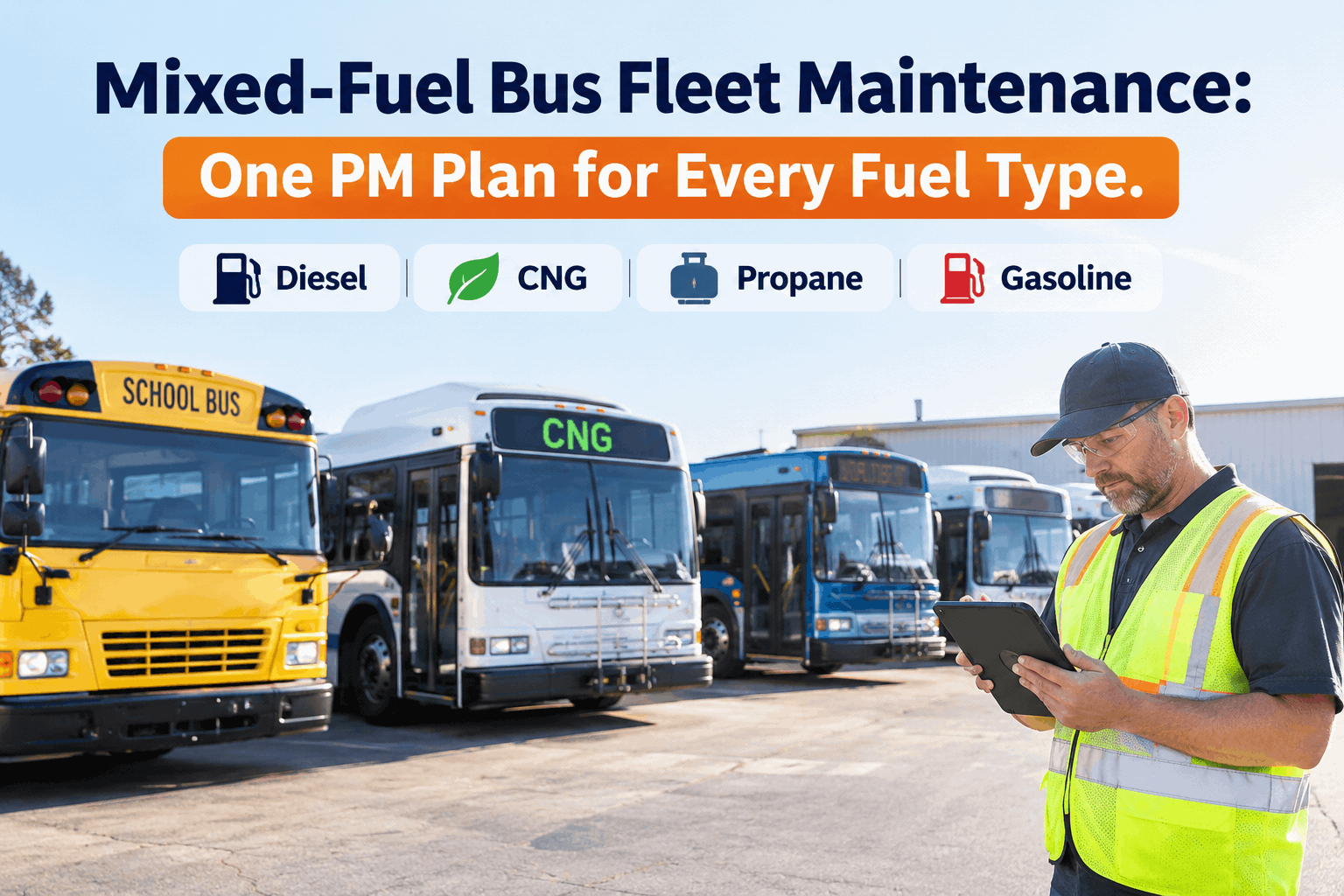
Run an all-gasoline fleet or a mix, and every bus keeps its own rhythm with nothing skipped. Book a walkthrough and we will set your gasoline PM tiers up by bus.
06 · THE RECAP
Key takeaways for gasoline school bus maintenance
1
Simpler, but a different beatGasoline is lighter to maintain than diesel — shorter oil rhythm, no DEF or regen, cheaper parts and faster service.
2
Spark plugs are the catchSpark-ignition means plugs and coils are a scheduled wear item — the one task a diesel crew won't do by reflex.
3
Run it in tiersPM-A frequent checks, PM-B oil and filters, PM-C annual — each builds on the last and keeps the schedule clean.
4
The record is the proofA dated history per bus keeps PM honest — incomplete records count as missed maintenance when it's reviewed.
Gasoline school bus maintenance FAQs
How is gasoline school bus maintenance different from diesel?
Gasoline is spark-ignition, so it has spark plugs and coils instead of injectors, and no DEF, DPF, or regen to manage. The oil rhythm is usually shorter, but parts are cheaper and service is simpler than diesel.
How often should a gasoline school bus have an oil change?
Follow the OEM interval for your engine and route severity; a commonly cited school bus benchmark is around 6,000 miles, and oil analysis can tune it. Stop-and-go routes shorten the interval.
When do spark plugs get replaced on a gasoline bus?
Spark plugs are a scheduled wear item on a spark-ignition engine, typically replaced on a longer interval such as the annual PM-C tier. A diesel-built schedule has no line for them, so they're the task most often missed.
What does a gasoline bus PM tier structure look like?
A common approach is PM-A frequent or pre-trip checks (fluids, brakes, lights), PM-B lube, oil and filters, and PM-C an annual deep service. Each tier includes the one before it, so nothing is skipped.
How does BusCMMS help with gasoline bus maintenance?
It schedules tiered PM per bus, turns failed inspections into work orders, keeps gasoline-specific tasks like spark plugs on the right interval, and maintains a dated service history for audits.