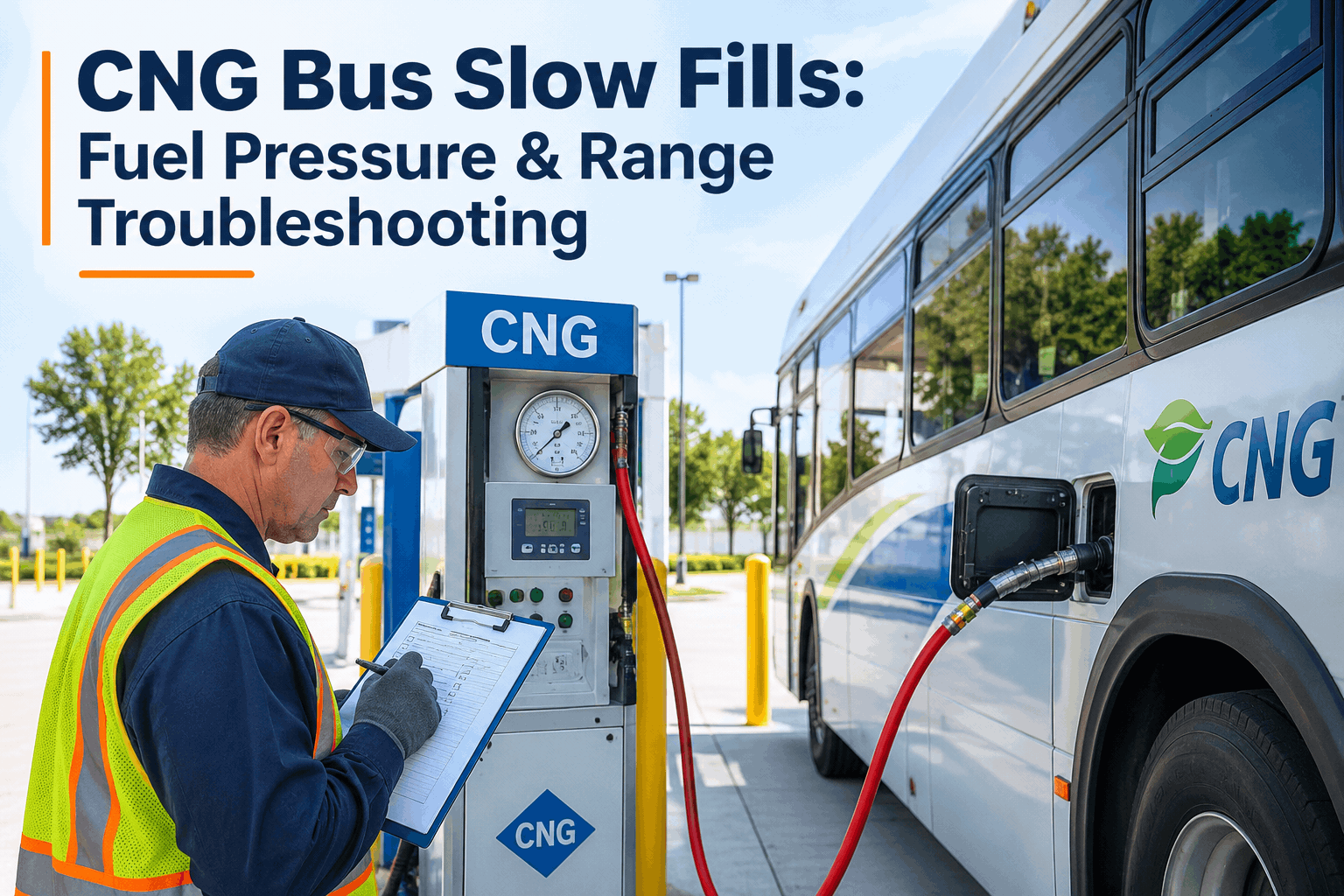
A driver radios in that the CNG bus "won't fill" or the range is down, and the easy assumption is a bad bus. Often it isn't — a slow or short fill can be physics, the station, or the bus, and chasing the wrong one wastes a bay. Book a demo of complaint tracking to see how a CNG bus slow fill gets triaged to the real cause.
CNG FUELING & RANGE
CNG Bus Slow Fills: Fuel Pressure & Range Troubleshooting
A CNG bus slow fill isn't always a bus problem. Here is how to tell whether the short fill lives in the physics, the station, or the bus's own fuel system — and which inspections to run before you pull a bus apart.
4,300 psitypical fast-fill station service pressure (DOE)
Pressurea CNG dispenser stops on pressure, not volume
Heatcompression heat is a top cause of short fast-fills
01 · THE PHYSICS
Why a fast fill can leave the tank short
Before blaming the bus, understand what CNG does. Unlike diesel, natural gas expands with heat and gets denser when cold — and a fast fill makes the gas hot. The dispenser stops on pressure, so a hot tank reads "full" with less gas in it, then loses range as it cools.
The Joule-Thomson and compression-heating effects are why fast fills run short; temperature compensation at the dispenser is what corrects for it. This is normal CNG behavior, not a defect — which is exactly why it has to be ruled out first. A demo of issue tracking shows how to separate physics from a real fault.
02 · THE CAUSES
Slow fill and range complaints: symptom to source
Match the complaint to its likely source before you assign the work. The single biggest tell: if every bus fills slow, it's the station or the weather; if one bus does, it's that bus.
SymptomLikely sourceWhat to check
All buses fill short on hot daysPhysics / temperatureNormal compression heating; confirm temp compensation is working
All buses fill slow or lowStationSupply pressure, compressor, storage, dispenser calibration
One bus fills slow, others fineBus — fill pathFill receptacle, check valve, high-pressure fuel filter
One bus low range on a full fillBus — deliveryPressure regulator, fuel shutoff valve, low-pressure filter
Frost or hissing at the connectionBus / leakFittings and receptacle for leaks — a safety check, not just a fill one
Swipe sideways to see all columns.
The pattern across buses is the fastest triage you have. Logging each complaint against the bus and the station makes that pattern visible — a free inspection log keeps it from living in scattered notes.
03 · THE CHECKLIST
The slow-fill triage checklist
Work this in order before anyone opens a fuel system. Most of it is free to check and rules out the expensive mistake — tearing into a bus that fueled fine at a different station.
One bus or all buses?The first and cheapest question. If every bus fills slow, the bus is innocent — look at the station or the weather before the fuel system.
FIRST
Hot day or fast fill?Compression heat on a fast fill reads full while hot, then settles short. Rule out normal physics before chasing a defect.
FIRST
Does it fill normally elsewhere?If the bus fills fine at another station, the problem is the first station, not the bus. A quick cross-check saves a teardown.
FIRST
Fill receptacle and filters inspectedIf it's one bus, start at the fill path: receptacle, check valve, and the high-pressure fuel filter for restriction.
BUS
Regulator and shutoff valve checkedFor a range complaint on a good fill, the delivery side — pressure regulator, fuel shutoff valve, low-pressure filter — is where to look.
BUS
Finding and fix logged to the busRecord what it turned out to be — physics, station, or a part — so the next identical complaint is diagnosed in minutes.
BUS
Run through it as a digital inspection and a real fault becomes a work order while the physics and station cases close themselves out. A demo of the triage flow shows how the pattern drives the decision.
Never tamper with a dispenser to force a "better fill"Temperature compensation limits cylinder pressure for a reason: overfilling a CNG tank has caused serious incidents, including a pressure relief device venting an entire tank. Adjusting or bypassing a dispenser to beat a short fill is always unsafe. If fills are genuinely low station-wide, the dispenser's pressure and temperature calibration is a job for qualified technical assistance — not a field workaround.
One or allthe question that decides bus, station, or weather
"We almost tore into a bus for a 'bad fill' that turned out to be a 95-degree afternoon and a fast fill — it was physics. Now the first thing I ask is whether the other buses did it too. Logging the complaints showed me it was the station's compressor, not my fleet."
— CNG fleet maintenance director
04 · THE SYSTEM
How BusCMMS turns fill complaints into fixes
BusCMMS is built for bus fleets, not adapted from trucking software. It captures the fueling complaint, surfaces the one-bus-or-all pattern, routes a real fault to a work order, and keeps the history that makes the next complaint faster to diagnose.
Capture fueling complaintsRecord every slow-fill or range concern against the bus and station, so nothing lives as a verbal note that gets lost.
See the one-bus-or-all patternA history per bus and station reveals whether it's a fleet-wide station issue or a single-bus fault — the fastest triage there is.
Inspections & work ordersWhen it's a real fault, the fuel-system inspection becomes a work order with an owner — receptacle, filter, or regulator.
Service history that speeds the next callEvery diagnosis timestamped per bus, so a repeat complaint is matched to its known cause in minutes, not a fresh teardown.
However your CNG fleet fuels, the complaints, patterns, and fixes stay in one place. Book a walkthrough and we will set your fill-complaint triage up.
05 · THE RECAP
Key takeaways for CNG slow-fill troubleshooting
1
Physics first, not the busA fast fill runs hot and settles short — often normal CNG behavior, and the first thing to rule out.
2
One bus or all is the triageAll buses short means station or weather; one bus means that bus — the cheapest question answers most complaints.
3
Match symptom to componentSlow fill points at the fill path and filters; low range on a full fill points at the regulator and delivery side.
4
Never force a fillTampering with a dispenser for a "better fill" is unsafe — station calibration is a qualified job, not a workaround.
CNG bus slow-fill FAQs
Why does my CNG bus fill slowly or come up short?
Often it's physics: a fast fill heats the gas, the dispenser stops on pressure, and the tank settles short as it cools. It can also be low station supply pressure or a bus fuel-system restriction. Check whether all buses do it or just one.
Is a short CNG fill a sign of a broken bus?
Not necessarily. Compression heating on a fast fill naturally leaves the tank short until it cools, and a miscalibrated or low-pressure station affects every bus. Suspect the bus mainly when one vehicle fills slow while others fill fine.
How do I tell if it's the station or the bus?
Ask whether all buses fill slow or just one, and whether the bus fills normally at a different station. Fleet-wide short fills point to the station or weather; a single-bus problem points to that bus's fill path or regulator.
What bus components cause slow fills or low range?
On the fill side, the receptacle, check valve, and high-pressure fuel filter. On the delivery side, the pressure regulator, fuel shutoff valve, and low-pressure filter. Frost or hissing at the connection is a leak check, not just a fill one.
How does BusCMMS help with CNG fill problems?
It records fueling complaints against the bus and station, surfaces whether it's one bus or all, routes real faults to work orders, and keeps the history so a repeat complaint is diagnosed fast. That triage saves pulling a bus for a station issue.