It's 5 a.m., the first buses are lining up to fuel, and the compressor won't build pressure. Now you are calling an emergency service tech at holiday rates while a yard full of buses waits — the exact scenario a maintenance plan is supposed to prevent. Book a demo of station PM scheduling to see how CNG compressor maintenance stays ahead of the breakdown.
CNG FUELING INFRASTRUCTURE
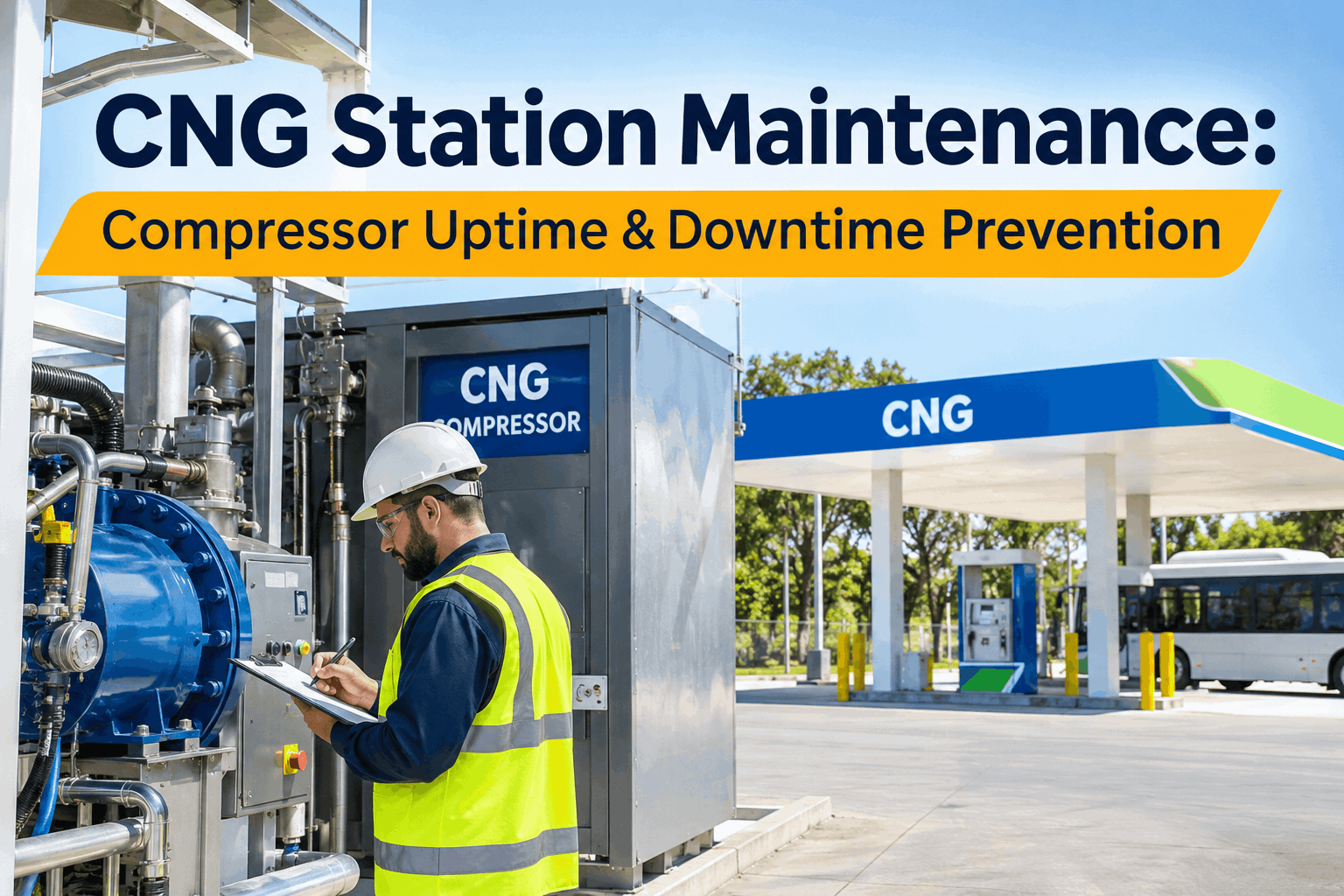
CNG Station Maintenance: Compressor Uptime & Downtime Prevention
CNG compressor maintenance is what stands between a full yard and a stranded one. Here is the station skid stage by stage, the PM each piece needs, and how to track it so an unmanned station doesn't fail at the worst possible hour.
99%a common station availability target (industry O&M spec)
<90 hrsmax downtime over 12 months at that target
Unmannedmany stations run with no one on site
01 · THE CHOICE
Proactive CNG compressor maintenance vs the 5 a.m. call
Every station runs one of two ways. One is a planned rhythm of daily monitoring and scheduled service. The other is waiting for the shutdown and paying emergency rates to recover. The gap between them is pure cost and lost fueling time.
Proactive maintenance
Daily monitoring of flow, temperature, pressure, and vibration
Fugitive-leak and false-alarm checks before they escalate
Scheduled oil, filter, and dryer service on the equipment's clock
Faults recorded and trended so a pattern surfaces early
Emergency maintenance
Unplanned service after the station has already shut down
A yard of buses waiting while a tech is called in
Premium rates, rushed diagnosis, and a scramble for parts
A post-mortem report on cause and downtime — after the damage
Because many CNG stations are unmanned, the only thing standing between a small drift and a full shutdown is a schedule that runs whether or not anyone is watching the skid.
02 · THE EQUIPMENT
Station PM by equipment: compressor, dryer, filters, dispenser
CNG station maintenance is a set of small, repeatable checks across the skid. Miss one and the effect shows up two stages downstream — moisture that should have dried becomes a problem at the dispenser. Here is what each piece needs and what to watch for.
EquipmentPM taskWatch for
CompressorCheck oil level and condition, drain accumulator, log noises and vibrationUnusual vibration, oil carryover, rising discharge temperature
Gas dryerVerify dew point within tolerance, check alarms and notificationsDew point out of spec — moisture carrying into storage
FiltersDrain inlet filter, check filter differential pressure while runningRising differential pressure — a loading or clogged element
Storage & pipingDrain receiver tank, check sight glass, inspect piping and hosesGas leaks, abrasion, or vibration on tubing and hoses
DispenserInspect hoses and breakaway, confirm metering and shutoffHose wear, slow fills, or a dispenser fault at the point of use
Swipe sideways to see all columns.
Performance specs make these measurable — lube oil under 10 ppm at the compressor skid discharge, water held to the dryer's dew-point spec. Load those checks into a free PM schedule so each one triggers on time.
03 · THE CHECKLIST
The CNG station PM checklist worth running on a schedule
These are the recurring checks that keep a station in spec. Run them as a digital inspection and a failed item becomes a work order, so the fault that would have stranded a yard gets fixed on a weekday instead.
Compressor oil level and condition checkedCheck oil and add as needed, and watch for carryover. Oil starvation or carryover is a fast path to a damaged compressor.
CRITICAL
Dryer dew point within toleranceMoisture past the dryer corrodes downstream equipment and reaches the vehicle. Verify the dew-point reading every cycle.
CRITICAL
No gas leaks on piping, tubing, hosesWalk the skid for leaks, abrasion, and vibration. A fugitive leak is a safety and emissions issue before it is a fueling one.
CRITICAL
Filter differential pressure in rangeCheck the differential while running and drain the inlet filter. A rising reading means an element loading up before it chokes flow.
PLAN
Accumulator and receiver drainedDrain the accumulator and receiver tank and check the sight glass, so liquids don't collect where they degrade performance.
PLAN
All operating faults recordedLog every fault and alarm, even ones that cleared. A trend across weeks is what warns you before a hard failure.
PLAN
On a clipboard these faults never get trended. As a demo of digital station inspections shows, a failed check auto-creates a work order and keeps a running fault history per compressor.
04 · THE MATH
What CNG station uptime is really worth
Uptime isn't an abstraction — it's a specific, measurable target with a downtime budget attached. See how little room a 99% availability spec actually leaves, and why trending faults matters.
Figures reflect a common industry O&M specification (99% availability, under 90 hours downtime over 12 months); your station's spec should have been set at design. A demo of uptime tracking shows how scheduled PM protects that budget.
3 signsof a healthy station: uptime, cost control, reliable throughput
"An unmanned station doesn't tell you it's drifting — the dew point creeps, the filter loads, the vibration climbs, and you find out when a bus can't fill. The stations that stay up are the ones where every one of those checks is on a schedule somebody actually follows."
— Transit facility maintenance manager, CNG fleet
05 · THE SYSTEM
How BusCMMS keeps your CNG station uptime high
BusCMMS is built for bus operations, not adapted from generic asset software. It treats your fueling station as a critical asset alongside the fleet — scheduling compressor and equipment PM, assigning work orders, and keeping a fault and service history that turns drift into early warning.
Equipment PM schedulingCompressor, dryer, filter, and dispenser checks each on their own interval, triggered by runtime or calendar — nothing waits for a failure.
Work order managementA failed check or a logged fault becomes a work order with an owner, so a known issue doesn't sit until it becomes an outage.
Fault trending by compressorRecord every alarm and operating fault per unit, so a repeating pattern surfaces as early warning instead of a surprise.
Service-history recordsEvery inspection, repair, and rebuild timestamped per unit — pull the full station history in seconds for a contractor or an audit.
Run one station or several, and the PM, work orders, and fault history stay in one place beside your fleet records. Book a walkthrough and we will set your station's PM schedule up by equipment.
06 · THE RECAP
Key takeaways for CNG compressor maintenance
1
PM is the whole skidCompressor, dryer, filters, storage, dispenser — a fault at any stage can stop fueling, so each needs its own checks.
2
Proactive beats the 5 a.m. callDaily monitoring and scheduled service cost a fraction of an emergency recovery with a yard of buses waiting.
3
99% leaves almost no roomA common uptime spec allows under 90 hours of downtime a year — one unplanned rebuild can spend most of it.
4
Trend the faultsUnmanned stations drift quietly; logging every fault per compressor turns that drift into early warning.
CNG compressor maintenance FAQs
What does CNG compressor maintenance involve?
Checking oil level and condition, draining the accumulator and receiver, logging noise and vibration, and watching discharge temperature and oil carryover. It runs alongside dryer, filter, and dispenser checks across the whole station skid.
How often should a CNG station be serviced?
On the intervals set by each piece of equipment and your station's performance specs, with daily monitoring of flow, temperature, pressure, and vibration. Routine maintenance should be scheduled outside peak fueling hours.
Why does the gas dryer matter so much?
The dryer removes moisture from the utility gas before compression. If its dew point drifts out of tolerance, moisture carries downstream and can corrode equipment and reach the vehicle, so verifying dew point is a core check.
What causes CNG station downtime?
Often a small drift that went untracked — a loading filter, a dew-point slip, rising vibration, or oil carryover that escalates to a failure. Many stations are unmanned, so these go unnoticed without scheduled PM and fault logging.
How does BusCMMS help keep a CNG station running?
It schedules compressor and station-equipment PM, turns failed checks and faults into work orders, trends faults per unit, and keeps a dated service history. That early warning is what protects a tight uptime budget.