Megachurch Bus Fleet Maintenance Software | BusCMMS Guide
A church van full of kids pulls out for a youth retreat, a volunteer at the wheel, and three campuses away nobody can say for certain when its brakes were last checked. That uncertainty is the real risk, and church bus fleet maintenance software exists to erase it — one record system that proves every vehicle at every campus is safe before it carries anyone. You can see how it works in a short demo.
FLEET MAINTENANCE · CHURCH & MINISTRY 2026
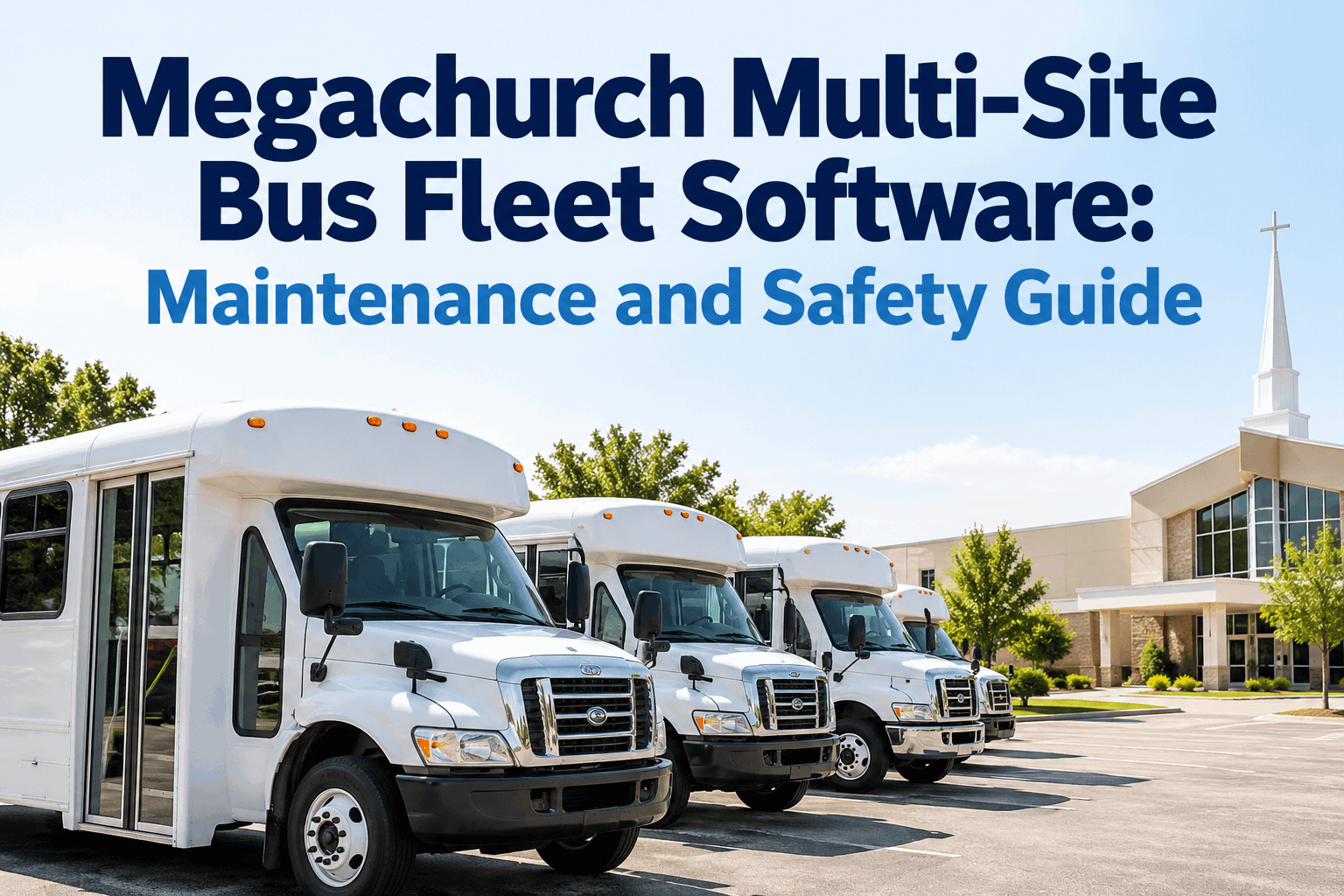
Megachurch Multi-Site Bus Fleet Software: Maintenance and Safety Guide
Volunteer drivers, precious passengers, a tight stewardship budget, and vehicles scattered across campuses — a church fleet carries risk a commercial fleet does not. Here is how purpose-built software keeps every bus safe, documented, and ready across every site.
ONE RECORD SYSTEM — EVERY CAMPUS, EVERY VEHICLE
Liabilitywith kids aboard and volunteers driving, the record is your shield
Stewardshipdonated budgets mean every repair dollar has to be justified and tracked
2–4 wkstypical BusCMMS rollout — simple enough for volunteers to use
Why Liability, Not Cost, Drives a Church Fleet
A commercial operator worries about cost per mile. A church worries about the family in the third pew whose kids ride the bus. When volunteers drive and children ride, the stakes of a missed brake check are measured in trust, not dollars — and if the worst happens, the first question anyone asks is whether the church can show the vehicle was maintained.
Volunteers, not professionals
A rotating roster of volunteer drivers handling larger vehicles than they drive daily. Consistency is hard, and you cannot rely on one person's memory for what has been serviced.
The record is the defense
After an incident, insurers and investigators want proof of due diligence. Date-stamped maintenance records and a clear work-order trail are what show the church took safety seriously.
Every dollar is donated
Fleet budgets come from the offering plate, so good stewardship means tracking cost per mile and catching small problems before they become expensive ones.
The question after an accident is never “what did it cost” — it is “can you prove this bus was safe”. A system answers that; a memory does not.
Volunteer Joe's Memory vs. a Real System
Most church fleets start the same way: one faithful volunteer who knows every vehicle and keeps it all in his head. It works right up until he moves, steps back, or simply forgets — and then nobody can prove what was done. Church bus maintenance software turns that knowledge into a record that outlives any one person.
WHERE YOUR MAINTENANCE HISTORY LIVES
Moving off memory and onto a system is the single biggest safety upgrade most church fleets can make. You can create a free account and start logging your vehicles today.
What a Church Fleet Is and Isn't Required to Do
Here is where churches get tripped up. A congregation that transports people for ministry without charging a fare is usually a Private Motor Carrier of Passengers (Non-Business), which is exempt from some commercial rules — but not from the ones that matter most for safety. Knowing the line keeps you both compliant and out of unnecessary paperwork, and you can book a demo to see the records side set up for a ministry fleet.
THE NON-BUSINESS CHURCH CARRIER LINE
Exempt from the logs does not mean exempt from the records. The maintenance trail is still on you — and it is the part that protects the ministry. This is general guidance, not legal advice; confirm your status with your own counsel.
The Church Bus Inspection Checklist Volunteers Can Actually Use
A pre-trip check only works if a volunteer can do it in five minutes from a phone. These are the items that belong on every church bus and van before it carries a group — simple enough for any driver, serious enough to catch what matters.
Brakes, tires & lightsThe safety basics a volunteer can check by feel and sight — firm brakes, good tread and pressure, every light working.
EVERY TRIP
Doors, seat belts & child safetyEntry doors latch, seat belts work, and any child restraints or booster provisions are in place for younger riders.
EVERY TRIP
Emergency exits & first-aid kitEmergency exits clear and working, fire extinguisher charged, first-aid kit stocked — the gear you hope never to need on a youth trip.
INSPECT
Fluids, mileage & PM due dateA quick fluid and mileage glance, and a flag if the vehicle is due for service — so no bus goes out past its maintenance window.
CHECK
Logged with the driver's nameEvery check saved with the volunteer's name, date and time — the record that shows the bus was inspected before it left, by whom.
RECORD
When the check lives on a volunteer's phone and saves itself with a name and time, the pre-trip finally happens every trip — and you can prove it.
What Church Bus Fleet Maintenance Software Should Do
The job is to keep every vehicle safe and documented across every campus, with a tool simple enough that volunteers will actually use it. BusCMMS is built for buses from day one, so a ministry fleet gets the same discipline a commercial operation runs on, without the complexity.
Simple pre-trip checks for volunteers
A five-minute digital inspection a volunteer does from a phone, saved with their name and time — the pre-trip finally happens, and it is on the record.
Date-stamped records for every vehicle
Every inspection, service and repair logged with a date — the due-diligence trail that protects the ministry if anyone ever asks whether a bus was maintained.
One view across every campus
See every vehicle at every site in one place, with mileage-based PM reminders, so no bus at any campus slips past its service window.
Cost tracking for good stewardship
Fuel, repairs and cost per mile tracked per vehicle and ministry, so you can plan the budget and show the board every dollar was spent wisely.
95%+fleet availability BusCMMS reports across its bus-fleet customers
25–35%maintenance-cost reduction reported within 12 months
2–4 wkstypical rollout — simple enough to train a volunteer in minutes
Availability, cost-reduction and rollout figures above are BusCMMS's own reported results from its customer data, not independently audited benchmarks.
A Church Transportation Director's Take
Key Takeaways on Church Bus Fleet Maintenance Software
Choosing church bus fleet maintenance software comes down to one thing: proving every vehicle is safe for the people you carry, across every campus, with a tool volunteers will use. Four things to carry into the decision.
01
Liability is the real stake
With kids aboard and volunteers driving, the maintenance record is your shield if anything goes wrong.
02
Get off one person's memory
A system of date-stamped records outlives any volunteer and can be proven; a memory cannot.
03
Exempt from logs, not records
A non-business church carrier skips some rules but still must keep maintenance records and safe vehicles.
04
Simple enough for volunteers
If the pre-trip is not easy on a phone, it will not happen — pick a tool your drivers will actually use.
Run your church bus fleet maintenance software so that every vehicle, at every campus, is safe and provably so, and you turn a quiet liability into a ministry you can stand behind. The clearest way to judge the fit is to see it set up for your campuses in a demo, or read the complete guide to what a bus CMMS does first. The buses are a blessing to the ministry — keeping them safe is how you keep it one.
FAQ
Church Bus Fleet Maintenance Software: Common Questions
What is church bus fleet maintenance software?+
It is maintenance management software set up for the realities of a ministry fleet: volunteer drivers, precious passengers, a stewardship budget, and vehicles spread across one or more campuses. Rather than tracking maintenance in one person's head or a glovebox folder, it gives every vehicle a digital record of inspections, services and repairs, lets volunteers run a simple pre-trip check from a phone, schedules preventive maintenance by mileage, and shows the whole fleet across every site in one place. For a multi-site church, the key is that the records are centralized and date-stamped, so anyone with access can confirm a bus was maintained and inspected before it carried a group. The goal is safety you can prove, not just hope for, and good stewardship of the money the fleet runs on.
Do churches have to follow DOT and FMCSA rules for their buses?+
Some, but not all, and the distinction matters. A church that transports people for ministry without charging a fare is generally treated as a Private Motor Carrier of Passengers (Non-Business), which is typically exempt from hours-of-service driver logs and some commercial driver-qualification rules. However, it is not exempt from the parts that protect safety: the church must keep vehicle maintenance records, run its own drug and alcohol testing program for drivers of larger vehicles, keep every vehicle in safe operating condition, and may need a DOT number for interstate travel. Inspectors do not always understand this classification, which is another reason to keep clean, organized records you can produce on request. This is general guidance rather than legal advice, so confirm your specific obligations with your own counsel or insurer — but the safe assumption is that the maintenance record-keeping is firmly your responsibility.
How does software help with volunteer drivers?+
Volunteer drivers are the biggest difference between a church fleet and a commercial one. They rotate, they often drive vehicles larger than their daily car, and they cannot be expected to remember a vehicle's service history. Software closes those gaps in two ways. First, it gives the volunteer a simple pre-trip inspection they can complete in a few minutes from a phone, which both catches obvious problems and creates a time-stamped record that the check was done, by whom. Second, it takes maintenance knowledge out of any one person's head and puts it in a system, so when a long-time volunteer steps back, nothing is lost. The driver does not need to understand the whole maintenance program — they just need to complete the check in front of them, and the system handles the scheduling, the records and the reminders behind the scenes.
Can one system handle buses across multiple campuses?+
Yes, and for a multi-site megachurch that is the main reason to use software at all. When each campus keeps its own paper records or spreadsheet, nobody has a complete picture, and a vehicle shared between sites can fall through the cracks. A centralized system puts every vehicle at every campus into one record set, so a transportation director can see the whole fleet in one place, check any vehicle's history regardless of which site it lives at, and get preventive-maintenance reminders for all of them on one schedule. Each campus still manages its own vehicles day to day, but the records, the reminders and the oversight live in one place. That is what turns several independent little fleets into one coordinated ministry operation with consistent safety standards across sites.
Is it affordable and simple enough for a church to run?+
Those are the two things a church rightly cares about, and both are central to a purpose-built tool like BusCMMS. On simplicity, the pre-trip checks and daily use are designed so a volunteer can be trained in minutes, not a tool that assumes a full-time professional mechanic is running it. On cost, the point of tracking fuel, cost per mile and repairs is stewardship: catching small issues before they become expensive ones and showing the board exactly where the fleet budget goes. BusCMMS is priced to fit ministry and school budgets rather than enterprise ones, and most fleets are up and running within two to four weeks because the bus-specific forms and logic are built in. You can start with a free account to try it on your own vehicles before committing anything, which is the lowest-risk way for a church to see whether it fits.