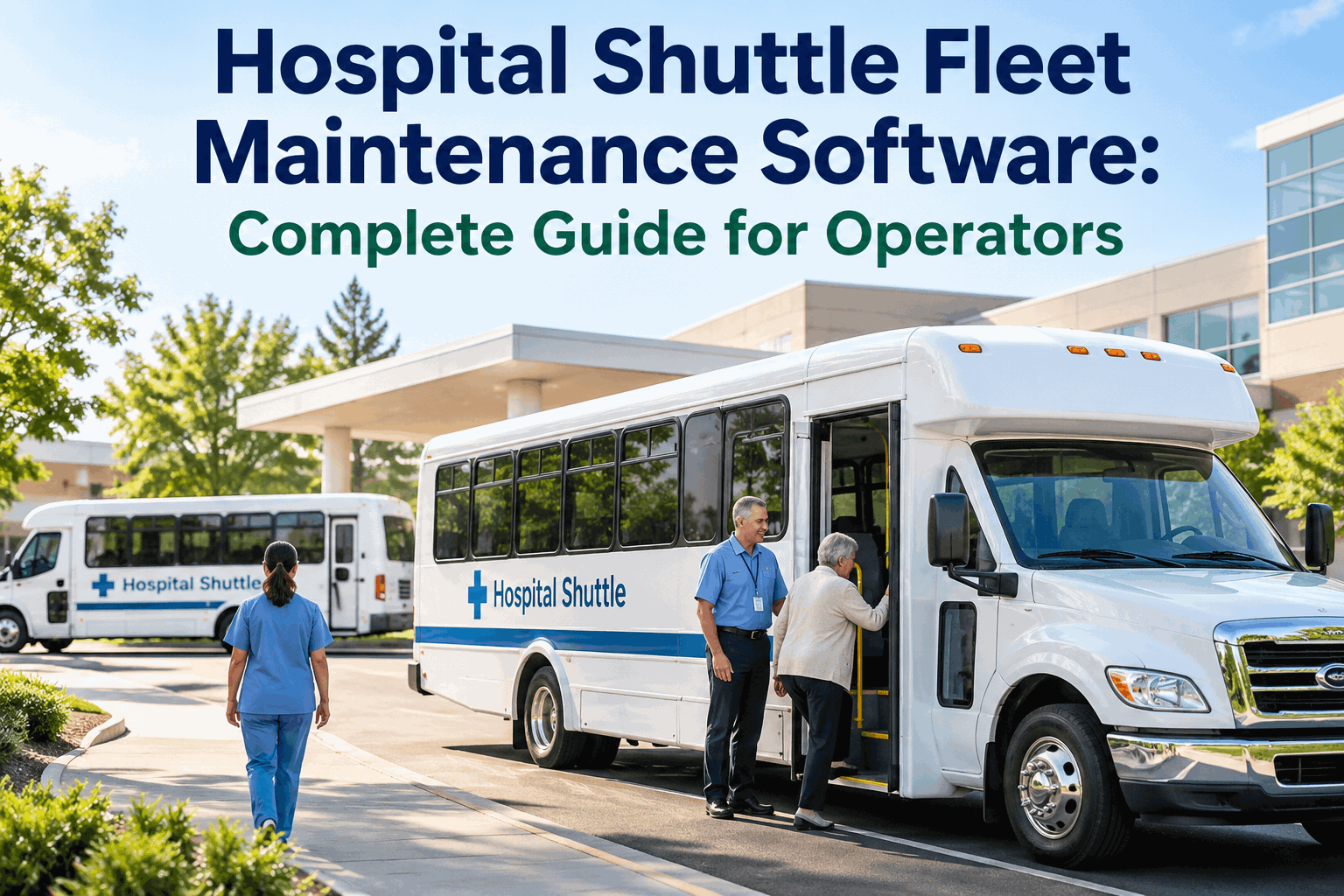
The rider waiting at the front entrance just had a procedure and cannot stand for long, or is a visitor who parked half a mile away in the rain, or a nurse who needs to be on the floor in eight minutes. Hospital shuttle fleet maintenance software matters because on a medical campus the shuttle is not a convenience — it is how patients, visitors and staff actually get where they need to be, and when a shuttle or its wheelchair lift goes down, the person it strands is often the one who can least afford it.
Hospital Shuttle Fleet Maintenance Software: Keeping Every Loop Running for the People Who Depend On It
A hospital shuttle runs a tight loop — parking, main entrance, garage, clinic building — over and over, from before the first appointment until after the last visitor leaves. The riders are patients, families and employees, and some of them are in a wheelchair. A system built for bus and shuttle fleets keeps the inspections, the preventive maintenance and the readiness of every vehicle and every lift in one place, so the loop keeps moving and the accessible ride is there when someone needs it.
Why a Hospital Shuttle Fleet Is Not Like Any Other
Plenty of operations run shuttles on a loop. What makes healthcare shuttle fleet maintenance its own job is who is on board and what it costs them when the ride is not there. Three things set the stakes higher than a normal campus shuttle.
The rider is often a patient
Someone leaving a procedure, an older visitor, a person who cannot stand in the cold or walk the extra distance. A missed shuttle is a missed appointment or a person stuck, not a minor delay.
The wheelchair lift has to work
Accessibility is not optional, and the lift is the single component that strands the exact rider who needs it most when it fails. It gets daily use and it has to be checked like it matters.
The loop never really slows
Appointments, shift changes and visiting hours keep demand steady from early morning to late evening, so the fleet racks up stop-and-go hours fast and there is little quiet time to catch up on service.
On a hospital campus, a down shuttle is not just a scheduling problem — it is a patient who cannot get to their appointment, and that is a reliability standard most fleets never have to meet.
The Wheelchair Lift Is the Component You Cannot Let Fail
Ask any hospital transportation manager which part keeps them up at night and the answer is the lift. It is the one item where a failure does not just inconvenience riders — it denies a ride to the person who has no other way on board. That is why a serious hospital shuttle inspection checklist treats the lift as its own daily event, and why a failed lift check has to become a tracked repair, not a note someone remembers to mention.
Treating the lift as a first-class maintenance item is the difference between finding a problem in the yard and finding it with a rider waiting. You can see how lift checks are tracked in a short demo and watch a failed check turn straight into a work order.
Demand Barely Dips, So Maintenance Has to Fit Around a Full Day
A hospital does not have a slow afternoon. Appointments, shift changes and visiting hours keep riders moving from early morning to late evening, which means the fleet is almost never idle and there is no natural window to pull a vehicle for service. That is exactly why preventive maintenance has to be scheduled and planned, not squeezed in whenever a shuttle happens to be free.
When the fleet never gets a break, planned maintenance is the only way to stay ahead of breakdowns. You can create a free account and start scheduling PM around your real ridership instead of around whatever happens to be free.
A Hospital Shuttle Inspection Checklist That Puts Access First
A good checklist is quick enough to run every shift and specific enough to catch what matters on a patient-carrying shuttle. These are the items that earn their place — the red ones checked every single shift, the gold ones on a set interval the system tracks and records for you.
- EVERY SHIFTWheelchair lift cycle and securement — does it deploy, hold and stow cleanly, with straps and locks intact?
- EVERY SHIFTDoors, steps and ramp — smooth operation and clear footing for riders who are unsteady on their feet.
- EVERY SHIFTBrakes, tires and lights — the basics that keep a stop-and-go campus loop safe all day.
- INSPECT & RECORDClimate control and interior cleanliness — comfort and infection-control matter with vulnerable riders aboard.
- INSPECT & RECORDScheduled PM by hours and mileage — lift service, fluids and brakes logged with a date stamp.
On paper, the lift check is the one that gets rushed on a busy morning. Loading your checklist into a system means every driver runs the same one and every result is saved, so you can book a demo to see the lift check built into the pre-trip.
What Hospital Shuttle Fleet Maintenance Software Should Do
Generic fleet tools were built for trucks or light vehicles and treat a shuttle like any other asset. When you evaluate hospital shuttle fleet maintenance software, these are the jobs it has to do well before anything else on the feature list matters.
Bus-specific pre-trips with the lift built in
Daily inspections made for a shuttle, not a pickup, with the wheelchair lift and securement as required items and a failed check that becomes a work order automatically.
Preventive maintenance by hours and mileage
PM triggered by how hard a stop-and-go loop actually works a vehicle, so lift service, brakes and fluids get attention on schedule instead of after a failure.
Parts tracking for lift and door systems
Auto-reorder alerts and usage tracking for the components that strand riders when they fail, so the common lift and door parts are on the shelf before you need them.
A readiness dashboard for accessible rides
Fleet availability and PM compliance at a glance, including how many wheelchair-accessible shuttles are up right now, so dispatch always knows the accessible ride is covered.
The availability, cost and rollout figures above are BusCMMS's own reported results across its customer base, not independently audited industry numbers — a reasonable guide to the range, not a guarantee for any one hospital fleet.
“The call I never want to get is that the lift is down and we have a patient in a wheelchair waiting at discharge. That is the whole job, right there. So the lift gets checked first, every shift, and I want it logged — because if a rider ever gets left, the first thing anyone asks is whether we knew the lift was bad. Having the check and the repair in one place is how I answer that honestly.”
Key Takeaways on Hospital Shuttle Fleet Maintenance Software
The rider raises the stakes
A patient leaving a procedure cannot absorb a missed shuttle the way a commuter can, so reliability is a patient-care issue, not just an ops metric.
The lift comes first
Check and log the wheelchair lift every shift and route a failed check into a tracked repair — it is the component that denies a ride when it quits.
Plan PM, do not squeeze it
Demand barely dips all day, so schedule preventive maintenance by hours and mileage instead of waiting for a free vehicle that never comes.
One dashboard, fast to stand up
Keep inspections, PM, parts and readiness in one place, with bus-specific forms ready on day one so you are live in weeks, not months.
Frequently Asked Questions
What makes hospital shuttle fleet maintenance software different from generic fleet software?
Generic tools are built for trucks or mixed fleets and treat a shuttle like any other vehicle. Hospital shuttle fleet maintenance software is built around a bus or shuttle carrying patients — pre-loaded pre-trip checks with the wheelchair lift as a required item, preventive maintenance tuned to a high-utilization campus loop, and a readiness view that tells you how many accessible shuttles are up right now. BusCMMS ships with that bus-specific logic on day one, so the shuttle is treated as a shuttle from the first inspection instead of a generic asset you have to configure.
How does it help keep wheelchair lifts reliable?
The lift is treated as a first-class inspection item that drivers check and log every shift, and a failed lift check turns straight into a work order so it cannot be forgotten. Preventive maintenance can be scheduled specifically for lift service, and parts tracking keeps common lift and door components on the shelf. The goal is simple: find a lift problem in the yard, never with a rider waiting at discharge.
Can it schedule preventive maintenance when the fleet runs all day?
Yes, and that is exactly the point. Because ridership barely dips during operating hours, PM is triggered by hours and mileage and planned into the schedule rather than squeezed in whenever a shuttle is free. You can stagger service so the fleet never drops below the vehicles the loop needs, and the dashboard shows PM compliance so nothing slips. If timing is tight, you can start a free account and begin scheduling right away.
Does it handle a mixed fleet of shuttles, vans and buses?
Yes. A hospital campus often runs a mix of cutaway shuttles, accessible vans and larger buses, and BusCMMS keeps them on one dashboard with maintenance logic suited to each, including separate schedules for diesel and electric vehicles as campuses electrify. One system means one place to see readiness, inspections and PM across every vehicle type you operate.
How quickly can a hospital fleet get set up?
BusCMMS reports a typical rollout of 2 to 4 weeks rather than the months a custom-configured system can take, because the bus-specific inspection forms and maintenance logic are already there. That means you can be running digital pre-trips, tracked work orders and a readiness dashboard across your shuttle fleet within weeks. You can see it set up for your fleet in a demo and talk through your vehicle mix.
A hospital shuttle fleet maintenance software platform will not change how busy your campus is, but it changes whether the busiest day catches you off guard. Keep the inspections, the preventive maintenance and the readiness of every shuttle and every lift in one place, and the ride your patients, visitors and staff depend on stays reliable loop after loop. If you want the full picture of how a purpose-built system fits a bus operation, start with the complete guide to what a bus CMMS does, then see it mapped to your own campus.