A Blue Bird limps back in derate, and the codes say aftertreatment again — a regen that never finished on a route of stop signs and 25 mph. Cummins B6.7 maintenance is unforgiving if you run it off the highway numbers in the manual. You can book a demo to see each engine's service schedule tracked and stop guessing when a B6.7 is due.
ENGINE MAINTENANCE · CUMMINS B6.7
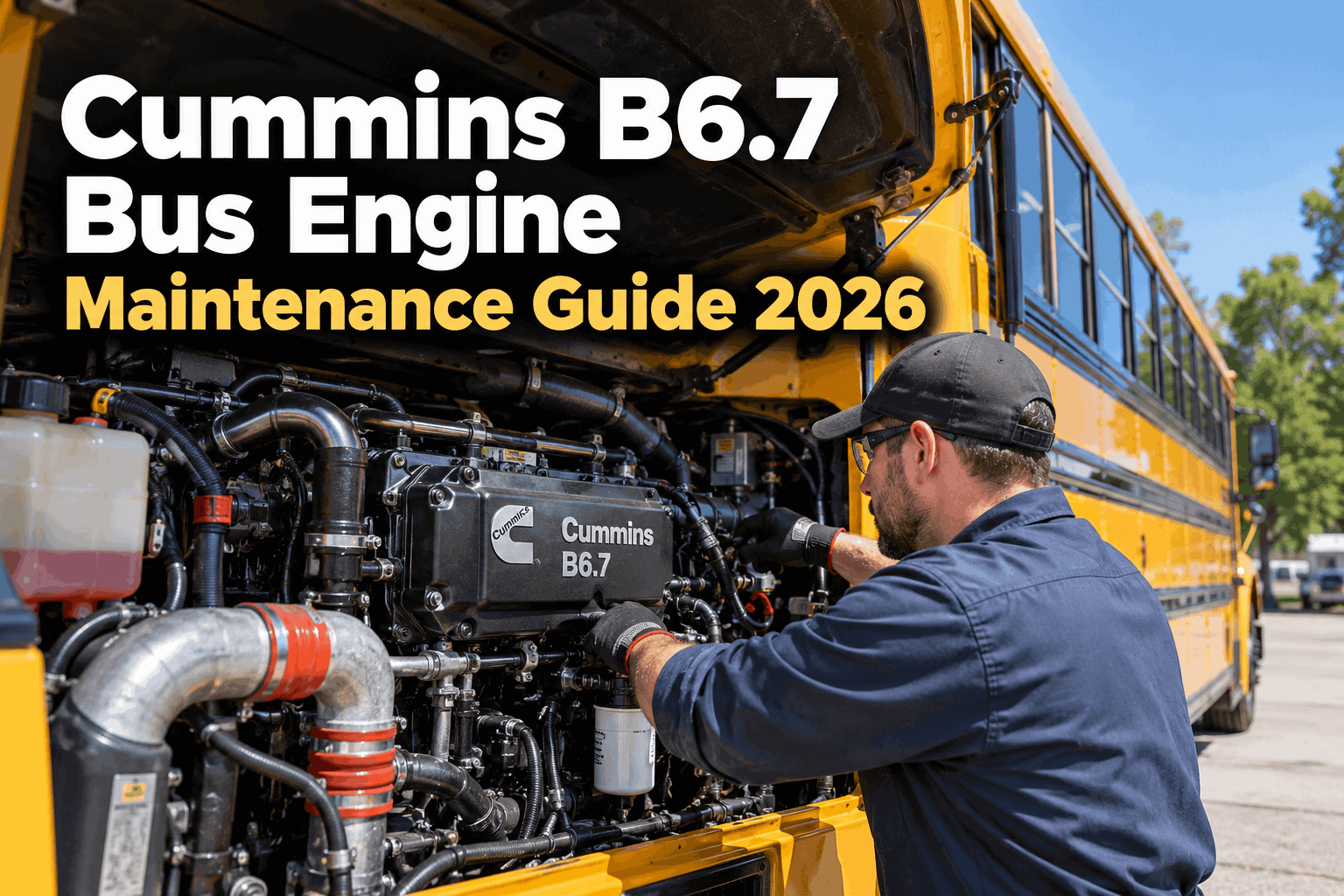
Cummins B6.7 Bus Engine Maintenance Guide 2026
The B6.7 is the diesel under most Blue Bird, Thomas, and IC school buses and plenty of transit cutaways. Here are its real service intervals, the problems that actually sideline it in bus duty, and how to keep a whole fleet of them on schedule without a wall of spreadsheets.
200-325 hpB6.7 output range — the 6-cylinder diesel in most school and transit buses
"Up to"Cummins intervals are maximums — severe bus duty pulls them shorter
2-4 wksTypical BusCMMS rollout — every engine on schedule, not on memory
Why the Cummins B6.7 Maintenance Schedule in the Manual Is Not Your Schedule
Cummins publishes the B6.7 oil interval as up to 30,000 miles, 1,000 hours, or 18 months — and every one of those is a ceiling for ideal duty, not a promise for yours. A bus route is the textbook definition of severe service, and three things about it quietly pull every interval in.
Stop-and-go, not highway
Constant stops, short legs between them, and low road speed are exactly the conditions those "up to" numbers assume you do not have. Hours pile up faster than miles, so hour-based limits hit first.
Idle time counts against you
Warming up on a cold morning, holding at a school, loading riders — idle hours age the oil and load the aftertreatment without adding a single mile to the odometer.
Routes rarely clear the DPF
Short, low-speed runs often never get hot enough to finish a regen, so soot builds between services and the DPF needs attention sooner than the mileage chart suggests.
The right B6.7 interval is a duty-cycle decision per engine, triggered by whichever comes first — miles, hours, or months — not one number copied off a spec sheet for the whole fleet.
The Cummins B6.7 Service Intervals, and What Bus Duty Does to Them
Start from the manufacturer maximums above, then shorten the two intervals bus duty hits hardest — oil and the DPF. Here is the oil interval drawn to scale: the highway ceiling versus where severe stop-and-go duty realistically lands.
The same logic applies down the list — fuel filters at up to 60,000 miles, DPF cleaning near 200,000, the DEF dosing filter around 300,000, and valve lash around 150,000 — each triggered by miles, hours, or months, whichever lands first. The win is not memorizing the chart; it is having the right trigger fire automatically for each engine, which you can book a demo to see it mapped to your own buses.
Where Cummins B6.7 Engine Problems Actually Start in Bus Duty
Most B6.7 downtime that lands a bus in the shop does not start with a blown engine — it starts with the aftertreatment, and it starts slowly. The failure almost always runs the same chain, and every step before the last one is catchable.
The other usual suspects feed the same chain: a carbon-clogged EGR valve that raises soot output, fuel filters left too long that starve the system, and a regen request the driver keeps clearing instead of letting finish. When a fault code auto-opens a work order the moment it appears, you fix it on a weekend, not on a shoulder — create a free account and route B6.7 codes straight into the work queue.
Your Cummins B6.7 Engine Maintenance and Inspection Checklist
Split the work into what a driver catches daily and what the shop tracks by interval. Build these into the digital pre-trip and the PM schedule so nothing on a B6.7 gets missed between services.
Oil level, leaks, and warning lampsDriver checks oil and coolant level, looks for leaks under the bus, and reports any check-engine, DPF, or DEF lamp before pulling out.
DAILY
Let active regens finishTrain drivers not to shut down or clear a regen request mid-cycle — an interrupted regen is how soot builds and the DPF clogs early.
DAILY
Oil & filter by whichever comes firstUp to 30,000 mi / 1,000 hr / 18 months — shortened for severe duty. Use oil analysis to dial in the real number for your routes.
BY INTERVAL
Fuel filters and water separatorFuel filters up to 60,000 mi / 2,000 hr; drain the water separator on schedule. Clean fuel protects the injectors and the aftertreatment.
BY INTERVAL
DPF, DEF, and valve set on the long clockDPF cleaning near 200,000 mi, DEF dosing filter near 300,000, valve lash near 150,000 — tracked per engine so the big intervals never slip.
RECORD
Every one of these should be time-stamped against the specific engine, not a paper log in a drawer — that history is what tells you the next B6.7 is trending the same way before it fails. You can book a demo to see the B6.7 schedule and service history built in.
What Engine Maintenance Tracking Software Should Do for a B6.7 Fleet
A generic fleet tool treats an engine as one line on a vehicle record. A bus-built CMMS tracks the B6.7 as its own asset with its own history, which is what lets you get ahead of failures instead of reacting to them — you can start a free account and set up your first engine in minutes. Four things matter most.
Per-engine PM by first-to-arrive
Schedule each interval by miles, hours, or calendar and fire on whichever lands first — the only correct way to run severe duty.
Full service history per engine
Every oil change, DPF service, and repair logged against that engine's ID — so a resale, warranty claim, or trend is one lookup away.
Fault codes into work orders
Telematics faults on a B6.7 auto-open a work order, so a regen or sensor code becomes a scheduled fix before it becomes a derate.
Parts ready before the service
Filters, DEF, and fluids tracked with auto-reorder, so the oil or fuel filter is on the shelf when the B6.7 is due, not back-ordered.
95%+Fleet availability BusCMMS reports for fleets on scheduled PM
25-35%Maintenance cost reduction BusCMMS reports within 12 months
2-4 wksTypical BusCMMS rollout, not months of setup
Figures above are reported by BusCMMS from its own customer data, not independent third-party research.
A Shop Foreman's Take
Key Takeaways on Cummins B6.7 Maintenance
Keep a B6.7 fleet healthy and it comes down to four habits, all of which live or die on tracking each engine on its own.
01
The manual numbers are maximums
"Up to 30,000 miles" is the highway ceiling — severe bus duty pulls it shorter.
02
Trigger on first-to-arrive
Service by miles, hours, or months — whichever lands first on that engine.
03
The aftertreatment fails first
Catch it at the warning light, not the derate — let regens finish.
04
History beats memory
Per-engine service records tell you which B6.7 is trending toward trouble.
Run every B6.7 on its own schedule and its own history, and the morning derate call mostly goes away. For how the pieces fit together, our complete guide to what a bus CMMS does walks through the whole system.
FAQ
Cummins B6.7 Maintenance: Common Questions
What is the oil change interval on a Cummins B6.7 bus engine?+
Cummins lists the B6.7 oil and filter interval as up to 30,000 miles, 1,000 hours, or 18 months, based on the engine's 19-quart oil pan. The key word is "up to" — those are maximums for favorable duty cycles, and a bus route is severe service. Constant stops, low road speed, and long idle periods age the oil faster than highway miles do, so most bus fleets run a shorter interval and let hours or months trigger the change rather than miles alone. The right number for your routes comes from oil analysis, and the practical rule is to service at whichever limit — miles, hours, or months — arrives first. Always confirm against the Cummins Operation and Maintenance Manual for your specific engine and model year.
How often should the fuel filters and DPF be serviced on a B6.7?+
Cummins lists the B6.7 fuel filter interval at up to 60,000 miles, 2,000 hours, or 18 months, and diesel particulate filter cleaning at around 200,000 miles or 6,500 hours. The DEF dosing filter is listed near 300,000 miles or 6,750 hours, and valve lash adjustment near 150,000 miles or 5,000 hours. As with oil, these are maximums tied to duty cycle. In bus service the DPF often needs attention sooner than the mileage figure suggests, because short, low-speed routes frequently never get the exhaust hot enough to complete a regeneration, so soot accumulates faster. Draining the fuel water separator on schedule and letting active regens finish both stretch these intervals toward the published numbers. Check your engine's manual for exact figures.
What are the most common Cummins B6.7 engine problems in buses?+
In bus duty, the most common problems are aftertreatment-related rather than mechanical engine failures. The usual chain: stop-and-go, low-speed routes do not get the exhaust hot enough to finish a diesel particulate filter regeneration, soot builds up, the DPF loads, and eventually the engine goes into a power derate or the filter cracks and the bus comes off the road. Contributing factors include a carbon-clogged EGR valve that raises soot output, fuel filters left in service too long, and drivers interrupting or clearing active regeneration requests instead of letting them finish. The good news is that every step before the final derate throws a warning, so the failures are catchable if someone acts on the code. Routing fault codes straight into a work order is the fix.
Why track B6.7 maintenance in software instead of a spreadsheet?+
A spreadsheet cannot watch three triggers at once. B6.7 intervals fire on miles, hours, or calendar — whichever comes first — and in bus duty the hour and calendar limits often arrive before the mileage one, which a mileage-based paper log misses entirely. Software pulls odometer and engine-hour readings from your telematics, so each engine's next-due date stays current automatically, and it opens a work order the moment a fault code appears rather than waiting for someone to notice. It also keeps a complete service history against each engine's ID, which matters for warranty claims, resale, and spotting an engine that is trending toward the same failure as the last one. Across a fleet of dozens of B6.7s, that per-engine tracking is the difference between planned service and surprise derates.
How does BusCMMS help manage a Cummins B6.7 fleet?+
BusCMMS treats each B6.7 as its own tracked asset. It schedules preventive maintenance per engine by miles, hours, or calendar and fires on whichever comes first; it stores the full service history — every oil change, DPF service, and repair — against that engine's ID; and it turns telematics fault codes into work orders so a regen or sensor code becomes a planned fix instead of a roadside derate. Parts like filters, DEF, and fluids are tracked with auto-reorder so they are on the shelf when an engine is due. Because the bus-specific schedules and inspection forms ship pre-loaded, most fleets are live in two to four weeks rather than months of setup. To see it mapped to your own buses and engines, book a demo and bring your fleet list.