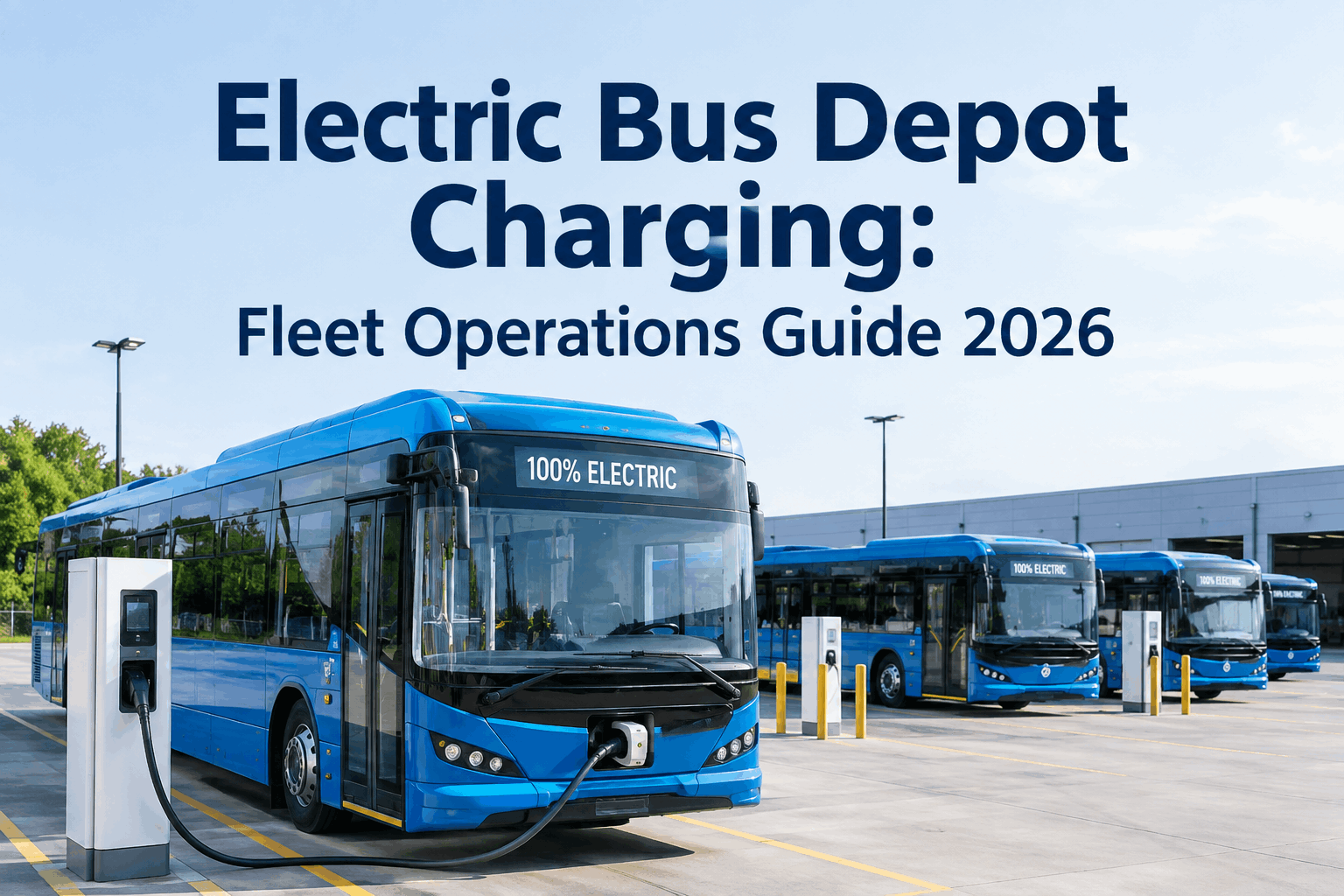
5:47 AM. A bus is scheduled to leave the depot on Route 12 in thirteen minutes. It came back last night at 78% state-of-charge and got plugged into Bay 4. The charge session throttled at 2:00 AM because the utility peak-demand alarm tripped when six other buses hit the yard within a fifteen-minute window. The bus is at 61% — not enough for the route. Now dispatch is scrambling to reassign, PM technician is walking back a scheduled inspection, and the transportation director is on the phone with the utility about that $840 demand charge that just landed. That is what electric bus depot charging without a coordination system looks like. This guide is about the system that prevents it.
Electric Bus Depot Charging: The Fleet Operations Playbook
The 24-hour depot rhythm, charging-window strategy, utility-rate coordination, and the readiness scorecard that keeps every bus rolling on time.
- 4Coordination Layers
- 3Charging Windows
- 6Failure Modes
Why Depot Charging Is a Coordination Problem, Not a Charging Problem
The old diesel depot ran on one loop: bus returns, driver parks, fueler tops it up on their pass, done. Electric bus depot charging has four moving pieces that all have to line up — the route schedule that says when the bus must leave, the bus itself (its arrival state-of-charge and battery health), the specific charger it plugs into (available, healthy, right power rating), and the utility rate that is running when it charges. Miss one and the whole thing wobbles. Miss two and buses do not leave the yard.
Every uncoordinated charging event costs money you do not see on the charger invoice. The utility demand charge for one badly-timed 15-minute peak can exceed a full week of energy costs. That is why depots that treat charging as "plug it in when it gets here" bleed money quietly for months before anyone connects the dots.
The fleets that get this right stop thinking of depot charging as an infrastructure question and start treating it as a scheduling problem — the same class of problem as bus rotation, driver assignment, or maintenance windows. All four have to be planned together because they compete for the same buses in the same bays. That is the whole game. Book a walkthrough to see how charging, PM, and route schedules coexist in one BusCMMS timeline.
The 4 Coordination Layers Every Depot Must Sync
Every charging decision at a depot touches four layers. A change in one cascades into the others. The layered diagram below is how to think about it — top-down, with each layer constrained by the ones above it.
Route Schedule
Fixed by the school bell schedule or transit timetable. Non-negotiable. Sets the departure deadline every other layer works backward from.
Bus State & Assignment
Which bus is on which route, its arrival state-of-charge, its battery-health-derated capacity, and whether it has a PM due. Determines how much energy each bus actually needs.
Charger Assignment
Which charger the bus plugs into. Right power rating for the time available, healthy (no derate faults), not already assigned to another bus in a queue conflict.
Utility & Grid Constraint
Time-of-use rate active during the session and the depot's contracted peak-demand ceiling. Determines whether the bus charges at $0.08/kWh or $0.31/kWh — and whether a demand charge triggers.
When these four layers live in four different systems — route sheet in a spreadsheet, bus state in the mechanic's head, charger assignment on a whiteboard, utility rate schedule in a PDF from the electric company — the coordination happens by accident. When they live in one system, the coordination becomes a query. That is the shift.
The Three Charging Windows: Which One Fits Your Depot?
Not every depot needs the same charging strategy. What works for a 12-bus rural school district looks nothing like what a 40-bus urban transit garage runs. Three windows cover almost every configuration.
Overnight Slow (Level 2)
Duration: 6-10 hours per bus, ~19 kW per station
Best for: School districts with clean overnight window (10pm-6am), no midday rotation
Trade-off: Cheapest hardware and lowest utility rates. Requires one charger per bus — no sharing possible in the overnight window.
Depot Fast (DCFC)
Duration: 1-3 hours per bus, 50-150 kW per station
Best for: Transit garages, split-shift school routes, mixed AM/PM depot returns
Trade-off: Chargers can be shared across multiple buses per shift — enables scheduling density. Higher hardware cost, more thermal management on the charger side.
Managed / Smart Charging
Duration: Variable, controlled by software
Best for: Any depot large enough to hit utility peak-demand thresholds; V2G or solar-tied depots
Trade-off: Software-orchestrated throttling and staggering to avoid peak-demand triggers and prioritize buses by departure time. Cuts demand charges 30-50% but adds a software layer to run.
Most fleets do not pick one of these. They run a hybrid: overnight slow for buses that return early and depart late, depot fast for split-shift and midday rotations, managed charging as the orchestration layer that keeps the whole depot from spiking the utility bill. The trick is that the hybrid only works if a single system knows which bus is on which window that day. Start free and map your fleet against the three charging windows in the first week.
Utility Rate Reality: The Real Charging Cost Isn't Energy
Fleet directors new to electric operations are usually surprised by their first commercial electric bill. Energy consumption charges are usually reasonable. Demand charges — billed on the single highest 15-minute power draw during the month — can double or triple the total. Understanding when you are actually paying premium rates is the difference between a $0.11/kWh effective cost and a $0.28/kWh one.
This map is why the overnight charging window is such a durable strategy. Buses that come back at 6pm and depart at 6am can charge entirely in the off-peak window — the cheapest energy the depot will ever buy. The problem is that "come back at 6pm and depart at 6am" describes only some routes. Everything else needs a plan.
The 6 Coordination Failures That Ground Buses
Uncoordinated depot charging fails in the same recognizable ways at every fleet. Here are the six most common patterns and what actually causes each one.
Low-SoC Departure
Bus rolls out below required SoC for its route because the charging session was interrupted, throttled, or started too late. Route runs short or a spare is scrambled last-minute.
Peak-Demand Spike
Multiple buses plug in within a 15-minute window, triggering a utility demand charge that shows up as a $400-$900 line item on the next bill. Happens most often on end-of-shift return.
PM & Charge Collision
Bus scheduled for PM at the same time it needs to be plugged in. Either PM gets pushed and slips out of compliance, or charging gets pushed and the bus misses departure SoC.
Charger Double-Booking
Two buses assigned to the same DCFC in overlapping windows because the assignment is on a whiteboard or a spreadsheet that nobody updated when the route swap happened.
Connector Orphaning
Driver leaves connector on the ground after unplug (or never plugs in at all). Bus does not charge overnight. Discovered at 5am pre-trip. Route coverage lost.
Dispatch-Charging Mismatch
Bus assignment changes at dispatch but the charging plan does not update — the bus meant for a long AM route is charging at the slow overnight-only rate and will not be ready in time.
Every one of these is a coordination failure, not a charging-hardware failure. And every one is preventable when the four layers (route, bus, charger, utility) are visible on one screen. That is why the coordination playbook is more valuable than any individual charging investment. Book a walkthrough to see coordination alerts firing before these failures happen.
The End-of-Day Readiness Scorecard
Every depot needs a "ready to roll" check that runs before the last operator leaves for the night. Six items, per bus. If any one is red, the bus is not automatically green for the morning — and the shift supervisor gets an alert before they walk out the door.
Connector Plugged & Confirmed
Handshake between bus and charger confirmed — not just physically plugged. OCPP session started.
Session on Schedule
Charging plan projects the bus reaches required departure SoC in time, accounting for any throttling.
Charger Fault-Free
Assigned charger showing no active fault codes, no thermal derate, firmware current.
No PM Collision
No preventive maintenance work order scheduled to intercept the charging window overnight.
Peak-Demand Ceiling Clear
Combined session power draw across the depot projected to stay below contracted demand threshold overnight.
Morning Route Assigned
Bus assignment confirmed against morning route requirement, including any driver-side pre-conditioning (cabin heat, defrost).
The value of this checklist is that it moves the "we found out at 5am" moment to 8pm the night before — when there is still time to move a bus to a different charger, wake a tech to reset a fault, or reassign a route. A missed morning departure is a route-coverage crisis. A caught 8pm alert is a phone call.
How BusCMMS Runs Depot Charging Coordination
A depot with 15 electric buses, 12 chargers, three utility rate periods, and a PM program cannot be run on separate systems that do not talk to each other. BusCMMS keeps all four coordination layers on one timeline so conflicts are visible before they happen instead of discovered after they cost route coverage.
-
Unified Depot Timeline
Route assignments, charging sessions, PM windows, and driver assignments on one visual timeline per bus. Conflicts flagged before they hit.
-
Charger Assignment Grid
See every charger × every time slot. Prevents double-booking and shows queue conflicts visually before dispatch commits.
-
Utility Rate Overlay
TOU rate schedule visible on the same timeline. Any session that runs into peak hours flagged with estimated cost impact.
-
Departure-SoC Projections
Live projection of what SoC each bus will have at scheduled departure, based on current session, throttling, and target. Red-flags shortfalls hours ahead.
-
End-of-Day Readiness Check
Automated scorecard runs at shift close — every bus green-checked for tomorrow, or an alert to the supervisor before they leave the depot.
-
Peak-Demand Ceiling Alerts
Depot-wide load projection warns when combined charging load will approach the contracted demand ceiling — before the utility triggers a demand charge.
The design principle is the same one that runs through every BusCMMS feature: what belongs on the same screen belongs in the same system. Depot charging is not a separate workflow — it is one facet of running the fleet, and it lives with the rest of the fleet.
The Practitioner View: What Coordination Actually Fixes
The number nobody talks about with electric bus fleets is the coverage-miss rate in year one. Every fleet has some. Almost none of them are actually charger hardware failures — they are coordination failures that just happen to show up at the charging point. Fix the coordination and the hardware starts looking a lot more reliable. Sign up free and get your first depot day mapped in under an hour.
The Bottom Line on Electric Bus Depot Charging
Depot charging is a scheduling problem wearing a hardware disguise. The chargers themselves are usually fine. What is missing at most fleets is a single system where the route schedule, the bus state, the charger assignment, and the utility rate all live on the same timeline. Four layers, three window strategies, six failure modes to avoid, and one end-of-day readiness check. That is the whole framework. Get those working together and morning coverage misses stop being a mystery. Book a walkthrough to see the coordination timeline running on a depot like yours.
What is electric bus depot charging?
Electric bus depot charging is the coordination of when, where, and how the buses in a fleet plug in to recharge between routes. It is not just an infrastructure problem — it is a scheduling problem that involves four layers working together: the fixed route schedule, each bus's arrival state-of-charge and PM status, which charger the bus is assigned to, and the utility rate active during the charging session. Fleets that treat depot charging as "plug it in when it gets here" typically lose morning route coverage to preventable coordination misses and overpay utility bills on peak-demand charges.
What are the main types of charging windows for depot charging?
Three windows cover almost every depot configuration. Overnight slow (Level 2) charges each bus 6-10 hours at ~19 kW — best for school districts with a clean 10pm-6am window and one charger per bus. Depot fast (DCFC) charges buses in 1-3 hours at 50-150 kW — best for transit garages and split-shift operations where chargers must be shared. Managed or smart charging is a software layer that stages and throttles sessions across the depot to avoid utility peak-demand charges and prioritize buses by departure time — typically added on top of Level 2 or DCFC once fleet size hits the peak-demand threshold. Most fleets run a hybrid of all three.
Why do utility demand charges matter for electric bus depots?
Commercial electric bills have two components: energy consumption (per kWh) and demand charges (billed on the highest 15-minute power draw during the month). For a depot with multiple DCFCs, uncontrolled simultaneous charging — say, six buses plugging in within a 15-minute window at end-of-shift — can trigger a demand event that adds hundreds of dollars to the monthly bill on its own. Well-managed depots use staggered plug-in scheduling and software-controlled throttling to keep combined depot load below the contracted demand ceiling, which can cut monthly utility spend 30-50% versus uncontrolled charging.
How do I prevent electric buses from missing morning departures?
Nearly every missed morning departure at an electric fleet traces back to a coordination failure caught too late. The fix is an end-of-day readiness check run before the last operator leaves the depot, testing six items per bus: connector plugged and OCPP handshake confirmed, charging session on schedule to reach required SoC by departure, assigned charger fault-free, no PM work order intercepting the charging window, depot-wide load under peak-demand ceiling, and morning route assignment confirmed. Any red flag alerts the shift supervisor before they leave — while there is still time to reassign a charger, reset a fault, or move a PM. A missed morning departure is a crisis; a caught 8pm alert is a phone call.
How does BusCMMS manage electric bus depot charging?
BusCMMS keeps all four coordination layers on one unified timeline — route assignments, bus state and PM windows, charger assignments, and utility rate schedule — so conflicts are visible before they turn into missed routes. The charger assignment grid prevents double-booking. TOU rate overlays flag any session running into peak hours with estimated cost impact. Departure-SoC projections warn about shortfalls hours ahead. The end-of-day readiness scorecard runs automatically at shift close, green-checking every bus for the next morning or alerting the supervisor before they leave. And peak-demand ceiling alerts prevent the depot-wide utility spike that adds hundreds to the monthly bill.