A driver on your fleet gets rear-ended at a four-way stop, insurance wants footage, and the only camera on that bus was aimed at the loading door because that's where the installer had an easy mounting point. No road view, no exoneration, and now you are fighting a claim with nothing to back your driver up. A forward-facing bus dash cam exists to prevent exactly that gap — a road-view camera mounted to actually capture the windshield's field of view, not wherever was convenient to run a cable.
What road-view field of coverage actually means on a bus
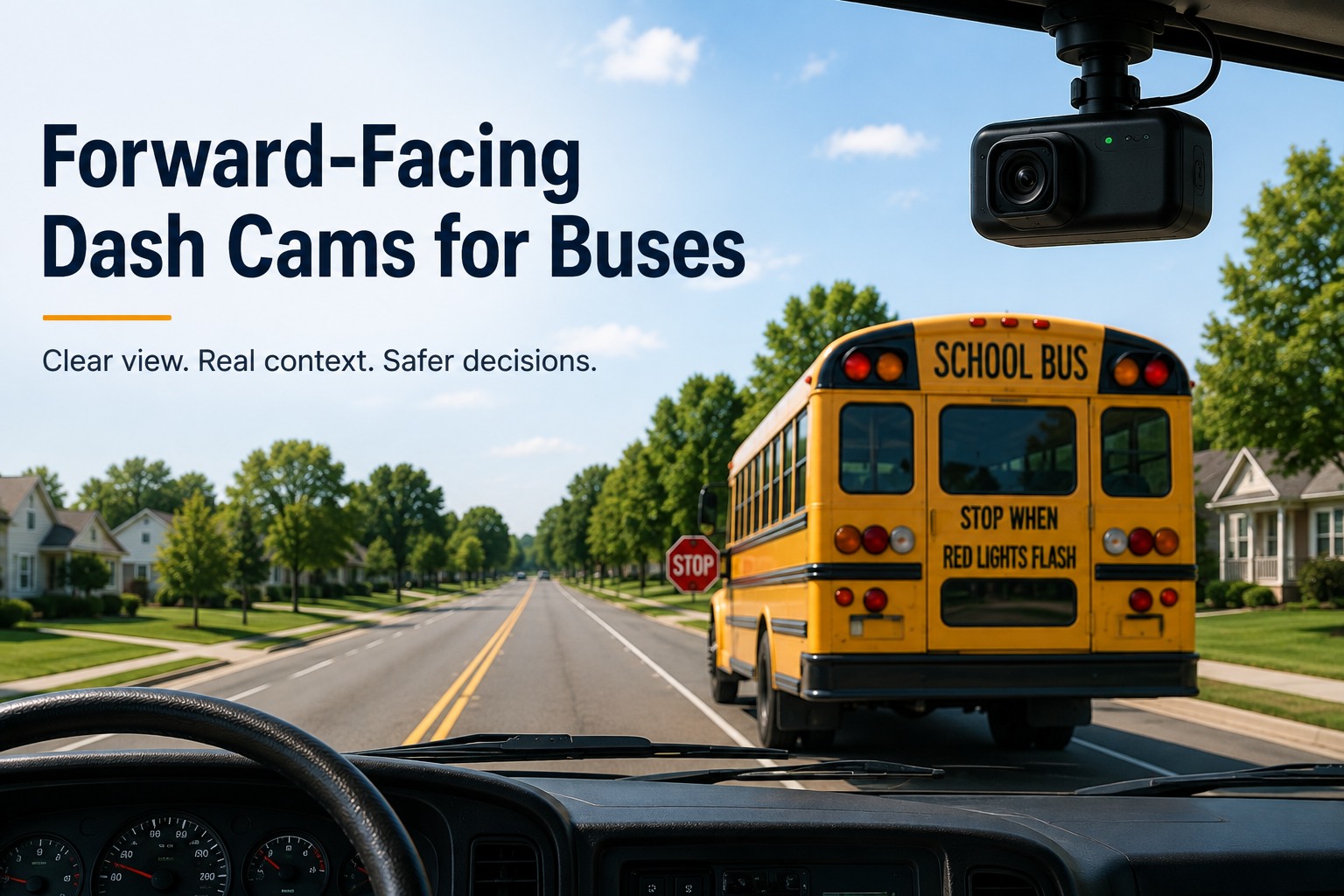
A forward-facing dash cam's whole job is capturing what the driver sees through the windshield — the road ahead, the vehicle in front, intersections, pedestrians stepping off a curb. On a bus, that sounds simple, but the geometry is different from a passenger car or even a semi cab. A bus windshield sits higher and wider, the wiper sweep only clears a specific zone, and the dash itself is often taller, which means a camera mounted without checking the actual sightline can end up recording a windshield reflection or the top of the dash instead of the road.
Field of coverage should be measured in practical terms: does the camera capture the full lane width in front of the bus, does it pick up a vehicle merging from either adjacent lane, and does it stay inside the wiper sweep so rain or snow doesn't blind half the frame. No single federal mandate governs forward-facing camera placement or field-of-view specs on buses — the compliance bar here comes from 49 CFR 396 maintenance record requirements and your own district policy, which means getting this right is entirely on your installation standards, not something a regulation checks for you. You can walk through actual placement examples on a BusCMMS camera program walkthrough before deciding where units go on your own fleet.
| Spec | What to look for |
|---|---|
| Mounting position | Inside wiper sweep, centered on windshield, above dash reflection line |
| Field of view | Wide enough to cover full lane width plus both adjacent lanes at intersections |
| Low-light performance | Rated for dawn-run and dusk conditions, not just daylight |
| Glare handling | WDR (wide dynamic range) or HDR to manage sun glare through glass |
| Housing rating | Vibration and temperature tolerance built for a bus chassis, not a passenger car |
| Recording trigger | Event-based capture (harsh brake, collision) plus continuous option for the road-view feed |
Forward collision and following-distance detection — what the AI layer adds
A basic forward-facing dash cam just records. An AI-enabled one adds detection on top of the footage — following-distance warnings when the bus is closing in too fast on the vehicle ahead, forward-collision alerts when a hazard appears with insufficient stopping distance, and lane-position cues on routes with narrow shoulders or construction zones. On a school bus route specifically, following-distance detection matters more than it might on a highway-heavy trucking route, since so many routes involve frequent stops, tight residential streets, and reduced visibility around parked cars near a pickup point.
The detection layer is also what turns a passive recording into something your safety team can actually act on without watching every mile of footage. A following-distance violation that crosses a threshold gets flagged automatically instead of requiring someone to review hours of road-view video looking for a pattern. That's the difference between a dash cam as a black box you check after a complaint, and a dash cam as part of an active safety workflow feeding into the same system as your maintenance and coaching records.
Download the bus camera programme checklist.
A practical install and evaluation checklist covering mounting position, field of view, and what to ask any camera vendor.
Glare, dawn runs, and the conditions that expose a bad camera fast
Most demo footage looks great on a clear afternoon. The conditions that actually reveal whether a forward-facing camera is worth the money are the ones nobody demos: a 6:15 AM winter route with the sun low on the horizon directly through the windshield, or a dusk run in late fall where headlights from oncoming traffic wash out a low-quality sensor. A camera without wide dynamic range or proper HDR handling will either blow out to white on the glare side or go completely dark trying to compensate — both useless if you need that footage later.
This is worth testing before a fleet-wide purchase, not after. Ask a vendor for footage from an actual dawn or dusk run, not a staged daytime clip, and check whether the road ahead is still legible when the sun is low. A camera that performs fine at noon and fails at 6:30 AM is a camera that will fail you exactly when a bus is most likely to be involved in a low-visibility incident.
The install mistake that leaves the loading door uncovered
Here's the failure worth naming directly: installers, working fast across a large fleet, often mount the forward-facing camera wherever's easiest to run a cable and mount a bracket — sometimes off-center, sometimes low enough that the dash blocks part of the frame, sometimes angled in a way that technically shows "forward" but misses the loading door entirely. That last gap is the expensive one. A stop-arm violation or a student incident at the loading door needs coverage from a dedicated exterior camera, not an afterthought crop from a forward-facing unit aimed at the road.
The fix isn't complicated, but it does require treating camera placement as a field-of-view decision, not a convenience decision. Before signing off on an install across your fleet, walk one bus yourself and check the actual recorded frame against what you need covered — road ahead, loading door, and the danger zone around it — rather than trusting that "forward-facing" automatically means adequate coverage everywhere it matters.
A scenario from a real bus operation
A school district running 34 buses had forward-facing cameras installed fleet-wide, but a shop supervisor doing a routine review noticed six units were mounted low enough that the dash cut off the bottom third of the frame — meaning stop-sign compliance at intersections was harder to verify from footage, since the frame didn't clearly show where the bus stopped relative to the line. Remounting those six units two inches higher and re-angling them resolved the issue. The catch: nobody had checked actual recorded frames against a standard until an unrelated incident review exposed the gap. That's the argument for a walk-and-check process at install time, not six months later.
See how camera events tie into your maintenance record.
BusCMMS reports serving 5,000+ bus fleets, with an average four-month payback once camera and maintenance data run through one platform.
The bottom line on forward-facing bus dash cams
A forward-facing bus dash cam earns its place on the bus when it actually covers the road-view field it's supposed to — inside the wiper sweep, wide enough for adjacent lanes, tested against glare and dawn-run conditions, not just a clean daytime demo. Get placement right at install, add following-distance and forward-collision detection so events get flagged instead of buried in raw footage, and make sure the loading door still has its own dedicated coverage rather than relying on a forward camera to catch everything. Get those pieces right, and a forward-facing camera stops being a box on a compliance checklist and starts being the thing that actually protects your driver the next time a claim comes in. See how a bus-specific operations platform ties camera events into the same record as your maintenance history.
Updated August 2026
Frequently asked questions
Where should a forward-facing dash cam be mounted on a bus?
Centered on the windshield, inside the area cleared by the wiper sweep, and positioned high enough that the dash doesn't cut into the bottom of the frame. The goal is a clear road-view field covering the full lane width and both adjacent lanes at intersections, not just a straight-ahead sliver of road.
Is there a federal requirement for forward-facing cameras on school buses?
No single federal mandate governs forward-facing dash cam placement or specs on buses. The compliance bar for bus records is set by 49 CFR 396 maintenance requirements and individual district policy, meaning camera placement standards are set at the district or fleet level rather than by federal rule.
Why does glare handling matter more on a bus than a passenger car?
Bus routes frequently run at dawn or dusk, when low sun angles create direct glare through the windshield. A camera without wide dynamic range or proper HDR handling will either blow out to white or go dark trying to compensate, making footage unusable exactly when low-visibility conditions make an incident more likely.
Does a forward-facing camera also cover the loading door?
Not reliably. A forward-facing camera is angled toward the road ahead, and relying on it to also capture the loading door and danger zone is a common install mistake. That area needs its own dedicated exterior camera to properly cover stop-arm violations and student safety at drop-off.
How does BusCMMS use forward-facing camera data?
BusCMMS reports serving 5,000+ bus fleets, with published figures of roughly 30% lower annual maintenance cost and an average four-month payback once forward-facing camera events — following-distance alerts, collision flags — feed into the same platform as maintenance and driver coaching records, rather than sitting in a standalone camera portal.