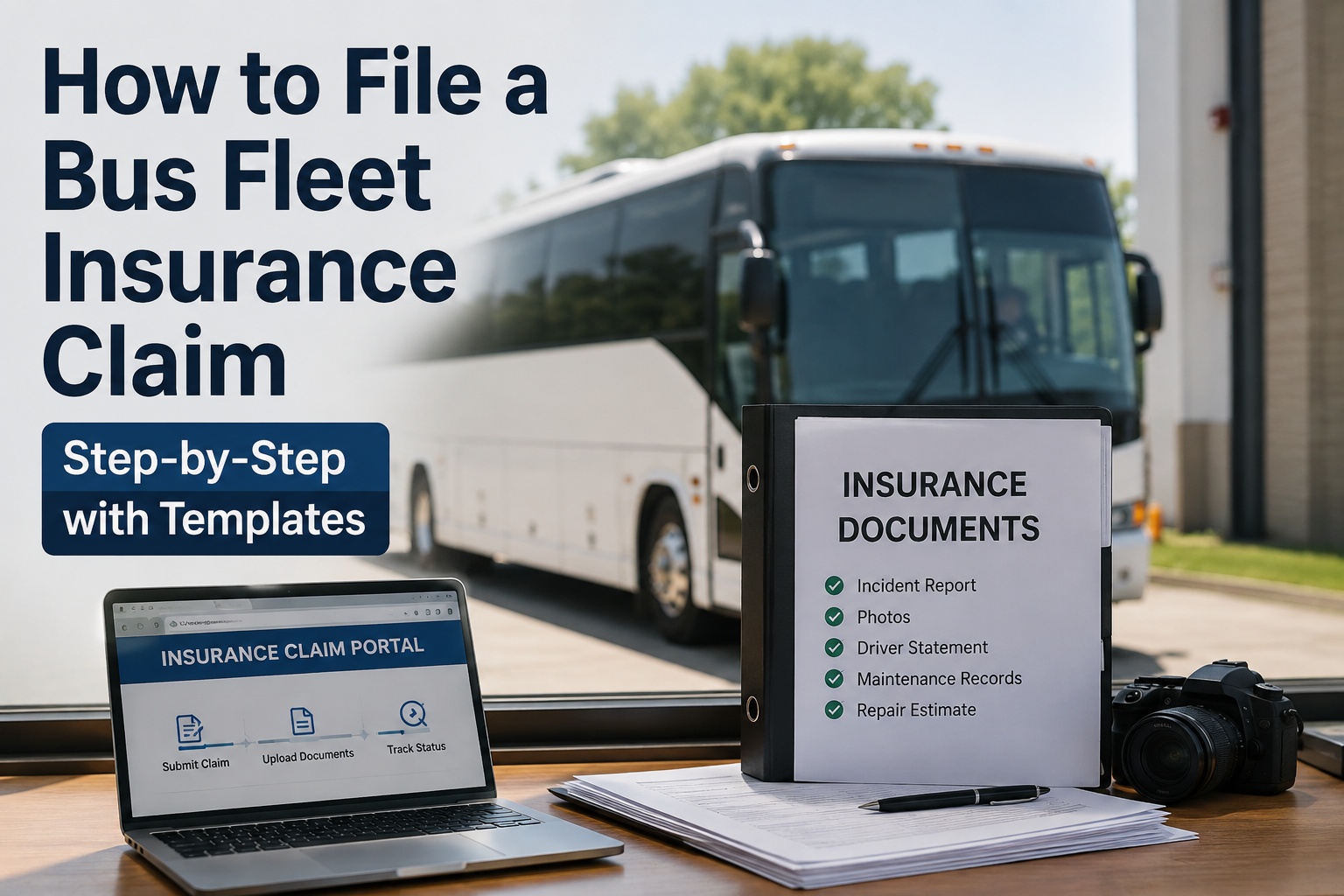
A bus accident's insurance claim outcome is decided in the first 4 hours. Miss the 30-minute scene documentation window and the physical evidence (debris field, skid marks, weather, witness locations) is gone. Miss the 24-hour First Notice of Loss window and the carrier has grounds to reduce or deny the claim. Commercial auto liability premiums are rising 15-40% at renewal after an at-fault claim in 2026, and 15 multimillion-dollar trucking/motorcoach verdicts totaled $1.4 billion in 2024 alone. This is the 2026 step-by-step bus fleet insurance claim guide -- the 6-phase process, the FNOL template, the 10-shot photo checklist, the incident report template, and the documentation trail that separates a paid claim from a denied one. See BusCMMS run digital incident reports with auto-attached DVIR + PM history → book a 20-min demo.
How to File a Bus Fleet Insurance Claim (2026)
The 6-phase claim workflow, FNOL and incident report templates, 10-shot photo checklist, and the documentation trail that separates a paid claim from a denied one.
Scene Documentation
Physical evidence degrades by the minute. Debris field, skid marks, witnesses, weather -- all disappear.
Internal Notification
Driver → dispatcher → fleet manager → broker. Delays here compound downstream.
FNOL to Carrier
First Notice of Loss. Most policies require this within 24-72 hours. Late FNOL = coverage denial grounds.
Adjuster Assigned
Carrier assigns adjuster. Every day of adjuster delay adds to your claim resolution time.
Total Resolution
Full claim resolution: investigation, estimate, settlement, payment. Faster with clean documentation.
The 6-Phase Claim Process
Every commercial bus insurance claim moves through these 6 phases. Know each one so nothing catches your fleet off-guard.
A commercial bus insurance claim is not a single action -- it is a 6-phase workflow that runs from the moment the accident happens through the closing of the claim file and the impact on next year's premium renewal. Understanding all 6 phases (and what documentation each requires) is what separates the fleet managers who get paid quickly from the ones who spend weeks answering "can you clarify..." emails from the adjuster.
- 01
Scene Response
0 - 30 MIN · DRIVERDriver secures scene, calls 911, checks for injuries, exchanges info, photographs scene, obtains police report number. Every minute matters -- physical evidence degrades and witnesses leave.
- 02
Internal Report
0 - 4 HRS · DRIVER → DISPATCH → FLEET MGRDriver reports to dispatch. Dispatch alerts fleet manager and broker. Fleet manager pulls morning DVIR, last PM record, driver certification file. This is the foundation of the claim file.
- 03
FNOL Filed with Carrier
0 - 24 HRS · FLEET MGR / BROKERFirst Notice of Loss submitted via carrier hotline or online portal. Includes policy number, date/time/location, description, injury status, other party info, police report number. Late FNOL is denial grounds.
- 04
Adjuster Investigation
24 HRS - 5 DAYS · CARRIERAdjuster assigned within 24-72 hours. Inspects damage 1-5 days. Reviews driver statement, scene photos, DVIR, PM history, police report. Requests any missing items. Determines liability and coverage.
- 05
Estimate + Settlement
3 - 30 DAYS · CARRIER + FLEETAdjuster issues repair estimate or total-loss valuation (3-7 days). Fleet negotiates if disputed. Payment within 5-10 days of accepted settlement. Subrogation pursued if not at fault.
- 06
Post-Close + Loss Run
POST-CLOSE · ONGOINGClaim closes, Loss Run updated (stays 3-5 years). Root cause analysis feeds fleet risk scoring. Premium impact assessed at renewal. Corrective actions logged for future prevention.
Phase 2 is where paper-based fleets lose the claim. Digital DVIR, PM history, driver certifications -- all searchable in seconds -- is what wins Phase 4. See BusCMMS pull DVIR + PM + certifications for any bus in seconds → book a demo.
The FNOL Template: 10 Fields That Open the Claim
First Notice of Loss submitted within 24 hours. Every field below either helps or hurts your claim outcome.
First Notice of Loss (FNOL) is the initial phone call, email, or portal submission that officially puts the carrier on notice. It is not the incident report. It is not the damage estimate. It is the trigger that starts the adjuster clock. Every insurance carrier's FNOL asks for the same 10 fields -- and the completeness of those 10 fields determines how quickly an adjuster is assigned and how few follow-up questions come back.
A FNOL with all 10 fields complete typically gets an adjuster assigned within 24 hours. A FNOL missing fields 3-4 or 10 stalls until each is provided -- adding days to the settlement clock. See BusCMMS auto-populate FNOL fields from driver on-scene reports → book a demo.
The 10-Shot Photo Checklist
Timestamped photos are the single most powerful piece of evidence in a bus insurance claim. Miss any of these 10 shots and the adjuster fills the gap with assumptions.
Insurance adjusters and defense attorneys work from what they can see. A bus fleet claim with 20+ timestamped, geo-tagged photos settles in an average of 30-90 days. A claim with 3 blurry cellphone photos taken later that week can drag on for 6-12 months. Every driver in every bus should have the 10-shot checklist below in their glove box, in their phone, and in their mandatory training.
Wide Overview
Full intersection or road segment. Show all vehicles in position. Standing 40-50 ft back.
Damage Close-Ups
Each impact point on every vehicle. 4-6 shots per vehicle minimum. Multiple angles.
All License Plates
Every plate visible and legible. Both vehicles minimum. Include witness vehicles.
Insurance Cards + Licenses
Other driver's insurance card front and back. Driver's license photograph.
Skid Marks + Debris Field
Physical evidence of speed and impact direction. Include a reference object for scale.
Traffic Signs + Signals
Stop signs, yield signs, traffic lights, speed limit signs. State of signals at time of loss.
Weather + Road Conditions
Wet pavement, ice, fog, sun position. Include broader view showing sky and visibility.
Interior of Bus
Especially if passenger injuries. Seat displacement, personal effects, damage to interior.
Bus 8-Light + Stop Arm
School bus specific. If loading/unloading, photograph active signal system status.
Wider Environment
Land marks, buildings, distance signs. Helps adjuster orient location from photos alone.
Every photo must carry timestamp and GPS coordinates in metadata. Turn location services on. A digital incident report platform embeds these automatically. A cellphone's default camera may or may not -- check before the incident, not during.
The Full Incident Report: 6 Documentation Bundles
FNOL opens the claim. The incident report is what the adjuster and defense attorney actually work from. Structure it in 6 bundles.
A structured incident report is the spine of the claim file. It ties every piece of physical evidence, digital record, and narrative statement together in one document that the adjuster, defense counsel, and (potentially) a jury can follow. Below are the 6 documentation bundles every bus fleet incident report should contain -- in this exact structure, in this exact order.
Incident Header
- Report number + filing date/time
- Date + exact timestamp of incident
- GPS location + address + intersection
- Weather + road surface + visibility
- Speed limit posted
Bus & Driver Info
- Unit #, VIN, year/make/model, odometer
- Driver name, CDL#, endorsements, hire date
- Morning pre-trip DVIR reference number
- Last PM service date + interval
- Route assignment + passenger manifest
Other Parties & Witnesses
- Other driver name, license#, insurance
- Other vehicle year/make/model/plate
- Witness names + contact info + statements
- Passenger injury reports (if applicable)
- Emergency responders on scene
Narrative + Diagram
- Driver statement (chronological, factual only)
- Scene diagram with vehicle positions
- Direction of travel arrows
- Location of debris field + skid marks
- Location of witnesses at time of incident
Physical Evidence
- Photo inventory (20+ timestamped, geo-tagged)
- Onboard camera video (if equipped)
- Police report number + agency + officer
- Tow receipt + storage location
- Initial damage estimate + repair quotes
Compliance Records
- Morning pre-trip DVIR (proves bus was operational)
- Driver certification + medical card current
- Driver training records (last refresher date)
- Bus PM history (proves maintenance compliance)
- Any relevant prior incident history
Bundle 06 is where fleets running paper systems lose. Digital DVIR + PM history + driver certification files attached in one PDF export saves the fleet manager 3-5 days of scrambling per claim. Sign up free and log incident reports with auto-attached compliance records →
10 Red Flags That Delay or Deny Claims
Adjusters look for these. Defense attorneys use them. Fix every one before the FNOL goes out.
- 01
FNOL Filed > 24 Hours Late
Coverage denial grounds under most policy language. Every hour past 24 raises the risk of dispute.
- 02
No Timestamped Photos
Adjusters cannot verify time/place. Metadata-stripped or later-day photos treated as low-credibility evidence.
- 03
Missing Morning DVIR
Cannot prove bus was operational at start of day. Opens the door to mechanical-cause defense against the fleet.
- 04
Missing PM History
Cannot prove maintenance compliance. Adjuster and defense will assume neglect if records unavailable.
- 05
Driver Statement Inconsistencies
Handwritten notes contradicting typed report. Speculation words ("I think", "probably", "must have"). Both get flagged.
- 06
No Police Report Number
Adjuster cannot pull independent scene documentation. Delays investigation phase by 5-10 days minimum.
- 07
No Witness Contacts
Third-party corroboration is the single strongest piece of evidence. Its absence weights the claim against the fleet.
- 08
Expired Driver Certifications
Expired CDL, medical card, or endorsement discovered post-incident is potentially fatal to the coverage.
- 09
No Repair Estimate
Adjuster cannot proceed without at least one written estimate. Fleets should have 2-3 quotes ready by day 5.
- 10
Filing a Claim Not Worth It
Damage under $2K on a $1K deductible = $1K recovered but Loss Run entry for 3-5 years. Do the math before filing.
Every red flag on this list is preventable with a structured digital claim workflow. The paper-and-cellphone approach that used to be industry standard is now the fleet's biggest exposure. See BusCMMS eliminate all 10 red flags with structured incident capture → book a demo.
Where BusCMMS Fits Your Claim Workflow
Six ways the insurance claim becomes a 20-minute PDF export instead of a 3-day paper scramble.
Digital Incident Reports From Scene
Driver captures incident on mobile at scene with structured checklist. Photos timestamped, geo-tagged, uploaded live. Fleet manager notified in real time.
Morning DVIR Auto-Attached
The bus's pre-trip DVIR from that morning attaches automatically to the incident file. Proof of operational condition, ready for adjuster.
PM History & Work Order Log
Bus's complete PM history and work order log auto-generates as a compliance appendix. No scrambling through spreadsheets after the fact.
Driver Certification File
CDL, medical card, endorsements, training completion dates all live on the driver record. Any expirations flagged before route, not discovered after incident.
Structured PDF Export for Adjuster
One-click export of complete incident file: FNOL fields, narrative, photo inventory, DVIR, PM history, driver file. Adjuster gets a clean claim package.
Loss Run Reconciliation
Every filed claim tracked in the system with settlement outcome, days-to-resolution, and root-cause note. Feeds risk scoring for renewal negotiation.
We had two claims within six weeks last spring. Both minor sideswipes. Before BusCMMS, our first one took 74 days to close. Adjuster kept coming back for PM records, driver training dates, one photo of the damage from a different angle, the morning DVIR -- I was pulling records from four different systems every time. Second one, we had BusCMMS live. Driver logged the incident on mobile at scene. Photos uploaded live. The morning DVIR, last PM, driver certification -- all auto-attached to the incident record. I exported the complete package as one PDF and sent to the adjuster within 6 hours of the call. Adjuster settled in 27 days. On the same category of accident. That difference -- 74 days vs 27 days -- is exactly why we bought the platform.
74 days vs 27 days on the same category of accident. That is the paper-to-digital delta. See how →
Frequently Asked Questions
How long does a bus fleet insurance claim take to resolve in 2026?
A commercial bus insurance claim moves through 6 phases with the following typical windows: scene response takes 0-30 minutes and is driver-owned, internal reporting to dispatch and fleet manager happens within 4 hours, First Notice of Loss (FNOL) is filed with the carrier within 24 hours, adjuster investigation runs 24-72 hours to be assigned followed by 1-5 days to inspect damage, repair estimate or total-loss valuation is issued in 3-7 days, and payment follows 5-10 days after accepted settlement. Total claim resolution typically runs 30-90 days for commercial auto claims, per First Heritage Insurance Agency 2026 guidance and industry standard timelines. Clean documentation dramatically speeds this timeline. One 54-bus motorcoach charter operator reported closing a comparable claim in 27 days after moving to digital incident reporting -- down from 74 days on a nearly identical previous claim using paper processes. Poor documentation, delayed FNOL, and missing DVIR or PM records can push resolution past 6 months and expose the fleet to denial or reduced payout.
What is FNOL and when do you need to file it?
FNOL stands for First Notice of Loss -- the initial phone call, email, or portal submission that officially notifies your insurance carrier that a loss has occurred. Most commercial bus policies require FNOL within 24-72 hours of the incident, with 24 hours being the safest standard. Late FNOL is legitimate coverage denial grounds under most policy language. FNOL is NOT the incident report and is NOT the damage estimate -- it is a specific 10-field submission that includes policy number, insured name and contact, exact date/time of loss, location of loss (address plus intersection), vehicle VIN and unit number, driver name and CDL number, a 3-5 sentence factual description (no speculation words like "I think" or "probably"), injury and casualty status, other party info including their insurance carrier and policy, and police report number. A FNOL with all 10 fields complete typically gets an adjuster assigned within 24 hours. A FNOL missing critical fields like date/location or police report stalls until each is provided, adding days or weeks to the settlement clock. Every hour past the 24-hour window raises the risk of dispute and potentially of denial.
What documentation does a bus insurance claim require?
A complete bus fleet insurance claim file organizes documentation into 6 bundles. Bundle 1 (Incident Header) covers report number, date/timestamp, GPS location, weather and road conditions, and posted speed limit. Bundle 2 (Bus and Driver Info) covers unit number, VIN, year/make/model, odometer, driver name/CDL/endorsements, morning pre-trip DVIR reference, last PM service date, and route assignment. Bundle 3 (Other Parties and Witnesses) covers the other driver's info, other vehicle info, witness names and contacts with statements, passenger injury reports, and emergency responders on scene. Bundle 4 (Narrative and Diagram) covers a chronological factual driver statement, scene diagram with vehicle positions, direction of travel, debris field and skid mark locations, and witness locations at time of incident. Bundle 5 (Physical Evidence) covers 20+ timestamped and geo-tagged photos, onboard camera video, police report number/agency/officer, tow receipt and storage location, and initial damage estimate plus 2-3 repair quotes. Bundle 6 (Compliance Records) covers the morning pre-trip DVIR proving bus was operational, driver certification and medical card current status, driver training records with last refresher date, complete bus PM history proving maintenance compliance, and any relevant prior incident history. Bundle 6 is where fleets running paper systems most often fail during claim disputes.
What red flags cause insurance adjusters to deny or delay bus claims?
Ten common issues delay or deny commercial bus insurance claims. FNOL filed more than 24 hours late is legitimate coverage denial grounds under most policy language. No timestamped photos means adjusters cannot verify time and place -- metadata-stripped or later-day photos get treated as low-credibility evidence. Missing morning DVIR means the fleet cannot prove the bus was operational at start of day, opening the door to mechanical-cause defense. Missing PM history means the fleet cannot prove maintenance compliance, and adjuster and defense will assume neglect. Driver statement inconsistencies from handwritten notes contradicting typed reports, or speculation words like "I think" and "probably", get flagged immediately. No police report number means the adjuster cannot pull independent scene documentation, delaying investigation 5-10 days minimum. No witness contacts means no third-party corroboration -- absence of witnesses weights the claim against the fleet. Expired driver certifications discovered post-incident are potentially fatal to coverage. No repair estimate means the adjuster cannot proceed, so fleets should have 2-3 quotes ready by day 5. Finally, filing a claim not worth filing -- damage under $2,000 on a $1,000 deductible recovers only $1,000 but adds a Loss Run entry that stays on record for 3-5 years and can raise premium 15-40% at renewal.
How does BusCMMS help file and manage bus fleet insurance claims?
BusCMMS runs digital incident reports captured on-scene by the driver using a mobile app with a structured checklist that ensures nothing critical is missed under stress. Photos are timestamped and geo-tagged automatically -- solving the metadata problem that undermines paper-and-cellphone claims. The bus's morning pre-trip DVIR automatically attaches to the incident file, providing proof of operational condition ready for the adjuster. The complete bus PM history and work order log auto-generates as a compliance appendix, eliminating scrambling through spreadsheets after the fact. The driver's CDL, medical card, endorsements, and training completion dates all live on the driver record, with any expiration flagged before the route rather than discovered post-incident. The entire incident file -- FNOL fields, narrative, photo inventory, DVIR, PM history, and driver certification file -- exports in one click as a structured PDF the adjuster receives as a clean claim package. Every filed claim is tracked with settlement outcome, days-to-resolution, and root-cause notes, feeding fleet risk scoring for the next premium renewal negotiation. Bus fleets that move to purpose-built CMMS incident reporting report resolving claims up to 60% faster and recovering 35% more in liability disputes, based on operational benchmarks from U.S. commercial bus fleet operations.