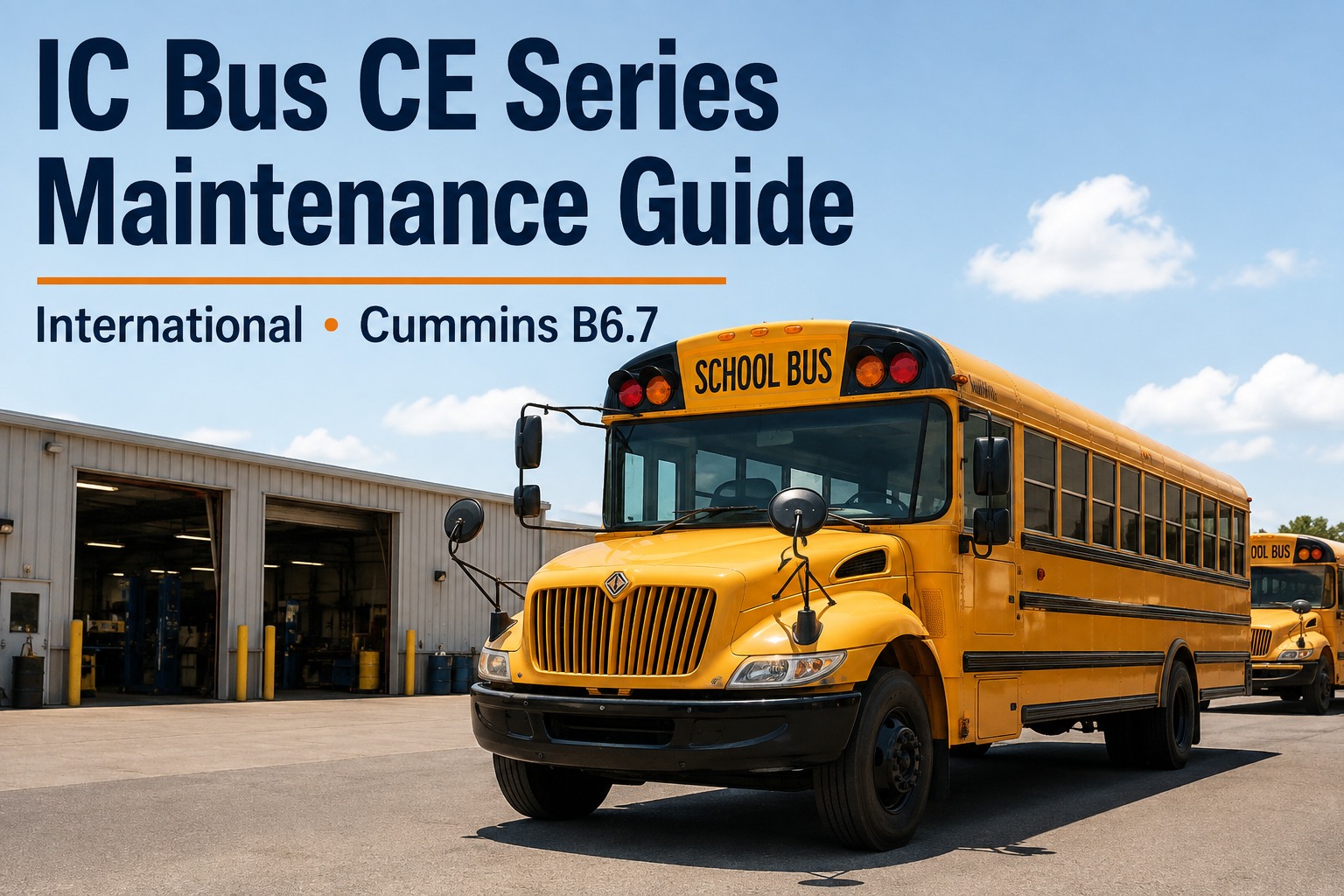
The IC Bus CE Series has been the top-selling school bus in North America for 20+ years, built in Tulsa, Oklahoma on an International chassis with a Cummins B6.7 diesel or electric powertrain. That means one specific piece of equipment sits on more shop hoists every morning than any other Type C in the country. Every CE tech knows the drill: tilt the three-piece hood, work through the checklist, close it back down. This guide is organized around that actual workflow -- not a generic PM template. Tilt hood access, DiamondLogic electrical reality, Cummins B6.7 emissions era discipline and the six faults every CE shop sees repeatedly. See BusCMMS run CE-specific PM templates on your fleet → book a 20-min demo.
The 90-Second Tilt Hood Access Map
Every CE service task starts with the Easy-tilt three-piece hood raised. This is what the tech sees the moment the hood is up -- five zones, laid out in the order most shops walk through them, so nothing gets missed before the hood closes back down.
- 01
Cummins B6.7 Engine Bay
6.7L inline-6 turbo diesel, 220-300 hp, 520-660 lb-ft. Dry weight 1,150 lb. Oil dipstick + filler cap driver-side. Serpentine belt front. Check oil, coolant reservoir, power steering fluid.
FIRST STOP - 02
DiamondLogic Electrical Panel
Exterior-mounted multiplexed panel — a Navistar signature. Master fuses, body-controller access, VOR (voice-over-ride) diagnostic ports. Check panel gasket seal for moisture ingress.
SECTION 1 DEEP-DIVE - 03
Cooling System Front
Radiator, charge-air cooler, condenser stacked front. Check for road debris, bug screen condition, fin damage. This is where CE fleets in warmer climates find the most cooling stress.
CLIMATE-CRITICAL - 04
DEF Tank Fill & SCR Access
Diesel Exhaust Fluid ISO 22241 32.5% urea. Tank fill on passenger side. Check level, cap seal, exterior for crystallization staining (a sign of cap leak).
AFTERTREATMENT - 05
Air Filter Housing & Intake
Modular filter access on the 2023+ next-generation CE. Check restriction gauge, filter condition, housing seal integrity. Skip this and you get gradual power loss no one can diagnose.
LAST STOP BEFORE CLOSE
Walk the 5 zones in this exact order every PM. It takes about 90 seconds. Skipping the order is how the tech closes the hood, realizes on the way back to the office that the coolant was never checked, and then has to tilt the hood again. Discipline saves 3-4 minutes per PM, per bus, per week.
The DiamondLogic Electrical Reality
Navistar's proprietary multiplexed electrical system is where 40% of CE service confusion lives. Techs who know it save hours per fault. Techs who fear it turn every warning light into a road call.
Every IC Bus CE Series built from 2001 onward runs DiamondLogic -- Navistar's multiplexed body electrical architecture. Instead of miles of point-to-point wiring, DiamondLogic uses a body controller, network buses, and modular electrical panels to reduce wire count by roughly 75%. That is genuinely elegant when it works and genuinely frustrating when a shop tech trained on old-school wiring tries to trace a single fault the old way. The four-quadrant grid below is how experienced CE shops actually think about DiamondLogic faults -- diagnostic complexity on one axis, business impact on the other.
LOW IMPACT / LOW COMPLEXITY
Handle in-house at next PM window
- Dome light module fault
- Single stop-arm LED failure
- HVAC blower speed anomaly
HIGH IMPACT / LOW COMPLEXITY
Fix today · simple fault, high urgency
- 8-light warning system fault
- Stop arm won't extend
- Reverse alarm silent
LOW IMPACT / HIGH COMPLEXITY
Batch into scheduled dealer visit
- Body controller intermittent fault
- Network bus resistance anomaly
- Multi-module code cascade
HIGH IMPACT / HIGH COMPLEXITY
Call International dealer immediately
- Complete body controller failure
- Intellipark parking brake fault
- Multiple safety-system codes
CE fleets that route DiamondLogic faults through this grid cut electrical road calls by 40-60% in the first 90 days. See BusCMMS route DiamondLogic fault codes to the correct workflow quadrant automatically → book a demo.
The Cummins B6.7 Service Discipline (By Emissions Era)
Same engine family since 2014. Different aftertreatment across four emissions eras. The service program needs to know which era each CE is in.
Cummins B6.7 has powered the IC Bus CE Series since 2014, and the underlying 6.7L inline-6 architecture has stayed consistent -- same block, same crank, same rotating assembly. What has changed is the aftertreatment discipline layered around it. Four emissions calibration eras exist in the field today. A CE-heavy district running 30-50 buses will likely have units from three of them on the shop floor simultaneously. Running one PM template across all of them is why regen faults happen, why DEF quality varies wildly per bus, and why some buses hit 400,000 miles and others get expensive premature repowers at 180,000.
Cummins ISB6.7 Introduction
Cummins B6.7 Rename · GHG17
Enhanced Emissions Calibration
Next-Gen CE · International MV Base
The 2023 next-gen CE moved instrument panel fuses inside the bus with a spill-resistant chassis fuse block. Improved modular access to HVAC filter, air dryer, fuel filter, stepwell heater, and oil filter cuts scheduled PM time meaningfully. Sign up free and log per-bus emissions era →
The 8-Step Tilt Hood Service Sequence
The exact order to work through with the hood tilted up so nothing gets missed and you don't have to lift it twice.
Here is what disciplined CE Series shops do every PM cycle. The Easy-tilt three-piece hood is a genuinely well-engineered service access point, but its efficiency depends entirely on the tech knowing the exact walk-through order. Random access = missed items and second tilts. Sequential access with the 8 steps below = every PM item captured, hood closed once, bus off the hoist on schedule.
- 01
Tilt hood, visual walk-around
Before touching anything: look for leaks, hoses, obvious damage. Photograph any concerns for the work order.
- 02
Engine oil check · top off if needed
Dipstick reading with engine cold. Level between marks. If low, note quantity added on work order for consumption tracking.
- 03
Coolant reservoir level + condition
Cummins B6.7 uses OAT extended-life coolant. Check both level and color. Discoloration or floating debris = deeper cooling issue that needs sampling.
- 04
Power steering fluid · brake reservoir
Level check and cap seal on both. Full-power hydraulic brake system on the CE means a low brake reservoir is not something you defer.
- 05
DiamondLogic panel visual + gasket check
Exterior electrical panel gasket integrity is the #1 water-ingress issue on CE. Open, look for moisture, note any codes on the display.
- 06
DEF tank level + external inspection
Cap seal, hose fittings, staining pattern. White crystallized deposits on tank exterior = cap leak that has already started SCR damage.
- 07
Air filter restriction gauge + housing
Restriction gauge in red = replace. Housing seal integrity check. On 2023+ next-gen CE, this access is meaningfully faster.
- 08
Close hood · leak-down check · sign off
Lower the hood carefully. Walk around the bus one final time. Check underneath for anything dripping. Sign the PM off in the maintenance record.
Eight steps, 90 seconds each. Do them in order every time and every CE PM finishes clean. See BusCMMS load the 8-step tilt hood sequence as a mobile checklist for every CE PM → book a demo.
The 6 Faults Every CE Series Shop Sees
Not a generic school bus fault list. The six specific failure patterns that come through the shop door repeatedly on IC Bus CE Series equipment.
Every CE-heavy fleet supervisor recognizes these six faults. They are not shared with other school bus platforms in the same proportion -- some are DiamondLogic-specific, some are Cummins B6.7 aftertreatment-specific, some are International chassis-specific. Understanding which failure lives in which system is what turns a road call at 5:47 AM into a routine PM catch three weeks earlier.
DiamondLogic Body Controller Water Ingress
Panel gasket degrades over years. Water enters the module and corrodes the board. Symptom: intermittent multi-system codes with no root cause. Cost: $2,800-$4,200 for module replacement plus network reprogramming. Prevention: gasket inspection at every PM · Zone 02 on the tilt hood map.
Cummins B6.7 EGR Cooler Crack
Known B6.7 wear pattern — thermal cycling stress on the EGR cooler leads to internal crack. Symptom: coolant loss with no external leak, white smoke, gradual power loss. Cost: $1,900-$3,200 for cooler replacement. Prevention: cooling system pressure test at every major PM.
DPF Regen Failure on Short Routes
CE Series routes that never reach highway speed cannot complete passive regen. DPF loads with soot. Symptom: warning light, reduced power mode, forced regen cycles. Cost: $600 forced-regen labor, $3,500-$4,500 if DPF needs cleaning or replacement. Prevention: route audit and monthly regen health check.
Tilt Hood Latch & Cable Wear
Signature CE feature under heavy daily use. Latch cable stretches, hood release becomes stiff, worst case: hood cannot be lifted for service. Cost: $180-$340 for latch and cable kit. Prevention: latch mechanism inspection at every C-service, cable lubrication quarterly.
Air Brake Charging Time Drift
Bendix AD-9 dryer cartridge aging pushes air brake build time past 40 seconds. Symptom: slow charge on cold mornings, driver complaint about brakes feeling soft. Cost: $220-$380 for cartridge + dryer service. Prevention: dryer cartridge replacement every 3 years.
Rear Leaf Spring Fatigue
Standard 18,500-lb rear steel spring suspension takes real punishment at 83 passengers loaded. Wear symptom: sagging rear, uneven ride height. Cost: $850-$1,400 per leaf pack. Prevention: ride-height check at every 30K PM, leaf inspection at 100K PM.
Every one of these six is a scheduled-PM catch instead of a road call — if the schedule is disciplined. If it is not, all six become emergency service. See BusCMMS load the 6-fault watch list on your CE PM templates automatically → book a demo.
We run 42 IC Bus CE Series buses in a district of about 8,400 students. Model years span 2016 to 2024, so we have three Cummins B6.7 emissions calibrations on the shop floor at the same time. Two years ago we had a fault storm that took eight buses off route in one week -- DiamondLogic body controller water ingress on six of them, and a DPF regen cascade on the other two. Every single fault traced back to skipped PM: nobody was checking panel gasket integrity, and nobody was tracking regen health per bus. We rebuilt the PM template around the tilt hood 8-step sequence and loaded the 6-fault watch list into every scheduled service. Zero body controller replacements in the 18 months since. Zero DPF replacements. Two forced regen cycles across the whole fleet in that time, both caught during PM instead of on the route. The bus is not the problem when this platform is maintained properly. The maintenance discipline is the problem.
Where BusCMMS Fits an IC Bus CE-Heavy Fleet
Six capabilities purpose-built for shops running CE Series equipment — not generic fleet CMMS features adapted after the fact.
Tilt Hood Sequence Templates
The 8-step sequence loads as a mobile checklist on every CE PM. Tech ticks each item on the tablet. Nothing missed. Hood closes once.
DiamondLogic Fault Routing
Every DiamondLogic fault code auto-sorts into Q1/Q2/Q3/Q4 workflow quadrants. Q4 codes trigger dealer notifications automatically.
Cummins B6.7 Per-Era PM
2014-2016, 2017-2020, 2021-2024, 2025+ each carry their own PM template. Oil spec, aftertreatment discipline, ECM update tracking auto-loads per VIN.
6-Fault Watch List
Body controller gasket, EGR cooler pressure test, regen health check, tilt latch, air dryer, leaf spring — loaded as inspection sub-items on scheduled PMs.
OnCommand Connection Ready
Navistar OnCommand telematics fault feeds route directly to bus records. Cummins over-the-air update status logged per bus.
Dealer Coordination Log
International Truck dealer network access needs paper trail. Warranty claim documentation, extended-warranty tracking, dealer visit history per bus.
Zero body controller replacements in 18 months on a 42-CE fleet after the tilt hood sequence became disciplined. That is the ROI — on one fault category alone. See how →
Frequently Asked Questions
What engines has the IC Bus CE Series used over its production run?
The IC Bus CE Series has run four different engine platforms since its 2000 introduction. Navistar DT 466 diesel (2000-2007) produced 210-255 horsepower. Navistar MaxxForce DT (2007-2014) produced 210-260 hp -- these are pre-Cummins-era buses that are now 12+ years old and largely aged out of most fleets. Cummins ISB6.7 (2014-2017) marked the platform shift to Cummins power, 200-260 hp with DPF and SCR aftertreatment. Cummins B6.7 (2017-present) is the current diesel option, producing 220-300 horsepower and 520-660 lb-ft of torque, built at Cummins' Columbus Indiana or Rocky Mount engine plants and buy-America compliant. As of 2026, the CE Series is available with the Cummins B6.7 diesel, Cummins B6.7 Octane gasoline, or a fully electric powertrain in the next-generation Electric CE Series introduced in 2023. All powertrains pair with a 5-speed Allison PTS 2500 automatic transmission as standard.
What is the DiamondLogic electrical system and why does it matter for maintenance?
DiamondLogic is Navistar's proprietary multiplexed body electrical architecture that has powered every IC Bus CE Series since 2001. Instead of miles of point-to-point wiring, DiamondLogic uses a body controller, network buses, and modular electrical panels to reduce total wire count by roughly 75%. This is genuinely elegant when it works and genuinely frustrating when a technician trained on old-school school bus wiring tries to trace a single fault the old way. Multiplexed systems require a completely different diagnostic mental model -- fault codes point at logical circuits, not physical wires. Experienced CE shops sort every DiamondLogic fault into a four-quadrant grid: low impact and low complexity items handle in-house at the next PM window; high impact but low complexity items get fixed today (8-light system faults, stop-arm failures, reverse alarm silent); low impact but high complexity items batch into scheduled dealer visits (body controller intermittent codes, network bus resistance anomalies); high impact and high complexity items get an International dealer call this afternoon (complete body controller failure, Intellipark parking brake fault, multi-safety-code cascades). Sorting the fault before touching a wire or scanner is the single biggest efficiency gain for a CE fleet running DiamondLogic.
What does the IC Bus CE Series tilt hood service sequence look like?
Every disciplined CE Series shop runs the same 8-step sequence with the Easy-tilt three-piece hood raised. Step 1: tilt hood and do a visual walk-around, photographing anything of concern. Step 2: check engine oil dipstick cold and log any top-off quantity for consumption tracking. Step 3: check coolant reservoir level and condition (Cummins B6.7 uses OAT extended-life coolant -- discoloration or floating debris means send a sample for lab analysis). Step 4: check power steering fluid and brake reservoir level and cap seal (the CE uses full-power hydraulic brakes -- a low reservoir is not deferrable). Step 5: DiamondLogic panel gasket visual inspection -- water ingress through a degraded gasket is the number one CE electrical failure cause and Zone 02 on the tilt hood access map. Step 6: DEF tank level plus external inspection for white crystallized deposits around the cap (a sign of cap leak that has already started SCR damage). Step 7: air filter restriction gauge and housing seal -- easier on the 2023+ next-gen CE with modular access. Step 8: close hood carefully, run leak-down walk-around, sign off in the maintenance record. The whole sequence takes about 90 seconds per zone -- 12 to 15 minutes total. Done in order, nothing gets missed and the hood closes once per PM.
What are the most common IC Bus CE Series faults every shop sees?
Six failure patterns dominate the CE Series shop backlog. DiamondLogic body controller water ingress ($2,800-$4,200 to replace) traces to degraded panel gasket letting moisture into the module -- prevention is monthly gasket inspection on Zone 02 of the tilt hood map. Cummins B6.7 EGR cooler crack ($1,900-$3,200) from thermal cycling stress causes coolant loss with no external leak, white smoke, and gradual power loss -- prevention is cooling system pressure test at every 100,000-mile major PM. DPF regen failure on short routes ($600 forced regen labor, $3,500-$4,500 if DPF needs cleaning or replacement) happens when routes never reach highway speed for passive regen -- prevention is route audit and monthly regen health scan. Tilt hood latch and cable wear ($180-$340) from heavy daily use -- prevention is quarterly latch service and cable lubrication. Air brake charging time drift ($220-$380) from Bendix AD-9 dryer cartridge aging pushes build time past 40 seconds -- prevention is 3-year dryer cartridge replacement. Rear leaf spring fatigue ($850-$1,400 per pack) from 83-passenger loading on the standard 18,500-lb rear steel spring suspension -- prevention is ride-height check at every 30,000-mile PM and leaf inspection at 100,000-mile PM. Every one is a scheduled-PM catch instead of a road call if the maintenance schedule is disciplined.
How does BusCMMS help manage an IC Bus CE Series fleet?
BusCMMS loads the 8-step tilt hood sequence as a mobile checklist on every CE PM -- technicians tick each item on the tablet with the hood raised, ensuring nothing gets missed and the hood closes only once. Every DiamondLogic fault code auto-sorts into the Q1/Q2/Q3/Q4 workflow quadrant with Q4 codes triggering International dealer notifications automatically. Cummins B6.7 per-era PM templates load automatically per VIN based on model year -- 2014-2016 ISB6.7 units get their DPF ash cleaning tracking at 100-150K miles, 2017-2020 GHG17-calibration units get SCR NOx sensor health tracking, 2021-2024 enhanced-calibration units get ECM software update logging, and 2025+ next-gen International MV base units get OnCommand telematics integration. The 6-fault watch list (body controller gasket, EGR cooler pressure test, regen health check, tilt latch, air dryer, leaf spring) loads as inspection sub-items on scheduled PMs -- anticipatory instead of reactive. Navistar OnCommand Connection telematics fault feeds route directly to bus records with Cummins over-the-air update status logged per bus. International Truck dealer coordination logs warranty claims and extended-warranty tracking per unit. One 42-CE-bus Mid-Atlantic school district maintenance manager running model years 2016 through 2024 reported zero DiamondLogic body controller replacements and zero DPF replacements in 18 months after rebuilding PM discipline around the tilt hood sequence -- versus a fault storm two years earlier that took eight buses off route in one week.