Winter afternoon routes are the hardest lighting case in pupil transportation — not the dark morning pickup most people assume. Low winter sun sitting directly at windshield height, combined with oncoming headlights in the same frame, defeats more bus cameras than pure darkness ever does. An infrared bus camera solves the darkness half of the problem; a wide dynamic range sensor solves the glare half — and most fleets only spec for one of the two. See a video event become a closed work order in BusCMMS → book a demo.
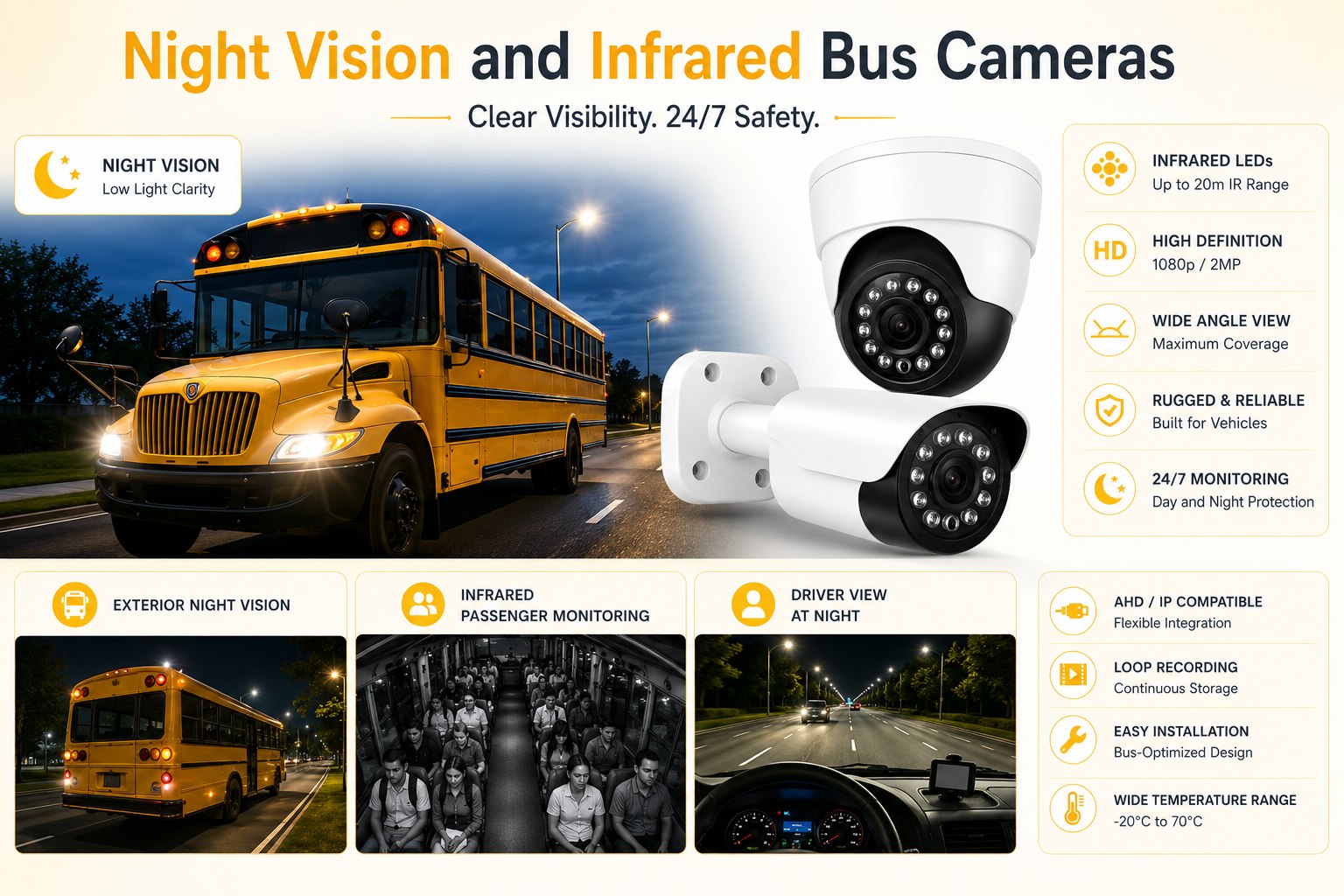
Night Vision and Infrared Bus Cameras
Why the hardest lighting case isn't full darkness, what IR actually illuminates, and the sensor spec that matters more than infrared for most routes.
Winter Afternoon Runs
Low sun at windshield height plus oncoming headlights in the same frame — glare and darkness simultaneously, the case most specs miss entirely.
Dawn Winter Pickup
Genuine low-light, but at least a consistent condition — this is what most IR specs are actually built to solve.
Full Interior Darkness
Predictable and even — a well-specified IR system handles this reliably, since there's no competing light source to fight.
What Infrared Illumination Actually Does
Not a filter or a mode — an active light source outside the visible spectrum.
An infrared bus camera uses IR LEDs to actively illuminate a scene with light outside the visible spectrum, which the camera's sensor can detect even though a human eye in the same spot would see near-total darkness. This is meaningfully different from a camera that simply has good "low-light performance" through sensor sensitivity alone — IR is an active light source, not just a passive ability to make the most of whatever ambient light exists. No single federal mandate governs infrared or night vision specifications on buses; the compliance bar here is 49 CFR 396 maintenance record requirements and district policy, which puts this decision entirely in the hands of fleet managers evaluating real route conditions rather than a regulatory checklist.
IR illumination is most valuable in two specific scenarios: dark morning pickup routes before sunrise, and interior coverage at night on activity trips or late-return routes where the bus interior has no external light source at all. In both cases, IR gives the camera something to actually see, where a standard sensor relying on ambient light alone would produce a mostly black frame.
Headlight Glare: The Problem IR Alone Doesn't Solve
IR fights darkness. Glare is the opposite problem, and needs a different fix entirely.
This is where a lot of camera specs quietly fail: IR illumination helps a camera see in the dark, but it does nothing to handle a bright oncoming headlight or low sun in the same frame as a dark background. Without proper handling, a bright light source in frame causes the camera's sensor to either overexpose that area into a white blowout, or compensate by darkening the entire image until everything else becomes unreadable. This is a completely different problem from darkness, and an infrared spec sheet that doesn't separately address glare handling is only solving half of what a bus camera actually needs to handle on a real route.
WDR Sensors: The Spec That Solves What IR Can't
Wide dynamic range is the actual fix for the winter afternoon problem — and it's often skipped in favor of a bigger IR spec.
A wide dynamic range (WDR) sensor captures multiple exposures of the same frame simultaneously — one tuned for bright areas, one for dark areas — and blends them into a single balanced image where both the bright headlight and the dark surrounding road remain visible and legible. This is the specific technology that solves the winter-afternoon problem described above, and it's a separate spec from infrared entirely. A camera with strong IR performance but no WDR handling can still produce a washed-out or blacked-out frame the moment a bright light source enters an otherwise dark scene, which is exactly the condition a winter afternoon route creates every single day.
Handles pure darkness well. Fails when a bright light source — oncoming headlights, low sun — enters the frame alongside dark areas, producing blowout or crush.
Handles darkness and mixed-lighting scenes. This combination is what actually covers the full range of conditions a bus route produces across a full day and full season.
Why Winter Afternoon Runs Are the Hardest Case in Pupil Transport
The specific combination that most demo footage never actually shows.
Winter afternoon dismissal routes create a specific, compounding lighting problem: the sun sits low on the horizon, often nearly level with the windshield, while the bus is also encountering oncoming vehicle headlights that have already switched on for the early winter dusk. That's direct glare and low ambient light in the same scene at the same time — the exact condition that exposes a camera with good IR but no WDR, or good WDR but insufficient IR range for genuinely dark stretches. Vendor demo footage is very rarely shot under this specific combination, because it's difficult to schedule and unflattering to show. Asking a vendor directly for footage from a winter afternoon route, not a summer daytime or clean nighttime demo, is the single most useful test before a fleet-wide purchase.
The Failure That Shows Up After the Cameras Are Installed
Even well-specified IR and WDR cameras fail silently without health monitoring.
Here's the objection worth naming directly: even a camera with excellent IR illumination and proper WDR handling is only useful if it's actually working on the day it matters. IR LEDs can fail or degrade over time, and a degraded IR array produces footage that looks fine in a quick daytime check but goes essentially unusable the moment darkness falls — a gap that isn't obvious until an actual night-route incident needs the footage. Installed but never health-monitored, it's common to find a meaningful share of a fleet's units with a degraded or non-functional IR array by the time anyone checks, typically discovered during exactly the kind of low-light incident review where it matters most.
AI-driven defect detection that runs ahead of a manual report changes this: instead of waiting for a night-route complaint to expose a failed IR array, the platform can surface which specific bus and which specific camera unit show degraded night performance before anyone opens a ticket. See how automated defect detection catches this ahead of an incident.
A Scenario From a Real Bus Operation
The route nobody realized was the fleet's worst-performing until AI detection ran ahead of a complaint.
A district running 44 buses had IR-equipped cameras fleet-wide, purchased with confidence based on strong summer daytime demo footage. Once AI-driven defect and event detection began running automatically across the fleet, it surfaced that one specific route — a long afternoon dismissal run with a stretch facing directly into the winter sun for several minutes — consistently produced the lowest-quality footage in the entire fleet, well before any parent complaint or incident review ever flagged it. The camera on that specific bus had adequate IR range but no WDR handling, meaning every winter afternoon on that route produced footage with the road either blown out or crushed to black depending on the sun angle. The fix was a targeted sensor upgrade on the buses running that specific route, rather than a fleet-wide replacement — a decision that only became visible because the riskiest bus and route surfaced automatically instead of waiting for someone to notice.
Every camera we ever bought had great night vision on the spec sheet, and every one of them still produced garbage footage on our worst winter afternoon route. Nobody ever explained that IR and glare handling were two separate problems until we actually dug into why one specific bus's footage was always unusable in December and January. Now I ask for winter-afternoon footage specifically, not a nighttime demo, because that's the condition that actually breaks cameras on our routes.
Not sure which of your buses have degraded IR performance right now? That's worth checking before winter, not during it. Sign Up and run a night-performance check →
Quick Spec Reference
Scannable on a phone during a vendor call.
| Spec | What to actually check |
|---|---|
| IR illumination range | Sufficient distance for dark morning pickup and interior night coverage |
| WDR handling | Separate from IR — required for mixed glare and darkness (winter afternoon) |
| Test footage requested | Winter afternoon route footage specifically, not summer daytime or clean night demos |
| IR health monitoring | Automated degradation alerts, not a manual daytime-only check |
| Regulation status | No federal mandate; governed by 49 CFR 396 records and district policy |
| FMVSS 111 relevance | Applies only under 10,000 lb GVWR — not the driver for most fleet's night vision decision |
Frequently Asked Questions
What does an infrared bus camera actually do differently from a standard camera?
An infrared bus camera uses IR LEDs to actively illuminate a scene with light outside the visible spectrum, which the camera's sensor can detect even in near-total darkness to the human eye. This is different from a standard camera's low-light sensitivity, which relies passively on whatever ambient light already exists rather than actively adding illumination.
Does FMVSS 111 require infrared or night vision cameras on school buses?
No. FMVSS 111 requires a rear-mounted camera only on vehicles at or under 10,000 lb GVWR, effective 1 May 2018, and doesn't specify infrared or night vision capability at all. Most Type C and D buses fall outside that weight threshold entirely, and infrared specification decisions are made at the fleet level based on route conditions, governed by 49 CFR 396 records and district policy rather than a specific federal mandate.
Why is a winter afternoon route harder for a camera than full darkness?
Winter afternoon routes combine low, direct sun glare at windshield height with oncoming vehicle headlights in the same frame as darker surrounding areas — a mixed-lighting condition that's harder for a camera to handle than consistent darkness alone. Full darkness is predictable and evenly handled by good infrared illumination, while the winter afternoon combination requires wide dynamic range handling specifically to avoid blowout or crushed blacks.
What's the difference between infrared illumination and WDR, and do I need both?
Infrared illumination adds active light in dark conditions where there's little or no ambient light at all. Wide dynamic range (WDR) handles scenes with both very bright and very dark areas in the same frame, like glare and shadow together. These solve different problems, and most bus routes encounter both conditions across a full day and season, making both specs necessary rather than either one alone being sufficient.
How can a fleet catch a degraded infrared camera before it fails during a real incident?
Without automated health monitoring, a degraded IR array can look fine during a routine daytime check while producing essentially unusable footage after dark, and this often goes unnoticed until a night-route incident actually needs the footage. AI-driven defect detection that runs proactively can surface which specific bus and camera unit show degraded night performance before an incident occurs, rather than waiting for a complaint to expose the gap.