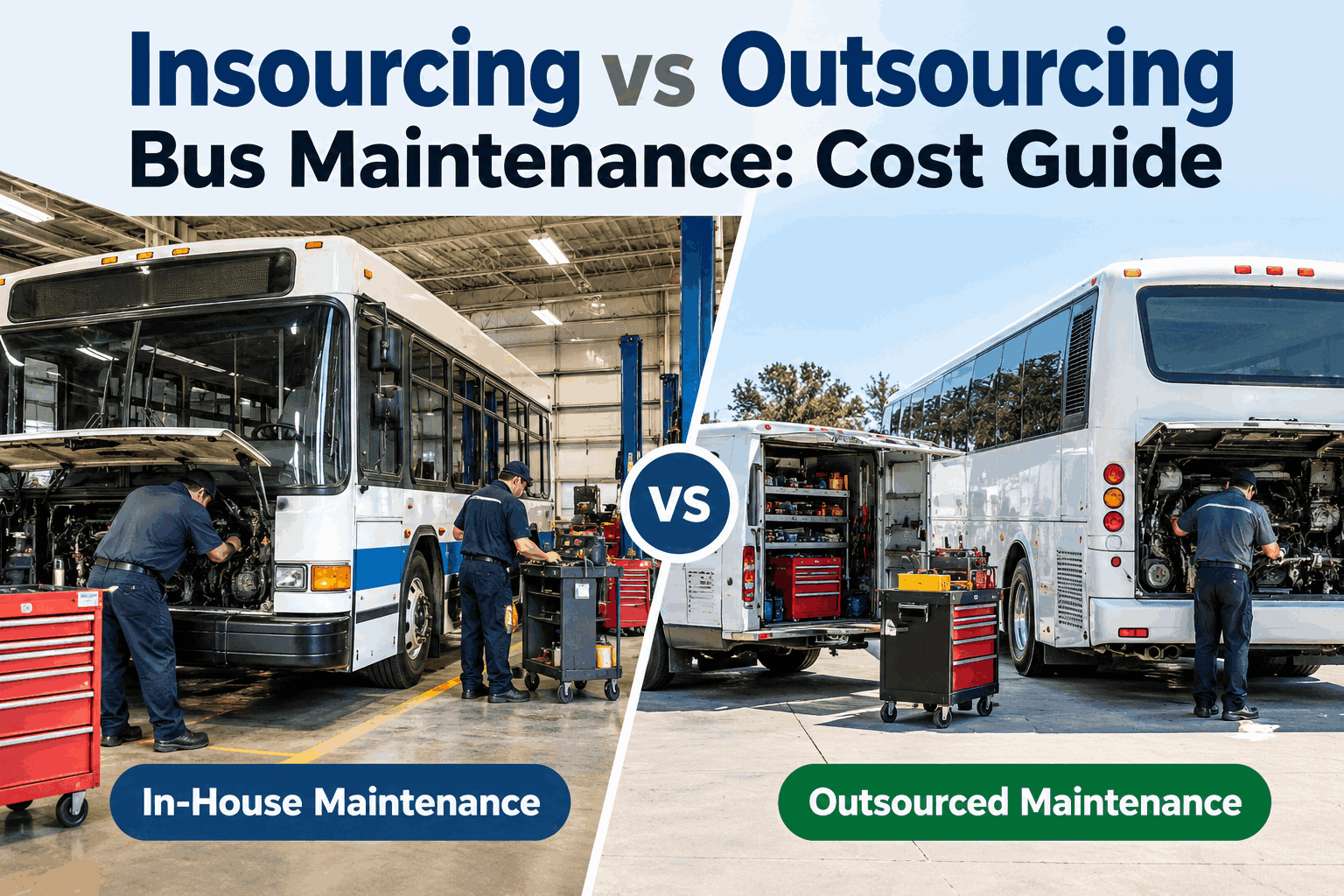
When a board asks why the maintenance budget looks the way it does, "we do some in-house and send some out" isn't an answer they can plan around. Insourcing vs outsourcing bus maintenance isn't really a shop-floor preference — it's a decision about your cost structure: how much of your maintenance spend is fixed versus variable, how it scales with the fleet, and whether you can model and defend it. For a director or finance lead, that framing matters more than any single invoice, because it's what turns maintenance from an unpredictable line item into a number you can forecast.
Insourcing vs Outsourcing Bus Maintenance
The real question isn't just which is cheaper — it's what each does to your cost structure. Here's how a director or finance lead models fixed vs variable, total cost, and the break-even that decides it.
staff, equipment, space Variable
parts
minimal Variable
per-job vendor rate
Why Cost Structure Is the Real Question
Most write-ups on insourcing vs outsourcing bus maintenance frame it as an operational preference — control and quality versus flexibility and convenience. Those matter, but for the people who own the budget the deeper question is financial: each model gives your maintenance spend a completely different shape, and that shape determines how predictable, scalable, and defensible your costs are. Get the structure right and the operational details fall into place; get it wrong and you're fighting your own cost base.
Fixed vs Variable
Insourcing converts maintenance into mostly fixed cost — staff, equipment, space — that you pay regardless of workload. Outsourcing keeps it variable, paid per job. Which is better depends entirely on your volume and how steady it is.
Predictability
A fixed cost base is easy to forecast but hard to flex down in a lean year. A variable base flexes with demand but can spike unpredictably. Finance has to choose which risk it would rather carry.
Scaling With the Fleet
Add or cut buses and the two models respond differently. In-house capacity is lumpy — you add a bay or a tech in steps — while outsourced cost scales smoothly per job. Growth plans should drive the call.
Defensibility to a Board
A sourcing model you can explain in fixed-and-variable terms, backed by a break-even, is one a board can approve. "It's cheaper, trust me" is not. The structure is what makes the number defensible.
This is why the same fleet can rationally reach opposite answers depending on its situation. A large operation running a high, steady volume of work usually benefits from converting to a fixed in-house base it can keep busy; a smaller or seasonal fleet is often better off keeping costs variable and paying only for what it uses. Neither is universally right — the right answer is whichever cost structure best fits your volume, stability, and growth plans. The operational side of this call — control, quality, convenience — is covered well in the broader look at outsourcing vs in-house for your fleet; here the focus is the financial model underneath it. Book a demo to see your maintenance cost split into fixed and variable.
The Full Cost Picture, Both Ways
A fair comparison has to put every cost on the table, not just the obvious ones. Fleets routinely compare a vendor invoice to in-house parts and labor and miss half the picture — the fixed overhead on one side, the downtime and coordination costs on the other. Here's what actually belongs in each column.
Insourced: Labor & Overhead
Technician wages and benefits, plus supervision, training, and the overhead of running a shop. This is the fixed base you carry whether the bays are full or idle — the biggest number on the in-house side.
Insourced: Equipment & Facility
Tools, diagnostic equipment, lifts, and the bay space itself — capital that has to be amortized across the jobs you do. The more work you run through it, the lower the per-job share.
Outsourced: Vendor Rate & Margin
The per-job price, which includes the vendor's own labor, overhead, parts markup, and profit. It's higher per job than your marginal in-house cost — that premium is what you pay to keep the cost variable.
Outsourced: Downtime & Coordination
The bus sitting off-route waiting on a vendor, plus the staff time to schedule, transport, and manage the relationship. These are real costs the invoice never shows, and they favor in-house.
The single most common error finance makes here is an apples-to-oranges comparison: weighing the outsourced invoice against only the in-house marginal cost (parts plus a tech's hourly), while ignoring the fixed overhead that in-house carries and the downtime that outsourcing carries. Both omissions distort the answer in opposite directions. The honest comparison is total cost against total cost — every fixed and variable component on each side — which is exactly the discipline a good bus maintenance cost breakdown brings to the table. Only once the full picture is assembled can you model the break-even. Sign up free and pull your true total cost per maintenance category.
Modeling Insourcing vs Outsourcing Bus Maintenance Costs
With every cost on the table, the decision becomes a model any finance lead can build: at your volume, does the lower per-job cost of insourcing ever repay its fixed base compared to paying a variable vendor rate? Four steps get you a defensible answer.
Measure Your Real Workload
Pull the actual volume of maintenance work by category from your records — how many jobs of each type per year. Volume is the variable the whole model turns on, and it should be counted, not estimated from memory.
Total Each Model's Annual Cost
For insourcing, add the fixed base (labor, equipment amortization, facility) plus variable parts. For outsourcing, multiply your volume by the true per-job cost including downtime. Now you're comparing total to total.
Find the Break-Even Volume
Determine the annual workload at which the two totals meet. Below it, outsourcing's low fixed cost wins; above it, insourcing's low per-job cost wins. This single number reframes the whole debate around your actual volume.
Test It Against Your Future
Run the model against where the fleet is heading — growth, contraction, seasonality. A decision that's right at today's volume can be wrong in two years, so stress-test it before committing capital.
The break-even is what turns a philosophical argument into a business decision. Instead of debating whether in-house is "better," you're asking a precise question: is our volume above or below the line, and is it heading further above or below? That reframing also lets you consider a hybrid, which is where many fleets actually land — insource the high-volume, steady work where the fixed base stays busy, and outsource the low-volume, specialized, or overflow work where a variable rate is cheaper than idle capacity. The model doesn't just pick a side; it tells you which work belongs on which side. Book a walkthrough to build your insource-vs-outsource break-even.
The Hidden Costs Finance Misses
A break-even is only as honest as its inputs, and a handful of real costs routinely get left out — always in ways that flatter whichever option someone already prefers. Catching these is what separates a rigorous model from a rationalization.
Downtime as a Cost
A bus off-route waiting on a vendor isn't free — it's lost availability that may force a spare into service or a missed run. Outsourcing models that ignore downtime understate its true cost.
Idle In-House Capacity
A fixed base only pays off if it's kept busy. Techs and bays standing idle in a slow stretch are pure cost. In-house models that assume full utilization overstate its savings.
Quality & Rework Costs
A cheaper job that comes back is expensive either way. Repeat-repair rates by source belong in the model — a low rate on one side can outweigh a higher sticker price.
Compliance & Liability
In-house means you own the compliance and safety documentation; outsourcing shifts some of it but not the accountability. The cost of getting this right belongs in the comparison.
Notice that these hidden costs cut both ways — downtime and quality risk lurk on the outsourced side, idle capacity and compliance burden on the insourced side. That's the point: a rigorous model surfaces the costs that argue against whichever option you're leaning toward, not just the ones that support it. The only way to keep the model honest is to feed it real data on all of them — utilization, downtime, and repeat-repair rates — rather than assumptions. That's precisely the data most fleets don't capture, which is why so many sourcing decisions get made on incomplete numbers. Sign up free and put real utilization and downtime data in your model.
The Analytics That Make the Decision Defensible
Every input to an insourcing vs outsourcing bus maintenance decision is data — workload, cost per job, utilization, downtime, quality — which is why analytics and reporting is what turns the choice from an opinion into a board-ready business case. BusCMMS captures the numbers finance needs and keeps them current, so the model rests on your fleet's reality rather than estimates.
-
Workload by Category
See how many jobs of each type your fleet actually does per year — the volume input the whole break-even turns on, measured from your records instead of guessed.
-
True Cost Per Job
Roll up labor, parts, and downtime into a real per-job cost for in-house work — the number you compare against a vendor's rate on an equal footing.
-
Downtime Tracking
Capture how long buses sit waiting on work, in-house or outsourced — the hidden cost that a fair comparison has to price in on both sides.
-
Cost Per Mile Trending
Track maintenance cost per mile over time, so after a sourcing change you can prove the structure actually lowered cost rather than just moved it around.
-
Quality by Source
Compare repeat-repair rates for in-house versus vendor work, so quality and rework costs enter the model as data — not as an assumption that cheaper is worse.
-
Board-Ready Reporting
Turn the whole analysis into a clean cost report — fixed vs variable, break-even, and projected savings — in the language a board or finance committee approves budgets in.
The reason a purpose-built bus platform matters for a finance decision is that the numbers are only useful if they're accurate and comparable, and a generic tool that lumps all maintenance into one bucket can't give you cost per job by category or quality by source. BusCMMS tracks work against the specific bus systems and job types involved, so the workload, cost, and quality data going into your model reflect what's actually happening rather than a rough average. That's what lets a director walk into a budget meeting with a sourcing recommendation backed by the fleet's own numbers — and BusCMMS reports fleets cutting maintenance costs 25–35% within a year once spend is managed this deliberately. The platform is typically live in two to four weeks.
A Director's Take
That's the decision at its best: not a dogmatic all-in-house or all-outsourced stance, but a cost-structure model that sorted the work by where each dollar goes furthest — and a case a board could approve because it was built on numbers, not conviction.
The Bottom Line on Insourcing vs Outsourcing Bus Maintenance
For a director or finance lead, insourcing vs outsourcing bus maintenance is a cost-structure decision before it's an operational one. Insourcing converts maintenance into a mostly fixed base — predictable but hard to flex — while outsourcing keeps it variable, flexible but carrying a per-job premium. The right answer depends on your volume, its stability, and where the fleet is heading, and the way to find it is to model total cost against total cost: measure your real workload, put every fixed and variable cost on both sides, find the break-even volume, and stress-test it against your future. Keep the model honest by pricing in the costs each side would rather ignore — downtime and quality risk when outsourcing, idle capacity and compliance burden when insourcing. Most fleets land on a hybrid, insourcing the high-volume steady work and outsourcing the low-volume specialty work, because the break-even tells them which work belongs where. Done this way, the decision stops being a debate about philosophy and becomes a business case a board can approve — one built on your fleet's own numbers rather than anyone's conviction. The structure is the strategy; the data is what makes it defensible. Book a walkthrough to model your sourcing decision on real fleet data.