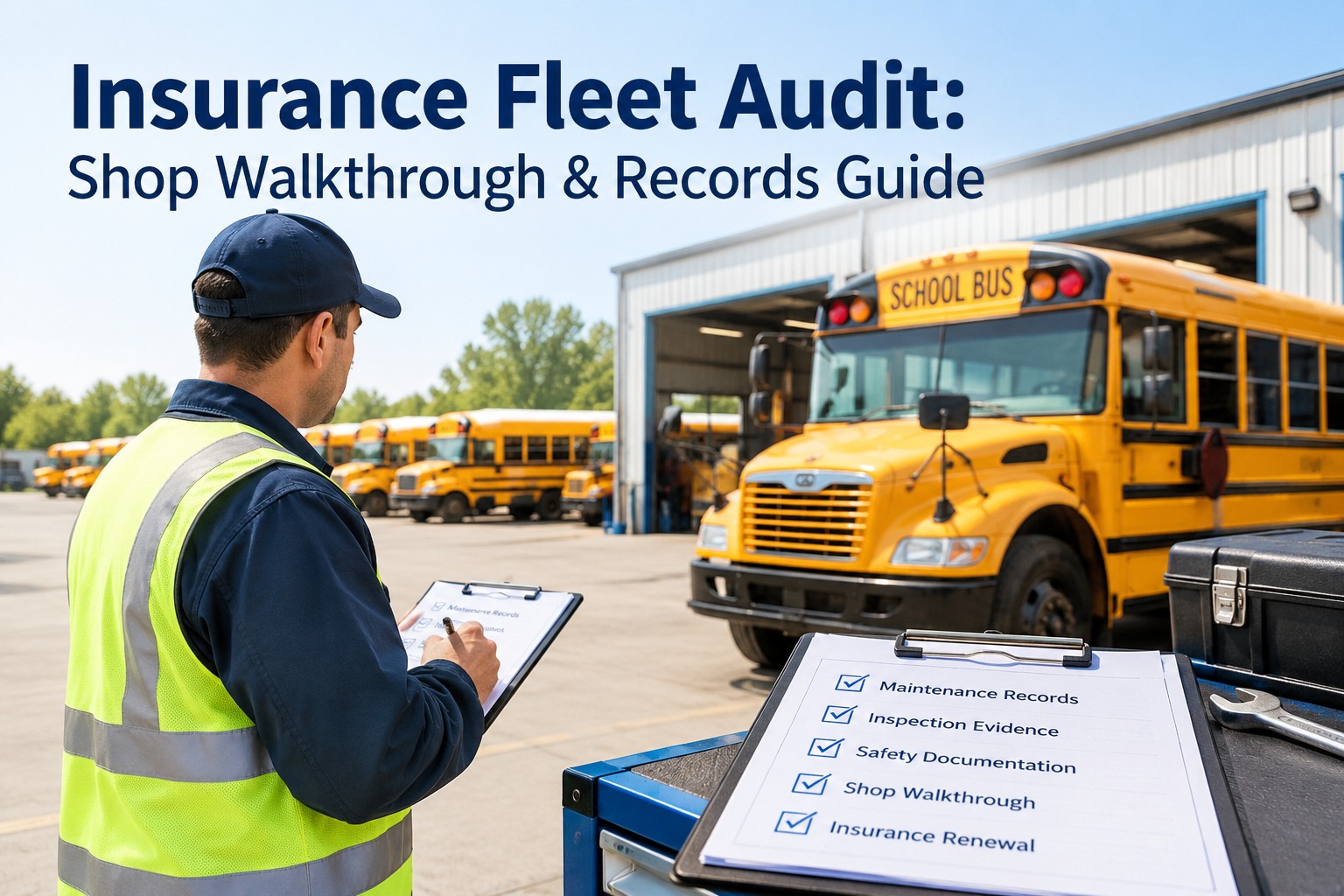
The auditor arrives Thursday — not a DOT inspector, but your insurance carrier's loss-control auditor, here to walk your shop and pull your maintenance files before renewal. How it goes quietly decides whether your premium climbs or drops. An insurance fleet audit isn't pass-fail; it's a pricing conversation where your records do the talking. Book a demo to see the renewal packet that walks in ready.
The Insurance Fleet Audit: A Shop Walkthrough and Records Survival Guide
When the insurer's auditor walks your shop and opens your files, they are building your risk profile from scratch. Here is exactly what they inspect, which records to have ready, and how to turn the walkthrough into a lower renewal — not a rate hike.
- 10-20%Premium reductions fleets negotiate when they bring documented PM and DVIR evidence to renewal
- RebuiltUnderwriters rebuild your risk profile from scratch every year — the data you show shapes the price
- Doc gapsMost audit findings are documentation failures, not actual mechanical defects
An Insurance Fleet Audit Isn't a DOT Inspection — It's a Price Tag
A DOT audit decides whether you keep operating. An insurance fleet audit decides what you pay to operate. The loss-control auditor works for the carrier that's about to quote your renewal, and their whole job is to gauge how much risk you actually carry.
Underwriters price from evidence, not assertions. Show up with a clean, documented safety and maintenance program and you get priced below the actuarial baseline for a fleet your size. Show up with a loss run and a shrug, and you get priced at it — or above it. Same buses, very different number.
That's the reframe that changes everything about how you prep: you're not trying to survive a walkthrough, you're assembling the proof that lowers your rate. And for a bus fleet carrying kids or transit riders, the risk stakes are high enough that underwriters look hard.
What the Auditor Sees on the Shop Floor vs. in the File Room
Every insurance fleet audit runs on two tracks at once. Half the auditor's attention is on what they can see and touch in the bays and on the buses. The other half is on whether your paperwork backs up what they're looking at. Gaps between the two are what get flagged.
On the Shop Floor
- Bus condition — visible wear, tire tread, fluid leaks, brake and body integrity
- Housekeeping and bay organization as a proxy for how the shop is run
- Whether buses in service match the units on your vehicle schedule
- Evidence of a real PM process — not a shop that only fixes what breaks
- Safety equipment condition: mirrors, stop arms, crossing gates, lifts, extinguishers
In the File Room
- PM service records with intervals matching your written maintenance program
- Daily DVIRs with driver IDs, defects noted, and defect-to-repair closure
- Annual periodic inspection certificates, current and on file per bus
- Work orders showing who fixed what, when, with parts and technician ID
- Driver qualification files, accident register, and training records
Here's the trap: the buses can be in genuinely good shape and you can still get dinged, because the auditor scores what you can prove. A defect fixed but never documented reads as a defect ignored. The file room is where most audits are won or lost. Sign up free and start building the defect-to-repair chain auditors look for.
The Maintenance Records to Have Ready — and What Each One Proves
Auditors don't just want records to exist; they want each one to prove something specific about your risk. Line these up before the walkthrough and map each to the story it tells an underwriter. Missing or scattered items are the documentation failures that quietly raise your rate.
-
PM service history, per bus
Proves a systematic program, not reactive repairs. Auditors match intervals to your written schedule.
-
DVIRs with defect resolution
Proves drivers inspect and defects get closed. Driver IDs and timestamps make it credible.
-
Annual inspection certificates
Proves each bus met minimum safety standards this year. A missing cert is an instant flag.
-
Work orders & parts records
Proves the defect-to-repair chain: who fixed it, when, with what part. Generic invoices leave gaps.
-
Driver files & medical cards
Proves qualified, medically fit drivers. Expired medical certs are the most common missed gap.
-
Accident register & training logs
Proves you track incidents and coach drivers. A maintained register signals a real safety culture.
Notice how many items hinge on completeness and timestamps rather than the repair itself. That's the whole game: an auditor traces a chain, and any broken link — a defect with no closing work order, a cert that expired — becomes a finding. Book a demo to see every bus's full history exportable in one click.
What Documentation Is Actually Worth at Renewal
This is where the insurance fleet audit stops being paperwork and starts being money. Underwriters rebuild your risk profile every year from what you can show — and the difference between documented and undocumented lands directly on the premium line.
Fleets that bring PM-compliance reports, DVIR completion logs, and defect-closure metrics to renewal regularly negotiate premiums below baseline.
Carriers who show up with elevated risk signals and no evidence to counter them get priced at or above the actuarial baseline.
The math is blunt. On a bus fleet, insurance is often one of the two or three largest line items after wages and fuel, so a swing of that size is real budget — the kind a transportation director has to explain to a board. And the lever moving it isn't luck; it's whether you can produce the evidence.
Better still, CMMS-generated maintenance records are regularly admitted as business records in accident litigation when created in the ordinary course of business — so the same documentation that lowers your premium also protects you in a claim.
The Findings That Spike Your Rate — and How to Kill Them First
Most rate-raising findings are predictable and fixable before the auditor ever arrives. These are the gaps that show up most often in fleet audits. Walk your own file room against this list first, and you close the openings the auditor would otherwise price in.
- !
Expired driver medical certificates
The single most common and most underwriting-relevant gap. Fleets routinely have a driver or two operating on a cert that lapsed weeks ago with nobody noticing.
- !
Defects with no closing work order
A DVIR flags a problem and the paper trail just stops. To an auditor, an unresolved defect is worse than no defect at all.
- !
PM intervals that don't match your program
Your written schedule says every 6,000 miles; the records show 9,000. That mismatch reads as a program you don't actually follow.
- !
Scattered records across shops and tools
Maintenance in one spreadsheet, DVIRs in a binder, driver files in a drawer. If you can't assemble it fast, the auditor assumes the discipline isn't there.
Every one of these is a documentation problem, not a mechanical one — which means every one is solvable with a system that tracks expirations, links defects to repairs, and keeps it all in one exportable place. Sign up free and let expiration alerts catch the gaps before an auditor does.
Assembling the Packet: Frantic Binder Hunt vs. One-Click Export
The gap between a fleet that dreads the audit and one that treats it as a rate-negotiation opportunity comes down to how the evidence gets assembled. Here's the honest before-and-after when the auditor's request lands.
- Days spent pulling files from the shop, the office, and three logins
- Gaps you discover the same moment the auditor does
- No quick way to prove PM-compliance % or defect-closure time
- Expired certs found too late to fix before the walkthrough
- You react to findings instead of walking in ahead of them
- PM compliance, DVIR completion, and defect closure in a one-click export
- Every bus's full service history searchable and ready on demand
- Expiration alerts flag medical cards and inspections before they lapse
- Defects auto-link to the work orders that closed them
- You hand the auditor a packet and steer the pricing conversation
This is the Compliance & Analytics side of BusCMMS doing exactly what an insurance fleet audit demands: turning scattered daily work into a clean, exportable evidence package. The same reports that satisfy the auditor are the ones your broker uses to argue for a lower rate.
A Fleet Director Who Changed the Renewal Conversation
"For years the insurance audit was a week of dread — me and my shop foreman digging through binders trying to reconstruct a year of maintenance before the auditor showed up, always finding two or three certs that had lapsed. The first year we ran everything digital, I handed the auditor one export: PM compliance, DVIR completion, defect closure per bus. He actually said it was the cleanest package he'd seen from a district our size. Our renewal came back flat in a year everyone else's went up. That export paid for the software by itself."
That's the shift the whole guide is pointing at: the audit isn't something you survive, it's something you use. Bring the evidence and you stop being a risk the underwriter has to guess about.
Insurance Fleet Audit: The Bottom Line
An insurance fleet audit is a pricing event wearing a clipboard. The auditor walks your shop and reads your files to rebuild your risk profile, and what you can prove — not just what you've done — sets the premium you'll pay all year.
The fleets that win bring documented PM, closed-out DVIRs, current certs, and a clean per-bus history the auditor can trace. Keep that evidence in one system that stays audit-ready year-round, and the walkthrough stops being a stress test and becomes your best lever on renewal. Book a demo and see your fleet's audit packet ready before the auditor emails.
Frequently Asked Questions
What is an insurance fleet audit?
An insurance fleet audit is a review conducted by your commercial insurer's loss-control auditor — separate from any DOT or FMCSA audit — to assess how much risk your fleet actually carries before quoting or renewing your policy. It usually includes a shop walkthrough where the auditor inspects buses and bay operations, plus a records review covering maintenance history, DVIRs, inspection certificates, and driver files. The findings feed directly into your premium, so a well-documented fleet is often priced below the baseline while an undocumented one is priced at or above it.
What records should I have ready for an insurance fleet audit?
Have per-bus preventive maintenance service history, daily DVIRs showing defects and their resolution, current annual periodic inspection certificates, work orders with technician IDs and parts records, driver qualification files with valid medical certificates, and an accident register with training logs. Auditors trace a chain from each reported defect to the repair that closed it, so completeness and timestamps matter as much as the repair itself. The most common gaps are expired driver medical cards and defects flagged on a DVIR that have no closing work order.
How does an insurance audit affect my premium?
Underwriters rebuild your risk profile every renewal from the evidence you present. Fleets that bring documented PM-compliance rates, DVIR completion logs, and defect-closure metrics regularly negotiate premiums well below the actuarial baseline, while fleets that show up with only a loss run and elevated risk signals get priced at it or higher. Because insurance is one of the largest line items in a bus operation's budget, the difference between a documented and undocumented audit can be a significant swing on the annual premium.
What does the auditor look at during the shop walkthrough?
On the shop floor the auditor assesses bus condition (tires, brakes, leaks, body and safety equipment like stop arms, mirrors, and lifts), bay organization and housekeeping as a proxy for how the shop is run, and whether the buses in service match your vehicle schedule. They're looking for evidence of a genuine preventive maintenance process rather than a shop that only fixes what breaks. Crucially, they score what you can prove — a bus in good condition with no supporting records still reads as a gap.
How does a bus CMMS help pass an insurance fleet audit?
A purpose-built bus CMMS like BusCMMS keeps PM records, DVIRs, inspections, work orders, and driver files in one place and exports them as the audit-ready packet underwriters request — PM compliance percentage, DVIR completion with driver IDs, defect-closure time, and per-bus service history — in one click instead of days of binder hunting. Expiration alerts flag medical cards and inspection certificates before they lapse, and defects auto-link to the work orders that resolved them, closing the documentation gaps that most often raise a fleet's rate. The same records also stand up as business records if a claim ever goes to litigation.