One of your buyers always orders new — "I don't trust rebuilt." Another always grabs the cheapest reman unit to protect the budget. Same part, same fleet, two completely different calls, and neither one is written down anywhere. Multiply that across a parts room and a year of orders and you've got a sourcing strategy that's really just a collection of personal habits. The new vs rebuilt bus components question deserves an actual answer — a policy that says which parts go new, which go rebuilt, and why, so the call is consistent no matter who's placing the order.
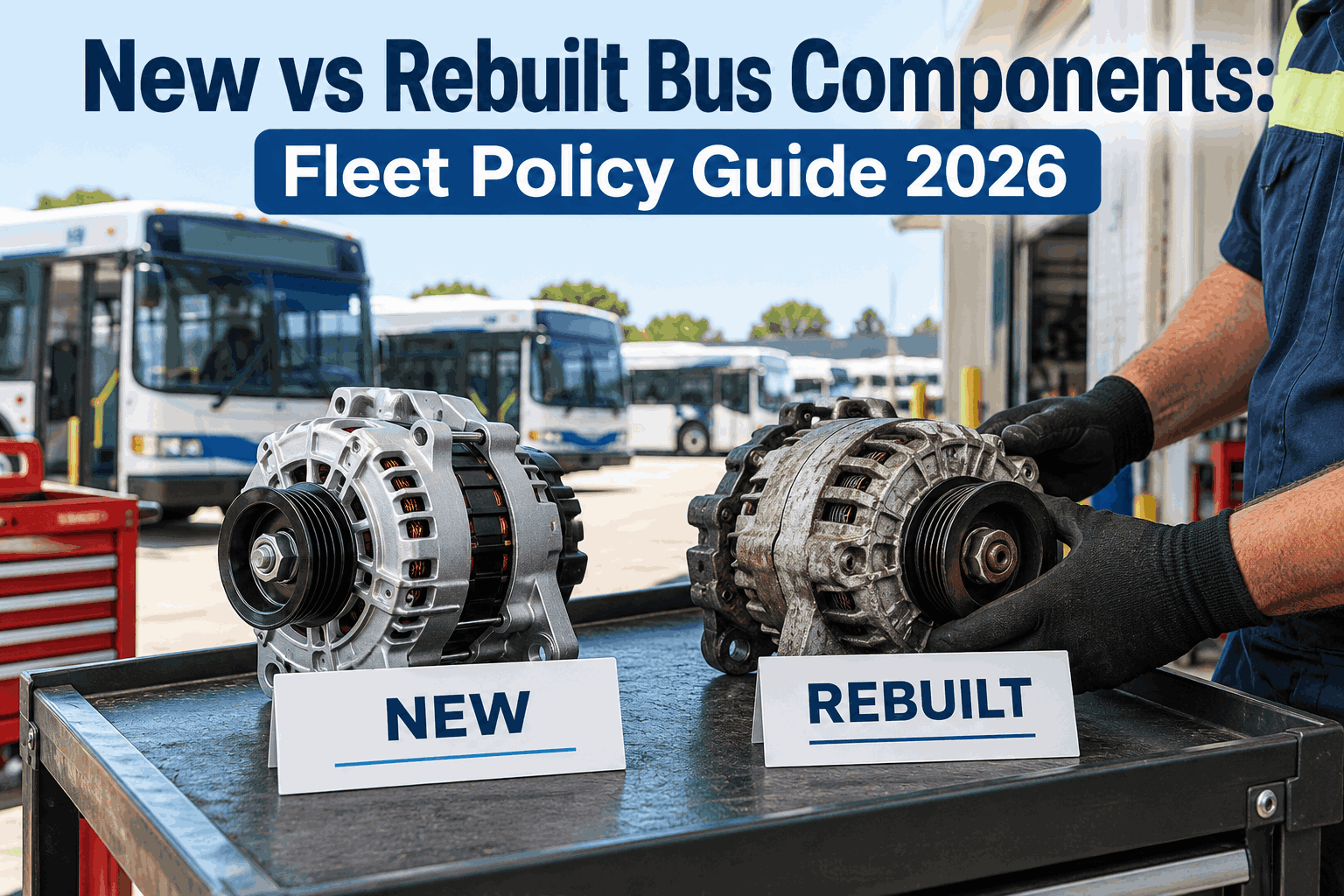
New vs Rebuilt Bus Components: A Fleet Policy Guide
Cost, reliability, warranty, and service life pull the decision in different directions. Here's how to weigh them — and turn a case-by-case guess into a consistent sourcing policy your whole parts room follows.
- Highest cost
- Full service life
- Longest warranty
- Most predictable
- Lower up-front cost
- Good service life
- Shorter warranty
- Varies by rebuilder
Why Inconsistent Component Sourcing Costs You
When there's no sourcing policy, every parts decision gets re-litigated from scratch, and the outcome depends on who's ordering and what mood the budget is in that week. That inconsistency is expensive in ways that don't show up on any single invoice — they show up in the aggregate, over a year, as money left on the table and reliability you can't predict.
Money Left on the Table
Buying new where a quality rebuilt unit would've done the same job wastes budget; buying rebuilt on a critical part that then fails early costs more than new ever would. Both happen without a policy.
Unpredictable Reliability
When the same component comes from new one month and an unknown rebuilder the next, you can't predict how long it'll last — which makes PM planning and budgeting a guessing game.
No Data to Learn From
If nobody tracks which source went where and how it performed, you never learn whether rebuilt actually holds up on your fleet. Every order repeats the same blind bet.
Hard to Defend to a Board
When a board asks why parts spend jumped, "it depends who ordered" isn't an answer. A written sourcing policy is what turns parts spending into a defensible, explainable line.
The fix isn't to mandate one answer for everything — "always buy new" wastes money and "always buy rebuilt" courts failures. The fix is a policy that makes the right call per component, based on the factors that actually matter, and applies it the same way every time. That's what separates a fleet that spends deliberately from one that just reacts to each order. Getting there starts with an honest look at how new and rebuilt actually stack up, because the tradeoffs are real in both directions and this decision sits alongside the other big sourcing axis — the OEM vs aftermarket choice — that every parts room also has to settle. Book a demo to see part-source performance tracked across your fleet.
New vs Rebuilt Bus Components: Head to Head
Rebuilt (or remanufactured) components are used units restored to working spec — disassembled, worn parts replaced, tested, and sold at a fraction of new. On the right component they're a smart buy; on the wrong one they're a false economy. Here's how the two options compare across the factors that decide the call.
The headline is that up-front cost and long-term value aren't the same number. A rebuilt starter that costs 40% less and lasts nearly as long is a clear win. A rebuilt brake component that saves a little and introduces any uncertainty into a safety system is not — the savings are dwarfed by the risk on a bus carrying passengers. The whole art of the policy is matching the option to the component, and the single biggest variable on the rebuilt side is the rebuilder: a reman unit from a reputable remanufacturer with a real warranty is a different product from a no-name rebuild, even for the identical part. Sign up free and compare real cost-and-life data on both options.
The Factors That Should Drive the Call
A good sourcing policy doesn't decide new vs rebuilt by price alone — it weighs a handful of factors and lets the component's role settle the answer. These four are the ones that should carry the most weight in any bus fleet's decision.
Safety Criticality
The single biggest factor. Brakes, steering, and other safety systems on a bus full of passengers lean strongly toward new, where reliability is most predictable. Non-safety parts have far more room for rebuilt.
Total Cost of Ownership
Not just the sticker price — cost per mile of service life. A rebuilt unit at half price that lasts 70% as long can still win; one that fails at 30% doesn't. TCO is the real yardstick.
Warranty & Rebuilder Reputation
A strong warranty from a proven remanufacturer de-risks the rebuilt choice; a vague one from an unknown source doesn't. Vet the rebuilder like you'd vet any critical supplier.
Bus Age & Remaining Life
A part's expected life should match the bus's. Putting a full-life new component in a bus three years from retirement can be overspending; a rebuilt unit that outlasts the bus is the smarter match.
That last factor is one fleets miss most often. Buses commonly run 8 to 15 years, and the sourcing call should shift as a bus ages — new components early in the lifecycle where they'll deliver their full value, and rebuilt later when you just need the bus to finish out its service life reliably. A policy that accounts for remaining bus life stops you from putting a premium new part into a vehicle that won't be around long enough to use it up, which is a quiet but common source of overspend. To weigh any of these factors, though, you need real numbers on how each source actually performs — which is exactly what most parts rooms don't capture. Book a walkthrough to see cost-per-mile-of-life by part source.
Which Components Suit New vs Rebuilt
Turning the factors into a policy means sorting your common components into buckets. It won't be identical for every fleet, but most bus operations land on a pattern like this — a starting framework you tune with your own performance data over time.
Lean New
Safety-critical, hard-to-access, or where consistency is everything.
- Brake system components
- Steering & suspension safety parts
- Wheelchair lift critical parts
- Parts requiring major labor to access
Lean Rebuilt
Major assemblies with a proven reman path and strong warranties.
- Starters & alternators
- Water pumps & A/C compressors
- Transmissions (from proven remanufacturers)
- Engines (reman, with warranty)
It Depends
Let bus age, TCO, and rebuilder reputation break the tie.
- Older buses near retirement
- Parts with mixed performance history
- New or unvetted rebuilder offerings
- High-cost parts where the savings are large
The point of bucketing isn't to lock the answer forever — it's to set a default that everyone follows, then let real data move parts between buckets. If your rebuilt alternators keep failing early, they move toward "lean new"; if a remanufactured transmission proves it lasts, it earns a permanent spot in "lean rebuilt." That feedback loop is what turns a static policy into one that keeps getting smarter, and it only works if you're capturing how each source actually performs on your buses. A sourcing policy without performance data is just an opinion with better formatting. Sign up free and let your own data refine your sourcing buckets.
The Parts Data That Makes the Policy Real
A new-vs-rebuilt policy lives or dies on data — what you paid, where it came from, and how long it lasted — and on being applied consistently at the moment an order is placed. BusCMMS parts and inventory management captures that data as a byproduct of normal work and puts it where the ordering decision happens, so the policy is both informed and enforced.
-
Part Source & Cost Tracking
Log new vs rebuilt, supplier, and price on every part used — so you know exactly what each source costs and can compare them on real numbers, not impressions.
-
Service Life by Source
Tie a part's failure back to whether it was new or rebuilt and from whom, revealing which sources actually last on your fleet — the TCO answer, from your own history.
-
Auto-Reorder to Policy
Set reorder rules that default to your policy's chosen source for each part, so the right new-or-rebuilt call is baked into restocking instead of decided fresh each time.
-
Prevents Duplicate Ordering
Usage tracking stops the parts room from over-ordering or double-buying, so cost comparisons aren't muddied by waste and the policy's savings are real.
-
Warranty Tracking
Record each part's warranty terms and dates, so a rebuilt unit that fails inside coverage gets claimed instead of eaten — which is a big part of what makes rebuilt pay off.
-
Sourcing Spend Reporting
See parts spend broken down by new vs rebuilt and by supplier — the board-ready proof that your sourcing policy is saving money without costing reliability.
The reason this matters is that the new-vs-rebuilt debate is unwinnable on opinion and easy on data. Once you can see that your rebuilt alternators from a given remanufacturer cost 40% less and last 90% as long, the policy writes itself — and once that default is wired into your reorder rules, it applies itself. Because BusCMMS is built for bus fleets, it already tracks parts against the specific components and buses they go on, so the performance picture is accurate rather than a rough average across a generic catalog. That's what moves a fleet from "it depends who's ordering" to a sourcing policy backed by numbers — and it pairs naturally with the broader work of extending bus service life to keep total fleet cost down, typically live in two to four weeks.
A Parts Manager's Take
That's the whole arc: two reasonable people guessing differently, until data turned the guess into a policy that saves money where rebuilt earns it and spends on new where it counts. The debate ended the moment the numbers showed up.
The Bottom Line on New vs Rebuilt Bus Components
The new vs rebuilt bus components question isn't a single answer — it's a policy that makes the right call per component and applies it consistently no matter who's ordering. Neither extreme works: always-new wastes budget, always-rebuilt courts failures. Weigh the factors that matter — safety criticality first, then total cost of ownership, warranty and rebuilder reputation, and the bus's remaining life — and sort your components into lean-new, lean-rebuilt, and it-depends buckets as a starting framework. Then do the part most fleets skip: capture how each source actually performs on your buses, and let that data move parts between buckets over time. Lean new on brakes and hard-to-access safety parts; lean rebuilt on major assemblies with a proven reman path and a real warranty; let bus age and TCO break the ties. That's how a sourcing decision stops being a coin flip at the counter and becomes a deliberate, defensible policy — one backed by your fleet's own numbers rather than whoever happened to place the order. The tradeoffs are real, but they're knowable, and a policy built on data is what turns them into savings you can prove. Book a walkthrough to build a data-backed sourcing policy for your fleet.