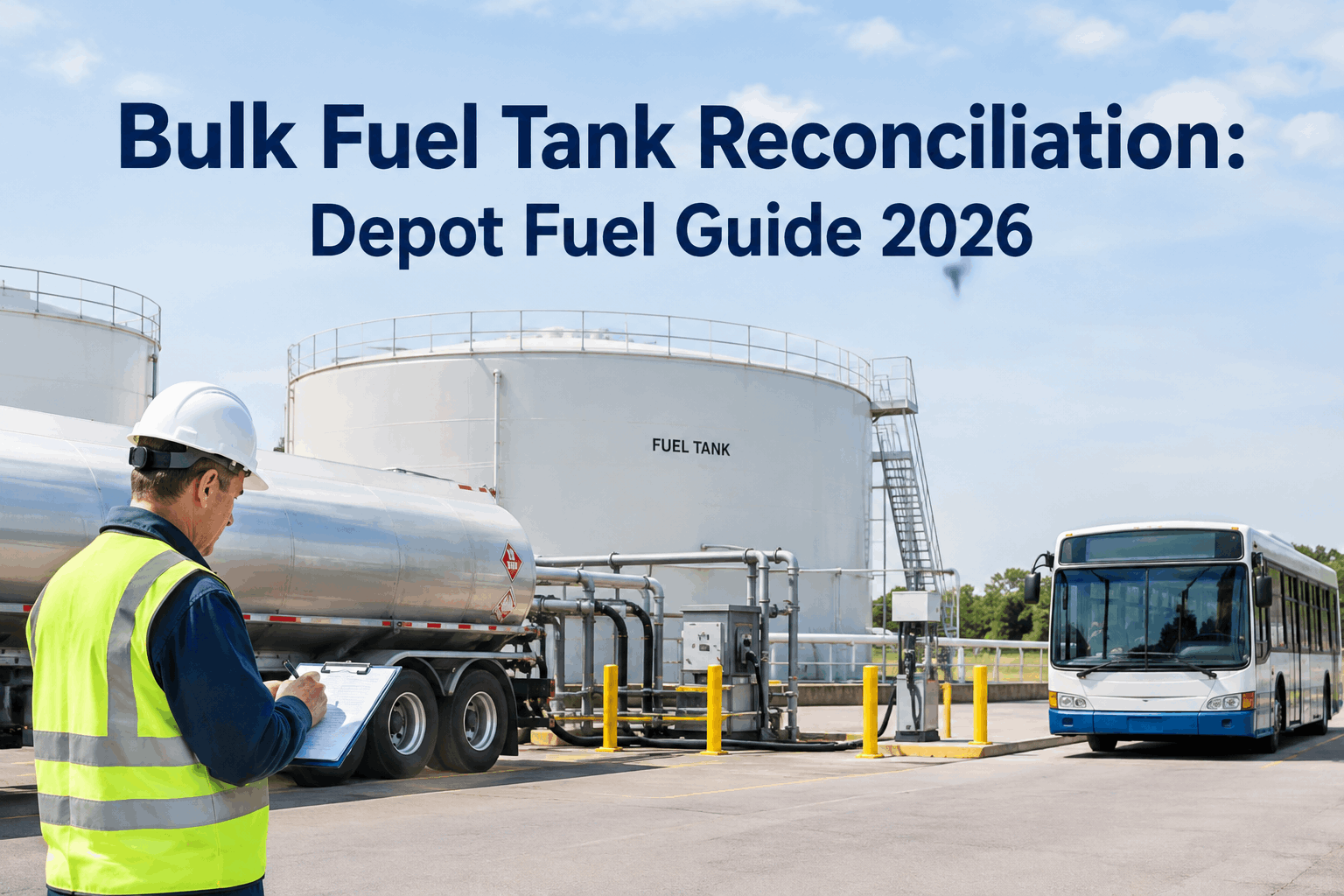
Every depot with an on-site fuel tank has the same recurring conversation. The finance manager pulls the fuel invoice for the month, compares it against the dispensing report, and the numbers do not match. Sometimes the gap is 40 gallons and forgettable. Sometimes it is 400 gallons and someone has to explain it to the superintendent. This guide covers bulk fuel tank reconciliation the way an accountable depot actually runs it — the formula, the variance sources, the tolerances, and the cadence that catches problems before they compound.
Bulk Fuel Tank Reconciliation: The Depot Accountability Playbook
The reconciliation formula, the six sources of variance, the tolerance thresholds that matter, and the weekly cadence that keeps every gallon accounted for.
- 1%Variance Ceiling
- 6Variance Sources
- QtrlyIFTA Requirement
Why Bulk Fuel Reconciliation Is Not Optional
Fuel is one of the largest line items in a bus fleet's operating budget — often second only to labor. And it is the line item most fleets reconcile the least carefully. A delivery ticket sits in a folder. A dispensing record sits in a fuel-key spreadsheet. A stick reading is scribbled on a clipboard hanging by the tank. Three systems, three sources of truth, almost never one person cross-checking them against each other every week. That gap is exactly where fuel loss, metering drift, dispensing errors, and outright theft hide in plain sight.
Under IFTA, bulk fuel tank operators are required to maintain quarterly reconciliation records for every tank — along with delivery receipts, tank capacities, and per-withdrawal logs identifying the vehicle fueled. This is not a best practice. It is a federal recordkeeping requirement, and an audit can request it any quarter.
Beyond the compliance floor, reconciliation is the single most reliable way to catch a slow leak, a drifting meter, an incorrectly-recorded delivery, or unauthorized dispensing before any of those becomes a serious loss. Depots that reconcile weekly catch issues within days. Depots that reconcile at quarter-end catch them 12 weeks late — by which point three months of loss have compounded. Book a walkthrough to see bulk tank reconciliation automated against per-bus dispensing records.
The Reconciliation Formula, Broken Down
The industry-standard formula is simple. What is not simple is having accurate numbers for each of the four inputs. Miss one and the whole reconciliation is fiction. Here is the equation in full, with what feeds each side.
Each input has its own accuracy problem. The beginning inventory is only as accurate as last month's ending stick. Deliveries can be short-shipped, over-shipped, or misrecorded. Withdrawals depend on a properly-calibrated dispensing meter and every fueler entering the right bus ID. And the actual ending reading depends on the stick or Automatic Tank Gauge (ATG) being calibrated to the tank's real shape. Any weak input contaminates the whole calculation.
The 6 Sources of Variance: Real vs Apparent Loss
Not every variance is a loss. A negative variance number can mean fuel is actually missing, or it can mean the math is wrong. Distinguishing the two is what separates a productive investigation from a wild goose chase. Six causes cover almost everything — three are real losses, three are apparent losses that resolve on closer inspection.
Tank or Line Leak
Fuel escaping the system. Ground contamination risk, environmental reporting exposure, and financial loss stacking daily. Fastest to detect via hourly ATG variance trending.
Unauthorized Dispensing
Fuel dispensed without a bus ID being entered, or entered under a wrong bus. Includes personal-vehicle fueling, off-book equipment fills, or straight theft. Pattern often ties to specific shifts or fuelers.
Delivery Shortage
Supplier delivered fewer gallons than the BOL claims. Common enough that fleets who verify delivery via ATG-measured tank change catch small shortages routinely.
Temperature Contraction
Fuel volume changes with temperature — roughly 1% per 15°F change on diesel. A delivery on a hot afternoon and a stick reading on a cold morning will show variance that is pure physics, not loss.
Meter Drift
The dispensing meter over- or under-reports gallons vs actual flow. Consistent drift shows up as a systematic variance in the same direction month after month. Calibration check resolves it.
Stick / Gauge Error
Wrong tank chart, uncalibrated stick, or ATG probe fouling. Especially common on older tanks where the chart no longer matches the tank's actual shape after settling.
The three apparent losses are why reconciliation is done monthly (to average out temperature swings) and why weekly checks focus on trends rather than single-day numbers. When variance keeps drifting in one direction, one of the first three is at work. When variance oscillates around zero within a small band, the second three are just background noise. Knowing which pattern you are looking at determines what you investigate. Sign up free and get your first month of variance trending pinned to a chart within a week.
Variance Tolerance: What Number Should Trigger an Investigation?
Not every variance requires action. Fuel is a liquid product measured through imperfect instruments in tanks that expand and contract with temperature. Some background variance is unavoidable. The tolerance bands below reflect the ranges most well-run depots use for monthly reconciliation, and what each band actually means.
The 1% action threshold is where most fleets converge. Below that, monthly variance is usually a mix of temperature and instrument noise. Above that, something specific is happening that deserves a named investigation. And a single month above 1% is different from three consecutive months above 1% — a one-time spike often resolves on the next month's reading; a trend requires immediate action because you are watching real fuel walk away.
The Reconciliation Cadence: Daily, Weekly, Monthly
Reconciliation is not a single event. It is a rhythm that runs on three overlapping intervals, each catching a different class of problem. Skip any tier and you inherit that tier's blind spot.
Stick or ATG Reading + Dispensing Snapshot
Owner: Fueler or shift supervisor at end of shift.
What it catches: Sudden large deltas — a leak, a stuck meter, an unrecorded delivery. Anything that would cost you a full day to notice otherwise.
7-Day Trend Reconciliation
Owner: Depot manager or finance ops.
What it catches: Drift and pattern — a meter that is slowly under-reporting, an emerging shift-time discrepancy, an unrecorded fueler transferring gallons under someone else's login.
Full Reconciliation Package
Owner: Finance manager. Signed off and filed.
What it catches: The formal audit record — matches IFTA quarterly reporting basis. Compares expected to actual against tolerance band; investigations documented; deliveries confirmed against BOLs.
The daily read is what makes weekly and monthly reconciliation trustworthy. Without daily readings, a monthly reconciliation is one giant number with no way to tell when the variance actually occurred. With daily readings, a monthly reconciliation is a trend line where you can point to Tuesday of week 2 and say "that is where the shift changed."
Variance Investigation: The Decision Tree
When variance crosses the action threshold, the investigation should follow a reproducible order. Working through the same tree every time prevents jumping to the dramatic explanation (theft) before ruling out the boring ones (calibration).
The tree exists so the investigation is systematic, not emotional. Jumping straight to a theft investigation on the first bad month poisons the shop environment. Working through calibration, delivery match, and dispensing logs in order finds the actual cause about 90% of the time before theft even needs to be on the list.
How BusCMMS Runs Bulk Fuel Reconciliation
Because BusCMMS captures per-bus dispensing as part of its fuel management module, the withdrawal side of the reconciliation equation is already live. Adding delivery BOLs and stick or ATG readings closes the loop — automatic reconciliation, variance trending, and audit-ready records.
-
Per-Bus Dispensing Records
Every fill logged per bus with gallons, driver, and odometer. Feeds the withdrawal side of reconciliation automatically — no separate spreadsheet.
-
BOL & Delivery Capture
Bulk fuel deliveries logged with supplier, BOL number, and gallons delivered. Attaches to the tank record and feeds the deliveries side of reconciliation.
-
Variance Trend Charts
12-month variance trended per tank against the tolerance bands. Drift patterns visible before they cross the action threshold.
-
Fuel Card Reconciliation
Fuel card imports matched against per-bus fill records to catch off-site fuel charges without a matching bus and odometer reading.
-
MPG-Drop Alerts
A bus whose fuel economy suddenly worsens is a mechanical alert — but a consistent MPG drop can also indicate a metering issue at the tank. Both surface as alerts.
-
IFTA-Ready Export
Quarterly reconciliation reports and per-withdrawal logs export in IFTA-compliant format — the exact records auditors request, in one click.
Because per-bus fueling is already captured for cost-per-mile analytics, adding bulk tank reconciliation is an addition to a workflow that is already happening — not a new workflow bolted on top. The dispensing data doing double duty is what makes the whole picture affordable at scale.
The Practitioner View: What Weekly Reconciliation Buys
That is the honest value proposition of tight reconciliation: most of what it finds is not theft. It is calibration drift, unrecorded deliveries, wrong bus IDs entered at the pump, and stick charts that no longer match a tank that settled six years ago. Boring stuff. But boring stuff quietly costs money every week it goes unnoticed. Sign up free and get your first weekly reconciliation report loaded within days.
The Bottom Line on Bulk Fuel Reconciliation
Fuel is a liquid product, measured through imperfect instruments, in tanks that expand and contract with the weather. Some variance is unavoidable. What is avoidable is not knowing whether your variance is normal noise or a real problem. The reconciliation formula, the six variance sources, the tolerance bands, and the daily-weekly-monthly cadence together make that determination straightforward. What ties them together is a single system where deliveries, dispensing, and readings all live — because a reconciliation you have to build by pulling three separate reports is a reconciliation you will not do weekly. And weekly is where the value lives. Book a walkthrough to see bulk tank reconciliation running on a depot like yours.
What is bulk fuel tank reconciliation?
Bulk fuel tank reconciliation is the periodic check that a fuel tank's beginning inventory, plus deliveries, minus withdrawals, equals its ending inventory as physically measured. The formula is: Beginning + Deliveries − Withdrawals = Expected Ending, which is then compared to the Actual Ending (stick reading or ATG reading). The gap between expected and actual is the variance. Reconciliation identifies whether that variance is normal instrument noise, a temperature effect, a calibration issue, an unrecorded delivery, unauthorized dispensing, or a real fuel loss like a leak.
What variance percentage is normal for bulk fuel tanks?
Most well-run depots use a three-band tolerance: 0 to 0.5% is normal instrument accuracy — log and move on. 0.5 to 1.0% is elevated and warrants a review of meter calibration date, temperature swings during the period, and delivery BOL matches. Anything above 1.0% is the action threshold, requiring active investigation into leaks, meter recalibration, delivery audit, or dispensing log review. A single month over 1% is different from three consecutive months over 1% — a one-time spike often resolves next cycle; a persistent trend means fuel is actively walking away.
What causes fuel variance that is not actual loss?
Three common causes of variance are not real fuel loss. Temperature contraction — fuel expands and contracts with temperature, roughly 1% per 15°F change on diesel, so a hot-day delivery reconciled against a cold-morning reading shows apparent loss that is pure physics. Meter drift — the dispensing meter over- or under-reports gallons versus actual flow, showing as a systematic variance in the same direction every month. Stick or ATG error — wrong tank chart, uncalibrated stick, or ATG probe fouling, especially common on older tanks where the chart no longer matches the tank's actual shape after settling. Ruling these out first prevents wild-goose-chase investigations before checking for actual loss.
Is bulk fuel reconciliation required by law?
Under IFTA (International Fuel Tax Agreement), bulk fuel tank operators are required to maintain quarterly reconciliation records for every bulk storage tank, along with delivery receipts, tank capacities, and per-withdrawal logs identifying the vehicle or equipment that was fueled. Withdrawal logs must include location, date, quantity, fuel type, and vehicle identification. State fuel-tax agencies can request these records during audit. Beyond IFTA, environmental regulations may also apply to leak detection and tank monitoring, especially for underground storage tanks.
How does BusCMMS handle bulk fuel tank reconciliation?
BusCMMS captures per-bus dispensing as part of its fuel management module, which means the withdrawal side of the reconciliation equation is already live from day one. Adding BOL delivery capture and daily stick or ATG readings closes the loop — reconciliation is calculated automatically, with 12-month variance trended per tank against the standard tolerance bands. Fuel card imports match against on-site dispensing records to catch off-site fuel charges without a corresponding bus and odometer entry. MPG-drop alerts surface possible metering issues at the tank alongside their more common use case for engine problems. Quarterly reconciliation reports and per-withdrawal logs export in IFTA-compliant format in one click.