Equipping your bus maintenance shop with the right tools is essential for efficient repairs, accurate diagnostics, and technician safety. From vehicle lifts and brake stroke gauges to J1939 scanners and refrigerant recovery systems, the right tools can reduce repair time by 50% and improve quality. This guide covers the top bus maintenance tools every shop needs in 2026.
Shop Tools Guide 2026
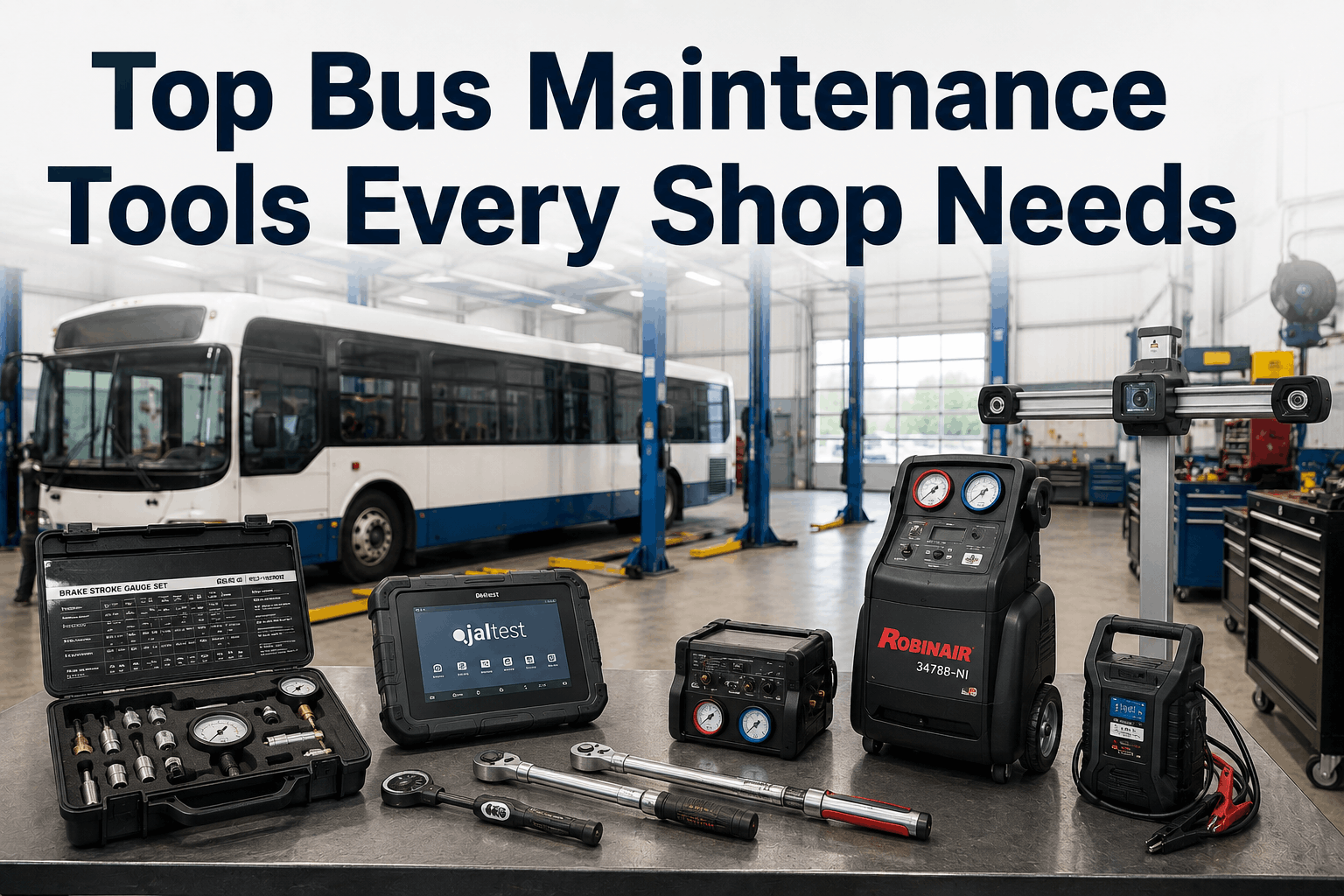
Top Bus Maintenance Tools Every Shop Needs
Top bus maintenance tools every shop needs. Lifts, brake stroke gauges, J1939 scanners, alignment systems, refrigerant recovery, torque tools — essentials.
Shop Tools Impact: The Cost of Poor Equipment
Without the right tools, repairs take longer, quality suffers, and technician safety is compromised. A well-equipped shop can reduce repair time by 50% and improve first-time fix rates. Investing in quality tools pays for itself quickly.
50%
Faster repairs with proper tools
$20,000-$100,000
Equipment investment range
2-3 years
ROI on quality tools
15+
Essential tools
Top Bus Maintenance Tools
1. Vehicle Lifts
Priority: Critical. Types: In-ground, surface-mounted, portable. Capacity: 20,000-40,000 lbs. Essential for under-vehicle access.
2. Brake Stroke Gauge
Priority: Critical. Types: Digital, mechanical. Use: Measure brake chamber stroke. Essential for air brake inspections and DOT compliance.
3. J1939 Diagnostic Scanner
Priority: Critical. Types: Multi-brand, OEM-specific. Use: Read heavy-duty bus fault codes. Essential for modern bus diagnostics.
4. Alignment System
Priority: High. Types: Laser, infrared, 3D. Use: Check and adjust wheel alignment. Prevents tire wear and improves fuel economy.
5. Refrigerant Recovery
Priority: High. Types: Portable, stationary. Use: Recover, recycle, and recharge AC systems. Environmental compliance required.
6. Torque Tools
Priority: Critical. Types: Torque wrenches, multipliers, impact. Use: Proper fastener tightening. Essential for safety-critical components.
7. Tire Service Equipment
Priority: High. Types: Tire changers, balancers, inflation systems. Use: Tire maintenance and replacement. Essential for daily operations.
8. Fluid Service Equipment
Priority: High. Types: Oil pumps, fluid exchange, filtration. Use: Efficient fluid changes. Reduces waste and improves consistency.
9. Welding Equipment
Priority: Medium. Types: MIG, TIG, stick. Use: Structural repairs and modifications. Essential for body and chassis work.
10. Diagnostic Software
Priority: High. Types: CMMS, fleet management, telematics. Use: Track repairs, manage inventory, schedule PM. Essential for modern shops.
11. Air Compressor System
Priority: Critical. Types: Rotary, reciprocating. Use: Power pneumatic tools and air systems. Essential for daily shop operations.
12. Safety Equipment
Priority: Critical. Types: PPE, fire suppression, ventilation. Use: Technician safety. Essential for OSHA compliance and worker protection.
Shop Tool Investment by Category
Safety equipment averages $2,000. Torque tools average $3,000. Diagnostic equipment averages $5,000. Alignment systems average $8,000. Tire service equipment averages $10,000. Vehicle lifts average $15,000. A full shop setup with all essential tools costs $20,000+. ROI is typically achieved within 2-3 years.
Tool Priority by Shop Type
Small Shop (<10 buses)
Large Shop (50+ buses)
Small shops prioritize diagnostics (35%), lifts (30%), and safety equipment (20%). Large shops distribute investment across lifts (25%), diagnostics (25%), tire service (25%), and alignment systems (25%). Shop size and fleet count determine equipment priorities.
Tool Selection Requirements
Fleet Size & Volume
Match tool investment to fleet size and repair volume. Larger fleets need more lifts and specialized equipment. Small fleets can start with essential tools and expand.
Bus Types
School buses, transit, and motorcoaches have different tool requirements. Consider bus weights, lengths, and systems. Some tools are universal, others specialized.
Shop Space
Consider available shop space when selecting equipment. Lifts require clearance. Alignment systems need floor space. Plan layout before purchasing.
Budget
Set a realistic budget for tool investment. Consider financing options. Prioritize safety equipment and essential tools. Plan for phased investment.
Technician Training
Ensure technicians are trained on new equipment. Include training in your investment plan. Some manufacturers offer training with purchase.
Maintenance & Support
Consider maintenance requirements and support availability. Choose reliable brands with good support. Factor in calibration and service costs.
Shop Tool Trends
Digital tool adoption has grown from 30% to 85% between 2019 and 2025. Electric and hybrid vehicle tool adoption has increased from 10% to 60% as fleets transition to electric buses. Shops must invest in modern diagnostic and safety tools to keep up.
Shop Tool KPIs
Track these five metrics to measure your shop tool program effectiveness:
Tool Utilization Rate
Target: 80%+ utilization for major equipment. Track monthly. Low utilization indicates over-investment.
Repair Time Reduction
Target: 30%+ reduction with new tools. Track quarterly. Measure before and after tool investment.
First-Time Fix Rate
Target: 90%+ with proper tools. Track monthly. Quality tools improve diagnostic accuracy.
Tool Maintenance Cost
Target: Under 5% of tool value annually. Track yearly. Proper maintenance extends tool life.
Technician Productivity
Target: 20%+ improvement with tool upgrades. Track monthly. Tools directly impact technician efficiency.
Our shop invested $45,000 in new equipment including lifts, alignment system, and diagnostic scanners. Within 18 months, repair time decreased by 45% and first-time fix rate improved from 78% to 94%. The equipment paid for itself in 22 months through reduced labor costs and improved uptime.
Digitize Your Shop Operations with BusCMMS
BusCMMS helps shops manage tool inventory, track maintenance schedules, and optimize technician workflows. Track tool usage, calibration dates, and repair times. Book a demo to see how BusCMMS improves shop efficiency.
Shop Tools FAQs
What are the most important bus shop tools?
The most critical tools are vehicle lifts, brake stroke gauges, J1939 diagnostic scanners, alignment systems, refrigerant recovery equipment, torque tools, tire service equipment, and safety equipment. These tools cover the most common bus maintenance tasks.
How much does a bus shop setup cost?
A basic bus shop setup costs $20,000-$50,000 for essential tools. A fully equipped shop with multiple lifts and specialized equipment costs $50,000-$150,000. Shop size, fleet count, and tool quality affect investment requirements.
What is the ROI on shop tools?
Quality shop tools typically provide ROI within 2-3 years through reduced repair time, improved first-time fix rates, and lower labor costs. Some tools, like diagnostic scanners, can pay for themselves within months.
How do I choose the right tools for my shop?
Consider fleet size, bus types, shop space, budget, and technician training needs. Start with essential tools and expand based on demand. Research brands for quality and support. Prioritize safety equipment and tools that improve efficiency.
What tools are needed for electric buses?
Electric buses require HV safety equipment, battery diagnostic tools, thermal management tools, and insulated tools. Shops need proper training and safety equipment before working on electric buses. HV safety equipment is critical.
Can BusCMMS help manage shop tools?
Yes. BusCMMS helps manage tool inventory, track calibration schedules, schedule maintenance, and track tool usage. The system can also track technician certifications and training for specialized equipment.
The Bottom Line
Equipping your bus maintenance shop with the right tools is essential for efficient repairs, accurate diagnostics, and technician safety. Vehicle lifts and brake stroke gauges are critical for under-vehicle access and brake inspections. J1939 scanners and alignment systems are essential for modern bus diagnostics. Refrigerant recovery, torque tools, tire service equipment, and safety equipment round out the essential tool list. Tool investment ranges from $20,000 for basic shops to $150,000 for fully equipped facilities. ROI is typically achieved within 2-3 years through reduced repair time, improved quality, and lower labor costs. When combined with proper training, maintenance, and digital management through CMMS, the right tools can transform shop efficiency and improve fleet reliability.