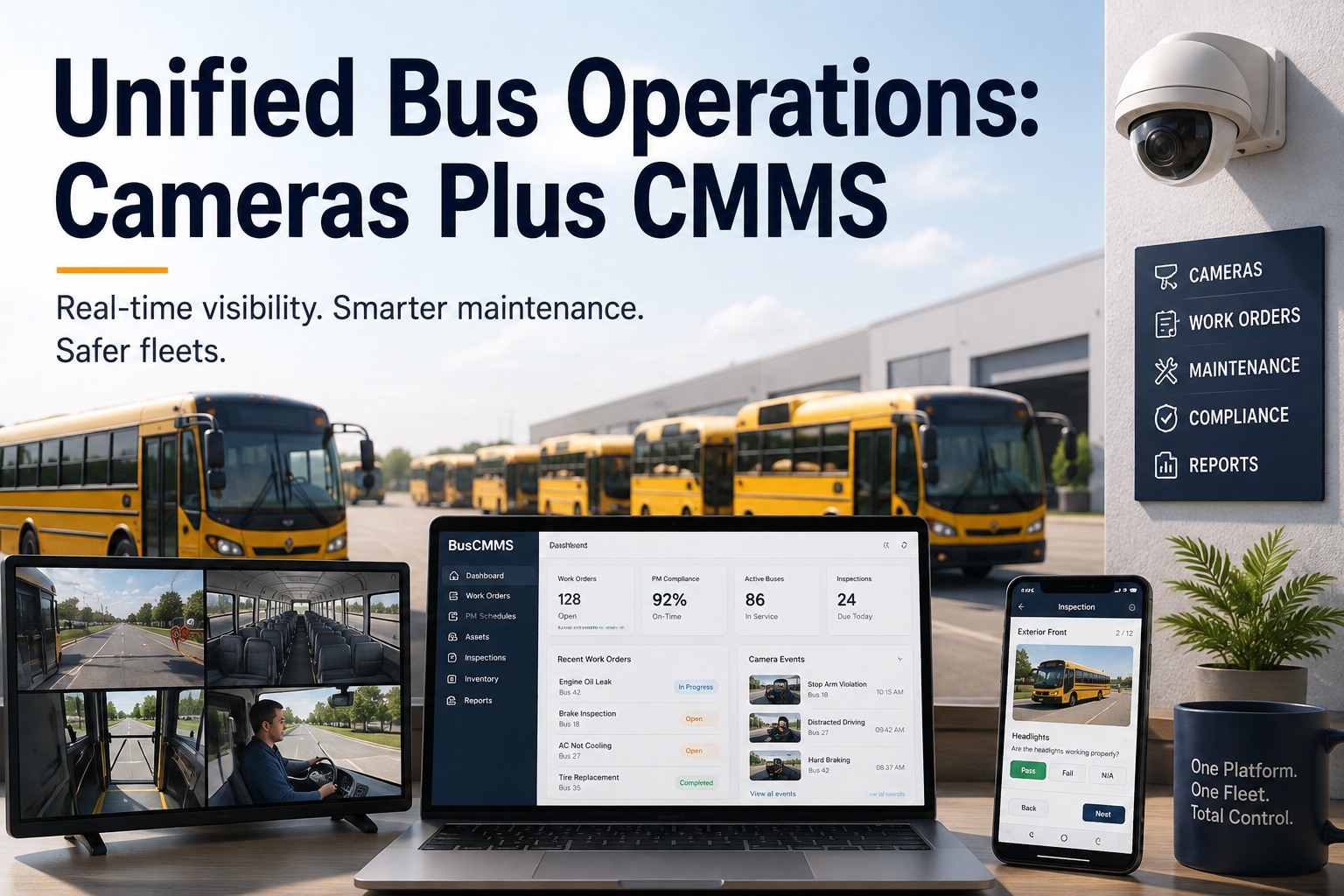
Picture the Tuesday before your FTA triennial review. Your shop foreman is pulling PM records from one system, your safety coordinator is exporting stop-arm clips from a separate camera portal, and somehow you're the one stitching both into a board presentation that is due in three days. A unified bus fleet operations platform is the fix for exactly this — one asset record where camera events and maintenance history live together, so nobody's cross-referencing two logins the week before an audit.
Why cameras and maintenance belong on one asset record
Roughly 480,000 yellow school buses carry about 26 million students every school day and cover an estimated 4.4 billion miles a year — the largest passenger fleet in the United States, larger than commercial airlines or intercity rail combined (School Transportation News safety resources, retrieved August 2026). That scale is exactly why running safety data and maintenance data as two disconnected systems doesn't just create inconvenience, it creates real gaps — a mechanical issue caught on camera that never reaches a technician, or a PM history that an auditor can't tie back to a documented safety event.
A single bus already generates both kinds of data every route: a video-flagged wheelchair lift anomaly is a mechanical signal, and a documented pre-trip inspection failure is a safety signal. Treating those as two separate records means somebody has to manually reconcile them, usually under deadline pressure. Treating them as one record — same bus, same timeline, same asset — means the reconciliation already happened before anyone asked for it. You can see this in practice on a BusCMMS unified operations demo using your own fleet's route and inspection data.
The video-event-to-work-order loop, and what breaks when it doesn't exist
Here's the workflow that a unified platform is supposed to run automatically, and it's worth walking through step by step, because this is where most fragmented setups quietly fail:
A camera flags a mechanical cue
A slow wheelchair lift cycle, a delayed door sensor, a repeated hard-brake pattern that suggests a brake issue rather than driver error.
The event routes into the same asset record
Not a separate safety dashboard — the bus's actual maintenance history, right next to its last PM and its DVIR record.
A work order opens on its own
No manual re-keying, no one waiting for a camera portal login to notice the flag days later.
The record closes the loop for the next audit
When an FTA reviewer or NTD submission asks about that bus, the safety event and the maintenance response are already in the same file.
When this loop doesn't exist, the failure isn't dramatic — it's quiet. A lift issue caught on video sits in a portal nobody's assigned to check daily. It gets found the hard way, usually at a stop, usually with a student aboard. A unified platform's whole job is making sure step 2 happens automatically instead of depending on someone remembering to look.
The mistake that doubles cost and halves usefulness
This is the objection worth naming directly instead of avoiding: most districts and agencies buy a camera system from one vendor and a maintenance system from another, on two separate budget cycles. Neither vendor is responsible for making sure a flagged event from one reaches the other. You end up paying twice — once for video analytics, once for a CMMS — and getting the full value of neither, because the connection between them depends on a person remembering to check a second portal.
That's the failure pattern in one sentence: running safety and maintenance as two separate purchases doubles the cost and halves the usefulness of both. A platform built purpose-first for buses avoids this because it treats the bus itself as the single asset the data belongs to — not two data streams that happen to be about the same vehicle. If you're weighing a rip-and-replace decision against layering a connector onto your existing tools, that's a conversation worth having on a BusCMMS consultation call before committing budget either direction.
Start a free BusCMMS trial and connect your first bus.
See a camera-flagged event turn into a work order on one real bus, before deciding on a fleet-wide rollout.
Shared KPIs across the shop, the office, and the board
One underrated benefit of a unified record is that the same data supports very different conversations without anyone re-formatting it. Your shop foreman cares about MTBF and MTTR on a specific bus. Your transportation director cares about fleet availability and PM compliance rate across the whole fleet. Your superintendent or board just wants to know if the fleet is safe and the budget line is defensible. Those are three different views of the same underlying numbers, not three separate reports someone has to reconcile by hand.
Role-based views matter here more than people expect. A shop technician doesn't need a board-level cost-per-mile summary cluttering their work order queue, and a superintendent doesn't need to see individual lift-cycle timestamps. The value of a genuinely unified platform is that everyone's looking at the same source of truth, filtered to what their role actually needs — which is a very different thing from everyone keeping their own spreadsheet and hoping the numbers line up before the next board presentation.
A scenario from a real bus operation
A mid-size transit agency running 55 buses had been operating exactly the fragmented setup described above — a camera vendor for safety events, a separate CMMS for maintenance, and a shared spreadsheet someone updated manually before each quarterly compliance check. During one particular week, a video-flagged brake pattern on three separate buses sat in the camera portal for eleven days before the maintenance team noticed it, because nobody's job description included checking that specific dashboard daily.
After connecting camera and telematics data into one asset record, that same category of event opened a work order the same day it was detected. Across the following quarter, the agency reported catching mechanical issues at the flag stage rather than the road-call stage in the majority of cases where a video event pointed to something mechanical — meaning technicians were inspecting a symptom, not responding to a breakdown already in progress on an active route.
What the eDVIR rule means for a unified operations platform
Federal inspection rules under 49 CFR 396.11 and 396.13 already require documented driver vehicle inspections and pre-trip checks. The FMCSA eDVIR final rule, under Docket FMCSA-2025-0115, becomes effective March 23, 2026, and moves the expectation toward electronic inspection records rather than paper. That shift matters for a unified platform specifically because an electronic DVIR isn't useful sitting in isolation — its real value is being tied to the same asset record as PM history and any camera-flagged mechanical events on that bus, so a failed inspection item and a video-detected issue on the same component show up together instead of in two separate systems an auditor has to cross-reference manually.
Give your shop, your office, and your board the same numbers, filtered to what each one needs.
See how role-based dashboards work from one underlying asset record on a live BusCMMS walkthrough.
The bottom line on a unified bus fleet operations platform
A unified bus fleet operations platform earns that name when cameras and maintenance share one asset record instead of two disconnected systems held together by someone's memory. That means a flagged mechanical event opens a work order automatically, a documented eDVIR failure and a video-flagged issue on the same component show up in the same place, and your shop, your office, and your board are all looking at the same underlying data instead of three separate spreadsheets. If you're still stitching two portals together the week before an audit, that's the gap worth closing now rather than during the next compliance deadline.
Updated August 2026
Frequently asked questions
Why should cameras and maintenance data live on one asset record?
Because a single bus generates both kinds of data on the same route — a video-flagged mechanical cue and a documented inspection result are both about that specific vehicle. Keeping them in separate systems means someone has to manually reconcile them, usually under deadline pressure before an audit. A shared asset record means that reconciliation has already happened by the time anyone needs it.
What is the FMCSA eDVIR final rule, and when does it take effect?
The eDVIR final rule, under Docket FMCSA-2025-0115, moves the federal expectation from paper-based driver vehicle inspection reports toward electronic records, and becomes effective March 23, 2026. It builds on the existing inspection requirements in 49 CFR 396.11 and 396.13.
What happens when camera and maintenance systems run separately instead of together?
The most common failure is cost and effectiveness both suffering — districts pay for a camera vendor and a CMMS vendor separately, and neither is responsible for making sure a flagged event from one reaches the other. Mechanical issues caught on video can sit unnoticed for days or weeks in a portal nobody's assigned to check regularly.
How large is the school bus fleet this kind of platform needs to support?
Roughly 480,000 yellow school buses operate nationwide, carrying about 26 million students on a typical school day and covering an estimated 4.4 billion miles a year, making it the largest passenger fleet in the United States (School Transportation News safety resources, retrieved August 2026).
Can different roles — shop, office, and board — use the same underlying platform data?
Yes, when the platform supports role-based views from one shared data source. A shop technician sees work orders and MTTR on individual buses, a transportation director sees fleet-wide availability and PM compliance, and a superintendent or board sees a higher-level safety and budget summary — all pulled from the same underlying record rather than separately maintained spreadsheets.