Ask three people in your operation what the maintenance standard is and you'll get three answers — the shop foreman describes what the techs actually do, the director quotes what the board thinks happens, and the new hire shrugs. That gap is exactly what a bus fleet maintenance policy closes. It's the one governing document that says, in writing, what maintenance this fleet commits to, who's accountable for it, and how you prove it was done — so "our standard" stops being a matter of who you ask.
Bus Fleet Maintenance Policy: A Complete Guide
The one governing document that sets what your fleet commits to, who's accountable, and how it's proven — so the maintenance standard is the same no matter who you ask. Here's how to write one that holds up.
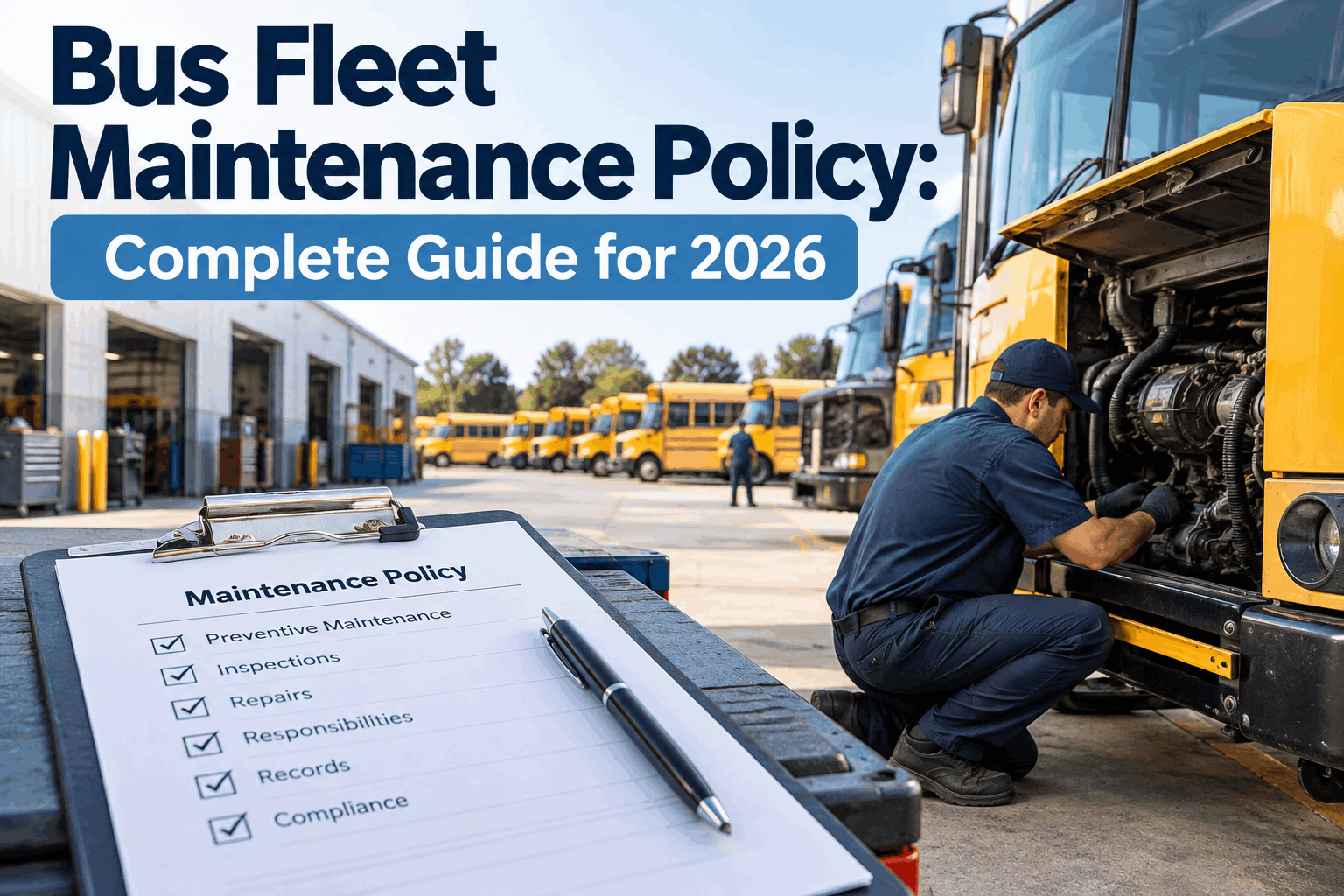
Maintenance Policy
- Applies to
- All revenue & support vehicles
- Accountable owner
- Director of Transportation
- Review cycle
- Annual
- Adopted
- Board / Agency approval
Why Habits Aren't a Bus Fleet Maintenance Policy
Most fleets don't run without standards — they run on standards that live in people's heads and drift over time. That works until it doesn't. A new director inherits a fleet with no written commitment to point to. A veteran tech retires and takes half the "how we do things" with him. An auditor asks who's responsible for verifying brake inspections and the room goes quiet. Habits can't answer any of those, because a habit isn't accountable to anyone and can't be handed off.
No Clear Accountability
When the standard isn't written, no one owns it. "Someone should have caught that" is what you hear after a failure — because the policy never said who "someone" was.
Standards That Drift
Without a written baseline, the bar quietly lowers under budget and staffing pressure. Six months later the fleet is running to a standard nobody consciously chose.
Audit & Board Exposure
An FMCSA review or a board budget question both ask the same thing: what's your standard, and can you prove you meet it? No policy means no defensible answer.
No Way to Improve
You can't hold a fleet to a target you never set. Without written commitments and metrics, there's nothing to measure against and no basis for getting better year over year.
The stakes are higher on a bus than almost anywhere else. A drifting standard in a warehouse means a forklift down; on a school bus it means a stop arm that doesn't deploy or a wheelchair lift that fails with a rider on it. A written bus fleet maintenance policy is how a director converts good intentions into a commitment the whole organization is accountable to — and, just as important, into something you can defend to a board or an auditor. It's not bureaucracy for its own sake; it's the difference between hoping the fleet is maintained to standard and being able to prove it. Book a demo to see how a policy runs as a live system, not a binder.
The Core Components of a Bus Fleet Maintenance Policy
A policy isn't a procedure manual — it operates one level up. It defines the commitments and the accountability; the SOPs and checklists sit underneath it as the how. Six components cover what a maintenance policy needs to establish for most school district, transit, and charter fleets.
Purpose & Scope
What the policy governs and which vehicles it covers — revenue buses, spares, support vehicles — and the safety and service goals it exists to protect. Sets the "why" everything else answers to.
Roles & Responsibilities
Who is accountable for what — director, maintenance manager, foreman, technician, driver. The section that makes "someone should have" impossible, because the policy names who.
Preventive Maintenance Standards
The PM commitment — intervals by mileage and calendar, differentiated by fuel type where it matters, and the compliance rate the fleet holds itself to. The heart of any maintenance policy.
Inspection & Repair Requirements
Daily DVIR expectations, defect-to-repair timelines, and what "safe to return to service" means — so a failed inspection has a defined, non-negotiable path back to the road.
Records & Documentation
What gets recorded, retained, and for how long — mapped to FMCSA and state DOT requirements — so the policy doubles as the fleet's record-keeping and audit-readiness standard.
Compliance & Review
Which regulations the policy satisfies, how compliance is monitored, and how often the policy itself is reviewed and re-approved — because a policy that's never revisited drifts as fast as the habits it replaced.
Two of these are where bus fleets most often fall short. Roles and responsibilities usually get one vague line when they deserve real specificity — naming, for example, that the driver owns the pre-trip DVIR, the foreman verifies safety-critical repairs, and the manager signs off on return-to-service. And the compliance section has to reference the actual rules the fleet lives under, like the record requirements in 49 CFR 396, rather than gesturing at "applicable regulations." Get those two right and the policy becomes genuinely defensible. Sign up free and map your policy commitments to a live fleet system.
From Policy to Practice: Making It Enforceable
A policy that only exists as a document is a policy that gets adopted, filed, and ignored — which is worse than none, because now you've committed on paper to a standard you can't show you're meeting. The gap between a written policy and an enforced one is the whole ballgame, and closing it comes down to four moves.
Turn Commitments Into Triggers
Every PM interval and inspection requirement in the policy should fire automatically as a scheduled task or work order — not depend on someone remembering. A commitment that isn't scheduled is a commitment that gets skipped on a busy week.
Assign Every Responsibility to a Name
Map each responsibility in the policy to an actual person and role in the system, so accountability isn't abstract. When the policy says the foreman verifies brake repairs, the system should record that it was the foreman who signed off.
Measure Against the Standard
If the policy commits to a 95% PM compliance rate, you need a live number to check it against. Metrics turn a policy from an aspiration into something you actively manage — and can report to a board.
Make the Records Automatic
The policy's documentation requirements should be satisfied as a byproduct of doing the work, not a separate filing chore. If proving compliance takes extra effort, it won't happen consistently — and the policy fails its own audit test.
Every one of these moves points to the same conclusion: a policy is only as strong as the system that enforces it. You can write the finest maintenance policy in the state, but if compliance depends on people remembering to do and log the right things, it degrades the first time the shop gets slammed. The reliable way to keep a policy real is to wire its commitments, responsibilities, and records into the platform the fleet runs on every day — which is exactly the operational layer a good maintenance SOP manual and CMMS provide beneath the policy. Book a walkthrough to see policy commitments enforced automatically.
What a Strong Policy Commits To — and Measures
The mark of a policy that actually governs is that every commitment has a number attached and a way to check it. Vague pledges to "maintain vehicles to a high standard" mean nothing; specific commitments paired with metrics are what let a director manage the fleet and answer to a board. Here's how strong commitments map to the numbers that prove them.
This is where the policy earns its keep at the leadership level. A director who can walk into a board meeting and say "our policy commits to 95% PM compliance and we're running at 96 this quarter" is having a completely different conversation than one who can only say "we're keeping up as best we can." The commitments give you the language; the metrics give you the proof. BusCMMS reports fleets averaging around $2,800 in savings per bus per year and 25–35% cost reductions within twelve months once maintenance runs to a consistent, measured standard — the kind of outcome a well-run policy is built to produce. Sign up free and put live metrics behind your policy commitments.
How BusCMMS Enforces Your Whole Maintenance Policy
A maintenance policy touches every part of the operation — PM, inspections, repairs, records, compliance, reporting — which is why enforcing it needs one platform, not a stack of disconnected tools. BusCMMS runs the entire policy as a working system: commitments become schedules, responsibilities become assignments, and the proof builds itself as the work gets done.
-
PM Scheduling Backs the PM Standard
Fuel-type-aware PM schedules for diesel, CNG, and electric buses fire on mileage or calendar — your policy's preventive maintenance commitment, running automatically instead of by memory.
-
DVIRs Enforce the Inspection Standard
Pre-loaded bus DVIRs cover stop arms, gates, lifts, and warning lights, so the policy's daily-inspection requirement is enforced item by item on every vehicle.
-
Work Orders Carry the Repair Standard
Defects auto-generate work orders with defined steps and sign-offs, so the policy's repair and return-to-service requirements are followed and recorded, not left to chance.
-
Dashboards Prove Accountability
Live PM compliance, fleet availability, and cost-per-mile dashboards turn policy commitments into numbers a director can manage against and report to a board.
-
Automated Compliance Reporting
Audit-ready FMCSA, FTA, state DOT, and NTD reports pull straight from the work done, so the policy's compliance commitment is provable in minutes, not a two-day scramble.
-
Roles Map to Real Accountability
Assignments and sign-offs tie each policy responsibility to an actual person, so "who owns this" is answered in the record — every inspection, repair, and approval attributable.
The reason a full platform matters here, rather than a point tool, is that a policy is inherently cross-functional — it doesn't just cover PM or just cover records, it covers how the whole operation holds to a standard. Run those pieces in separate systems that don't talk to each other and the policy fractures along the seams; run them on one platform and the policy stays whole, enforceable, and provable end to end. And because BusCMMS ships with bus-specific forms, compliance logic, and reports already built, you're enforcing a policy tuned to buses from day one, typically live in two to four weeks.
A Transportation Director's Take
That's what a bus fleet maintenance policy is really for at the leadership level: not a document that satisfies a requirement, but a standard the organization is accountable to and a director can prove. The policy sets the bar; the platform is what keeps everyone clearing it and gives you the numbers to show it.
The Bottom Line on Your Bus Fleet Maintenance Policy
A bus fleet maintenance policy is the governing standard that turns scattered habits into a written commitment the whole organization answers to. Build it around six components — purpose and scope, roles and responsibilities, preventive maintenance standards, inspection and repair requirements, records and documentation, and compliance and review — and be specific where fleets usually stay vague, especially on who's accountable and which regulations you're satisfying. Then do the part that separates a real policy from a filed one: make it enforceable by wiring its commitments into triggers, its responsibilities into named assignments, its standards into live metrics, and its records into automatic byproducts of the work. That's when a bus fleet maintenance policy stops being a document you adopted and becomes the standard your fleet demonstrably runs on — defensible to an auditor, credible to a board, and consistent no matter who you ask. The policy commits you to a standard; the right platform is how you keep it and prove it. Book a walkthrough to see a maintenance policy enforced on a fleet like yours.