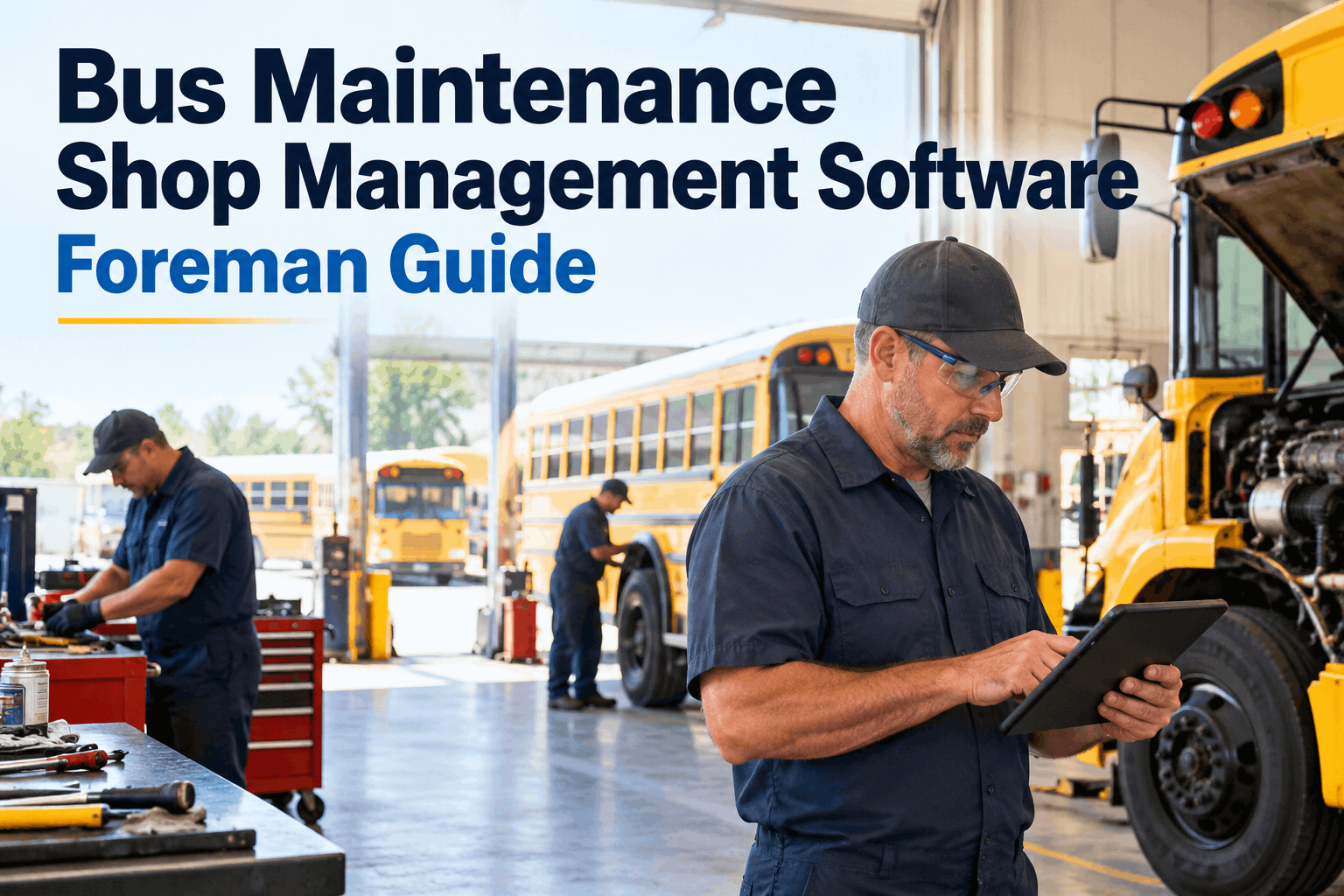
Two of your techs replace a brake chamber the same afternoon. One torques to spec, logs the part number, and notes the road test. The other eyeballs it, grabs whatever chamber's on the shelf, and writes "brakes — done." Same repair, two completely different standards — and you won't know which bus got which until something goes wrong on a route. A bus maintenance SOP manual exists to close that gap: one written standard for how every job gets done, so the work doesn't depend on who happened to pick up the ticket.
Bus Maintenance SOP Manual: A Complete Fleet Guide
One written standard for how every job gets done — so the quality of a repair doesn't depend on which tech picked up the ticket. Here's what belongs in the manual and how to make it stick.
- 01Scope & Responsibilities
- 02Daily Inspection (DVIR) Procedures
- 03Preventive Maintenance Procedures
- 04Work Order & Repair Procedures
- 05Safety & Lockout Procedures
- 06Parts & Documentation
- 07Records & Compliance
Why Inconsistent Bus Maintenance Procedures Cost You
When there's no written standard, every tech runs their own version of the job. That's not a knock on your people — it's what happens when the "procedure" lives in a few heads and gets passed on by whoever's around to show the new hire. The result is a fleet where the same work gets done to different standards, and you find out where the gaps are the hard way: a road call, a failed state inspection, or a DOT auditor asking for a record that was never created.
Quality Swings by Tech
The same repair done three ways by three people. One misses a torque spec, another skips the road test — and there's no standard to catch it, because no one wrote the standard down.
New Hires Take Months
With a tech shortage, you can't afford a six-month ramp. Without documented procedures, every new mechanic learns by shadowing — slow, uneven, and gone the day that senior tech retires.
Audit Gaps
When procedures aren't standardized, the records aren't either. Come an FMCSA review or state inspection, you're missing documentation for work that got done but never logged to a standard.
Safety Items Slip
On a bus, a skipped step isn't a scratch — it's a stop arm that doesn't deploy or a wheelchair lift that fails. Inconsistent procedures put safety-critical items at the mercy of memory.
The through-line is risk that compounds quietly. A fleet can run for years on tribal knowledge and get away with it — until the tech who held it all in his head leaves, or the one shortcut nobody documented finally causes a failure on a bus full of kids. A bus maintenance SOP manual turns that scattered know-how into a shared standard the whole shop works to. It's the difference between hoping every job was done right and being able to prove it. Building a solid preventive maintenance program is a big part of that standard — but the manual is what ties every piece together. Book a demo to see how standardized procedures run inside one system.
What Belongs in a Bus Maintenance SOP Manual
A good manual isn't a novel — it's a reference a tech can pull up mid-job and know exactly what "done right" means. Keep it to the sections that actually govern daily work in a bus shop. These seven cover the ground for most school district, transit, and charter fleets.
Scope & Responsibilities
Which vehicles the manual covers, who does what (tech, foreman, manager), and who signs off on completed work. Sets the rules of the road before any procedure.
Daily Inspection Procedures
The DVIR standard — exactly how a pre-trip and post-trip inspection is done, item by item: stop arms, crossing gates, mirrors, lifts, warning lights, emergency exits.
Preventive Maintenance Procedures
Step-by-step PM tasks by interval and by fuel type — diesel, CNG, and electric each get their own procedure, since their service needs aren't the same.
Work Order & Repair Procedures
How a repair is documented start to finish — opening the order, recording parts and labor, torque specs, road test, and sign-off. The standard for every repair.
Safety & Lockout Procedures
Shop safety, lockout/tagout, lift and jack procedures, and how high-voltage EV systems are handled. Non-negotiable steps that protect the tech and the next rider.
Parts & Documentation
Approved parts, how usage is logged, reorder thresholds, and what gets recorded on every job so the paper trail matches the wrench work.
Records & Compliance
What records to keep and for how long, mapped to FMCSA and state DOT requirements — so the manual doubles as your audit-readiness standard.
Notice these sections mirror the actual workflow of a bus shop rather than some generic template borrowed from a trucking or manufacturing manual. That matters — a stop-arm inspection procedure or a wheelchair-lift certification step has no equivalent in a truck fleet's SOP, and a manual that doesn't name those items isn't really your manual. The work-order and records sections are where most fleets have the biggest gap, and where a good work-order documentation standard pays off fastest. Sign up free and see procedure-driven work orders on real bus jobs.
How to Write a Procedure Techs Actually Follow
A section title isn't a procedure. The manual only works if each SOP is written so a tech can follow it without guessing — specific, sequenced, and testable. Every procedure in the manual should hit these four marks.
Name the Exact Trigger
Say precisely when this procedure runs — "at every 6,000-mile PM," "on any failed brake DVIR item," "before the bus returns to service." No vague "as needed." The trigger removes judgment calls about whether the SOP applies.
List Steps in Order, With Specs
Number the steps and put the real numbers in — torque values, fluid capacities, wear limits, part numbers. "Check the brakes" is a wish; "measure lining, replace below 1/4 inch, torque to spec" is a procedure a tech can actually execute the same way every time.
Flag Safety-Critical Steps
Mark the steps that can't be skipped — the stop arm test, the lift cycle, the high-voltage lockout — so they stand out from routine ones. On a bus, these are the steps where a shortcut becomes a headline.
Require a Verifiable Sign-Off
End every procedure with what gets recorded and who confirms it — the tech's name, the reading, the road-test result. If it isn't documented, it didn't happen, and you can't prove the standard was met.
The sign-off is where a lot of manuals fall down. A procedure that ends without a recorded, verifiable result is just advice — there's no way to tell later whether it was followed. That's also the exact point where a paper manual and a digital system split apart: on paper, the sign-off is a signature on a sheet that may or may not get filed. In a work-order system, the procedure steps and the sign-off are the same record, captured as the job is done. Book a walkthrough to see procedure steps and sign-offs on one work order.
From Binder on a Shelf to an Enforced Standard
Here's the hard truth every maintenance manager learns: writing the manual is the easy 20%. The other 80% is getting it followed, day in and day out, when the shop is slammed and a bus is down. A binder on a shelf gets read once during onboarding and never again. The manual only changes anything when the procedure reaches the tech at the moment of the job — which is the difference between a document and a system.
- Procedure lives in a document nobody opens mid-job
- Sign-off is a signature that may never get filed
- Updates mean reprinting and hoping everyone swaps pages
- No way to see whether the SOP was actually followed
- Audit prep is a scramble through paper records
- Procedure steps ride on the work order to the tech
- Sign-off and readings captured as the job is done
- Update the template once, everyone gets it instantly
- Completion records show the standard was met, every time
- Audit-ready reports pull straight from the record
The shift from left to right is the whole game. When the SOP is baked into the work-order template, following the procedure isn't extra effort — it's just how the job gets logged. The tech can't close the ticket without hitting the required steps, the reading gets captured where it happened, and the record that proves compliance builds itself. That's how a standard stops being aspirational and starts being automatic. Sign up free and turn your procedures into work-order templates.
How BusCMMS Operationalizes Your Maintenance Procedures
A manual sets the standard; a CMMS is how the standard gets executed and proven on every bus. BusCMMS turns your SOP manual from a reference document into the way work actually flows — carrying procedures to techs, enforcing the safety-critical steps, and building the compliance record as a byproduct of the work.
-
Standardized Work Orders
Build your repair and PM procedures into work-order templates, so every tech gets the same steps, specs, and required fields on every job — the SOP, delivered at the point of work.
-
Pre-Loaded Bus DVIRs
Digital inspection forms already cover stop arms, crossing gates, lifts, and warning lights — your daily-inspection SOP enforced item by item, with nothing left to memory.
-
Fuel-Type PM Scheduling
Separate PM logic for diesel, CNG, and electric buses means each fleet's service procedures fire on the right interval — your PM SOP running automatically by mileage or calendar.
-
Auto-Generated From Triggers
A failed DVIR item or a due PM creates the work order automatically — the procedure's trigger enforced by the system, so nothing that should happen falls through the cracks.
-
Audit-Ready Records
Every completed procedure builds the compliance trail — FMCSA, state DOT, and NTD reports pull straight from the work done, so audit prep isn't a paper scramble.
-
Update Once, Everywhere
Change a procedure template and every tech gets the new standard on their next job — no reprinting binders, no wondering who's still working off last year's version.
The pattern across all six is the same: the SOP stops being something techs are supposed to remember and becomes the path of least resistance — the way the work naturally flows through the system. That's what makes a standard hold up under a driver shortage and a packed shop, when good intentions are the first thing to go. And because BusCMMS ships with bus-specific forms and logic already built, you're standardizing on procedures that fit buses on day one, not adapting a generic tool over weeks. BusCMMS reports fleets reaching 95%+ availability once maintenance runs to a consistent standard.
A Shop Foreman's Take
That's the payoff of a manual that lives inside the workflow instead of on a shelf: the standard gets followed because it's easier to follow than to skip, and the proof builds itself. The procedures didn't get more complicated — they got closer to the wrench.
The Bottom Line on Your Bus Maintenance SOP Manual
A bus maintenance SOP manual solves the quiet problem that costs fleets the most: work done to whatever standard each tech carries in their head. Write it around the seven sections that govern a real bus shop — scope, daily inspections, preventive maintenance, work orders, safety, parts, and records. Make every procedure specific enough to follow without guessing: a clear trigger, sequenced steps with real specs, flagged safety-critical items, and a verifiable sign-off. Then do the part that actually matters — get it followed — by moving the manual off the shelf and into the work orders, DVIRs, and PM schedules the shop uses every day. That's when a bus maintenance SOP manual stops being a document you wrote once and becomes the standard the whole fleet runs on, with the records to prove it. The manual sets the bar; the system is what keeps everyone clearing it. Book a walkthrough to see standardized procedures running on a fleet like yours.