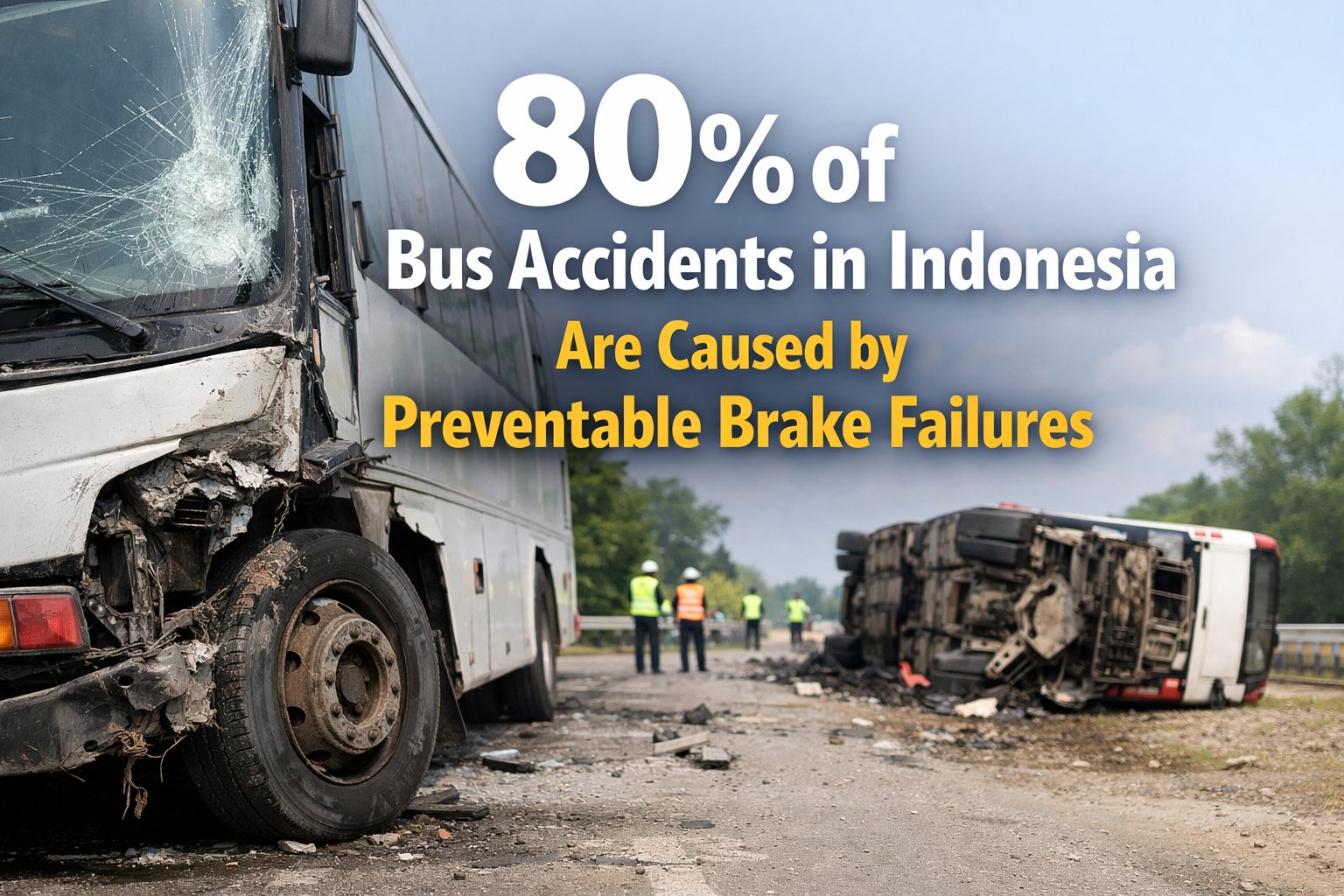
Three days before the Subang accident, a driver reported that the brakes felt soft on the downhill stretch. There was no digital work order. No inspection was triggered. No one followed up. On May 11, 2024, that bus carried 61 students and teachers down a hill in West Java—and never stopped. Eleven people died. The brakes did not fail without warning. The system failed to listen. Indonesia's KNKT has confirmed that 80% of public transport accidents involve brake failure or human error—and the majority of those brake failures were preventable. This is not a mechanical problem. It is a maintenance management problem.
Brake Failures Don't Happen Suddenly — They Build Over Time
Every brake failure has a history. Brake fade on mountain roads. Worn brake pads approaching their limit. Air pressure dropping in pneumatic systems. A driver who reported "soft pedal feel" that was logged and forgotten. The mechanics of failure are well understood — what's missing is the system that tracks, schedules, and acts on that data before the threshold is crossed.
This four-step failure chain repeats across Indonesia's fleet every year. The intervention point is always steps 1 through 3 — never step 4. Start your free BusCMMS trial and put an automated brake PM schedule on every vehicle in your fleet today.
Why Indonesia's Aging Fleet Makes This Worse
Brake systems in older buses degrade faster and require more frequent inspection intervals. A bus that is 12 years old operating on mountain routes in Java or Sumatra is not the same maintenance challenge as a new vehicle on flat urban corridors. Yet most operators apply the same loosely tracked inspection schedule regardless of vehicle age, route profile, or accumulated mileage.
What Preventive Brake Maintenance Actually Requires
Preventing brake failure is not complicated. It requires three things working together: a consistent inspection checklist, a mileage- or time-triggered schedule, and a closed-loop process that ensures defects reported by drivers become work orders that get completed. Most Indonesian operators have none of these in a reliable digital form.
Without digital tools, this process breaks down at step one: the driver reports a problem verbally, it's not written down, and the vehicle departs the next morning. Book a live demo to see how BusCMMS handles driver brake defect reports and automated work order creation.
Expert Review: Manual Brake Tracking vs. Digital PM Scheduling
Indonesian fleet operators typically manage brake maintenance through one of two approaches: paper-based manual tracking or digitally automated preventive maintenance scheduling. The difference in safety outcomes and operational burden is significant.
The Real Cost of One Preventable Brake Accident
Fleet operators often delay digital maintenance tools because of perceived cost. But that calculation rarely accounts for what one brake-related accident actually costs — in regulatory consequences, legal liability, reputational damage, and the loss of operating licenses that can follow a KNKT investigation.
The monthly cost of a fleet management platform like BusCMMS is a fraction of a single legal settlement. Sign up now and build a defensible brake maintenance record for every vehicle in your fleet.
The Fix Is Not Complicated — It Requires Commitment to Process
Indonesia is investing in fleet modernization. TransJakarta's target of 10,000 electric buses by 2030, the Ministry of Transportation's goal for 90% electrified urban transit by 2030 — these are meaningful commitments. But the 241,000 buses operating on Indonesian roads today are mostly older, mostly on manual maintenance schedules, and mostly one missed inspection away from a brake event. The solution does not require waiting for a new fleet. It requires a digital system that schedules brake inspections automatically, captures driver defect reports instantly, creates work orders without delay, and maintains a complete per-vehicle brake history. That is exactly what BusCMMS does — for fleets of any size, in any part of Indonesia.
Every day a bus departs without a completed brake inspection is a day the driver and passengers are carrying a risk that your maintenance team doesn't know about. Book a demo and see how BusCMMS closes that gap for Indonesian fleet operators.
Frequently Asked Questions
What percentage of Indonesian bus accidents are caused by brake failure?
According to Indonesia's National Transportation Safety Committee (KNKT), 80% of public transport and freight vehicle road safety incidents involve brake failures and human error. Brake failure is consistently identified as the leading mechanical cause in KNKT accident investigations, particularly on mountain and downhill routes in Java and Sumatra.
How often should bus brake systems be inspected in Indonesia?
For buses operating on mountain routes — such as those through West Java, Central Java, and Sumatra highlands — brake inspections should be conducted every 10,000 km due to the accelerated heat and wear from repeated downhill braking. For flat urban routes, every 15,000 km is a common standard. Pre-trip air pressure checks should be performed at every departure. Vehicles over 10 years old should have shortened inspection intervals regardless of route type.
What should a driver do if they notice a brake problem before departure?
The driver should immediately file a defect report identifying the specific symptom — soft pedal feel, reduced stopping distance, unusual noise, or warning light. The vehicle should be held from service until a qualified technician inspects and clears the brake system. With a CMMS like BusCMMS, this process is digital: the driver submits a mobile defect report, a work order is automatically created, and the vehicle is flagged as unavailable until the defect is resolved and documented.
Does a CMMS help with KNKT investigations after an accident?
Yes — significantly. When KNKT investigates a brake failure, one of the first things they examine is the maintenance history of the vehicle. A digital CMMS provides a complete, timestamped record of every brake inspection, every defect report, every work order, and every part replaced on that vehicle. This demonstrates due diligence and can be the difference between a finding of negligence and a finding of proper procedure. Without digital records, operators are left trying to reconstruct history from paper documents or memory.
How does BusCMMS specifically help prevent brake failures?
BusCMMS prevents brake failures through three integrated mechanisms: automated PM scheduling that triggers brake inspections based on mileage or time thresholds (before the safe limit is reached), mobile driver defect reporting that converts brake complaints into immediate work orders, and per-vehicle brake service history that makes every technician aware of what was done and when. The system also flags vehicles with open brake-related defects so they cannot depart without clearance — closing the gap between a driver's observation and a mechanic's action.