I want to start with something uncomfortable: in 2026, 53% of fleet managers are researching AI maintenance capabilities. Only 5.6% have deployed it broadly. That gap — nearly fifty percentage points between interest and action — is not a technology gap. The technology works. Machine learning models are now achieving 85–95% accuracy predicting major component failures, surfacing risk 20–45 days before traditional diagnostics raise any alarm. The gap is a confidence gap. Fleet managers who've spent careers reading physical symptoms — a sound, a smell, a driver's verbal report — are being asked to trust a number on a dashboard that says a bus they just inspected looks fine on the outside but has a 78% probability of a cooling system failure within 19 days. This article is an honest look at what AI is doing in bus fleet maintenance right now, what it can't do, and where the managers who've actually implemented it say the real value lies.
5.6%
of fleet managers have broadly deployed AI maintenance
Fleetio 2026 Fleet Benchmark, 600+ professionals
70%
believe 2026 marks a turning point for AI in transport
Microlise Survey, 250 decision-makers, 2026
20–45
days advance warning AI delivers before traditional diagnostics
Intangles / FleetRabbit fleet analytics data
$8,500
average cost of an unplanned bus breakdown in 2026
BusCMMS Fleet Benchmark 2026
The Three Maintenance Eras — And Where Most Fleets Still Live
Understanding where AI fits requires being honest about where most bus fleets actually operate today. The industry talks about AI and predictive maintenance constantly. The reality is a more fragmented picture, with most operations sitting somewhere in the first two eras — not the third.
Era 1
Reactive
Fix it when it breaks
3–5×
higher cost than planned repairs
11%
of annual operational hours lost to breakdowns
Still common in: smaller private operators, aging fleets with no telematics
Era 2
Preventive
Service on fixed schedule
40%
of part life wasted replacing components early
Better
but blind to actual vehicle condition
Majority of: mid-size transit agencies, school districts, coach operators
Era 3
Predictive / AI
Service exactly when needed
27%
of fleets operational (65% planning adoption)
30%
lower maintenance costs vs. preventive approach
Early movers: major transit agencies, tech-forward private operators
The important point: Era 3 is not yet the industry standard. The fleet managers in Era 2 who are doing their jobs well — consistent PM schedules, clean inspection records, organized work orders — are not failing. They are simply leaving money and performance on the table that AI would recover for them. Start a free BusCMMS trial and begin building the data foundation that makes AI maintenance possible for your fleet.
What AI Actually Does — Breaking Through the Hype
The word "AI" in fleet management marketing covers an enormous range of actual capabilities — from simple mileage-triggered alerts that were possible in 2010, to genuine machine learning models analyzing thousands of sensor data points simultaneously. Here is what 2026-era AI fleet maintenance systems actually do, and what distinguishes real predictive intelligence from rebranded scheduling software.
01
Vehicle Sensor Analysis at Scale
A modern connected bus generates up to 25,000 data points per day across engine diagnostics, brake system pressure, coolant temperature, fuel trim values, vibration patterns, and transmission behavior. Human technicians cannot track these signals continuously across a fleet of 50 buses. AI can — and does — monitoring every reading against each vehicle's established baseline, not a generic threshold.
What it looks like in practice:
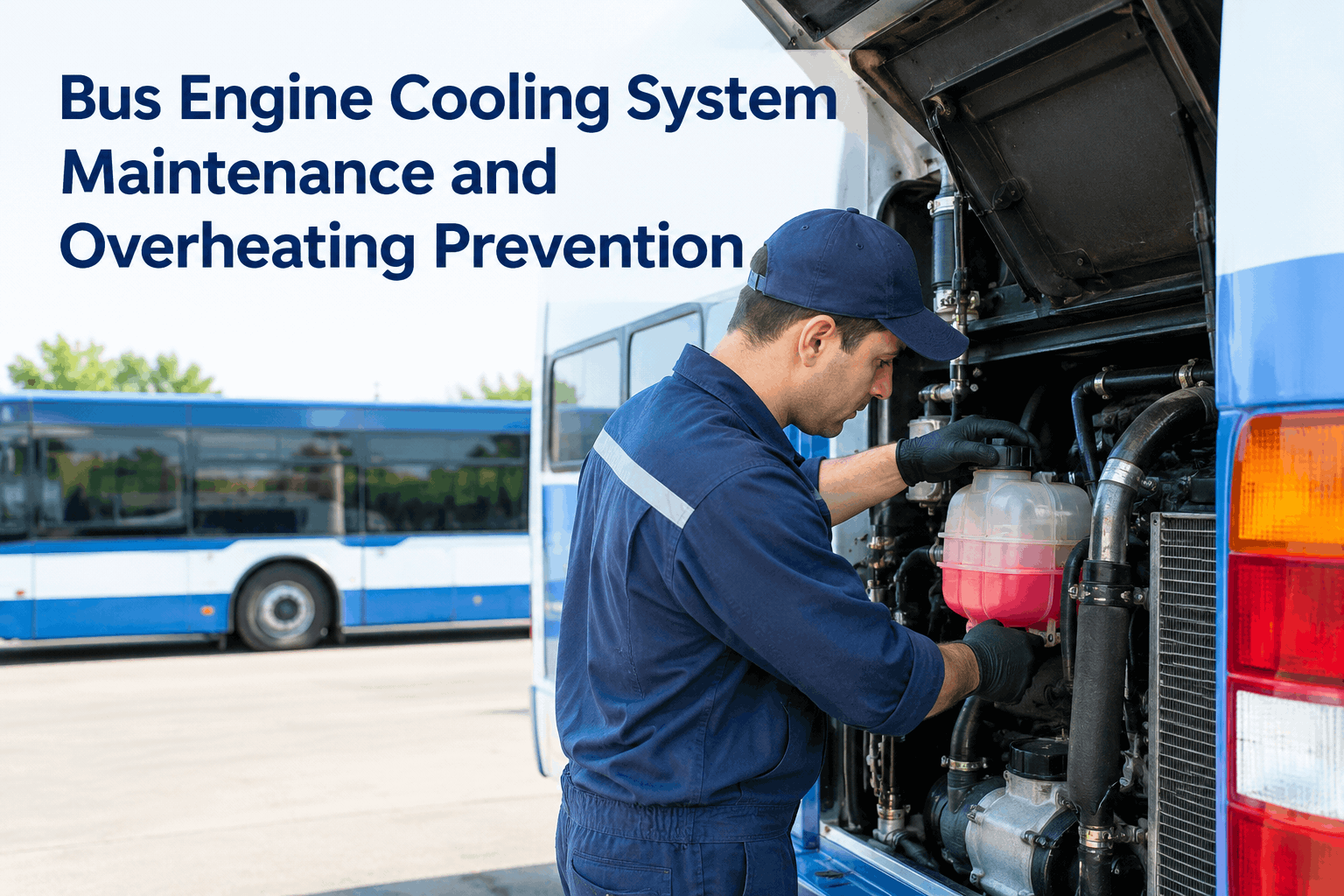
Coolant temperature on Bus #31 has been running 11°F above its baseline for 14 consecutive days. No fault code has triggered yet. AI flags it as high probability cooling system intervention required within 18 days. Technician schedules inspection — finds degraded thermostat before overheating event.
89%
prediction accuracy for major failures (2026 systems)
02
Usage-Based PM Scheduling
Traditional PM schedules treat all buses identically: oil change every X km, brake inspection every Y days. AI replaces this with condition-based scheduling — a bus running mountain routes with heavy braking gets a brake inspection triggered earlier than an urban flat-route bus. A bus with an aging engine showing elevated fuel consumption gets more frequent oil analysis. Service happens when the data says it's needed, not when the calendar says so.
What it looks like in practice:
Bus #22 and Bus #23 both departed 18,000 km ago on their last brake service. Bus #22 runs highways — AI keeps it on standard schedule. Bus #23 runs a steep downhill corridor — AI triggers brake inspection at 14,000 km based on ABS activation frequency and deceleration G-force data.
40%
reduction in wasted part life vs. fixed-interval PM
03
Driver Behaviour Impact Analysis
AI connects the dots between driver behaviour and component wear rates. Harsh braking, aggressive acceleration, excessive idling, and over-speed patterns on specific routes are correlated with accelerated wear in brakes, drivetrain, and fuel systems. This allows fleet managers to have data-backed coaching conversations — and to identify which routes are structurally harder on vehicles, independent of driver behaviour.
What it looks like in practice:
Three buses on Route 7 show brake wear rates 35% higher than fleet average. AI analysis shows the cause is the 800-metre downhill approach to the terminal — a structural route factor. All three vehicles flagged for more frequent brake inspections. Driver training on engine braking technique also initiated.
15%
fuel efficiency improvement from AI driver behaviour analytics
04
Automated Compliance Reporting
AI systems connected to a CMMS automatically track inspection due dates, document completion timestamps, flag upcoming compliance deadlines across the entire fleet, and generate audit-ready reports without manual compilation. For bus fleets managing DOT annual inspections, DVIR records, ADA documentation, and state-specific requirements simultaneously, this automation converts a multi-week annual scramble into a continuous, always-current record.
What it looks like in practice:
14 days before Bus #44's annual DOT inspection expires, the system automatically creates a work order, notifies the maintenance supervisor, and pre-populates the inspection checklist. The day an auditor arrives: full 14-month inspection history exported in under 60 seconds.
<60s
to produce full audit record vs. hours searching paper
BusCMMS Is Built for the Fleet Manager Making This Transition
From PM scheduling to digital DVIRs, work order automation, and compliance tracking — BusCMMS gives your fleet the operational foundation that AI systems require to deliver real predictions, not just alerts.
Real Results: What Fleets Are Reporting After AI Implementation
The claims made about AI in fleet maintenance would be suspicious if they weren't corroborated by multiple independent data sources. Here is what documented implementations and industry-wide studies are showing in 2026.
SBS Transit, Singapore
20% drop
in bus breakdowns after deploying AI predictive maintenance across 1,000 buses. Now expanding to 3,000 units — 62% of the full fleet — with real-time visibility into brakes, engines, and battery health through a centralized AI platform.
Source: Cogent / Busline News
Municipal Refuse Fleet
62% fewer
roadside breakdowns after Intangles predictive analytics identified early engine and electrical stress before fault codes appeared. Repairs moved into planned service windows — towing events eliminated, fuel efficiency improved, route reliability increased.
Source: Intangles fleet case study, 2026
Ford Transit Fleet
Service: 24h → 3h
Predictive maintenance program on commercial Transit fleets reduced service time from 24 hours to 3 hours per repair through pre-positioning of parts before the vehicle arrived. AI-flagged components were ready — eliminating diagnostic and procurement delays entirely.
Source: FleetRabbit / industry benchmark data
Industry Benchmark, 2026
25–35% savings
in maintenance costs reported by fleets running 80–85% planned maintenance through AI-integrated software, compared to reactive operations. The global predictive maintenance market has reached $9.21 billion in 2025, reflecting the scale of documented ROI across industries.
Source: FleetRabbit 2026 industry data / BusCMMS Benchmark
A Fleet Manager's Honest Assessment: What AI Does and Doesn't Replace
The most common misconception about AI in fleet maintenance is that it replaces the experienced technician. It doesn't — and the best implementations are explicit about this. What AI replaces is the impossible task of manually monitoring thousands of signals across dozens of vehicles simultaneously. What it does not replace is mechanical judgment, physical inspection, and the expertise of someone who has fixed the same component hundreds of times.
Monitor all vehicles simultaneously, 24/7, without fatigue
Physical inspection — seeing, hearing, feeling what sensors miss
Identify statistical patterns across thousands of data points
Interpreting ambiguous findings and making judgment calls
Correlate driver behaviour with component wear rates
Understanding the full operational context of a problem
Alert exactly when a component needs attention — not by calendar
Deciding whether to repair, replace, or monitor an aging component
Generate compliance records automatically — no manual compilation
Building relationships with drivers who report soft problems early
Learn from every repair — improving predictions over time
Mentoring younger technicians and transferring institutional knowledge
"The technology barrier has disappeared. What required enterprise budgets is now available at $15/unit/month. Fleets operating without real-time visibility face cost penalties of 20–35% compared to data-driven competitors. The question isn't whether predictive maintenance works — it's how quickly you can build capabilities before falling irreversibly behind."
— Fleet Technology Trends Report 2026, Verizon Connect
Where to Start: The AI-Readiness Ladder for Bus Fleets
Most bus fleet operators cannot jump straight from a paper logbook to a full AI predictive maintenance system. Nor should they try. The path to effective AI in fleet maintenance has a prerequisite layer — and getting that layer right is what determines whether the AI delivers value or just generates alerts nobody trusts.
Level 4
Predictive AI
Machine learning models analyze sensor data to predict failures 20–45 days out. Auto-generated work orders. Condition-based PM scheduling. Full fleet health dashboard.
Requires: 6+ months of clean digital maintenance history per vehicle
Level 3
Digital Integration
Telematics connected to CMMS. Mileage auto-updates work orders. Fault codes surface in maintenance view. Per-vehicle cost reporting active.
Requires: CMMS platform, telematics hardware (90%+ of 2015+ buses already have this)
Level 2
Digital Work Orders & DVIRs
All maintenance jobs tracked in a system. Drivers submit digital pre-trip inspections. Defects create work orders. Completion is documented with parts and labor.
Requires: CMMS software + driver mobile app adoption
Level 1
Per-Vehicle Digital History
Every vehicle has a digital record. Service dates, odometer, parts used, and technician notes are captured and searchable. No paper logbooks.
Start here. This is where most fleets need to begin — and where BusCMMS delivers immediate value.
Most bus operators are at Level 0 (paper) or Level 1. Getting to Level 2 is where 80% of the practical value is — and where BusCMMS is designed to get you. Book a demo and see how quickly your fleet can move from paper records to a digital maintenance foundation ready for AI.
What's Coming in 2027 and Beyond — The Realistic Outlook
The AI trajectory in fleet maintenance is not slowing. The global fleet management market reached $27 billion in 2025 with 16.9% annual growth. By 2031, the AI-in-transportation market is projected to reach $6.51 billion, up from $2.11 billion in 2024. For bus fleet operators, three specific developments are worth tracking.
01
EV Fleet Maintenance — A Different AI Problem
Electric buses eliminate oil changes, transmission services, and exhaust repairs. But they introduce battery health monitoring as a critical capability. Battery degradation shows up first as uneven thermal behavior, inconsistent charging efficiency, and accelerated capacity loss under specific duty cycles — patterns that are invisible without AI analysis. Fleets making the transition to electric need AI systems that can track battery state-of-health alongside traditional maintenance needs, in the same platform, with the same visibility.
02
Technician Shortage Makes AI Non-Optional
Over 30% of diesel technician positions are currently unfilled across the US. 42% of experienced technicians plan to retire by 2028. This talent crisis means fleets cannot simply hire their way out of maintenance challenges. AI that handles pattern detection, diagnostic pre-work, and parts pre-ordering extends the productivity of the technicians you have — and reduces the diagnostic knowledge that walks out the door when an experienced technician retires.
03
Natural Language Fleet Management
The next frontier is not more complex dashboards — it's simpler ones. Fleet management platforms are beginning to integrate natural language interfaces: "Show me all buses with brake-related open work orders that are scheduled for routes tomorrow" produces an instant answer. "Which driver's fuel consumption went up this month and why?" generates a comparative report. This shift from navigation to conversation is where AI adoption will accelerate fastest, because it removes the barrier of technical skill to access data.
Start Building the Data Foundation That Makes AI Work
BusCMMS gives your bus fleet the digital work orders, inspection records, per-vehicle history, and maintenance intelligence that AI systems need to deliver real predictions — not generic alerts. The fleet managers who start building this data foundation in 2026 will have the operational advantage in 2027 and beyond.
Frequently Asked Questions
How accurate is AI predictive maintenance for bus fleets in 2026?
Modern machine learning models deployed in 2026 achieve 85–95% accuracy in predicting major component failures, with prediction windows of 20–45 days before traditional diagnostics raise alarms. During the initial learning phase (first 1–3 months), accuracy typically sits at 75–80% while the model establishes per-vehicle baselines. By month 6, platforms consistently exceed 90% accuracy as the model trains on your specific fleet's operational patterns. Some specific failure types — brake system wear and battery degradation — achieve prediction accuracy as high as 98–99% due to the clean, continuous data these components generate.
Does my bus fleet need new hardware to use AI maintenance systems?
In most cases, no. Over 90% of buses manufactured after 2015 have factory telematics already broadcasting engine diagnostics, temperature readings, brake system data, and other parameters that AI models require. Predictive platforms connect to existing telematics systems rather than requiring new hardware installation. For older fleets, aftermarket OBD-II gateway devices can be installed at relatively low cost to generate the data streams needed for AI analysis. The barrier to AI maintenance is almost never hardware — it's the absence of a CMMS platform to receive, organize, and act on the predictions the AI generates.
What is the ROI timeline for AI fleet maintenance in bus operations?
Bus fleets typically see measurable ROI within 3–6 months of AI maintenance deployment — faster than most vehicle types because the high passenger load cost of a bus breakdown is immediately significant. Industry data shows 10:1 to 30:1 ROI within 12–18 months for committed implementations. The initial ROI driver is almost always the first prevented major breakdown: a single avoided transmission rebuild ($18,000+) or engine-related breakdown ($8,500 average) typically covers months of platform cost. Ongoing ROI comes from reduced parts waste (30–40% improvement), lower emergency repair costs, and technician time recovered from reactive diagnostics.
How does AI handle electric bus maintenance differently from diesel?
Electric bus maintenance eliminates many traditional failure categories (no oil changes, no transmission services, no exhaust repairs) but introduces new ones — primarily battery health monitoring. AI models for EVs track battery state-of-health through thermal behavior patterns, charging efficiency trends, capacity loss rates under specific duty cycles, and cell voltage variance. These patterns surface battery degradation weeks before range reliability drops or battery replacement becomes unavoidable. 2026-era fleet management platforms that support both diesel and electric vehicles in the same interface allow mixed fleets to manage both maintenance regimes from a single dashboard, applying appropriate AI models to each vehicle type automatically.
What maintenance data does a bus fleet need before implementing AI predictive maintenance?
AI predictive maintenance requires a foundation of clean, structured, per-vehicle historical data to train on. Specifically: at least 6 months of timestamped maintenance work orders per vehicle (what was done, when, at what mileage), consistent digital DVIR records linking driver-reported defects to repairs, telematics data streaming from each vehicle (engine diagnostics, temperature, fault codes), and parts usage history showing which components were replaced and when. Fleets without this foundation should start with a CMMS platform that begins capturing this data before attempting AI implementation — the AI is only as accurate as the history it learns from.