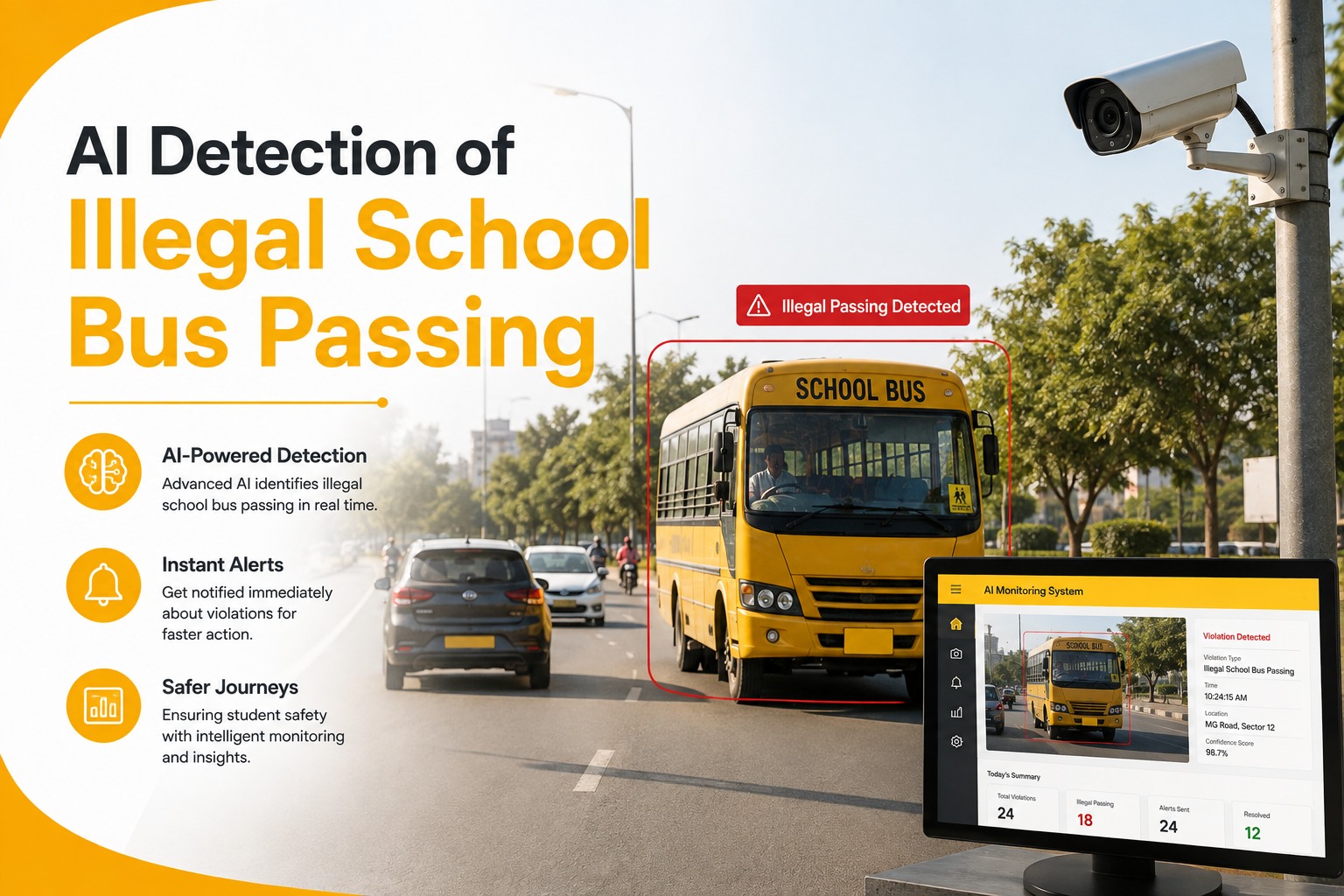
67,258 illegal passes of stopped school buses were recorded in a single day of counting, extrapolating to roughly 39.3 million a year nationwide (NASDPTS, Jul 2025; verified Aug 2026). Illegal passing detection uses onboard AI to catch a vehicle passing a stopped bus in the act — tied to stop-arm deployment, capturing plates across multiple lanes, day or night — and package that moment into evidence a court or district can actually use. See how a detected pass becomes a citation-grade packet in BusCMMS.
AI Detection of Illegal School Bus Passing
How detection ties to stop-arm state, what a citation-grade evidence package needs, and why alert volume alone can defeat the whole program.
Why This Number Should Change How You Budget a Camera Program
One prevented injury crash pays for a fleet-wide rollout.
An average injury crash is widely cited at $148,279 using FMCSA crash-cost figures (as cited across 2026 industry sources — worth re-verifying against FMCSA directly before publishing externally). Against 39.3 million illegal passes extrapolated annually nationwide, the math for a district or agency isn't close: one prevented injury crash covers a stop-arm camera program across dozens of buses. This isn't a nice-to-have safety feature — it's a budget line that pays for itself on a single avoided incident.
How Detection Ties to Stop-Arm Deployment State
The event only counts as a violation in a specific window.
Detection logic has to be tied directly to the stop-arm's actual deployment state, not just to the bus being stationary. A vehicle passing before the arm extends, or after it's fully retracted, isn't the violation the system needs to flag — the window that matters is arm-extended-and-locked through arm-retracting. Cameras need to capture plate reads across multiple lanes simultaneously, since a pass can happen on either side of the bus depending on road configuration, and detection accuracy has to hold up in both daylight and full dark, since a meaningful share of routes run before sunrise or after sunset for at least part of the school year.
The Objection Worth Naming: Alert Fatigue Kills the Program
Too many alerts is functionally the same as no alerts.
Here's the failure mode that quietly defeats most camera-based enforcement programs: alert volume climbs so high that safety staff stop reviewing footage in any meaningful way, and real violations drown in a flood of false positives — a shadow, a parked car, a bus's own turn signal reflecting off wet pavement. A system worth deploying has to filter at the source: tying detection specifically to stop-arm deployment state rather than generic motion, and surfacing only events with a readable plate and a clear timestamp. Anything less turns a safety tool into a chore nobody keeps up with past the first month.
A Scenario From a Real Bus Operation
One flagged event, one full evidence packet, no manual assembly.
A public transit agency running school-tripper routes had a stop-arm camera system generating over 200 alerts a week across its fleet, and the safety team had quietly stopped reviewing most of them. After switching to a system that filtered on stop-arm deployment state and plate readability specifically, the weekly review list dropped to roughly 15 confirmed candidate events — a volume the safety director could actually review personally. Within the first month, two events were forwarded to law enforcement with a complete packet: plate, timestamp, deployment log, and video, assembled automatically rather than pieced together by a staff member the night before a hearing.
We had a camera system for two years before we actually used footage in a case, because the alert list was so long nobody had time to go through it. Once it was filtered down to actual stop-arm-window events with a readable plate, our review time dropped from hours a week to about twenty minutes. That's the difference between having cameras and actually using them.
Curious how many stop-arm passes your fleet may already be missing in the noise? That's worth a look. Talk to the team about a detection audit →
One Evidence Trail, Not a Manual Assembly Job
The wedge BusCMMS solves that a standalone camera vendor can't.
BusCMMS is an AI-native bus fleet operations platform, and the wedge here is where the video evidence lands. A detected illegal pass doesn't sit in a separate camera vendor's export tool waiting for someone to manually build a case file — it attaches directly to that bus's DVIR, the relevant work order, and the driver record on the same asset. When a district needs to hand a packet to law enforcement or defend a decision at a board meeting, the audit trail is already assembled, not built the night before.
Quick Reference: What a Citation-Grade Packet Needs
Scannable on a phone before a review meeting.
| Element | Why it has to be there |
|---|---|
| Stop-arm deployment log | Proves the arm was extended and locked at the moment of the pass |
| Readable plate capture | Multi-lane coverage, day and night, or the case doesn't stand |
| Timestamp accuracy | Synced time is what ties video to the deployment log |
| Video clip, not a still | Shows the full approach and pass, not a single frozen frame |
| Governing statute cited | All 50 states prohibit passing a stopped school bus; cite the specific state statute |
| Chain of custody | Attached to the bus's asset record, not a standalone export file |
Frequently Asked Questions
How does AI detection know a pass is actually illegal?
Detection ties directly to the stop-arm's deployment state — a vehicle passing while the arm is extended and locked, through the retraction window, is flagged as a candidate event, rather than treating every nearby motion as a possible violation.
How many illegal passes happen nationally each year?
A single-day count recorded 67,258 illegal passes of stopped school buses, extrapolating to roughly 39.3 million a year nationwide (NASDPTS, Jul 2025; verified Aug 2026).
Why do stop-arm camera programs sometimes fail even with cameras installed?
Alert volume climbs so high that safety staff stop reviewing footage consistently, and real violations drown in false positives from unrelated motion. Filtering specifically on stop-arm deployment state and plate readability keeps the review list small enough to actually act on.
Is passing a stopped school bus illegal in every state?
Yes, all 50 states prohibit passing a stopped school bus. Enforcement mechanisms vary by state, with a growing number authorizing automated stop-arm camera enforcement under specific enabling legislation tracked by NCSL.
What does an evidence packet need to include to be citation-grade?
A stop-arm deployment log, a readable plate capture across the relevant lane, a synced timestamp, full video of the approach and pass, and the specific state statute being cited — assembled together rather than as separate files.