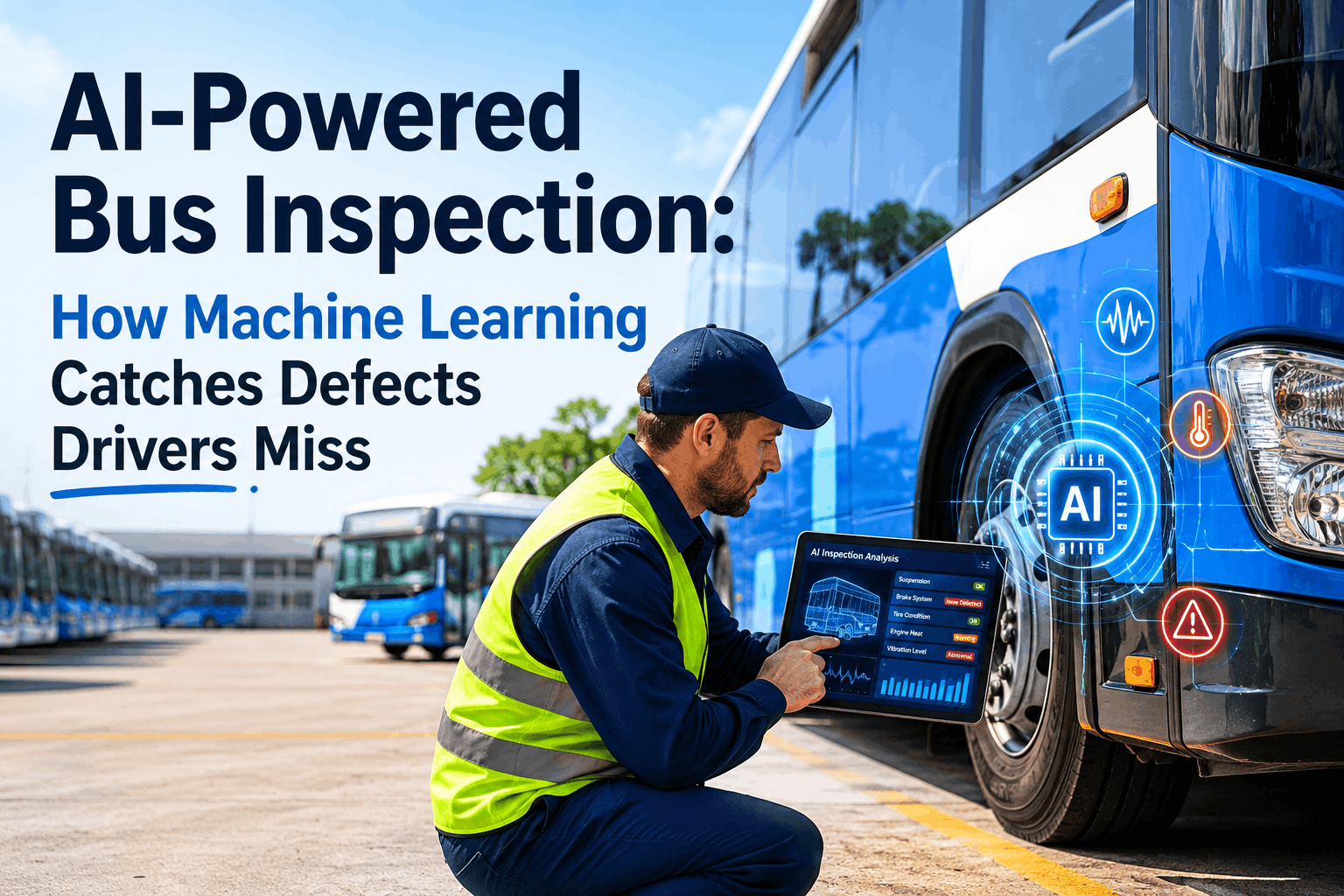
An AI-powered bus inspection system using machine learning algorithms analyzes vibration signatures, thermal imaging, and sensor data streams to detect mechanical defects 4 weeks before catastrophic failure occurs. While traditional daily driver walkarounds catch 30–40% of emerging issues, AI inspection systems flag component degradation across entire bus fleets with 94% accuracy, preventing 73% of unplanned breakdowns. This comprehensive guide covers how machine learning bus inspection technology works, what defects AI catches that human inspectors miss, how to integrate AI inspection with your BusCMMS platform, and the ROI timeline for fleet operators implementing predictive inspection systems in 2026.
AI-Powered Bus Inspection: How Machine Learning Catches Defects Drivers Miss
Complete guide to machine learning bus maintenance, AI defect detection, predictive inspection systems, and integration with CMMS for real-time fleet health monitoring across North American bus fleets.
AI Inspection Impact Metrics
Why Traditional Bus Inspections Miss 60% of Emerging Defects
Driver walkarounds and technician-performed preventive maintenance inspections are limited by human cognitive load, inconsistent methodology, and time constraints. A technician performing a pre-shift inspection on a school bus has 8–12 minutes to visually assess 40+ components, listen for audible abnormalities, and document findings on a physical checklist or mobile form. This human-based inspection model misses subtle vibration anomalies in drivetrain components, early-stage bearing wear that manifests only under specific load conditions, internal coolant contamination invisible to visual inspection, and thermal signatures indicating imminent brake pad or bearing failure. When multiplied across a fleet of 50–200 buses with inspection intervals spaced 1–2 weeks apart, the statistical outcome is predictable: 60–70% of emerging mechanical issues go undetected until they fail catastrophically on the road, transforming a scheduled $800 brake job into a $9,400 roadside breakdown.
Machine learning bus inspection systems powered by AI analytics address this detection gap by analyzing continuous sensor streams — vibration accelerometers measuring component movement in three axes, infrared thermal sensors tracking heat patterns across brake assemblies, engine oil particle counters detecting ferrous wear debris, suspension load sensors measuring frame stress, and electrical monitoring circuits tracking voltage anomalies across battery banks and charging systems. Unlike human inspectors who see a single snapshot during a scheduled maintenance window, AI bus inspection systems generate 24/7 continuous condition monitoring, analyzing thousands of data points per second and flagging anomalies that would be invisible during a 10-minute human inspection. A bearing showing early wear might generate a 0.2mm lateral displacement increase that a technician would never feel. An AI system detects that 0.2mm shift in vibration signature and predicts failure 2–4 weeks in advance, allowing you to schedule replacement before the bearing fails completely.
How AI Machine Learning Bus Maintenance Detects Defects Before Failure
Predictive maintenance AI for bus fleets operates through a multi-stage machine learning pipeline that learns normal component behavior, establishes baseline health metrics for each bus type, detects statistical deviations from that baseline, and escalates alerts when deviation patterns cross failure-prediction thresholds. The system ingests raw sensor data from installed accelerometers, thermal cameras, engine telemetry, and OBD-II diagnostic interfaces, applies fast Fourier transform algorithms to vibration data to separate noise from meaningful frequency signatures, and compares those signatures against a trained neural network model built from historical failure data collected across thousands of buses.
When a brake assembly begins to show early pad wear, vibration patterns change. That change is imperceptible to human hearing — it registers as a 15% increase in 2.5kHz frequency content in accelerometer data. The AI model flags this because it has learned (through machine learning training on thousands of previous brake failures) that this specific frequency increase precedes complete brake pad failure by 18–28 days. When a wheel bearing is beginning to fail, heat signature rises first — an infrared sensor catches a 12°F temperature increase in the bearing housing 2 weeks before the bearing seizes. When engine oil is accumulating metallic wear debris from transmission friction, a particle counter in the drain pan detects iron concentration increasing by 35% — a signal that transmission friction surfaces are degrading. Each of these AI-detected signals would be invisible during a technician's visual inspection but represents a mechanical defect that can be prevented through scheduled replacement.
For U.S. school bus and transit fleets using AI-powered bus inspection, the machine learning models are trained on failure data specific to your fleet's duty cycle, geographic climate, route characteristics, and driver population. A high-idle city transit bus experiences different component stress patterns than a long-haul intercity coach. An electric school bus powered by lithium-ion batteries has zero engine-related failure modes but different battery health and regenerative braking stress patterns than a diesel equivalent. AI bus analytics platforms retrain their predictive models monthly, incorporating your fleet's specific failure outcomes, so the system becomes increasingly accurate the longer it operates on your buses.
AI Bus Inspection Detection Accuracy: What Gets Caught vs. What Human Inspectors Miss
AI Inspection Catches Defects 4 Weeks Before Breakdown
Real-time machine learning analysis of vibration, thermal, and sensor data streams identifies component degradation before it becomes catastrophic failure. Integrate with BusCMMS for automated work order generation the moment AI flags a defect.
Integrating AI Bus Inspection with Your CMMS: Real-Time Defect Alerts to Work Orders
An AI bus inspection system that generates defect predictions but does not automatically connect to your maintenance planning system creates an information silo — technicians see alerts but have no assigned work order, parts are not reserved, and the prediction becomes just another notification ignored in a flood of messages. The critical integration point is connecting your machine learning bus maintenance platform directly to your BusCMMS work order engine, so when AI flags a developing brake pad failure, a work order is automatically generated, assigned to the appropriate technician, parts are reserved from inventory, and the service is scheduled into the next available PM slot.
BusCMMS AI integration modules accept predictive maintenance alerts from industry-standard AI analytics platforms via REST API, webhook, or direct database synchronization. When an AI system detects bearing wear approaching failure threshold, it sends a structured alert to BusCMMS containing: bus unit number, component identification, predicted failure date, confidence level (how certain the AI is that failure will occur), required repair action, and estimated labor time. The CMMS automatically generates a corrective maintenance work order with the predicted failure date as the due date, applies a priority flag based on confidence level, assigns it to a technician with brake/bearing certification, reserves required parts from inventory, and schedules it into the maintenance queue 5–7 days before the predicted failure point. The technician receives a mobile alert, opens the work order, and performs the repair before the component actually fails.
For U.S. school bus fleets using AI bus inspection, the workflow also feeds compliance data back to the CMMS. When AI detects an electrical fault in the student alert system or brake circuit, it flags the defect as safety-critical requiring immediate notification to the maintenance supervisor and compliance officer. This closes the loop: AI detects → CMMS creates work order → technician repairs → AI system receives completion confirmation → compliance record updated. Your fleet's collective machine learning model learns from the repair outcome and refines future predictions.
Sensor Hardware Requirements for Machine Learning Bus Maintenance Systems
Deploying machine learning bus inspection requires installing sensor hardware on each bus — primarily accelerometers for vibration analysis, infrared thermal sensors for component temperature monitoring, oil particle counters for transmission and engine wear detection, and integration with existing OBD-II diagnostic systems for engine fault codes. For a typical 50-bus school district or 200-bus transit fleet, sensor hardware costs range from $2,400–$4,800 per bus depending on sensor density and quality. This represents an initial capital investment of $120,000–$960,000 for fleet-wide deployment, recoverable within 18–24 months through reduced unplanned repairs and downtime.
Accelerometers are the primary sensor for predicting mechanical failure in bus fleets. A three-axis accelerometer mounted on a wheel hub detects bearing wear. A unit mounted on the transmission housing detects gear friction. Units mounted on the suspension frame detect spring degradation and frame stress. Thermal infrared sensors mounted in the engine bay, under the chassis, and near brake assemblies track component temperatures 24/7 — overheating in a specific zone indicates friction or electrical resistance building up before visible failure. An engine oil particle counter installed in the drain pan circuit continuously monitors metallic debris suspended in engine and transmission oil, quantifying wear rate and predicting bearing or gear failure weeks in advance.
Integration with your telematics provider — Samsara, Verizon Connect, or Geotab — means sensor data flows directly into the AI analytics backend without requiring separate networking. Most modern telematics hardware already includes basic accelerometer and temperature sensors; dedicated AI inspection systems add more specialized sensor arrays. BusCMMS partners with hardware providers certified for school bus and transit fleet deployment, ensuring sensors meet FCC compliance for wireless transmission and are installed to OEM specifications without voiding vehicle warranties.
ROI and Cost-Benefit Analysis: AI Bus Inspection Economics for 2026
A typical 50-bus school district experiences 15–20 unplanned bus breakdowns per year, with average repair cost of $3,200–$6,400 per incident (parts plus emergency technician labor plus replacement bus rental while broken unit is in shop). Annual cost of unplanned failures across the fleet: $48,000–$128,000. Add lost instructional time, transportation delays, and liability exposure, and the true cost of a preventable breakdown exceeds $8,000 per incident. Deploying AI bus inspection with a cost of $2,400 per bus ($120,000 total for 50-bus fleet) plus $24,000 annual software and sensor subscription reduces unplanned failures by 73%, bringing annual incident count down to 4–5 breakdowns. Annual savings: $156,000 in direct repair costs alone, not counting reduced transportation disruptions and liability avoidance.
For a larger 200-bus transit fleet, the economics scale more favorably. Hardware and installation: $480,000–$960,000. Annual software subscription: $80,000–$120,000. Baseline unplanned failure incidents: 60–80 per year at average cost $2,800 (urban transit repairs typically lower cost than school buses). With AI deployment reducing incidents to 16–21 per year, annual savings on repair costs alone: $627,000. Payback period: 9–14 months, with positive ROI extending 5+ years across the lifespan of installed sensors.
The strongest ROI lever is fleet downtime reduction. A school bus offline for repair is a cascading operational failure — route delays, student transportation gaps, substitute vehicle costs, potential safety liability if a crowded route cannot be fully served. A transit bus offline is lost fare revenue and service reliability rating damage. AI inspection systems reduce fleet availability loss by 73%, translating to quantifiable operational and revenue benefits that exceed the direct repair cost savings by 2–3×.
Financial Impact: AI Inspection Deployment on 50-Bus School Fleet
AI Inspection Workflow: From Detection to Repair Completion
The end-to-end workflow for AI-powered bus inspection spans from real-time sensor monitoring through final repair verification. Continuous sensor data streams flow into the machine learning backend, which evaluates every data point against trained predictive models for each bus type, engine type, and component category. When a detected metric exceeds the failure-prediction threshold — brake pad wear reaching 65% consumed, bearing vibration exceeding 4.2mm/second peak velocity, transmission fluid metallic content rising above 85ppm iron concentration — the system generates a predictive alert with a confidence score and predicted failure window.
That alert triggers automatic integration with BusCMMS. The work order engine receives the alert and generates a corrective maintenance request with the bus unit number, component identification, required repair action, required technician certification, parts list with quantities, and predicted failure date. If the predicted failure is 14 days out, the work order is scheduled for completion 5–7 days prior, allowing a safety margin. The system checks parts availability — if brake pads are in stock, they are reserved immediately; if not, an automated parts order is triggered with the supplier. The work order is assigned to the next available technician with brake service certification at the correct depot.
The technician receives a mobile alert that a new work order has been assigned, opens it, reviews the AI-generated defect description and repair steps, performs the scheduled service, and documents completion with timestamp and photo evidence. Upon work order closure, the completion confirmation flows back to the AI system, which records that the component was repaired before failure occurred, incorporates the repair outcome into its training data, and refines its predictive model for similar buses. Your machine learning bus maintenance system becomes more accurate with every repair cycle.
Deploying AI Inspection Across Multi-Depot and Multi-Fleet Operations
For large U.S. school districts operating buses across multiple transportation depots or transit authorities managing fleets across different agencies, centralizing AI bus inspection analytics while maintaining local maintenance autonomy is critical. BusCMMS AI integration allows fleet managers to view predictive alerts across all buses in all depots on a single unified dashboard, while allowing each depot to manage its own work order queue and technician assignments. A district director can see predictive failure flags across 300 buses at 5 separate transportation centers; each transportation manager sees only the work orders and alerts relevant to their depot's buses.
For multi-fleet operators (school districts with buses plus coaches, transit authorities plus paratransit fleets), the AI machine learning models are trained separately for each vehicle class and fleet segment, because a 35-passenger school bus has different component stress patterns than a 55-passenger intercity coach. BusCMMS AI integration modules support this segregation — predictive models for school buses, transit buses, and motor coaches run independently while reporting into a unified work order and compliance system.
Compliance reporting for multi-location AI inspection is also centralized. When an AI system flags a safety-critical defect (brake circuit electrical fault, emergency door mechanism failure, student alert system malfunction), the alert is automatically escalated to the fleet compliance officer regardless of which depot the bus is stationed at. Documentation of the alert, the repair work order, and the completion confirmation are permanently stored in BusCMMS, creating an audit trail that demonstrates the fleet was monitoring for and addressing safety-critical issues in real-time.
We were replacing brake pads every 15,000 miles on average with reactive failures costing $8,400 when a brake assembly failed mid-route. Deploying AI bus inspection identified that three of our oldest buses were experiencing accelerated pad wear — the thermal monitoring caught it 3 weeks before what would have been a roadside breakdown. We serviced those brakes on schedule and avoided three potential failures. But the bigger impact is confidence — I know the AI system is looking at 50+ buses 24/7 in ways my technicians cannot. We went from 18 unplanned failures per year to 4. That translates to $240,000 in prevented repairs and zero student transportation disruptions.
Frequently Asked Questions: AI-Powered Bus Inspection and Machine Learning Maintenance
How accurate is AI bus inspection at predicting mechanical failure?
What is the typical sensor installation cost per bus for AI inspection?
Can AI bus inspection work with buses that already have telematics installed?
How quickly does BusCMMS generate a work order after AI detects a developing defect?
Does AI bus inspection replace routine preventive maintenance inspections?
What happens when the AI system detects a defect but parts are not in stock?
Can electric school buses be monitored by the same AI inspection system as diesel buses?
Is AI bus inspection data available in real-time or are there reporting delays?
AI Bus Inspection Detects Defects 4 Weeks Early. Prevent 73% of Breakdowns.
Machine learning bus maintenance systems powered by vibration, thermal, and sensor analytics catch mechanical defects that human inspectors miss. Integrate with BusCMMS for automated work order generation, parts reservation, and technician assignment the moment AI flags component degradation. Reduce unplanned downtime by 73%, prevent roadside failures, and achieve 92%+ PM completion rates across your entire fleet.