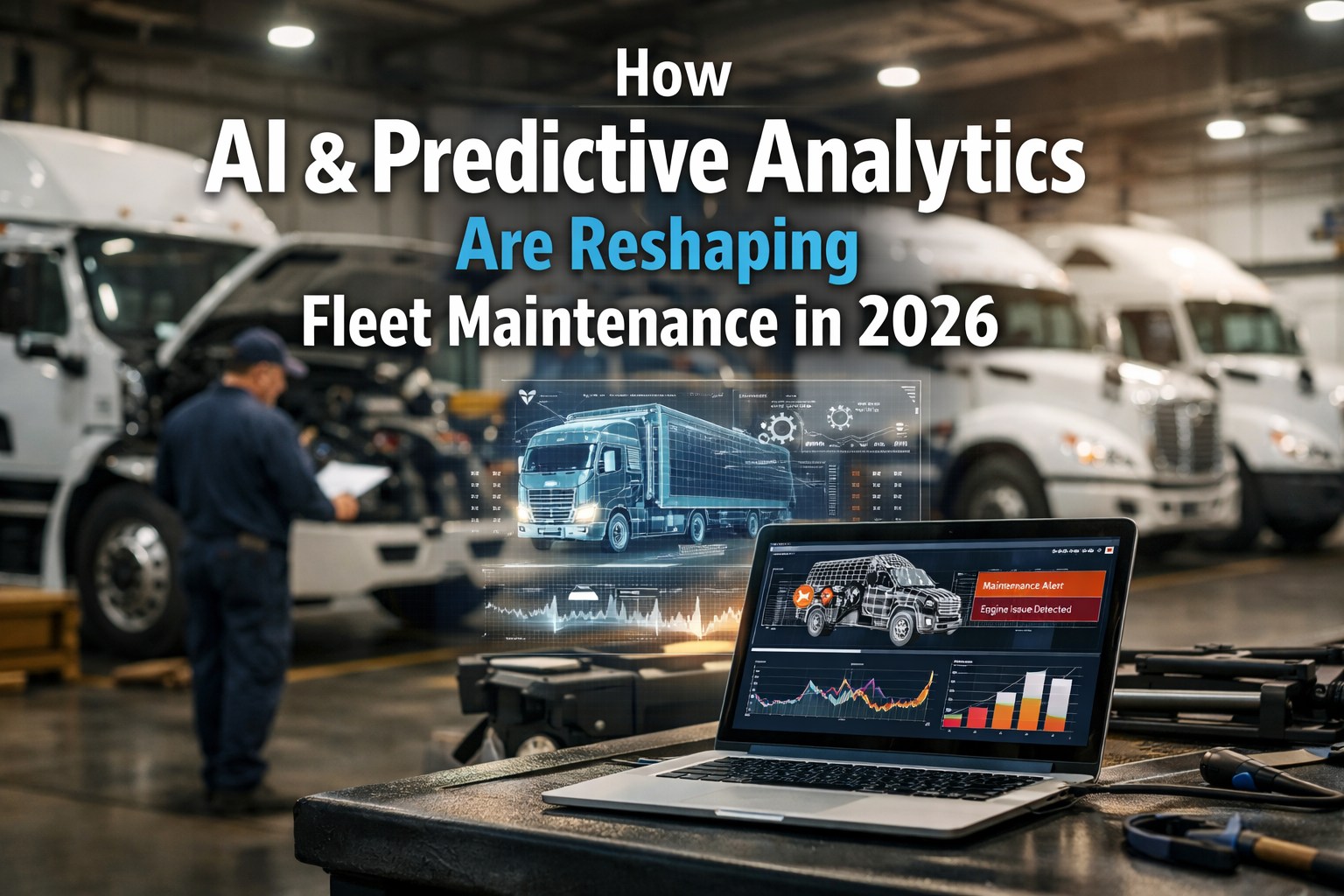
The maintenance playbook that worked for decades is officially obsolete. In 2026, AI isn't a competitive advantageit's the baseline. Fleets still running on spreadsheets and reactive repairs are paying a 20-35% cost premium compared to data-driven competitors. Here's what's actually changing and how to stay ahead.
The 2026 Reality: From Reactive to Predictive
Here's the uncomfortable truth: only 27% of fleets currently use predictive maintenance, yet 65% plan to adopt AI by year's end. That gap represents the biggest competitive opportunityand risk—in fleet management today.
The shift isn't just about technology—it's about transforming maintenance from a cost center into a strategic advantage. Fleets using predictive diagnostic alerts saw nearly a 30% reduction in safety-related vehicle failures. That's not incremental improvement; that's operational transformation.
How Predictive Analytics Actually Works
Forget the marketing hype. Here's what AI predictive maintenance actually does under the hood:
Telematics sensors capture engine temp, oil pressure, vibration, voltage, and 100+ parameters in real-time
AI analyzes billions of data points against historical failure patterns across similar vehicles
Algorithms identify specific components drifting toward failure—20-45 days before traditional diagnostics
System creates work order, checks parts inventory, schedules technician, orders parts if needed
The key difference in 2026: AI doesn't just alert—it acts. When a failure is predicted, the system automatically triggers the entire repair workflow. No human intervention required until the technician picks up the wrench. Learn how modern AI predictive maintenance software for bus fleets makes this possible.
Real ROI: What Fleets Are Actually Seeing
Forget theoretical projections. Here's what fleets using AI predictive maintenance are reporting:
Early adopters report equipment downtime drops by nearly half within first year
Optimized parts inventory, reduced emergency repairs, extended component life
First prevented breakdown often pays for entire system investment
Leading organizations achieve 10:1 to 30:1 returns within 12-18 months
A Texas contractor with 35 vehicles implemented AI predictive maintenance and saw:
Want to see what predictive maintenance could save your fleet? Book a demo to get a personalized ROI analysis based on your fleet size and current costs.
5 AI Capabilities Transforming Bus Fleet Maintenance
AI surfaces risk 20-45 days before traditional diagnostics raise alarms. That lead time transforms emergency repairs into planned maintenance.
Instead of drowning in 8,000 fault codes annually, AI identifies which 5-10 actually require attention. Focus on what matters.
When AI detects an issue, it creates work orders, checks parts inventory, and schedules repairs—no manual entry required.
Digital DVIRs, automated inspection scheduling, and audit-ready documentation that satisfies regulatory requirements instantly.
For electric fleets, AI tracks battery degradation trends, thermal management, and charging patterns to optimize lifecycle.
See how these capabilities compare across platforms in our AI maintenance tools every bus fleet should use.
Every unplanned breakdown costs $3,000-$8,500 in emergency repairs, towing, and operational disruption. See how AI can prevent them.
Implementation Roadmap: From Zero to Predictive
You don't need to replace your entire fleet or hire data scientists. Here's the proven path to AI-powered maintenance:
- Deploy telematics on high-value assets
- Digitize inspections (DVIRs)
- Establish baseline metrics
- Connect telematics to CMMS
- Automate work order workflows
- Enable mobile technician access
- Activate AI failure prediction
- Pilot on highest-failure assets
- Validate predictions against repairs
- Expand to full fleet
- Refine models with your data
- Measure business outcomes
Ready to build your implementation plan? Create your free account and our team will help you map a roadmap specific to your fleet.
Why 2026 Is the Tipping Point
Three factors are converging to make 2026 the year predictive maintenance becomes non-negotiable:
Maintenance costs increased 11.3% in 2024, following years of sustained increases. Parts inflation has driven 15-25% increases since 2022. These aren't cyclical—they're structural.
AI prediction accuracy now exceeds 92% after 6 months of learning. Modern platforms start at $15/unit/month—often less than a tank of diesel.
65% of fleets plan AI adoption by year-end. Fleets without real-time visibility will face 20-35% cost penalties compared to data-driven competitors.
The commercial vehicle telematics market is projected to reach over $130 billion by 2030. AI-powered predictive maintenance is moving from competitive advantage to baseline expectation.
Conclusion: The Question Isn't If—It's When
The technology is proven. The ROI is documented. The only remaining variable is action.
Fleets that operationalize predictive maintenance in 2026 will run vehicles longer, reduce maintenance budgets by 25-40%, achieve higher uptime, and prove their prevention efforts to insurers and regulators.
Fleets that wait will keep paying the reactive maintenance tax: emergency repairs, roadside breakdowns, rush shipping, lost revenue, frustrated drivers, and disappointed customers.
BusCMMS integrates predictive analytics, telematics data, and automated workflows in one platform built specifically for bus fleets.
Frequently Asked Questions
How much does AI predictive maintenance software cost for bus fleets?
Modern predictive maintenance platforms typically cost $15-45 per vehicle per month, depending on features and fleet size. This represents a shift from heavy upfront capital investment to flexible SaaS pricing. Most fleets see positive ROI within 3-6 months, with the first prevented breakdown often paying for the entire system. When you consider that a single unplanned breakdown costs $3,000-$8,500, the math becomes compelling quickly.
How accurate is AI at predicting vehicle failures?
Modern AI predictive maintenance systems achieve 75-80% accuracy during initial deployment, improving to over 92% accuracy after 6 months of learning your fleet's specific patterns. AI can typically predict failures 20-45 days before traditional diagnostic systems raise alarms, giving maintenance teams ample time to schedule repairs during planned downtime rather than responding to emergencies.
Do I need new telematics hardware for AI predictive maintenance?
Not necessarily. Most buses manufactured after 2015 come factory-equipped with robust telematics hardware that broadcasts hundreds of CAN bus data points. Modern AI platforms can ingest data directly from OEM telematics systems (Geotab, Samsara, etc.) without additional hardware. For older vehicles, affordable aftermarket OBD-II devices ($50-150) can provide the sensor data AI needs.
How does predictive maintenance help with DOT compliance?
AI-powered CMMS platforms automate DOT compliance through digital DVIRs, automated inspection scheduling, and audit-ready documentation. The system tracks every inspection, repair, and preventive maintenance activity, creating a complete compliance history accessible within seconds during audits. Fleets using these systems report achieving 100% inspection compliance and zero DOT violations.
What ROI can we expect from implementing AI predictive maintenance?
Leading organizations achieve 10:1 to 30:1 ROI ratios within 12-18 months. Specific results include: 25-40% reduction in overall maintenance costs, 30-50% reduction in unplanned downtime, 20-40% extension in equipment lifespan, and 10-15% fuel savings through optimized maintenance. Studies show predictive maintenance programs reduce unplanned downtime by 32% and maintenance costs by 20-40%, with most fleets seeing positive ROI within 6 months.