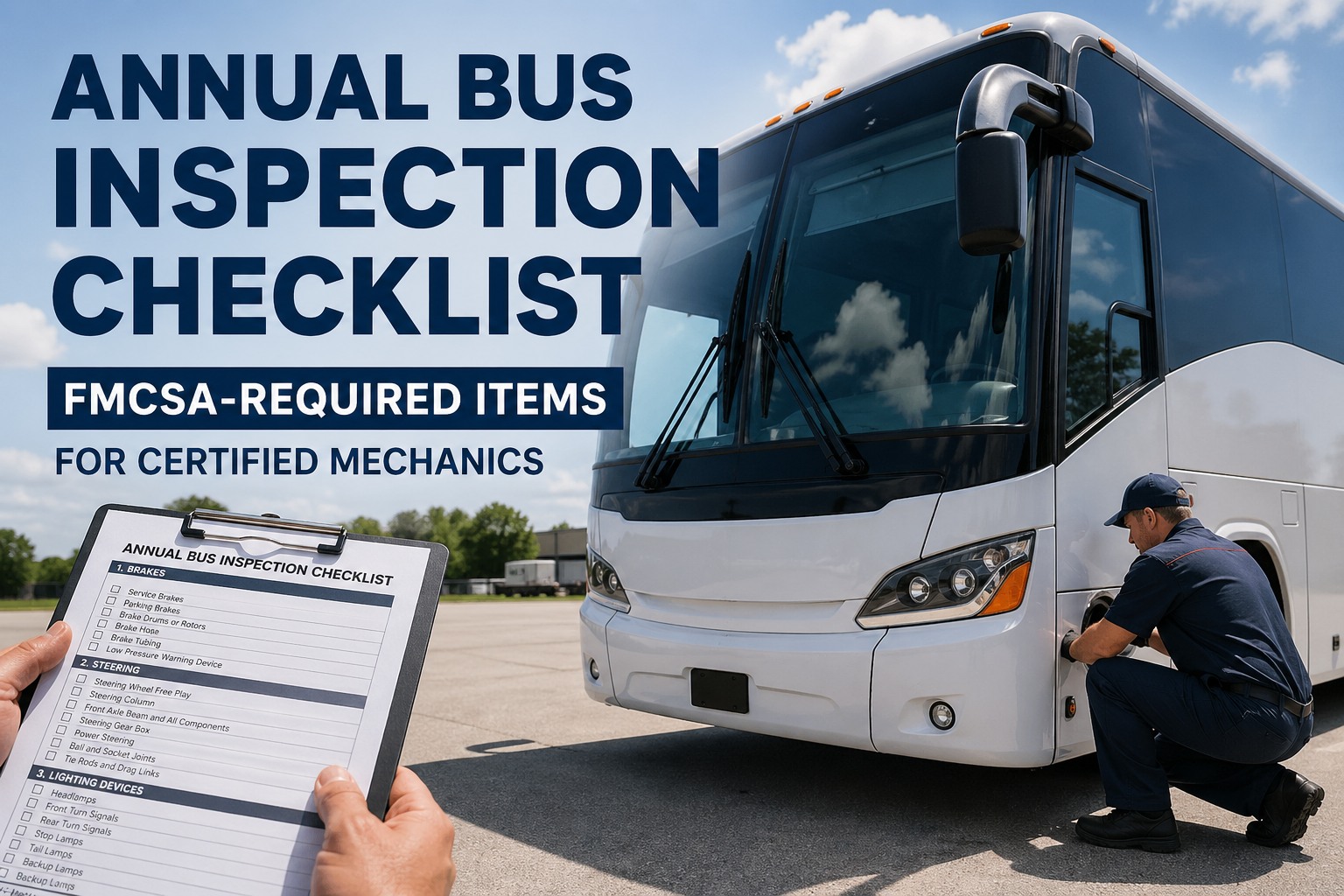
At the 2025 CVSA Roadcheck, inspectors pulled 41% of all out-of-service orders for brake violations alone. Tires added another 21.4%. Every one of those was an item a proper annual inspection should have caught months earlier. This is the complete FMCSA Appendix A checklist — every category, every measurement, every pass/fail criterion — so your certified mechanic walks the bus once and misses nothing.
Annual Bus Inspection Checklist: FMCSA-Required Items for Certified Mechanics
15 categories. Pass/fail criteria. Measurement specs. The checklist that keeps buses on the road and off the shoulder.
Where Buses Get Grounded
The Rules at a Glance
Every 12 months — no exceptions, no substitutions, no roadside-as-annual
Qualified inspector per 396.19 — training program or 1 year experience minimum
Retain reports 14 months — proof must travel on the bus at all times
Bus emergency exits need separate 90-day inspection cycle (396.3)
eDVIRs now legal — FMCSA rule effective March 23, 2026
$1,000–$4,200+ per violation — plus CSA BASIC score damage
The Complete 15-Category Checklist
Brake System
41% of OOSTires & Wheels
21.4% of OOSFree play within limits, power steering functional, pitman arm/tie rods secure, column mounted, no fluid leaks
No broken/cracked springs, U-bolts and hangers secure, air bags no leaks, shock absorbers functional
No cracks or loose fasteners, no sagging floor sections, body mounts secure
No leaks near combustibles, heat shields present, no exhaust entering passenger compartment
No leaks from tank, lines, or fittings; fuel cap secure; tank properly mounted
All lights operational: headlamps, tail, stop, turn, clearance, hazards, reflectors
No cracks in wiper sweep area; wipers operational on all speeds
Operational and audible at required minimum distance
Properly mounted, adjusted, unobstructed; crossover mirrors on school buses
Fifth wheel/pintle secure, locking mechanism functional, safety chains present
Get all 15 categories as a guided mobile checklist — sign up free
Emergency Equipment
School Bus Only
Failed items auto-create work orders — see it in a 20-min demo
Paper Checklists Miss Items. Digital Inspections Don't.
BusCMMS turns every Appendix A item into a guided mobile inspection — measurement fields, photo capture, pass/fail gates. Failed items auto-generate work orders. Certification blocked until defects corrected.
Documentation That Keeps You Compliant
14 months
Inspection Report
Inspector, date, vehicle, all items inspected, defects, certification signature
With report
Repair Records
What repaired, by whom, when, parts used. Re-verified before certification.
On vehicle
Proof on Bus
Report copy or decal per 396.17(c)(2) must be on the bus at all times
1 year
Inspector Quals
Training/experience evidence per 396.19, retained 1 yr after last inspection
Auto-generate compliant reports with timestamps and photos — free
Fleet Expert Review
The annual inspection isn't done when the mechanic signs it. It's done when every deficiency is corrected, repairs are documented, and records are stored. Fleets fail audits not because mechanics missed something — but because repair documentation was incomplete or the 14-month retention lapsed.
Brakes, tires, lights, and steering account for 80%+ of OOS violations. A CMMS that guides inspectors through every Appendix A item and blocks certification until defects are resolved eliminates the human error that turns a clean fleet into a compliance problem.
The Bottom Line
Every bus must pass all 15 Appendix A categories annually. Reports retained 14 months. Emergency exits need separate 90-day inspections. As of March 2026, electronic DVIRs are FMCSA-authorized. BusCMMS digitizes this entire checklist — guided prompts, photo capture, measurement fields, auto-generated work orders, and compliant reports in one click.
Your Annual Inspection Should Take Minutes to Document
Guided checklist. Measurement fields. Photo capture. Auto-certification. Failed items create work orders. Reports generate automatically. 14-month retention built in.