Annual DOT Bus Inspection Checklist: 49 CFR Appendix A
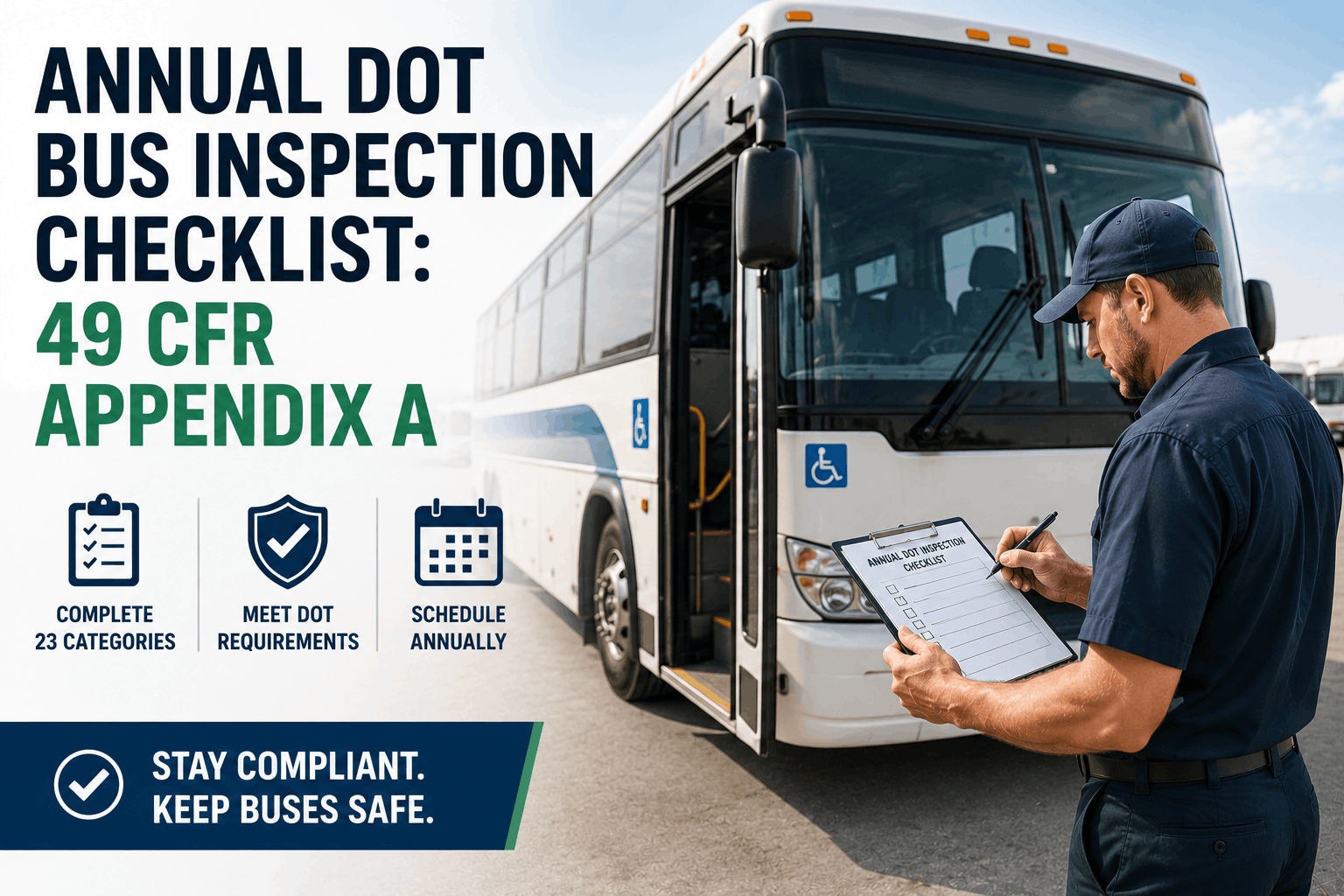
Every commercial bus in the USA must pass an annual DOT inspection that meets or exceeds the minimum standards in 49 CFR Part 396, Appendix A -- at least once every 12 months, performed by an inspector who meets the qualification requirements in 49 CFR 396.19. This is not a recommendation. A bus operating without a current annual inspection certificate is subject to immediate out-of-service order at the first roadside check. The maximum civil penalty for operating a vehicle under an out-of-service order: $23,048 per violation. The annual inspection covers every safety-critical system on the vehicle, from service brakes and steering to windshield glazing and exhaust routing. For buses specifically, additional requirements beyond the standard Appendix A categories apply -- emergency exits, passenger aisle conditions, wheelchair lift operation, and heating systems all require documented inspection before the annual certificate can be issued. This guide breaks down all 23 inspection categories relevant to bus fleets in plain English: what the inspector examines, what constitutes a failure, and the most common defects that cause buses to fail. Build every category as a digital checklist in BusCMMS so your mechanics can prepare each bus before the formal inspection and your fleet never fails on a preventable defect.
49 CFR Part 396, Appendix A -- Annual Inspection Quick Reference
Minimum Periodic Inspection Standards for Commercial Motor Vehicles
Regulation49 CFR 396.17 + Appendix A
FrequencyOnce per 12-month period (minimum)
InspectorMust qualify per 49 CFR 396.19
Report retention14 months from inspection date
OOS penaltyUp to $23,048 per violation
Bus additionsEmergency exits (90-day cycle), passenger equipment, accessibility features
01Top Annual Inspection Failure Categories for Bus Fleets
Understanding which systems most commonly cause annual inspection failures lets your mechanics focus pre-inspection preparation where it matters most. The failure rates below reflect CVSA roadside inspection data and FMCSA compliance review findings -- the same systems that cause roadside OOS orders also cause annual inspection failures. Brake system defects alone account for nearly half of all out-of-service findings. Schedule a demo to see how BusCMMS tracks each category below with pre-inspection preparation checklists.
Annual Inspection Failure Rate by Category -- Bus Fleets (CVSA Data)
02The 23 Inspection Categories: What Gets Checked and Why It Fails
The 23 categories below cover the 13 base Appendix A inspection standards plus the 10 bus-specific requirements from 49 CFR Parts 393 and 37. For each category, the criteria are drawn directly from the CFR text. BusCMMS Custom Checklists can be built for every category below, allowing mechanics to pre-inspect each bus before the formal annual inspection and document findings digitally. Sign up free and build your annual inspection checklist template today.
Group A -- Safety-Critical: Braking SystemsHighest failure rate: 46% of all OOS violations
01
Service Brake System49 CFR 396 App. A, Section 1 -- Brake System
Inspector examines: Brake adjustment on every wheel, lining thickness at all brake positions, brake drum/rotor condition, brake hose routing and connections, anti-lock brake system (ABS) warning lamp operation, air system pressure build and leak-down rate (air brake buses), and parking brake holding ability on grade.
Fail: Any brake more than 1 inch out of adjustment (type 30 chamber); cracked drums or rotors; lining thickness below minimum; hoses rubbing or chafing against frame; air leakage exceeding 3 PSI per minute with service brakes applied
Note: Per 2020 FMCSA rulemaking, automatic brake adjusters found out of adjustment must not simply be re-adjusted -- the underlying cause must be identified and corrected before the vehicle can pass
02
Emergency and Parking Brake Systems49 CFR 396 App. A, Section 1 -- Brake System (Emergency/Parking)
Inspector examines: Parking brake holding ability on level and graded surface, emergency brake operation (spring brake function on air-brake buses), and emergency brake application from driver position.
Fail: Parking brake that does not hold vehicle stationary on required grade; inoperable spring brakes; missing or broken emergency brake components
Group B -- Structural: Frame, Suspension, and SteeringSteering and suspension: 8% of OOS violations
03
Frame and Body Structure49 CFR 396 App. A, Section 9 -- Frame
Inspector examines: Frame rails for cracks, breaks, and corrosion at critical stress points; cross-member integrity; body mounting; floor structure condition relevant to safe operation; any structural modification that affects load capacity or integrity.
Fail: Cracked, broken, or sagging frame rails; loose or missing cross-members; cracked frame at suspension mounting points; any structural modification not to manufacturer specification that degrades frame strength
04
Suspension System49 CFR 396 App. A, Section 8 -- Suspension
Inspector examines: Spring leaves (leaf spring buses) for cracking or separation, air bag suspension for leaks and proper inflation, shock absorber mounting integrity, torque rod and tracking component condition, U-bolt tightness and condition.
Fail: Any spring leaf cracked, broken, or shifted; air bag with visible tears or leaks; cracked torque or radius rod components; missing or broken U-bolts; any part that is cracked, loose, broken, or missing
Inspector examines: Steering wheel free play (lash), steering column and U-joint condition, power steering fluid level and hose condition, tie rod and drag link ends for wear, steering gear mounting, and wheel alignment indicators (tire wear pattern).
Fail: Steering wheel free play exceeding limits (varies by wheel diameter -- typically 4.5 inches on 20-inch wheel); cracked or loose steering gear mounting; worn or loose tie rod end; power steering fluid leak; any bent or cracked steering linkage component
Group C -- Tires, Wheels, and HubsTires: 21% of OOS violations -- second highest category
06
Tires49 CFR 396 App. A, Section 10 -- Tires
Inspector examines: Tread depth on all tires (steer tires and drive/tag tires measured separately), sidewall condition for cuts, bulges, and ply separation, tire age (DOT date code), inflation relative to rated load, and any recapping on front steer axle tires.
Fail: Steer axle tread below 4/32 inch; other axle tread below 2/32 inch; any tire with sidewall bulge or ply separation; regrooved or recapped tire on front steer axle; tire in contact with any vehicle component; mismatched tire sizes on same axle
07
Wheels, Rims, and Hubs49 CFR 396 App. A, Section 11 -- Wheels and Rims
Inspector examines: Wheel fastener tightness and count, rim condition for cracks and damage, hub seal condition for leaks, lock ring integrity (on lock-ring-type wheels), and evidence of wheel looseness from studs or lug pattern wear.
Fail: Any cracked, broken, or loose lug nut; missing wheel studs; cracked rim at bead seat or spoke area; hub oil leak onto brakes; loose or improperly installed lock ring; lug nut hole elongation indicating prior wheel looseness
Group D -- Lighting, Electrical, and SystemsLighting: 18% of OOS violations -- third highest category
08
Lighting Devices, Lamps, and Reflectors49 CFR 396 App. A, Section 5 -- Lighting Devices
Inspector examines: All lighting devices required by 49 CFR Part 393 must be operational -- headlamps (high and low beam), tail lamps, stop lamps, turn signals, clearance lamps, identification lamps, emergency warning lamps (school bus), and all required reflectors.
Fail: Any required lamp not working; any required reflector missing or not visible; turn signals that do not self-cancel or flash at incorrect rate; any lamp lens so cracked that lamp function is compromised; school bus warning lamp system that does not operate in proper sequence
09
Electrical Systems and Wiring49 CFR 396 App. A, Sections 5 and 9 -- Electrical
Inspector examines: Wiring harness routing in engine compartment and battery area, insulation condition on all visible wiring, battery mounting security and terminal condition, and grounding connections.
Fail: Exposed bare wire in engine compartment; damaged insulation near exhaust or moving parts; battery not securely mounted; corroded terminals with high resistance; any wiring that creates fire or short circuit risk
10
Exhaust System49 CFR 396 App. A, Section 3 -- Exhaust System
Inspector examines: Exhaust system for leaks from manifold to tailpipe, routing relative to fuel system and wiring, proximity to combustible materials, and discharge point location relative to the rearmost part of the bus.
Fail: Any exhaust leak forward of rearmost part of bus (non-gasoline: 15 inches); exhaust positioned where it would burn, char, or damage wiring or fuel supply; exhaust leak into cab or passenger area; loose or missing exhaust clamps or hangers
11
Fuel System49 CFR 396 App. A, Section 4 -- Fuel System
Inspector examines: Fuel tank mounting security, filler cap seal condition, fuel line routing away from exhaust and rotating components, and visible fuel leaks at all connections.
Fail: Any fuel leak at tank, cap, or connections; fuel tank not securely attached due to loose, broken, or missing mounting brackets; fuel cap missing or damaged allowing spillage; fuel lines routed near exhaust system
Group E -- Driver Interface and VisibilityAppendix A Sections 12, 13 + 49 CFR 393 driver-interface requirements
12
Windshield and Glazing49 CFR 396 App. A, Section 12 -- Windshield Glazing
Inspector examines: Windshield condition in critical vision area (area swept by wipers), side window glazing for cracks or damaged areas, safety glass markings, and any aftermarket tinting that reduces visibility below required levels.
Fail: Any crack or discoloration in critical vision area impairing driver view; any glazing not meeting safety glass standards (AS-1 marking required on windshield); broken or missing glazing in any location creating safety risk or weather exposure
Inspector examines: Wiper blade condition (no torn or deteriorated rubber), wiper arm pressure and contact across full sweep, wiper motor operation at all required speeds, and washer fluid system operation.
Fail: Any wiper that fails to clear the windshield sufficiently for safe driving in rain; torn or missing wiper blade elements; wiper arm not maintaining contact across full sweep area; inoperable wiper motor
14
Horn, Mirrors, and Speedometer49 CFR 393.81, 393.80, 393.82
Inspector examines: Horn audibility, rear-vision mirror coverage from driver seat (all required mirror positions for bus type), and speedometer accuracy and operability.
Fail: Inoperable horn; any required rear-vision mirror missing, broken, or improperly positioned; speedometer not operational (buses operating on public roads require functioning speedometer)
BusCMMS pre-builds annual inspection checklists for all 23 categories. Schedule your entire fleet's annual inspections automatically and track completion status per bus in real time.
Inspector examines: Emergency door operation (opens from both inside and outside), roof hatch operation, push-out window function, emergency exit marking light visibility, emergency exit labeling, and clearance for emergency egress route.
Fail: Emergency exit that cannot be opened from inside or outside; missing or non-functioning emergency exit marking lights; blocked emergency exit aisle; missing or unreadable emergency exit labeling
Note: Emergency exits are also subject to a separate 90-day inspection cycle per 49 CFR 396.3 -- the annual inspection does not satisfy the quarterly requirement
Inspector examines: Fire extinguisher (type, charge level, accessibility, and inspection date tag), emergency triangles or flares (required quantity and condition), and first aid kit (where required by state or contract).
Fail: Missing or discharged fire extinguisher; fire extinguisher not meeting 5 B:C rating minimum; fewer than 3 emergency warning devices; emergency devices inaccessible or damaged; fire extinguisher with expired inspection tag
17
Passenger Aisle, Steps, and Floor49 CFR 393.62, 393.90 -- Bus requirements
Inspector examines: Aisle clearance from front to rear emergency exit, step condition (tread material, riser height, and securement), floor integrity (no holes or soft spots), and absence of obstructions that would impede emergency egress.
Fail: Aisle blocked by seats, equipment, or cargo; missing step tread material creating slip hazard; floor with structural holes; steps with broken or missing risers; any condition blocking rapid emergency evacuation
18
Interior Handrails and Grab Handles49 CFR 393.90 -- Bus requirements
Inspector examines: Handrail mounting security at entry steps and interior, condition of handrail surface (no sharp edges or cracks), and presence at required locations for passenger support during boarding and exiting.
Fail: Loose or missing handrails at entry steps; cracked or broken grab handles with sharp exposed edges; any handrail that detaches or moves under normal passenger loading force
19
Seat Belts and Passenger Restraints49 CFR 393.93 -- Seats, seat belts, and seat anchorages
Inspector examines: Driver seat belt presence and operation, passenger seat belt condition where required (over-the-road buses and charter buses), seat anchorage integrity, and child restraint anchoring points (where applicable).
Fail: Missing or inoperable driver seat belt; torn webbing on any required seat belt; retractor that does not lock under load; seat mounting bolts loose or missing; any seat that moves under normal passenger loading
20
Wheelchair Lift and Accessibility Equipment49 CFR 37.163 + Part 38 -- ADA accessibility
Inspector examines: Lift deployment and stow operation, platform capacity rating placard presence, roll-stop and barrier function, emergency manual override operation, and lift mounting integrity.
Fail: Lift that fails to deploy or stow; missing capacity placard; roll-stop that does not engage; inoperable manual override; hydraulic leaks at lift mounting; any lift defect that prevents boarding for a passenger with a disability
21
Stop Arm and Crossing Gate (School Buses)49 CFR 393.86 + state school bus regulations
Inspector examines: Stop arm deployment and retraction operation, crossing gate extension and retraction, warning lamps on stop arm (8-light flasher sequence), and physical condition of arm and gate hardware.
Fail: Stop arm that does not fully deploy or retract; missing or inoperable stop arm lamps; crossing gate that does not extend to required position; bent or cracked arm hardware that prevents proper operation; loss of synchronization with 8-light system
Inspector examines: Applicable to articulated buses with coupling systems and to any bus towing a trailer. Includes fifth wheel mounting, kingpin condition, and locking mechanism integrity.
Fail: Cracked or broken fifth wheel; missing fasteners; locking mechanism that does not secure kingpin; damaged or worn kingpin or upper coupler exceeding wear limits
23
HVAC, Heating, and Defrost System49 CFR 393.43 + state school bus standards
Inspector examines: Heater and defroster operation sufficient to maintain visibility through the windshield, heat delivery to passenger area, and absence of combustion heater exhaust entering passenger compartment.
Fail: Defrost system insufficient to clear windshield in reasonable time; combustion heater with exhaust leaking into passenger area; any heater creating fire or CO poisoning risk
Automate Annual Inspection Scheduling for Your Entire Fleet.
BusCMMS Custom Checklists include a pre-built annual inspection template covering all 23 categories. Inspections auto-schedule 90 days before each bus's expiry date. Results are retained 14 months automatically. Inspector qualification documentation stored per 49 CFR 396.19.
03Inspector Qualification: Who Can Perform a 49 CFR Annual Inspection
The annual inspection must be performed by an inspector who meets the qualification requirements in 49 CFR 396.19. An unqualified inspector means the inspection is not valid -- even if the vehicle would have passed. FMCSA auditors specifically check inspector qualification documentation, and a properly conducted inspection done by an unqualified person carries the same penalty exposure as no inspection at all.
Who Qualifies as an Annual Inspector
A mechanic with demonstrated knowledge of the inspection criteria in 49 CFR Part 393 and Appendix A to Part 396, obtained through training or experience
A state-certified vehicle inspector conducting an inspection under a state program meeting Appendix A minimum standards
A commercial garage, fleet leasing company, or truck stop employee who meets the knowledge requirements and is employed by a facility with appropriate inspection equipment
A fleet's own mechanic who has completed a DOT-recognized annual inspection training course covering all Appendix A categories
Documentation Required (49 CFR 396.19)
Written record of each inspector's qualifications must be kept by the motor carrier during the inspector's employment plus one year after departure
Completed annual inspection report must be retained for 14 months from the date of inspection
Annual inspection sticker or certificate must be displayed on the vehicle or inspection report must be in the vehicle during operation
BusCMMS stores inspector qualification records per vehicle, links them to each completed annual inspection, and alerts at 90 and 30 days before each bus's inspection anniversary
BusCMMS Customer
"We had three buses fail their state annual inspection on the same day -- all three on brake adjustment. Before BusCMMS, nobody was tracking pre-inspection brake checks systematically. After building a BusCMMS annual inspection prep checklist that runs 30 days before each bus's annual date, we have not had a single annual inspection failure in two years. The inspectors actually comment on how well-prepared our fleet arrives."
Expert Verdict: Custom Checklists vs General CMMS for Annual Inspection Management
General CMMS platforms manage work orders and PM schedules across multiple asset types. They do not have pre-built 49 CFR Appendix A annual inspection checklists, no bus-specific category structure covering all 23 items above, no integration between inspection results and the 14-month documentation retention requirement, and no automatic scheduling of pre-inspection preparation checklists 30-90 days before each bus's annual date. BusCMMS Custom Checklists are configured around the specific 49 CFR 396 requirements from day one. Annual inspection prep checklists, inspector qualification documentation, and 14-month report retention are all built into the platform for bus fleets specifically -- not retrofitted from a generic maintenance template.
The Bottom Line
The 49 CFR Part 396, Appendix A annual inspection is not a bureaucratic formality -- it is a comprehensive 23-category review of every safety-critical and bus-specific system on every vehicle in your fleet, required every 12 months, performed by a qualified inspector, documented and retained for 14 months. The penalty for operating without a current annual inspection is up to $23,048 per vehicle per violation. BusCMMS automates every part of this compliance obligation: scheduling inspections 90 days in advance, pre-built checklists for all 23 categories to prepare each bus before the formal inspection, inspector qualification documentation storage, and 14-month report retention. Sign up free and activate your annual inspection workflow today.
Every Bus. Every Year. Every Category. Documented and Audit-Ready.
Pre-built 49 CFR Appendix A checklists for all 23 categories. Auto-scheduling 90 days before expiry. 14-month report retention. Inspector qualification documentation. Pre-inspection preparation workflow. Built for bus fleets, available on day one.
Frequently Asked Questions: Annual DOT Bus Inspection 2026
What does 49 CFR Part 396 Appendix A require for the annual bus inspection?
Appendix A to Part 396 defines the minimum periodic inspection standards that every CMV annual inspection must meet, covering 13 core categories: brakes, coupling devices, exhaust, fuel, lighting, safe loading, steering, suspension, frame, tires, wheels, windshield glazing, and windshield wipers. For buses, additional requirements from 49 CFR Part 393 add emergency exits, passenger equipment, and accessibility systems. BusCMMS pre-builds checklists covering all 23 relevant categories for bus fleet annual inspections.
How often is a DOT annual bus inspection required?
At minimum, once every 12 months per 49 CFR 396.17. The 12-month clock runs from the last day of the month in which the inspection was performed -- so a bus inspected on March 15 has until March 31 of the following year before the inspection expires. State inspections meeting Appendix A minimum standards also satisfy the federal annual inspection requirement for 12 months from the last day of the inspection month.
Who is qualified to perform a 49 CFR annual bus inspection?
The inspector must meet the requirements of 49 CFR 396.19 -- demonstrated knowledge of 49 CFR Parts 393 and Appendix A inspection criteria, obtained through training or experience. The motor carrier must maintain written records of each inspector's qualifications during their employment plus one year after departure. FMCSA auditors specifically check inspector qualification documentation, and an inspection performed by an unqualified inspector is treated as no inspection regardless of the vehicle's actual condition.
How long must annual inspection reports be retained?
Annual inspection reports must be retained for 14 months from the date of inspection per 49 CFR 396.17. During this 14-month window, the inspection report must be available for review -- kept either in the vehicle or at the motor carrier's principal place of business. BusCMMS stores annual inspection records indefinitely beyond the 14-month minimum, making records available for any FMCSA audit request in under 60 seconds.
What is the penalty for operating a bus with an expired annual inspection?
Operating a commercial bus without a current annual inspection is an out-of-service violation. The maximum civil penalty for operating under an out-of-service order is $23,048 per vehicle. Additionally, each day the vehicle operates in OOS condition is a separate violation. CVSA roadside inspectors specifically check annual inspection certification, and an expired inspection discovered at roadside results in immediate OOS order and the vehicle cannot move until the violation is corrected.
Does a school bus emergency exit inspection replace the annual inspection?
No. The 90-day emergency exit inspection required by 49 CFR 396.3 is a separate, additional requirement on top of the annual inspection -- not a substitute for it. School buses must comply with both: annual inspection per 396.17 covering all Appendix A categories, AND emergency exit inspection every 90 days per 396.3. BusCMMS schedules both cycles independently for every school bus in the fleet, with separate alert windows and documentation for each.
Can a state annual inspection replace the federal DOT annual inspection?
Yes, if the state inspection meets the minimum standards in Appendix A to Part 396. Per 49 CFR 396.17(f), vehicles passing inspections under any US state government program that meets Appendix A minimum standards are considered to have met the federal annual inspection requirement for 12 months from the last day of the inspection month. Not all state inspections meet Appendix A standards -- verify your state's inspection program covers all required categories before relying on a state inspection to satisfy the federal requirement.
How does BusCMMS automate the annual bus inspection scheduling process?
BusCMMS tracks the annual inspection expiry date for every bus in the fleet and sends alerts at 90, 60, 30, and 7 days before each bus's inspection anniversary. At 30 days, BusCMMS automatically generates a pre-inspection preparation work order using the custom annual inspection checklist template, allowing mechanics to address defects before the formal inspection. Inspector qualification records are stored in BusCMMS and linked to each completed inspection report. All records are retained beyond the 14-month minimum with one-click export for FMCSA audit response.