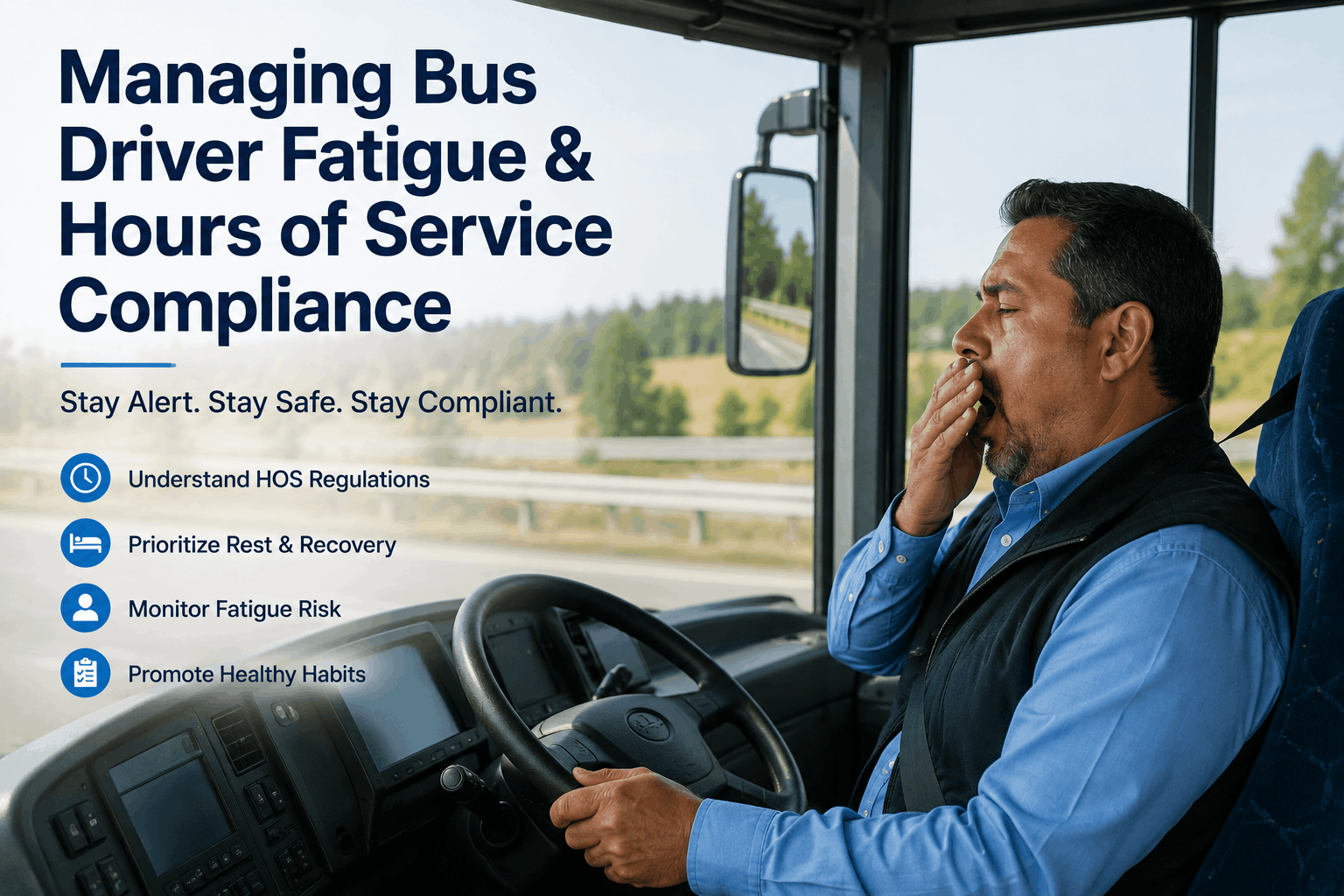
Bus driver fatigue is one of the most significant contributors to commercial vehicle crashes, accounting for nearly 20% of all fatal bus collisions according to NHTSA data. Driver fatigue impairs reaction time, judgment, and decision-making—effects comparable to driving under the influence. For bus fleet operators, managing driver fatigue through hours-of-service (HOS) compliance and proactive fatigue prevention strategies is not just a regulatory requirement but a critical safety and operational imperative. The Federal Motor Carrier Safety Administration (FMCSA) sets strict HOS rules specifically designed to prevent fatigue-related incidents. Yet many fleet operators struggle to monitor compliance, enforce rest periods, and detect early warning signs of driver drowsiness. This comprehensive guide explains FMCSA hours-of-service rules for bus drivers, identifies the physiological and behavioral factors that increase fatigue risk, outlines practical fatigue-management strategies that leading fleets deploy, and shows how modern fleet management software tracks driver hours, triggers alerts, and protects both driver safety and your fleet's liability exposure in 2026.
Managing Bus Driver Fatigue & Hours of Service Compliance
Driver fatigue is a leading crash factor. Learn FMCSA hours-of-service rules for bus drivers and practical fatigue-management strategies to protect your fleet and passengers.
Why Bus Driver Fatigue Matters: The Safety Crisis
Driver fatigue affects approximately 13.5 million working adults in the United States who drive heavy vehicles for commercial purposes. Research from the American Transportation Research Institute shows that fatigue-related incidents cost bus operators an average of $8,500 per event in damage, liability, and downtime. But the human cost is far higher. Fatigued drivers operate with impaired cognitive function, delayed reactions, and poor decision-making—conditions that escalate minor incidents into serious crashes.
NHTSA data reveals that drivers operating on less than 4 hours of sleep have crash risk equivalent to drivers operating at a blood alcohol content (BAC) of 0.08%—the legal limit for impairment. Bus operators carry high passenger loads and operate in complex urban and highway environments. A single fatigue-related crash can result in multiple injuries, fatalities, regulatory investigation, civil lawsuits, and permanent reputational damage. Proactive fatigue management is not optional—it is a foundational safety requirement.
FMCSA Hours of Service Rules for Bus Drivers 2026
The Federal Motor Carrier Safety Administration (FMCSA) enforces strict hours-of-service (HOS) regulations under 49 CFR 395 to standardize driver work hours and mandatory rest periods. These rules apply to most commercial bus operators, including intercity buses, motor coach operators, and transit agencies operating vehicles over 10,001 pounds. Understanding these rules and maintaining compliance is essential for avoiding violations, fines, and safety risks.
FMCSA HOS rules are designed around the principle that fatigued drivers are unsafe drivers. Compliance protects your drivers, your passengers, and your fleet's reputation. Non-compliance carries penalties ranging from $500 to $5,000 per violation, Out-of-Service (OOS) orders, and potential criminal liability if an incident results in injury or death.
The Physiology of Driver Fatigue: Understanding the Biology
Driver fatigue is not simply "tiredness"—it is a measurable degradation of cognitive and motor function caused by circadian rhythm disruption, sleep deprivation, and prolonged wakefulness. The human body operates on a 24-hour circadian cycle that regulates alertness, hormone production, and core body temperature. Bus drivers who work irregular shifts, drive during late-night hours, or accumulate multiple short sleep episodes fall progressively out of alignment with this natural cycle.
Research from the National Sleep Foundation identifies three primary fatigue types affecting commercial drivers: acute fatigue (caused by single episodes of sleep loss), chronic fatigue (cumulative effect of insufficient sleep over days or weeks), and circadian fatigue (driven by driving during the body's natural sleep window, typically 2 AM to 6 AM). All three impair safety equally. A driver operating after 17 consecutive hours of wakefulness has performance equivalent to a 0.05% BAC. After 24 hours, the equivalent rises to 0.10% BAC—above the legal limit for impairment.
Cumulative Sleep Deprivation Impact on Driver Safety
Early Warning Signs of Driver Fatigue
Detecting fatigue before a safety incident occurs is critical. Supervisors and fleet managers should train themselves and their drivers to recognize the following warning signs:
Practical Fatigue Management Strategies for Bus Fleets
Leading bus operators implement comprehensive fatigue management programs that go beyond basic HOS compliance. These programs combine policy, technology, training, and culture to create a safety-first environment that prioritizes driver health and passenger safety.
Schedule routes and shifts to align with natural circadian rhythms. Avoid rapid shift rotations (back-to-back early starts, then late shifts). Provide at least 24 hours notice for schedule changes when possible. Research from the University of Pennsylvania Sleep Center shows that consistent scheduling reduces fatigue-related incidents by up to 35%. Many progressive fleets now use AI-driven scheduling software to balance driver preferences, passenger demand, and fatigue risk.
Establish written policy allowing strategic napping during long routes. A 20-minute nap taken during scheduled break periods can restore alertness and reduce crash risk by 26% according to the Journal of Sleep Research. Provide designated rest areas (break rooms, driver lounges) with basic sleep amenities. Do not penalize drivers for taking authorized breaks—the cultural message must be that rest is encouraged, not punished.
Conduct annual fatigue awareness training covering circadian biology, early warning signs, sleep hygiene, and company fatigue policies. Train supervisors to recognize fatigue symptoms during pre-trip inspections and vehicle walkarounds. Encourage drivers to self-monitor and self-report fatigue. Research shows that drivers who receive formal fatigue training and feel empowered to report concerns have 40% fewer fatigue-related incidents.
Deploy fleet management software with automatic HOS tracking and compliance alerts. Modern systems integrate GPS, vehicle telematics, and driver input to maintain accurate records of driving time, on-duty time, off-duty time, and sleeper berth time. Real-time alerts notify drivers when they approach HOS limits, allowing them to plan breaks proactively. Digital logging devices (ELDs) are now mandatory for interstate commercial vehicles, so capturing this data should be seamless and integrated into your daily operations.
Partner with occupational health providers to screen for sleep disorders (sleep apnea, insomnia, narcolepsy) that increase fatigue risk. Drivers with untreated sleep apnea are 2.5 times more likely to have a safety incident. Offer confidential support, treatment referrals, and periodic follow-ups. Create a culture where drivers feel comfortable reporting sleep issues without fear of job loss.
Use fatigue detection technology (eye-tracking cameras, reaction time devices, behavioral analysis) to screen drivers before high-risk shifts. Some progressive fleets use brief digital assessments that measure reaction time and alertness—similar to a "sobriety test"—to determine if a driver is fit for duty. If a driver fails the assessment, they are pulled from service and provided rest time with pay, preventing incidents before they occur.
Ensure driver seats are ergonomically designed, climate control is functional, and lighting is adequate. Poor seat design, uncomfortable temperature, and dim interior lighting all contribute to fatigue. Upgrade older vehicles with modern ergonomic seats, ventilation, and adjustable controls. Driver comfort directly correlates with alertness and safety.
Build a safety culture where drivers feel responsible for their own health and safety, and for their peers'. Establish peer mentoring programs where experienced drivers support newer drivers in managing fatigue. Celebrate drivers who maintain perfect safety records and HOS compliance. Make it clear that pushing through fatigue is not heroic—it is unsafe and against company policy.
How Fleet Management Software Supports Fatigue Prevention
Modern fleet management systems (CMMS and telematics platforms) play a critical role in fatigue management by providing visibility, automation, and real-time decision support. Here is how:
FMCSA Compliance and Liability Protection
FMCSA audits bus operators for HOS compliance during roadside inspections and facility audits. Non-compliance is a serious violation with consequences including civil penalties, Out-of-Service (OOS) orders that remove your bus from service, and increased liability exposure. If a fatigued driver is involved in a crash, the FMCSA will investigate your HOS logs, training records, and safety policies. Poor documentation or evidence of negligent fatigue management can result in punitive damages in civil lawsuits and criminal liability for management.
Conversely, fleets with documented fatigue management programs, comprehensive HOS compliance records, and evidence of proactive monitoring are better protected in litigation. Digital record-keeping, automated compliance systems, and clear safety policies demonstrate due diligence and significantly reduce liability exposure.
For more information on FMCSA rules and regulations, visit the official FMCSA website at https://www.fmcsa.dot.gov. The Federal Register also maintains detailed guidance on hours-of-service rules and compliance procedures.
Customer Safety Profile: How Better Fatigue Management Transformed Operations
After implementing a comprehensive fatigue management program including real-time HOS tracking, shift scheduling optimization, and mandatory fatigue training, our 65-bus fleet reduced fatigue-related safety incidents by 68% within 18 months. More importantly, our drivers reported feeling safer and more respected. One driver told me, "I know the company cares about my health, not just getting the route done." That culture shift is invaluable. We've also seen reduced maintenance costs and improved on-time performance as secondary benefits of better-rested drivers. The investment in fleet management software and driver support paid for itself in incident reduction alone.
Frequently Asked Questions About Bus Driver Fatigue and Hours of Service
What is the difference between off-duty time and sleeper berth time under FMCSA rules?
Off-duty time is any period when a driver is not on duty, not driving, and not in the vehicle. Sleeper berth time is when a driver is resting in a sleeper berth of a commercial vehicle. Both satisfy HOS break requirements, but off-duty time (leaving the vehicle entirely) provides better physiological recovery and is preferred for genuine rest.
Can a bus driver reset their hours of service clock by taking time off?
Yes, drivers can reset their 70-hour/8-day clock by taking 34 consecutive hours off duty. This is called the "weekly reset." Many fleets schedule full days off strategically to allow drivers to reset and prevent accumulation of fatigue.
Are there exceptions to FMCSA HOS rules for emergency situations?
Yes, the FMCSA allows emergency exemptions (emergency relief operations, natural disasters) but these must be documented and reported. Most bus operators should not rely on exemptions. Regular HOS compliance is the standard requirement.
What is the penalty for HOS violations, and how is compliance documented?
Penalties range from $500 to $5,000 per violation. Electronic Logging Devices (ELDs) are mandatory for most commercial buses. Digital logs provide automatic compliance documentation reviewed during FMCSA audits. Non-compliance carries operational and financial consequences.
How often should bus fleets conduct fatigue awareness training for drivers?
Minimum annual training is recommended, with refresher training every two years. Best practices include quarterly toolbox talks covering seasonal fatigue risks, post-incident training following any fatigue-related event, and ongoing coaching by supervisors. Digital training platforms make this scalable and auditable.
Can fatigue detection technology replace human oversight and HOS compliance?
No. Fatigue detection (eye-tracking, reaction time tests) is supplemental. HOS compliance, proper scheduling, adequate rest, and human oversight are foundational. Technology enhances these practices but does not replace them. The goal is layered prevention, not single-point solutions.
What should I do if a driver self-reports fatigue or fails a fitness-for-duty assessment?
Remove the driver from service immediately with pay. Offer rest time (nap, overnight break), provide hydration and meal support, and reassess before allowing return to driving. Document the incident. If fatigue is recurring, escalate to occupational health screening and potential sleep disorder evaluation.
How can BusCMMS help with hours-of-service management and fatigue prevention?
BusCMMS provides integrated HOS tracking, real-time compliance alerts, driver behavior monitoring, and scheduling optimization tools. Automated logging and historical analysis identify fatigue patterns early. Reports support FMCSA audits and liability defense. Schedule a demo to see how your fleet can improve fatigue management and safety.
Protect Your Drivers and Passengers: Start Proactive Fatigue Management Today
Driver fatigue is preventable. Bus fleets with systematic HOS compliance, proper scheduling, fatigue training, and real-time monitoring achieve 60–80% reductions in fatigue-related safety incidents. Your drivers deserve a workplace culture that prioritizes their health. Your passengers deserve safe travel. Your fleet deserves protection from liability and regulatory risk.