65% of fleet maintenance teams plan to adopt AI inspection tools by the end of 2026. The AI vehicle inspection market hit $1.9 billion in 2024 and is projected to reach $6.9 billion by 2033. Computer vision now detects defects across 163+ vehicle components with 95–99% accuracy — catching 40% more issues than manual inspections. But here's the problem: every platform says "AI-powered." Most are just digital checklists with a camera button. Real AI means the system identifies defects in your photos, predicts failures from patterns, and auto-routes repairs — not just stores pictures. We tested 6 platforms specifically for bus fleet operations and ranked them on what actually matters: bus-specific detection, FMCSA compliance, defect-to-repair automation, and cost for school districts and transit agencies.
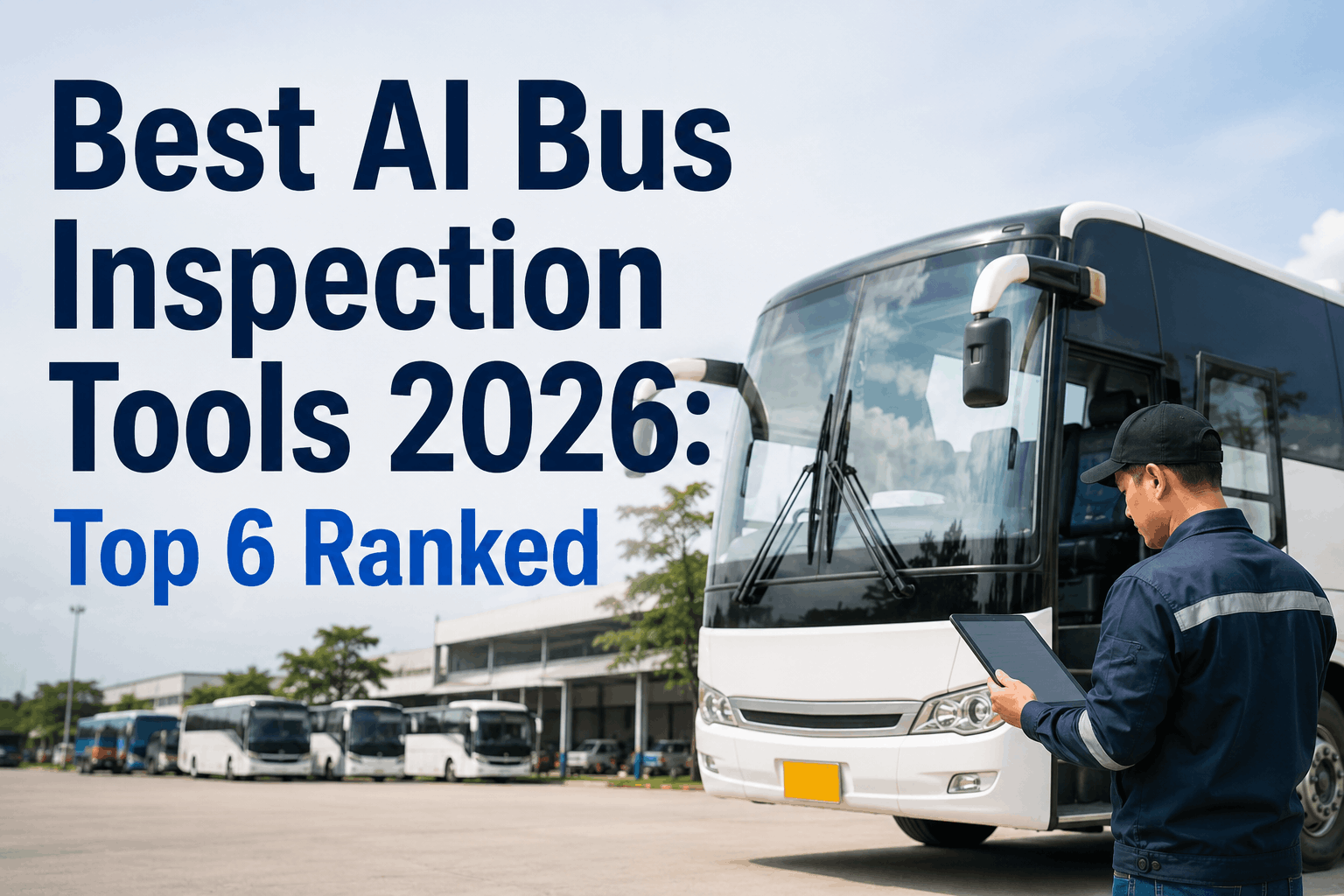
Best AI Bus Inspection Tools 2026: Top 6 Ranked
Ranked on bus-specific AI detection, FMCSA compliance, defect-to-repair workflow, mobile experience, and pricing for school districts and transit agencies.
AI Inspection in 2026
How We Scored: 5 Criteria That Matter for Bus Fleets
Most comparison sites rank on generic "features" and "ease of use." We ranked on what actually determines whether an AI inspection tool works for school buses and transit fleets — because inspecting a 72-passenger school bus is nothing like inspecting a semi-truck.
The Top 6 AI Bus Inspection Tools — Ranked
The only AI inspection platform built exclusively for school bus and transit fleets — bus-specific templates, stop arm detection, emergency exit verification, and wheelchair lift tracking included out of the box.
See BusCMMS AI inspect a school bus in a live demo — book 20 minutes
IoT-powered fleet operations with AI dashcams, fault detection, and maintenance workflows. Strongest when you need GPS tracking and AI inspection in one ecosystem.
Hardware ~$99/vehicle + $20–50/vehicle/mo
Mobile-first digital inspection platform with customizable checklists, photo/video capture, and real-time defect reporting. Strongest driver adoption rates in the industry.
Starts ~$5/vehicle/mo · Custom enterprise pricing
Cloud-based fleet maintenance with strong inspection workflows, work orders, and parts tracking. AI features are growing but still secondary to the core CMMS.
$4/vehicle/mo (Essentials) · $7/vehicle/mo (Premium)
RFID-verified EVIR inspections that prove the driver physically touched each checkpoint. Tamper-proof compliance records. Strong in student transportation.
Quote-based · Typically $10–20/bus/mo + hardware
AI-powered fleet platform with strong ELD, dashcam, and DVIR. Built for trucking — powerful technology but requires customization for bus-specific workflows.
Quote-based · Typically $20–40/vehicle/mo + hardware
Compare BusCMMS AI against your current platform — book a demo
Every Platform Says "AI-Powered." Only One Is Built for School Buses.
BusCMMS AI includes pre-loaded school bus DVIR templates, stop arm and emergency exit detection, fuel-type-specific inspections, native GPS integration, defect-to-work-order automation, and district-friendly pricing — all out of the box. No customization. No enterprise minimums. No hardware required.
"We evaluated Samsara, Fleetio, and BusCMMS. Samsara's AI was impressive for dashcam and GPS — but their inspection templates didn't have stop arm or emergency exit fields. Fleetio's work orders were great but no bus-specific AI. BusCMMS had everything pre-loaded on day one — school bus templates, photo-verified defect detection on bus components, fuel-type PM, and auto-generated work orders. Our defect detection went from 2% on paper to 14% in the first month. The AI flagged 3 crossing gate delays and 2 emergency exit issues our drivers had been walking past."
65% of maintenance teams plan AI adoption by end of 2026. The eDVIR rule is live. CSA now scores "Driver Observed" violations separately. The AI inspection market is growing 15.8% annually. Early adopters are catching 40% more defects and saving $8,500 per bus per year. Every month you wait is a month your competitors are building the data foundation that powers predictive maintenance.
Fleet Expert Review
The market splits cleanly: telematics platforms (Samsara, Motive) that added AI inspection as a feature, inspection-first platforms (Whip Around, Zonar) that added maintenance as a feature, general CMMS platforms (Fleetio) that added AI as a feature, and bus-specific platforms (BusCMMS) that built AI into the bus fleet workflow from the start. Each category excels at its original strength and is weaker elsewhere.
For school districts and transit agencies, the critical question isn't "which has the best AI" — it's "which has the best AI for buses." A platform that detects tire wear with 99% accuracy but doesn't have a field for crossing gate inspection is missing the component that matters most for student safety. BusCMMS ranks #1 because it's the only platform where the AI, the inspection templates, the PM schedules, and the compliance workflows were all designed for buses from day one — not adapted from trucking after the fact.
The Bottom Line
AI bus inspection in 2026 catches 40% more defects, cuts inspection time 67%, and saves $8,500 per bus annually. Six platforms can do it — but only one was built for buses from the ground up. BusCMMS AI includes school bus DVIR templates, bus-component detection, fuel-type inspections, defect-to-work-order automation, and district pricing. If your fleet carries students, the tool built for students is the tool that protects them best.
The #1 AI Inspection Tool for Bus Fleets. Try It Free.
Bus-specific AI detection. Pre-loaded DVIR templates. Defect-to-repair automation. Fuel-type inspections. District pricing. No hardware. No enterprise minimums. The AI platform built for the fleets that carry students.