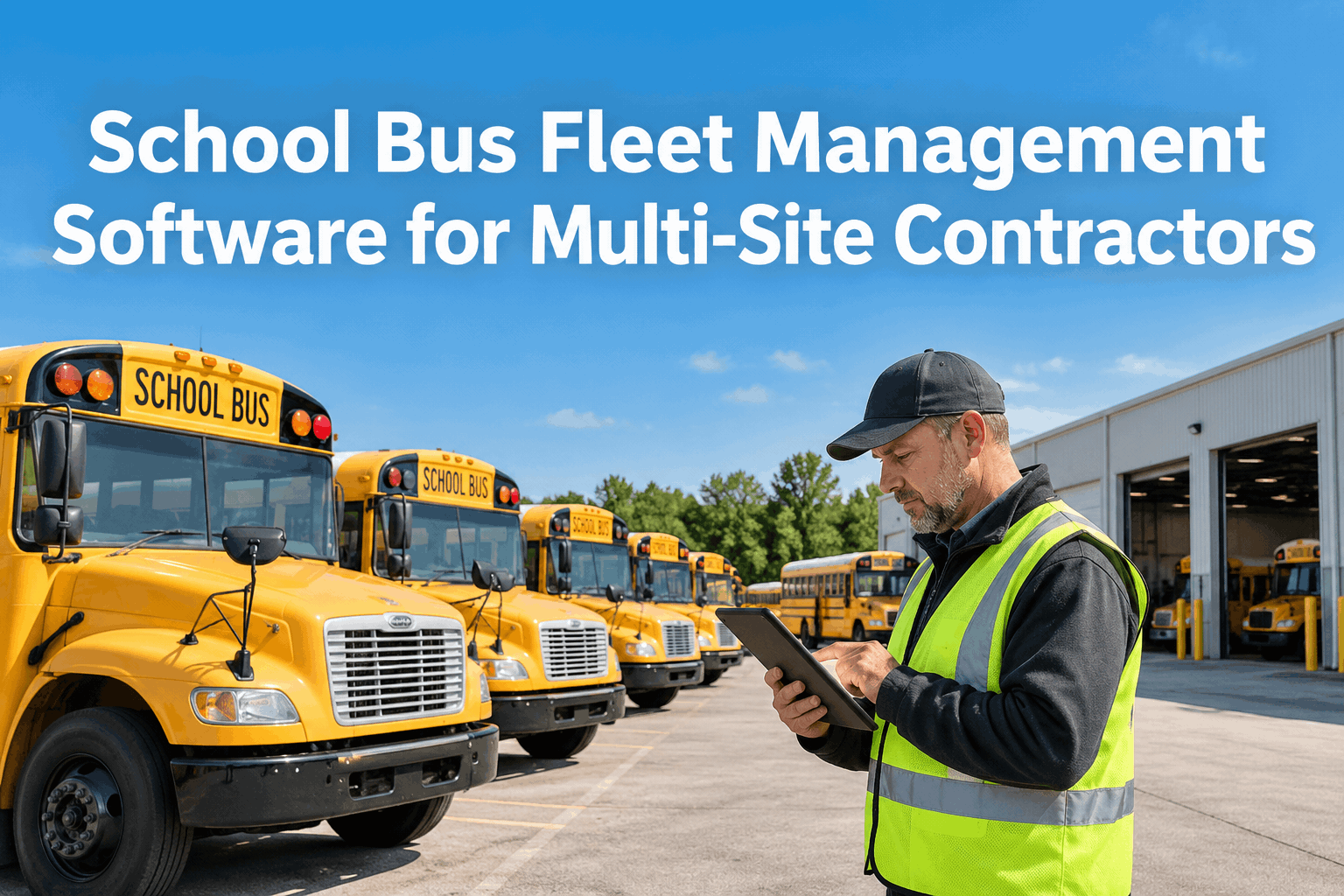
A 67-bus Texas school district spent two years managing fleet maintenance with a generic CMMS platform designed for manufacturing facilities. The software had hundreds of features, a steep learning curve, and required constant customization to match school bus workflows. Their technicians spent more time navigating menus than fixing buses. Their fleet manager spent weekends manually syncing DOT inspection schedules. Their transportation director had no real-time visibility into which buses were available for routes. When they switched to a platform built specifically for school buses, everything changed. Implementation took two weeks instead of two months. Technicians stopped fighting the interface and started using it. DOT compliance transformed from a manual file-shuffle into automated alerts and batch reports. The lesson: a CMMS designed for bus fleets beats a generic platform customized for buses every time. This comparison walks through the seven best school bus CMMS platforms in 2026 — rated on what actually matters for school transportation: DOT compliance, ease of use, telematics integration, mobile access, and total cost of ownership.
School Bus CMMS Comparison — 2026
Best School Bus CMMS Software 2026: Full Comparison of Top 7 Platforms
Independent comparison of the seven leading school bus maintenance platforms in 2026. Rated on DOT compliance automation, ease of use, telematics integration, mobile app capability, and total cost of ownership. Which platform is right for your district?
Quick Selection Guide
For school districts focused on DOT compliance and DVIR automation
Pick: BusCMMS
For districts needing routing + scheduling + maintenance integration
Pick: Transfinder or Versatrans
For districts already using Geotab telematics
Pick: Geotab maintenance module
For large districts with enterprise budget and customization needs
Pick: Fleetio or RTA
School bus fleet management is fundamentally different from managing a trucking company or manufacturing equipment. Buses carry students, operate on fixed routes, require federal safety compliance, need daily pre-trip inspections, and run on school calendars. A CMMS designed for factories or freight fleets requires heavy customization to work for schools. Platforms built specifically for school buses deliver value immediately, with zero configuration overhead.
We compared seven leading platforms on five criteria that determine whether a CMMS actually works for school districts: DOT compliance automation, mobile app quality, telematics integration, ease of implementation, and total cost of ownership. The results may surprise you.
Which Platform Wins? The Answer Depends on Your District's Priorities.
For districts focused purely on school bus CMMS with zero customization needed: BusCMMS wins. For districts needing routing + scheduling integration: Transfinder or Versatrans. For districts already committed to a telematics provider: Geotab or Samsara with a paired CMMS.
Generic CMMS comparison sites score on features that look impressive in demos but rarely get used in actual school operations. We evaluated these seven platforms on five criteria that determine whether a system creates value for school districts: DOT compliance automation, mobile app quality, telematics integration, implementation speed, and cost structure that scales with district growth instead of punishing it.
1
DOT Compliance Automation
Can the system automatically track federal inspection schedules, DVIR requirements, and safety certification deadlines without manual configuration? How much does the fleet manager need to customize the system to match federal requirements?
2
Mobile App Quality
Can technicians inspect buses, log work orders, and request parts from the shop floor using smartphones? Does the app work offline or require constant connectivity? How quickly do changes sync back to the server?
3
Telematics Integration
Does the platform natively integrate with GPS and diagnostic data from your buses, or require third-party connectors? Can the system use diagnostic faults to trigger predictive maintenance?
4
Implementation Speed
How long before your district goes live with core CMMS functionality? Do you need a lengthy customization phase, or can you use the platform as-designed from day one?
5
Cost Structure
Does pricing scale fairly with fleet size, or do per-vehicle fees punish larger districts? Are there hidden costs for modules or integrations? Is trial and evaluation truly free?
"We were using Transfinder for routing and a generic CMMS for maintenance — a painful dual-system environment. We compared BusCMMS, Fleetio, and staying with our existing setup. BusCMMS won because our fleet manager could be productive on day one. No configuration. No training. The DVIR process matched our school's workflow, not the other way around. We switched 67 buses in two weeks, and within 30 days we were catching maintenance issues we'd been missing with the generic CMMS. Total cost: $1,200 annually for the platform. Savings from prevented breakdowns: $47,000 in the first year."
— Fleet Manager, 67-bus Texas school district
Your District Deserves CMMS Built for School Buses — Not Customized Factories.
The difference between a platform built for buses and one customized for buses is thousands of dollars in implementation cost, months of delayed go-live, and ongoing frustration when workflows don't match school operations. BusCMMS is built for school buses. From DOT compliance pre-configuration to mobile-first design to fair pricing that scales with your district, every feature assumes you're managing yellow buses carrying students — not trucks carrying freight.
What is the typical cost difference between platforms when managing a 75-bus fleet?
BusCMMS free tier covers 75 buses at zero cost; paid tier adds $99/month for advanced features ($1,188/year). Fleetio at $75/vehicle/month costs $67,500/year. Transfinder quote-based averages $25,000–$35,000 annually. Cost difference: $0–$67,500 annually depending on platform choice.
Can I implement a new CMMS platform without disrupting my school year?
Platforms designed for buses (BusCMMS) deploy in 2–3 weeks without operations disruption. Generic platforms (Fleetio, RTA) require 2–4 months of customization and training, typically requiring summer implementation. Router/scheduling platforms (Transfinder) take 3–6 months. Plan implementation for May–August.
Do I need a separate telematics platform (like Samsara) or does the CMMS integrate with my existing system?
BusCMMS integrates with Samsara, Verizon Connect, Geotab, and Zonar — keep your existing telematics, add CMMS on top. Generic CMM require separate connectors. If you don't have telematics, BusCMMS can function without it, then add integration later when you adopt GPS tracking.
Which platform has the best DOT compliance automation for school districts?
BusCMMS has federal inspection schedules pre-loaded with school-specific DVIR requirements (no setup required). Fleetio and RTA require customization. Transfinder and Versatrans include compliance but within routing/scheduling context, not as primary feature.
What happens if I need customization beyond the platform's standard features?
Bus-specific platforms (BusCMMS) rarely need customization. Generic platforms (Fleetio, RTA) offer professional services for $150–$300/hour. Enterprise platforms (Transfinder, Versatrans, Geotab) build customization into implementation projects at premium cost. Rule: avoid platforms requiring customization.
Can I evaluate multiple platforms before committing to one?
BusCMMS offers unlimited free tier for evaluation — no credit card needed. Fleetio, RTA offer free trials. Transfinder and Versatrans require quotes before demo. Geotab and Samsara require hardware installation. Start evaluation with BusCMMS for zero-friction assessment of bus CMMS capability.
How do I migrate data from my current CMMS to a new platform?
Bus-specific platforms handle migration from generic CMMS templates. Import/export typically completed in days using CSV imports of parts, vehicles, and service history. BusCMMS migration team handles data mapping at no additional cost. Generic platforms charge for migration services.
What support model should I expect — how quickly can I reach someone if there's a problem?
Bus-specialized platforms (BusCMMS) offer 24/7 email/chat and business hours phone at all tiers. Generic platforms vary: Fleetio offers business hours support at free tier, 24/7 at paid. Enterprise platforms include dedicated success manager. School districts should demand 24/7 coverage for daily operations.
The market for school bus CMMS splits into three categories: specialized platforms (BusCMMS) built exclusively for buses, general-purpose platforms (Fleetio, RTA) customized for schools, and transportation suites (Transfinder, Versatrans, Geotab) that integrate routing and maintenance. For districts focused purely on fleet maintenance reliability and DOT compliance, the specialized platform wins every time — lower cost, faster implementation, fewer surprises. For districts wanting routing and maintenance in one system, transportation suites make sense despite higher cost and longer implementation. The 67-bus Texas district saved $47,000 in prevented breakdowns in their first year by switching to a platform built for their actual workflow instead of a customized general platform. Your district's cost, compliance, and uptime depend on that choice.
Platform Built for School Buses. Not Customized. Built.
BusCMMS ranks #1 in 2026 school bus CMMS comparison because it's the only platform designed from the ground up for school district operations — with pre-configured DOT compliance, mobile-first design, free tier for unlimited buses, and implementation in 2–3 weeks without disrupting your school year. Evaluate it free, then compare against the alternatives. You'll see why 156 fleet managers chose purpose-built over customized.