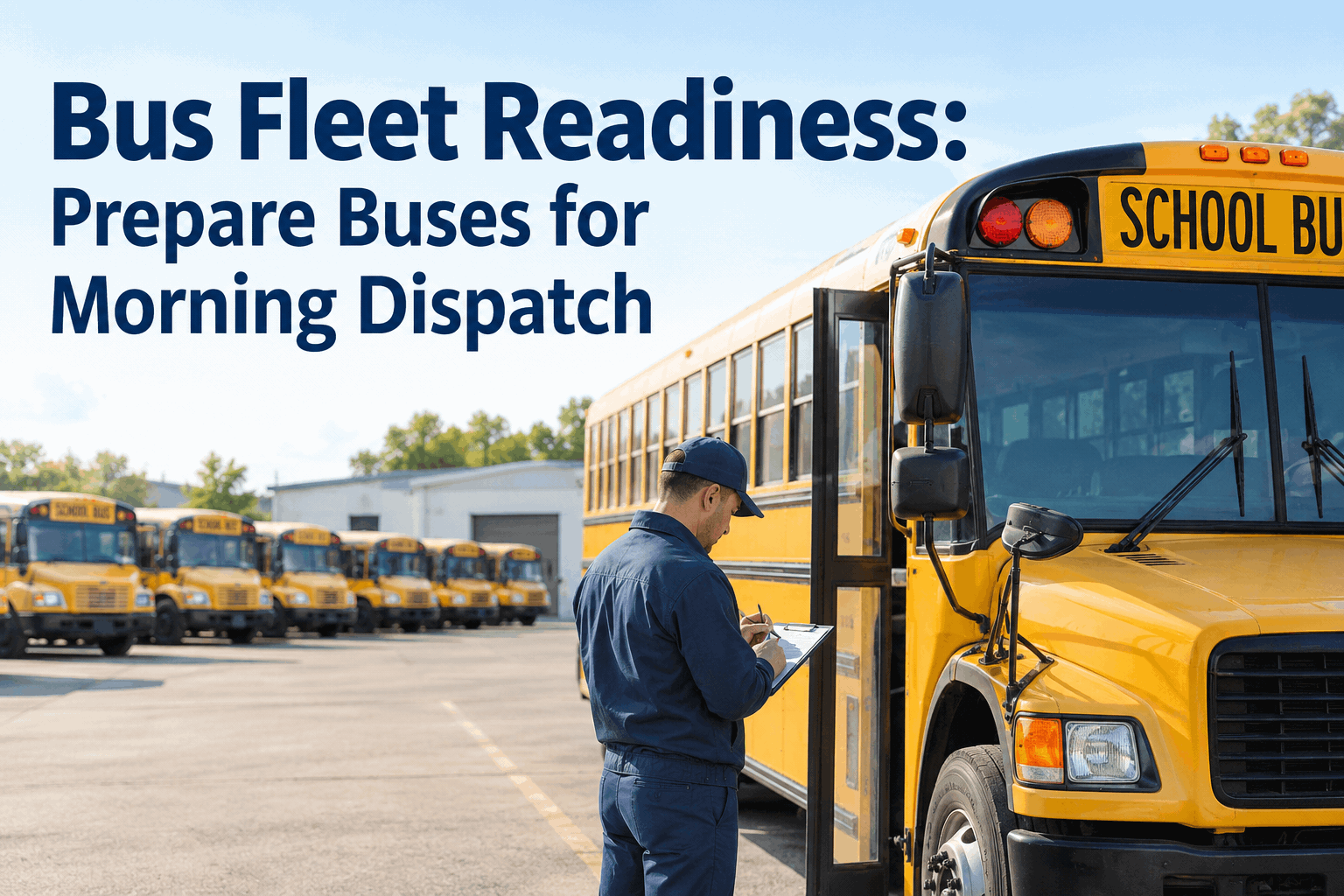
Every morning, 480,000 yellow school buses carry 26 million students across America. Behind every safe route is a maintenance shop, a fleet manager tracking oil changes, and a compliance binder that better be DOT-ready. The software you choose to manage those buses determines whether your fleet runs at $0.32/mile or $0.58/mile — whether buses break down on routes or get fixed before they leave the yard. We ranked 10 platforms on what actually matters for school bus operations: keeping buses safe, compliant and on the road.
Top 10 School Bus Fleet Management Software in 2026: Honest Comparison for Districts
Scored on what transportation directors actually evaluate — not marketing claims
How We Scored: 6 Categories That Drive the Buying Decision
Most comparison sites score on generic "features" and "ease of use." We scored on what actually determines whether a platform works for a school bus fleet — because managing 50 yellow buses is nothing like managing a trucking company.
The Top 10 at a Glance
Here's the full ranking before we dive into detailed reviews. Each platform was scored 1–10 across all six categories, weighted equally.
Detailed Reviews: Top 5
What Makes BusCMMS the #1 Choice for School Districts
Pre-loaded inspection forms covering stop arms, crossing gates, emergency exits, student mirrors, and every bus-specific item. No manual setup required.
Separate PM schedules for diesel, propane, and electric buses running simultaneously on one dashboard. Mileage or calendar triggers generate work orders automatically.
Pre-built Samsara and Geotab connectors. Fault codes auto-create work orders. Odometer readings auto-trigger PM schedules. Idle time feeds fuel reports. Zero custom development.
Track fuel consumption per bus, per driver, and per route. Auto-flag MPG drops, reconcile fuel card purchases against consumption, and catch theft or waste instantly.
Auto-scheduled annual inspections, 90-day emergency exit checks, DVIR retention tracking, and instant audit-ready reports. FMCSA 2026 eDVIR compliant out of the box.
When a driver flags a defect during inspection, it becomes a trackable work order in seconds — assigned, prioritised, and documented without any manual re-entry.
Real Results from BusCMMS Districts
Book a 20-min demo and we'll walk through it with your actual fleet data
Strengths
Intuitive mobile app with offline mode and photo capture
Strong work order and parts inventory management
Open API integrates with most telematics providers
Limitations
DVIR templates are generic — requires custom setup for school buses
5-vehicle minimum; pricing scales quickly at larger fleet sizes
No built-in school bus compliance calendar or student-specific features
$4/vehicle/mo (Essentials) · $7/vehicle/mo (Premium) · 5-vehicle minimum
Strengths
AI-powered fault detection predicts failures before breakdowns
Voice-to-text DVIR notes and video-verified inspections
Best-in-class dashcam and safety camera ecosystem
Limitations
Telematics-first — maintenance and work orders are secondary features
Hardware costs ($99+/vehicle) plus $20–50/mo subscription
Best paired with BusCMMS for complete maintenance depth and work order management
Hardware ~$99/vehicle + $20–50/vehicle/mo · Enterprise pricing available
Quote-based · Typically $10–20/bus/mo + hardware · 99% customer retention
Quote-based · Typically $5–15/student annually · Large district focus
Sign up free and run a real inspection on your first bus in minutes
Platforms #6–10: Quick Reviews
How Does Your Current System Compare?
Whether you're on Fleetio, Samsara, spreadsheets, or nothing at all — BusCMMS was built to replace or integrate with your current setup. A 20-minute demo uses your fleet size and your buses.
What Fleet Managers Say After Switching
"We used Fleetio for two years. Great tool, but we spent weeks building school bus inspection forms from scratch. BusCMMS had everything pre-loaded on day one — stop arms, crossing gates, emergency exits, student mirrors."
"Samsara gives us incredible GPS data. But for maintenance and work orders, we needed a real CMMS. Now Samsara handles tracking and BusCMMS handles everything in the shop. They sync automatically."
The market splits into three categories: routing platforms (Transfinder, Versatrans) that handle routes and schedules but not maintenance; telematics platforms (Samsara, Geotab, Zonar) that track GPS and diagnostics but lack deep CMMS; and maintenance platforms (BusCMMS, Fleetio, RTA) that handle work orders, PM, and compliance. Most districts need a maintenance CMMS plus a GPS/routing tool. BusCMMS ranks #1 because it's the only maintenance platform built specifically for bus fleets — with bus-specific DVIRs, fuel-type PM schedules, native telematics integration, and district-friendly pricing already included. Districts switching to BusCMMS consistently report the fastest time-to-value because there's zero customisation needed to match school bus workflows.
If maintenance, inspections, and DOT compliance are your primary challenges — and they are for most school districts — BusCMMS is the clear #1 choice in 2026. It's the only platform that ships with school bus DVIR templates, fuel-type PM schedules, native GPS integration, per-bus fuel tracking, and DOT compliance automation without requiring weeks of custom setup. Districts that switch to BusCMMS from Fleetio, spreadsheets, or paper report the fastest deployment and highest adoption rates because everything is pre-built for how bus fleets actually work.
Fleetio is an excellent runner-up if you also manage non-bus vehicles. Samsara is unmatched for telematics and camera-based safety (and integrates natively with BusCMMS). Zonar leads in tamper-proof inspections. And Transfinder is the routing specialist for large districts. But for the complete bus fleet management stack — maintenance, inspections, compliance, fuel, and GPS in one place — BusCMMS stands alone.
Sign up free and see how it feels to manage your fleet without spreadsheets
Ready to See the #1-Ranked Platform?
Join the districts that have eliminated paper DVIRs, automated PM scheduling, and achieved 100% DOT compliance. A 20-minute demo walks through your fleet size, your buses, and your specific challenges.