A 140-bus transit agency in Ohio faced a triennial FTA review with maintenance records scattered across paper defect reports, spreadsheets, and the fleet manager's institutional memory. When auditors asked for mean distance between failures, roadcall analysis by mode, and state of good repair documentation, the agency had no way to produce the data. The review identified $7.3 billion in regional transit infrastructure needs — but the agency's own maintenance data was so poor that auditors questioned whether they could manage federal funding responsibly. Federal funding was at risk not because the buses were poorly maintained, but because the agency had no digital system to prove they were maintaining them. This guide covers every bus maintenance software requirement for public transit agencies in 2026: FTA compliance automation, National Transit Database (NTD) reporting capability, Transit Asset Management (TAM) plan support, ADA tracking, cost-per-mile calculation, and the platform features that separate software built for transit from software borrowed from trucking or school buses.
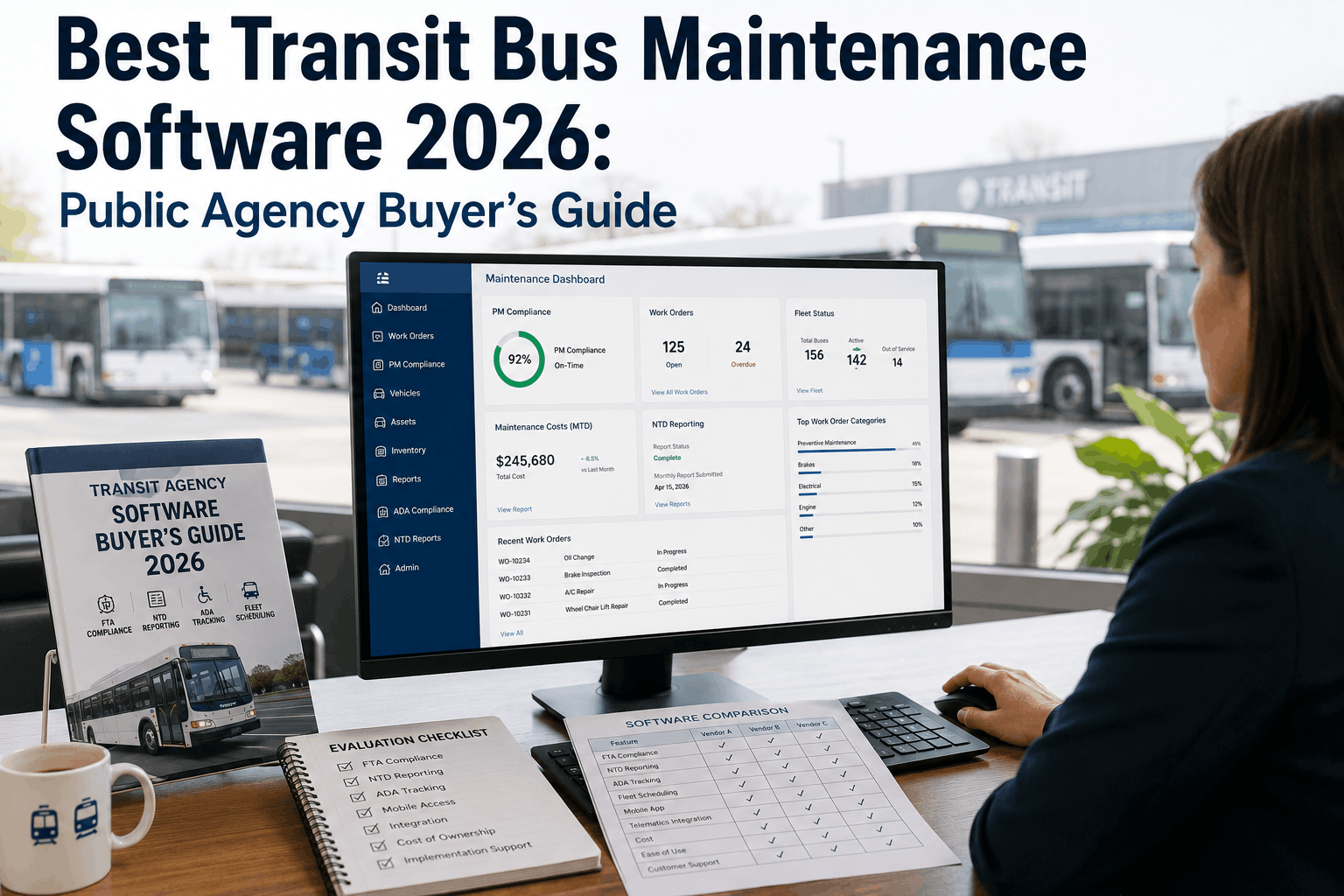
Best Transit Bus Maintenance Software 2026: Public Agency Buyer's Guide
Comprehensive guide to transit bus maintenance software for public agencies. Covers FTA compliance, NTD reporting, TAM planning, ADA accessibility tracking, and total cost of ownership for agencies of all sizes — from 30-bus rural systems to 500-bus metro agencies.
Transit Agency Compliance Requirements
FTA Triennial Review
Maintenance documentation + asset plan required
NTD Annual Reporting
Due 4 months after fiscal year end
TAM Plan (4-year)
Next update due October 2026
ADA Compliance
Accessibility feature maintenance documentation
The Four Compliance Frameworks Every Transit Agency Must Navigate
Transit agencies receiving federal funding operate under four overlapping compliance frameworks that pure school bus or commercial fleet software cannot address. The Federal Transit Administration (FTA) requires triennial reviews every three years — audits that examine your maintenance practices, asset management planning, and financial controls. The National Transit Database (NTD) requires annual data submission covering ridership, revenue, expenses, and fleet condition — with submission deadlines 4 months after fiscal year end and validation rules that reject incomplete or inconsistent data. The Transit Asset Management (TAM) Final Rule requires updated asset management plans every four years (next due October 2026) showing how you maintain and replace bus fleet assets. ADA compliance requires documentation of accessibility features, maintenance of wheelchair lifts, audible announcement systems, and boarding accessibility — with federal auditors spot-checking compliance during triennial reviews.
Generic CMMS platforms built for manufacturing or school buses do not address these transit-specific requirements. They lack NTD reporting templates, TAM data structures, roadcall tracking by mode, or ADA maintenance documentation. Adapting a generic platform to transit requirements requires customization that costs $50,000–$150,000 and pushes implementation timelines from 2–3 months to 6–9 months. Transit-focused platforms have these compliance features pre-built, allowing implementation in 2–4 weeks and immediate NTD and TAM reporting capability.
Four Compliance Frameworks: What Each Requires From Your Maintenance Software
FTA Triennial Review
Requires: Maintenance PM plans documented, roadcall data tracked, asset inventory with condition status, cost-per-mile calculations, safety incident reports
Frequency: Every 3 years | Risk: Corrective action if data is missing or inconsistent
NTD Annual Reporting
Requires: Revenue vehicle miles, operating expenses, maintenance costs, R-20 roadcall data by mode, ridership counts, fuel consumption, vehicle inventory
Deadline: 4 months after fiscal year end | Risk: Late submission affects funding allocation
TAM Plan (4-year)
Requires: Asset inventory with replacement value, condition assessment, useful life by category, annual funding needs, capital plan for next 10 years
Next update: October 2026 | Risk: Plan not submitted = eligibility loss for 5337 capital funding
ADA Compliance
Requires: Wheelchair lift maintenance records, accessible feature PM (audible stops, visual displays, door sensors), accessibility defect tracking
Continuous monitoring | Risk: FTA audit finding = corrective action agreement
Transit Agencies Need Software Built for Compliance — Not Customized to Avoid It.
BusCMMS was built by transit operators for transit agencies. FTA compliance, NTD reporting, TAM planning, and ADA tracking are pre-built, not bolted on. Your agency goes live generating compliant data from day one.
NTD Reporting: Where Most Transit Agencies Fail and How Software Prevents It
The National Transit Database is the federal government's primary source of transit statistics. Every transit agency receiving FTA funding must submit annual NTD data by a deadline that is 4 months after fiscal year end. The submission covers five categories: Basic Agency Information, Service Data, Financial Data, Safety Data, and Asset Data. Miss the deadline or submit incomplete data, and FTA validation rejects the submission, triggering follow-up requests and potential funding delays.
Most transit agencies compile NTD data from paper driver defect reports, maintenance logs, fuel receipts, and spreadsheets — then spend 2–3 weeks manually transferring that information into NTD forms. Data errors are common. Reconciliation of conflicting numbers from different sources is manual. Late submissions are endemic. A transit agency without digital CMMS typically receives NTD validation errors requiring correction submissions 30–40 days after the initial deadline.
The most critical NTD field for your agency's funding is the R-20 form: Maintenance Performance. This form requires tracking every revenue vehicle system failure (roadcall) by mode — fixed-route buses, demand-response vehicles, etc. FTA uses this data to calculate Mean Distance Between Revenue Vehicle System Failures (MDBF) — a key performance metric that auditors compare against your triennial review targets. An agency with poor MDBF data is flagged for corrective action, even if actual maintenance performance is good.
NTD Reporting Timeline: How Digital CMMS Eliminates the Annual Scramble
Without Digital CMMS
Month 0: Fiscal year ends
Month 1–2: Dig through paper logs for roadcalls, fuel, maintenance costs
Month 2–3: Build NTD spreadsheets, reconcile conflicting numbers
Month 4: Submit NTD — often with errors and late
Month 5: FTA validation rejects submission
Month 6–7: Resubmit corrected data
Total effort: 200–300 staff hours | Risk: Late submission, audit findings
With Digital CMMS
Month 0: Fiscal year ends — CMMS has captured all data automatically
Month 1: Click "Generate NTD Report" — one-click export ready for submission
Month 1–4: Review NTD report during year, no scrambling at deadline
Month 4: Submit NTD — clean data, on time, first-pass validation
Total effort: 20–30 staff hours | Result: Compliant, on-time submission
TAM Planning: Building Data-Driven Asset Replacement Strategy
The Transit Asset Management Plan is a 10-year capital strategy showing how your agency will maintain and replace bus fleet assets. FTA requires TAM plans to be updated every 4 years, with the next update due October 2026. The plan must address: asset inventory by type and age, current condition status, remaining useful life by category, annual replacement needs, total capital requirements, and how you will fund replacements.
Most agencies treat TAM planning as a compliance checkbox — assembling data under deadline pressure, filing the plan, and forgetting it until the next 4-year cycle. The better approach is maintaining a live asset register throughout the year, updating condition status automatically as maintenance occurs, and letting your CMMS calculate useful life status (ULB) continuously. When TAM planning cycle arrives, you have current data ready instead of guessing at asset conditions.
The $89.8 billion national transit infrastructure backlog exists partly because agencies cannot demonstrate funding needs with defensible data. TAM plans built on live maintenance data show clear replacement timelines and capital requirements — giving you stronger justification when requesting Section 5337 capital funding from FTA.
"Our agency faced a triennial review with three years of maintenance data scattered across paper logs and spreadsheets. When auditors asked for roadcall analysis and mean distance between failures, we had no reliable numbers. The review flagged our maintenance documentation as 'insufficient to support federal funding oversight.' We were at risk of corrective action. We implemented BusCMMS immediately after the review and spent six months cleaning up historical data. The next year, our NTD submission was clean, on time, and passed first-pass validation. Our TAM plan update came with live asset data instead of estimates. The triennial review this year flagged zero documentation deficiencies. Compliance went from failing to flawless — not because we changed how we maintain buses, but because we have proof we're maintaining them."
Your Buses Are Maintained. Your Data Should Prove It.
BusCMMS was built for transit agencies by people who have passed FTA triennial reviews, submitted hundreds of NTD reports, and built TAM plans with real data. Pre-configured FTA compliance, NTD reporting, TAM planning support, and ADA tracking — ready to go live within weeks.
FAQ: Transit Bus Maintenance Software for Public Agencies
Is FTA compliance automation really necessary, or can we handle compliance manually with spreadsheets?
Manual compliance works until you face a triennial review with auditors asking for historical data to support your current practices. Then you discover gaps. Digital CMMS turns compliance from reactive firefighting (during review) to automatic capture (throughout the year). The $89.8B national infrastructure backlog exists partly because agencies lack defensible maintenance data.
How much does an NTD submission fail because of data quality issues with generic CMMS?
Industry data shows 35–45% of first-time NTD submissions from agencies using generic (non-transit) CMMS fail initial validation. Transit-focused CMMS deployments achieve 90%+ first-pass validation rate. The difference is pre-built NTD data structures vs. customized workarounds.
What is the cost difference between implementing transit-specific software vs. customizing generic CMMS for transit?
Transit-specific platform (BusCMMS): 2–4 weeks implementation, $5,000–$20,000 setup cost. Generic CMMS customization: 6–9 months implementation, $50,000–$150,000 setup + $15,000–$30,000 annual customization maintenance. Transit-specific software is faster and cheaper.
How do I prepare for the next TAM plan update (October 2026 deadline)?
Start capturing live asset data now using a transit-focused CMMS that tracks replacement value, useful life, and condition status automatically. By October 2026, you'll have 18+ months of data supporting your TAM plan instead of having to estimate asset conditions.
Can telematics data (GPS, diagnostics) improve maintenance scheduling and NTD reporting?
Yes — telematics provide continuous condition data that CMMS can use to trigger predictive maintenance and capture roadcall analytics for NTD. BusCMMS integrates with Samsara, Verizon Connect, Geotab, and other transit telematics providers to pull diagnostic data automatically.
What happens during FTA triennial review if my maintenance documentation is incomplete?
Auditors issue CAP (Corrective Action Plan) findings requiring you to improve documentation and resubmit proof within 90 days. If you don't comply, you risk loss of federal funding eligibility. Digital CMMS with live maintenance documentation eliminates this risk.
Is ADA maintenance tracking built into transit CMMS platforms?
Yes — transit-focused platforms like BusCMMS have pre-configured PM schedules for wheelchair lifts, audible announcement systems, visual displays, and door sensors. Generic CMMS do not track these ADA-specific components unless heavily customized.
How large of an agency is best-suited for digital CMMS — is it only for big 300+ bus systems?
Transit CMMS benefits agencies of all sizes. Even small 30-bus rural agencies benefit from automated NTD reporting and FTA compliance documentation. Total cost of ownership is typically 2–5% of annual maintenance budget — affordable for agencies of any size.
Transit agencies operate under compliance frameworks that generic fleet software was not designed to address. FTA triennial reviews, NTD annual reporting, TAM 4-year planning, and ADA accessibility tracking are not optional — they determine federal funding eligibility and audit outcomes. The 140-bus Ohio agency that faced a triennial review with incomplete maintenance records is not unique. What made them different was implementing digital CMMS immediately afterward and going from failing to flawless compliance within one year. Your buses are maintained. Your data should prove it with the rigor and consistency FTA requires.
Transit Agency Compliance Built In. Not Bolted On.
BusCMMS was built by transit operators for transit agencies. FTA compliance, NTD reporting, TAM planning, ADA tracking, roadcall analytics, and cost-per-mile calculations are pre-configured. Your agency goes live within weeks, generating compliant data from day one. No customization. No 6-month implementation. Just immediate compliance and reporting capability.