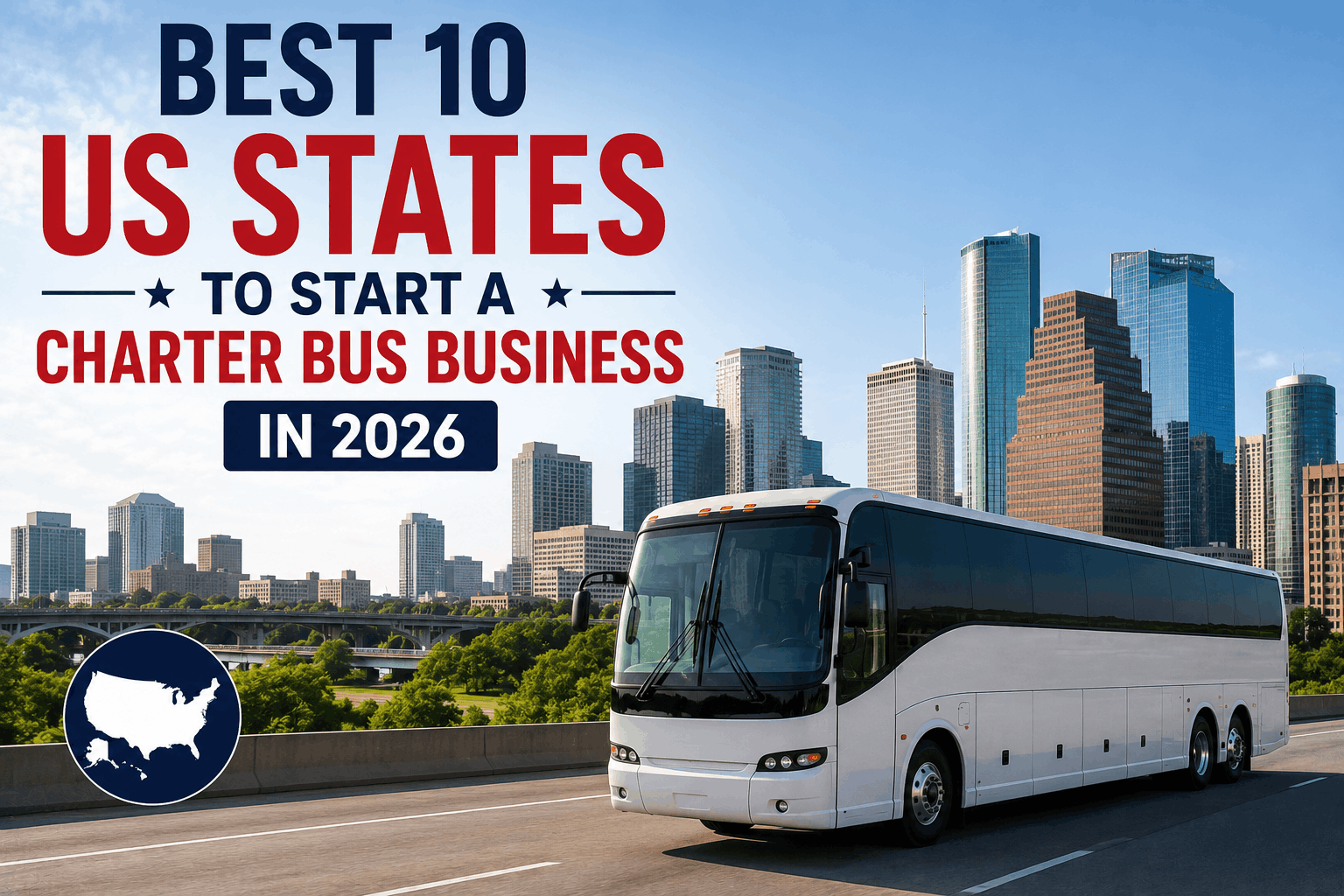
Starting a charter bus business requires choosing the right state. Demand, regulatory costs, licensing, and competition vary widely. This guide ranks the 10 best US states to launch a charter bus business in 2026 based on market demand, ease of compliance, and profitability potential.
Best 10 US States to Start a Charter Bus Business 2026
Best 10 US States to Start a Charter Bus Business in 2026
Ranked: 10 best US states to start a charter bus business. Demand, licensing, insurance, fuel taxes, IFTA, IRP, USDOT process and competitive landscape.
Why Location Defines Your Charter Startup Success
Choosing the right state impacts everything from insurance costs to customer demand and regulatory burden. The top-ranked states offer a blend of tourism traffic, favorable tax policies, and streamlined permitting that accelerates profitability.
$1.2M+
Average startup capital needed
22%
Market growth in top 5 states
40%
Lower insurance in friendly states
3 Years
Typical break-even timeline
Starting Your Charter Bus Business — Step-by-Step Progress
1
Business Plan & Market Research
Analyze local demand, tourism data, and competitor fleets. Select your target state based on this guide's ranking.
2
Register Business & USDOT
Form LLC or corporation, obtain USDOT number, and activate operating authority with FMCSA.
3
Secure IFTA & IRP
Register for International Fuel Tax Agreement and International Registration Plan to operate across state lines.
4
Obtain Insurance & Licensing
Secure $5M liability coverage, state-specific charter permits, and driver qualification files.
5
Launch Operations & Marketing
Deploy booking software, hire drivers, and promote services to tour operators, schools, and corporate clients.
Top 10 States for Charter Bus Business — Ranked
#1 Texas
Massive tourism, pro-business climate, and no state income tax. Dallas, Houston, and Austin drive year-round charter demand.
#2 Florida
Theme parks, cruise ports, and retiree group travel create endless opportunities. Lower insurance costs than coastal competitors.
#3 Georgia
Atlanta hub, film industry, and major sports events. Streamlined state licensing and competitive fuel costs.
#4 North Carolina
Growing tech and university sectors, mountain tourism, and moderate regulatory environment. Strong group travel market.
#5 Tennessee
Nashville and Memphis music tourism, plus corporate relocations. Low operating costs and central location for multi-state trips.
#6 Ohio
Dense population, manufacturing tours, and sports charters. Affordable real estate for fleet parking and maintenance facilities.
#7 Arizona
Grand Canyon and resort tourism, snowbird season peaks, and lower regulatory complexity. Strong winter demand.
#8 Colorado
Ski season, outdoor recreation, and corporate retreats. Higher insurance but premium pricing potential.
#9 Nevada
Las Vegas entertainment and convention traffic. Year-round tourism with high per-trip revenue opportunities.
#10 Indiana
Manufacturing tours, college sports, and crossroad logistics. Low entry costs and stable demand base.
Charter Bus Demand by State — Market Index Comparison
Texas leads with a demand index of 96, driven by massive tourism and corporate travel. Florida follows at 88, fueled by year-round group trips. Georgia, North Carolina, and Tennessee round out the top five, each offering unique local advantages for new operators.
Charter Bus Industry Revenue Growth in the US
The charter bus industry has recovered strongly, growing from $12.1B in 2020 to a projected $16.8B in 2026. States with the highest tourism and corporate travel capture the largest share of this expansion.
5 KPIs to Measure Your Charter Startup Success
Track these metrics from day one to ensure your new charter business is on the path to profitability:
Revenue per Mile
Target: Above $3.50/mile. Combines trip pricing and route efficiency; critical for covering high fixed costs.
Fleet Utilization Rate
Target: 75%+ of available coach days booked. Maximizes return on your largest capital investment.
Customer Acquisition Cost
Target: Below 8% of trip revenue. Monitor marketing spend per new group client to maintain healthy margins.
Safety Score
Target: Satisfactory USDOT rating. Clean inspections and zero preventable accidents protect your operating authority.
Break-Even Timeline
Target: Under 36 months. Track cumulative net income; state choice heavily influences this timeline.
State Selection Pass/Fail Checklist
Demand Density
Pass: High tourism, university presence, and corporate HQs within 100-mile radius.
Fail: Sparse population and seasonal dips that leave coaches idle most of the year.
Regulatory Friendliness
Pass: Streamlined charter permits, clear IFTA/IRP processes, and proactive state DOT support.
Fail: Excessive intrastate operating rules, long processing times, and frequent policy changes.
Insurance Affordability
Pass: Multiple carriers offering $5M liability at competitive rates with fleet discounts.
Fail: Limited carrier options, high minimum premiums, and frequent exclusions for charter operations.
Fuel Tax & Operating Cost
Pass: Competitive diesel prices and IFTA rates that don't erode margins on long hauls.
Fail: High fuel taxes and toll-heavy highways that disproportionately raise per-mile costs.
Labor Availability
Pass: Sufficient pool of CDL drivers with passenger endorsements and clean records.
Fail: Severe driver shortage, forcing expensive sign-on bonuses and constant recruiting cycles.
Competitive Landscape
Pass: Growing market with room for a quality-focused entrant; few mega-fleet monopolies.
Fail: Saturated market with price wars that make it impossible to achieve profitable rates.
We launched our charter business in Texas after evaluating all 10 states. The demand from Houston and Austin corporate clients exceeded projections, and the state's business-friendly approach cut our licensing time in half. Using BusCMMS from day one gave us integrated booking, maintenance, and compliance tracking that made our first year audit-ready.
Launch Your Charter Bus Business with the Right Tools
BusCMMS provides startup charter fleets with booking, dispatch, maintenance, and compliance in one platform. Start managing your new business from day one with the same system used by large motorcoach operators.
Starting a Charter Bus Business FAQs
How much capital do I need to start a charter bus company?
Plan for $1.2M to $2.5M to cover your first coach purchase or lease, insurance, permits, and operating capital for 6-12 months. State-specific costs can shift this range significantly.
Which state is the absolute best for a charter startup?
Texas consistently ranks #1 due to massive tourism, pro-business policies, and strong corporate demand. Florida and Georgia are excellent alternatives with slightly lower entry costs but comparable revenue potential.
What licenses do I need to operate a charter bus interstate?
You need a USDOT number, FMCSA operating authority (MC number), IFTA fuel tax registration, IRP apportioned plates, and a $5 million liability insurance policy. State-level charter permits may also apply.
How long does it take to become profitable?
Most charter startups reach break-even within 24 to 36 months. Strong demand states and efficient operations with integrated software like BusCMMS can shorten this to 18 months.
Can BusCMMS help with startup compliance?
Yes. BusCMMS tracks all vehicles, drivers, inspections, and compliance documents from day one. It helps new operators stay audit-ready for FTA reviews, DOT audits, and insurance renewals.
Is it better to buy or lease my first charter bus?
Many startups lease their first coach to conserve capital while testing markets. Leasing also simplifies maintenance and upgrading. As revenue stabilizes, purchasing used or new coaches often yields better long-term ROI.
The Bottom Line
Selecting the right state is the single most important decision when launching a charter bus business. Texas, Florida, and Georgia lead the 2026 rankings with exceptional demand, reasonable costs, and supportive regulatory environments. Use the five-step progress plan to move from research to full operations, and apply the pass/fail checklist to evaluate any state's viability. Track the five core KPIs to stay profitable, and leverage a platform like BusCMMS to manage bookings, maintenance, and compliance from your very first trip. With the industry projected to reach $16.8 billion in 2026, there has never been a better time to enter the charter bus market in a high-opportunity state.