Your buses roll back into the depot at 6pm and every charger kicks on at once. The depot's power draw spikes, and next month the utility bill has a demand charge on it bigger than the energy you actually used. You did not drive more — you just all plugged in at the same minute. That peak is schedulable. You can see how a charging schedule flattens the peak and cuts the demand charge.
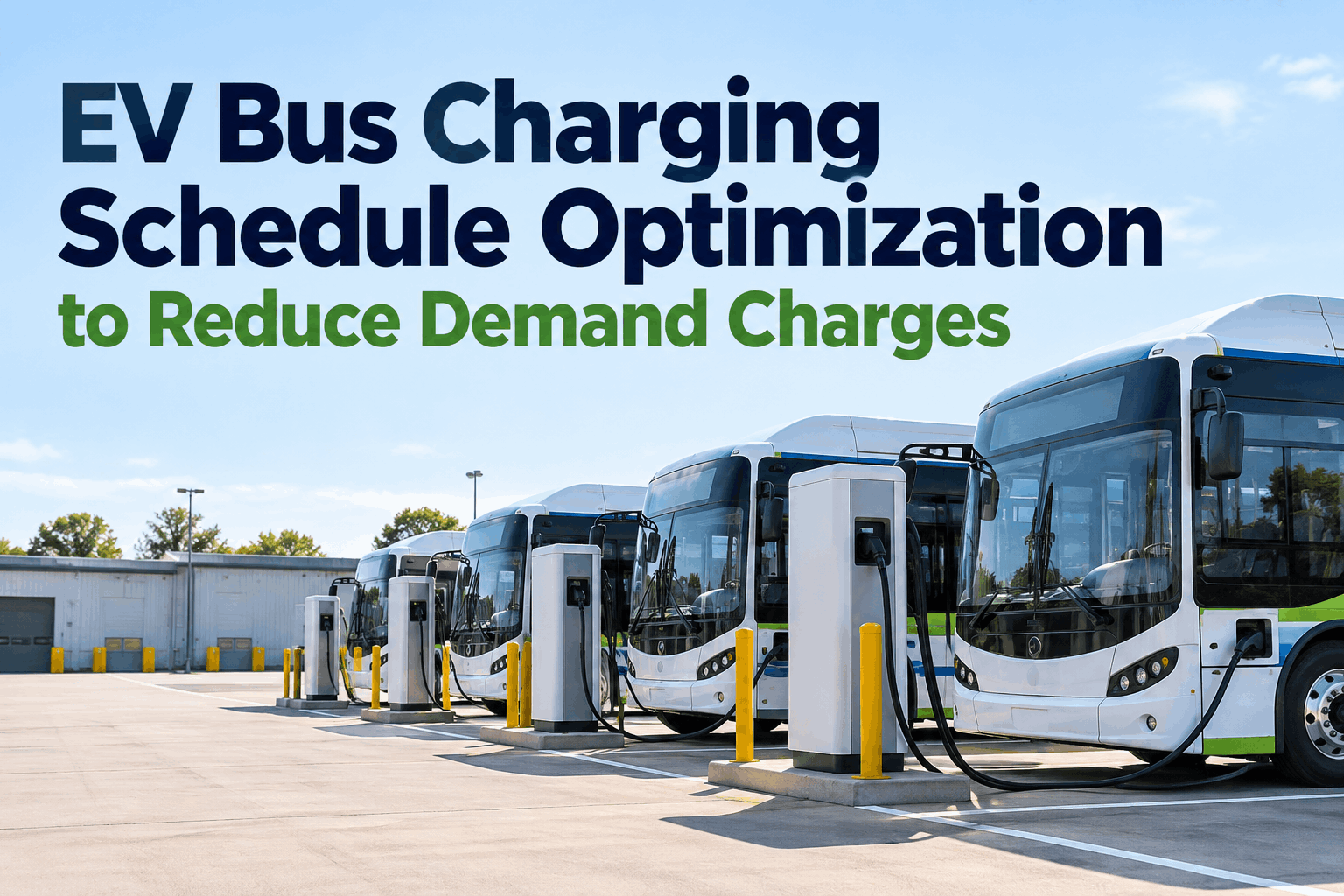
EV Bus Charging Schedule Optimization to Reduce Demand Charges
EV bus charging schedule optimization is about one thing the utility bill cares about most: your peak power draw. Demand charges are billed on the highest kilowatts you pull at any moment, not the total energy you use — so plugging every bus in at once builds a tall, expensive peak. Spread the same charging across the night and that peak flattens, while every bus still leaves full.
Why Demand Charges Dominate an EV Bus Depot Bill
An electric utility bill has two parts: energy, billed per kilowatt-hour you consume, and demand, billed per kilowatt of peak power you pull at any single moment. For a bus depot charging a whole fleet, the demand side is the one that hurts — and the one a schedule can control.
of total charges came from the demand portion in CALSTART's examples — 60% for a 50 kW customer, 94% for a 500 kW customer, on identical energy use.
per kW demand charge across the 26 utilities CALSTART reviewed, with some time-of-use rates reaching $59.24 per kW.
is all it takes — demand is usually billed on your highest average kW over any 15-minute interval in the month, and some rates ratchet that peak across a full year.
That last point is the whole game: one careless 15-minute spike can set your charge for the month, or longer. A deeper look at EV charging cost management for bus fleets walks through the tariff side; the rest of this guide is about building the schedule that keeps that spike from ever happening.
The Core Lever: Stretch the Time, Drop the Power
A bus needs a fixed amount of energy overnight — say 375 kilowatt-hours. Whether that takes four hours or eight does not change the energy, but it changes everything about the peak power. Charge slower over a longer window and the kilowatts you pull at once fall sharply.
Figures from CALSTART's FTA white paper on peak demand charges — doubling the charging window from 4 to 8 hours cuts the power draw in half, which is exactly where the demand-charge savings come from.
Most buses sit at the depot far longer than they need to charge, so that slack time is free money — if the schedule uses it. You can map your own dwell windows free and see how much room you have.
Sequencing the Fleet: A Staggered Charging Schedule
Stretching one bus is easy; the real optimization is sequencing the whole fleet so the groups overlap as little as possible. Split the buses into waves, send each wave to the off-peak window, and the depot's combined draw stays under your target instead of stacking into one spike.
The constraint that makes this hard by hand is readiness — every bus still has to be full for its route, so you cannot just push charging late. A system that knows each bus's departure window solves the puzzle automatically. It is worth a live look at scheduling the fleet against real departure times.
How BusCMMS Optimizes EV Bus Charging Schedules
A good charging schedule balances three things that fight each other: the demand-charge target, the off-peak rate window, and every bus being ready to roll. Four capabilities make that balance hold on a real depot.
Charging sequenced to a peak target
Buses are grouped into waves that keep the depot's combined draw under the kilowatt target you set, so no 15-minute spike ever sets a demand charge you did not plan for.
Shifted into the off-peak window
Charging lands in your low-rate hours by default, so you capture the time-of-use savings on energy at the same time you are shaving the demand peak.
Readiness by route and departure
Every bus is scheduled to reach the charge its next route needs before it leaves, so optimizing the bill never means a bus rolling out short on range.
One dashboard for cost and fleet
Charging cost, peak draw and fleet availability sit beside your diesel and CNG maintenance on the same dashboard, so energy is managed as part of operations, not a separate silo.
That turns charging from a bill you react to into a schedule you control — the same bus-specific system already runs your preventive maintenance, so charging strategy lives right next to it. The fastest way to judge it is a short walkthrough on your own depot's charging.
Our first full month on electric, the demand charge was almost the whole bill — we were pulling three hundred kilowatts because every bus charged the second it parked. Once we split the fleet into three waves across the night, the peak dropped by more than half and the bill came down with it. The hard part was never the chargers, it was making sure every bus was still full by first route. Letting the schedule handle both at once is what finally made the math work.
EV Bus Charging Schedule Optimization: Key Takeaways
Demand charges are the target
They are billed on peak kilowatts, not total energy, and can be the majority of a depot's bill — so lowering the peak, not using less energy, is where the savings are.
Stretch time to drop power
The same energy over a longer window means lower kilowatts at once. Doubling the charging window can roughly halve the peak power you draw.
Stagger the fleet into waves
Sequencing bus groups across the off-peak window keeps the combined draw flat and under target, instead of every charger spiking at once.
Readiness is the real constraint
Optimizing the bill only works if every bus is full for its route. A schedule that knows departure times is what makes the savings safe to take.
EV bus charging schedule optimization is not about charging less — it is about charging smarter, so the peak that sets your demand charge never happens. Build the schedule around your dwell windows and departure times, and the bill follows. You can start building your charging schedule free and size up the savings.
EV Bus Charging Schedule Optimization: Frequently Asked Questions
What is a demand charge on an EV bus depot bill?
A demand charge is the part of a commercial electric bill based on your peak power draw, measured in kilowatts, rather than the total energy you consume in kilowatt-hours. It is usually billed on the highest average kilowatts you pull over any 15-minute interval in the month, and some rates ratchet that peak across a full year. For a bus depot charging a whole fleet at once, this peak can be large: CALSTART found demand charges made up 60 percent of the bill for a 50 kW customer and 94 percent for a 500 kW customer on identical energy use. That is why EV bus charging schedule optimization focuses on the peak.
How does charging schedule optimization reduce demand charges?
By lowering the peak kilowatts the depot pulls at any one moment. A bus needs a fixed amount of energy overnight, but spreading that charge over a longer window drops the power required at once — CALSTART's figures show 375 kilowatt-hours needing 94 kW over four hours but only 47 kW over eight. Sequence the fleet into staggered waves so chargers do not all run together, and the combined depot draw stays flat under a target instead of spiking. The energy delivered is identical; only the peak changes, and the peak is what the demand charge is billed on.
Will optimizing the charging schedule leave a bus short on range?
Not if the schedule is built around readiness. The constraint that matters is that every bus reaches the charge its next route needs before it departs. A proper optimization schedules each bus's charging inside its dwell window and against its departure time, so flattening the peak never pushes a bus's charge too late. This is exactly why doing it by hand is hard and why a system that knows each bus's route and departure time is worth having — it solves the cost and readiness puzzle at the same time.
What is the difference between time-of-use rates and demand charges?
They are two separate levers. Time-of-use rates change the price per kilowatt-hour of energy by time of day — cheaper off-peak, more expensive on-peak — so shifting charging into the off-peak window lowers the energy portion of the bill. Demand charges are billed on peak kilowatts regardless of the hour. A good charging schedule captures both: it moves charging into the low-rate window and staggers it so the peak stays low. Optimizing only one leaves savings on the table, which is why a schedule should target the rate window and the peak together.
Do I need special chargers to optimize an EV bus charging schedule?
Smart, networked chargers make automated sequencing easier, but the strategy starts with the schedule, not the hardware. The core moves — stretching charge time to lower power, staggering buses into waves, and shifting into off-peak hours — come from how you plan charging against dwell and departure times. A fleet system like BusCMMS builds that plan around each bus's route and readiness, tracks charging cost and peak draw, and keeps it beside your maintenance on one dashboard, so the schedule drives the chargers rather than the other way around.