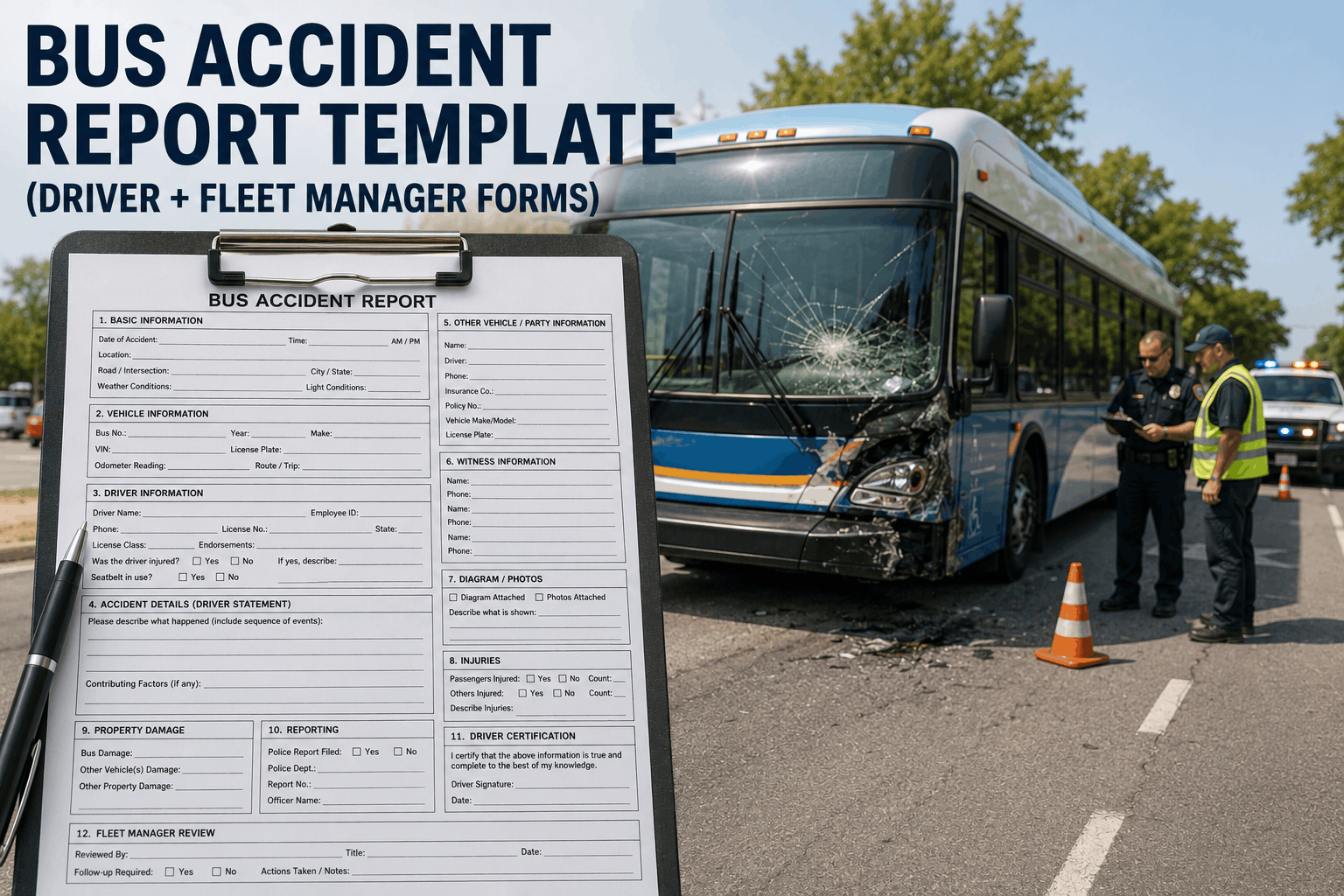
A regional school bus operator with 156 buses and 182 drivers faced a critical liability challenge after a serious intersection collision involving one of its vehicles. The driver submitted a handwritten incident report that omitted key details about road conditions, witness information, and the sequence of events. The fleet manager's internal investigation form was stored separately, and the required FMCSA accident register entry was completed weeks later with inconsistent data. When the state DOT conducted a post-accident review, investigators found that 41% of the operator's accident files lacked complete driver statements, 28% had no witness contact information, and 53% of FMCSA accident register entries contained errors or omissions. These documentation gaps not only delayed insurance claims but also exposed the district to regulatory penalties and liability exposure. After implementing a structured digital accident report framework with unified driver and manager forms, the operator reduced report processing time from 72 hours to 4 hours, achieved 100% complete documentation on all subsequent incidents, and passed their next compliance review with zero findings related to accident reporting. True accident preparedness means having a comprehensive, accessible reporting template that captures every critical detail from the moment of first response.
Bus Accident Report Template: Driver + Fleet Manager Forms
Stop losing critical incident details in paper forms. Capture driver statements, witness info, diagrams, and FMCSA‑ready data in one unified system.
Accident Reporting Impact — 156‑Bus Fleet
Report Processing Time (Manual)
48–72 hours average
Incomplete Driver Statements
41% missing critical details
FMCSA Register Errors
53% with omissions or inaccuracies
Digital Template Processing
4 hours or less
Documentation Completeness
100% verified records
Liability Exposure Reduction
Zero documentation‑related findings
The Accident Reporting Challenge: Fragmented Forms and Critical Omissions
Bus accident reporting typically involves multiple stakeholders—drivers, fleet managers, safety officers, and insurance adjusters—each collecting different pieces of information on separate forms. Drivers often provide handwritten statements that miss crucial details like road conditions, weather, or mechanical factors. Managers fill out investigation forms focused on damage estimates and repair timelines, while safety staff must separately compile FMCSA accident register data. These fragmented processes create gaps: driver statements may lack witness contact information, manager reports might omit time‑stamped photos, and register entries often contain inconsistent vehicle or driver details. A unified digital accident reporting template solves this by bringing all required fields into a single structured workflow. The driver completes their section on a mobile device at the scene, the manager adds investigation findings, and the system automatically populates the FMCSA register with validated data—creating a complete, audit‑ready file from the first moment of the incident.
Fragmented Paper Reporting
Driver Statement
Handwritten, often illegible, missing scene details and witness info.
Manager Investigation
Stored separately; damage and repair data not linked to driver report.
FMCSA Register
Manually compiled, leading to errors and omissions.
Photo/Diagram Capture
Loose files; often misplaced or not time‑stamped.
Unified Digital Accident Template
Driver Statement
Structured digital form with mandatory fields; immediate capture.
Manager Investigation
Integrated workflow; linked directly to driver and vehicle records.
FMCSA Register
Automatically populated from validated incident data.
Photo/Diagram Capture
Attached with timestamps and GPS coordinates.
Critical Accident Report Components to Capture
To ensure complete and defensible accident documentation, your template must capture five essential data pillars. First: Driver Section—personal information, route details, weather conditions, road surface, traffic controls, sequence of events, and a narrative statement. Second: Vehicle Section—damage assessment, mechanical condition, safety equipment status, and photos. Third: Witness Information—full contact details and statements from all involved parties and bystanders. Fourth: Diagram and Scene—drawing of the collision with positions, directions, and landmarks. Fifth: FMCSA Accident Register—recordable accident criteria, driver medical status, hazmat information, and reportable conditions. Consolidating these components into a single digital workflow eliminates omissions and ensures your reports meet both operational and regulatory requirements.
Accident Report Completeness Benchmarks
Digital Template Target
Paper‑Based Systems
Witness Capture Rate
FMCSA Register Accuracy
Accident Reporting Framework in Action: Real‑World Liability Protection
A mid‑sized private motorcoach operator running 67 coaches and 89 drivers faced a major liability crisis after a rear‑end collision involving one of their buses. The driver submitted a one‑page handwritten report, but the insurance company demanded detailed scene photos, witness statements, and a precise vehicle damage assessment to process the claim. The operator had no standardized process—the photos were on the driver's phone, witness contacts were on napkins, and the manager's investigation was conducted days later. The claim was delayed by eight weeks, and the operator ultimately paid a settlement higher than necessary due to insufficient documentation. After adopting a unified digital accident reporting template, the operator deployed mobile forms that guided drivers through each required field, including photo uploads, GPS tagging, and a scene diagram tool. Managers received real‑time alerts and could complete their investigation within hours. The result: claim processing times dropped from 60+ days to under 10 days, and the operator secured a 12% reduction in liability insurance premiums.
Disconnected Accident Response
Driver reports handwritten and incomplete.
Photos and evidence scattered across devices and email.
Witness information often lost or not recorded.
FMCSA register entries manually reconstructed.
Result: Delayed claims, regulatory exposure, and higher liability costs.
Unified Digital Accident Framework
Mobile‑first driver forms with mandatory fields and validation.
Direct photo and video capture with timestamps and GPS.
Witness contact and statement fields built into the workflow.
FMCSA register automatically generated from validated data.
Result: Faster claims, lower premiums, and complete regulatory compliance.
Strategic Rollout: 90‑Day Accident Reporting Integration
Implementing a digital accident reporting template can be completed in three focused phases without disrupting your daily operations. Month one: template design and driver training—configure your digital forms to capture all required data fields, including driver statements, vehicle details, witness fields, and FMCSA register triggers. Train drivers on mobile reporting procedures and practice scenarios. Month two: manager and safety team integration—enable investigation workflows, photo management, and diagram tools; test end‑to‑end reporting with simulated incidents. Month three: activate automated register generation and real‑time dashboards; conduct a live drill to validate process speed and completeness. This phased approach ensures your team is confident and prepared when the next real incident occurs.
Accident Reporting Template Rollout Timeline
Days 1–30
Days 31–60
Days 61–90
Audit Ready 2026
The Bottom Line
Managing bus accident reports through fragmented paper forms and manual data entry exposes your organization to serious liability, regulatory penalties, and insurance delays. A unified digital accident reporting template ensures that every incident is documented completely, accurately, and in full compliance with FMCSA requirements. From driver statements and scene photos to witness information and register data, a structured workflow captures everything in one place, ready for claims processing or regulatory review. BusCMMS provides the tools to build and deploy comprehensive accident reporting forms, integrate with driver and vehicle records, and generate audit‑ready files on demand. This framework reduces claim processing times, lowers liability costs, and gives your team the confidence that every incident is properly documented.
Digitize Your Accident Reports. Eliminate Documentation Gaps. Reduce Liability.
Centralize driver statements, witness info, diagrams, and FMCSA register data. Free 14‑day trial.
Frequently Asked Questions
What information must a bus accident report include for FMCSA compliance?
FMCSA requires driver and vehicle details, accident circumstances, injuries, fatalities, hazmat involvement, and a recordable accident determination. The template guides you through all required fields to ensure complete compliance.
How does a digital template improve driver reporting at the scene?
Drivers use a mobile device to complete a structured form with mandatory fields, photo capture, and GPS location. This ensures critical details are captured immediately, not hours or days later when memory fades.
Can the template handle multiple vehicle and witness entries?
Yes. The system supports unlimited vehicle and witness entries, with dedicated fields for contact information, statement, and relationship to the incident, all linked to the primary accident record.
How is the FMCSA accident register populated from the report?
The system automatically extracts validated data from the driver statement and manager investigation to populate FMCSA register fields, reducing manual entry errors and ensuring consistency.
What about uploading photos and diagrams?
The template includes dedicated photo capture with timestamp and GPS metadata, plus a scene diagram tool that lets drivers or managers sketch accident positions directly on the form using touch or mouse input.
How does the system support accident investigation and liability management?
Managers receive real‑time alerts when an accident report is submitted, allowing immediate investigation, damage assessment, and evidence collection. The complete digital file can be exported for claims, legal, or regulatory review.
Bring Your Accident Reporting Into a Fully Digital, Audit‑Ready Framework.
Standardize driver statements, capture scene evidence, and generate FMCSA‑ready reports instantly. Free 14‑day trial.