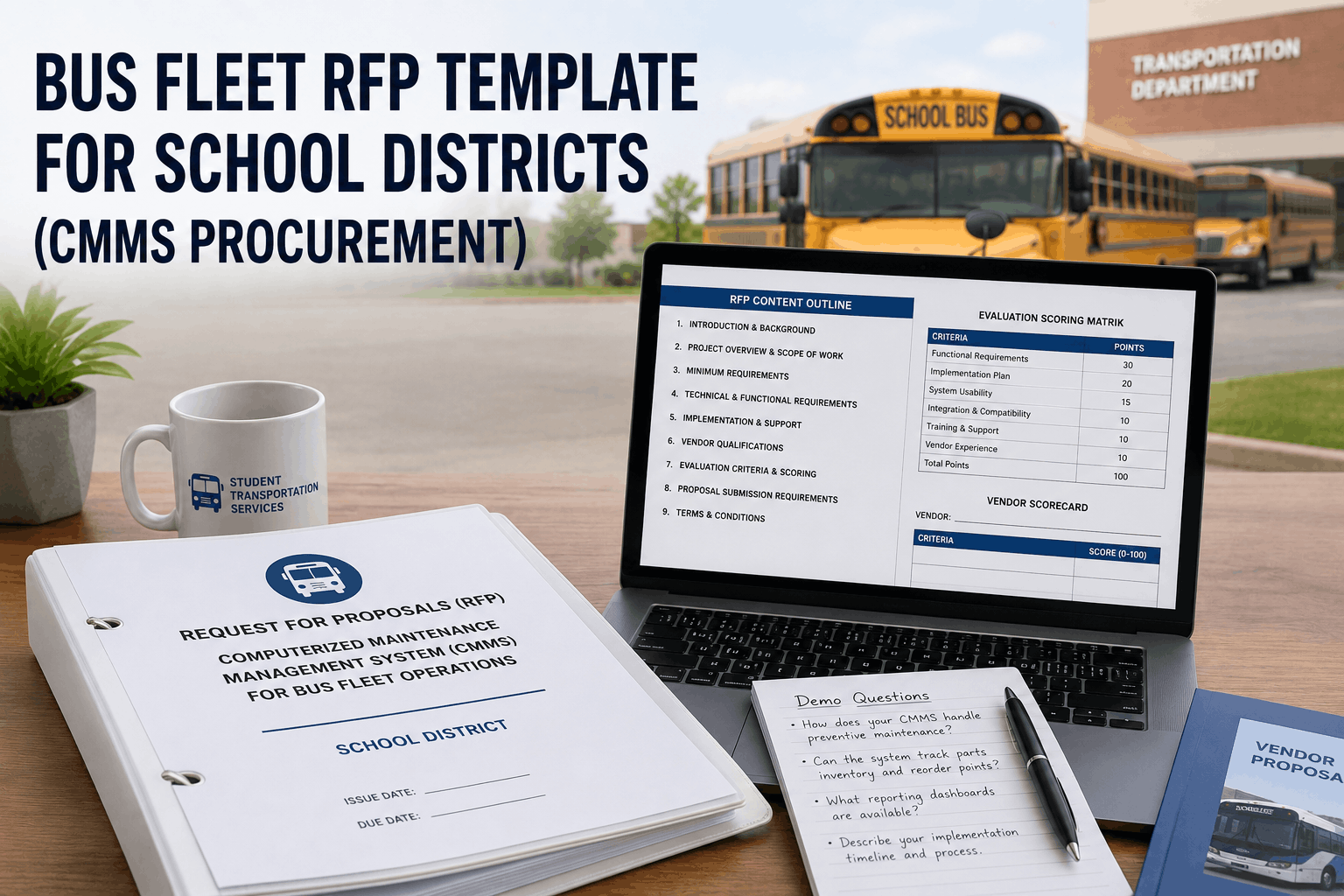
A mid‑sized school district operating 165 buses across 12 schools decided to replace its outdated, paper‑based maintenance tracking system with a modern CMMS. The transportation director drafted a request for proposals, but the initial RFP was vague: it listed basic features like work order management and parts inventory, but lacked clear evaluation criteria, compliance requirements, or a scoring matrix. When vendor proposals arrived, they were difficult to compare—each vendor highlighted different features, and the district had no structured way to assess them against operational needs. After a confusing selection process, the district ended up with a system that didn't integrate with their student transportation software, costing months of delays and $40,000 in change orders. A well‑structured RFP template, complete with functional requirements, evaluation weights, and vendor demonstration scripts, would have saved time, money, and frustration. This template provides school districts with a proven framework to procure a CMMS that fits their fleet, budget, and compliance needs.
Bus Fleet CMMS RFP Template for School Districts
Streamline your software procurement with a comprehensive RFP template. Include scope, functional requirements, evaluation criteria, scoring matrix, and vendor demo questions.
RFP Impact — 165‑Bus District
Vendor Proposal Evaluation Time
6–8 weeks (unstructured)
Change Orders Due to Scope Gaps
$35,000 – 50,000 average
RFP Response Relevance
35% off‑target proposals
Structured Template Implementation
3‑week evaluation, 90% relevant
Post‑Implementation Change Orders
Zero scope‑related change orders
Vendor Selection Confidence
High (data‑driven scoring)
A structured RFP template eliminates ambiguity, ensures fair comparison, and secures the right CMMS for your district.
The RFP Challenge: Vague Requirements vs. Structured Procurement
Many school districts approach CMMS procurement with a short list of features copied from vendor websites, lacking a clear definition of functional needs, integration requirements, and compliance standards. This leads to proposals that are difficult to compare, hidden costs, and post‑implementation surprises. A comprehensive RFP template must include: Project Scope—clear description of your fleet, current pain points, and desired outcomes. Functional Requirements—detailed list of must‑have and nice‑to‑have features (work orders, preventive maintenance, parts inventory, reporting, mobile access). Technical and Compliance Requirements—integration with student information systems, data security, FTA/state reporting capabilities. Vendor Qualifications—experience in school transportation, references, support structure. Evaluation Criteria and Scoring—weighted matrix to objectively compare proposals. By using a structured template, you ensure all vendors respond to the same requirements, simplifying evaluation and reducing risk.
Vague RFP (High Risk)
Scope
Brief description, no specific pain points or success metrics
Requirements
Generic features list, missing integration and compliance needs
Evaluation
Subjective judgment, no scoring matrix
Vendor Qualification
No specific references or industry experience required
Structured RFP Template
Scope
Detailed problem statement, objectives, and expected outcomes with KPIs
Requirements
Comprehensive functional, technical, and compliance sections with priority levels
Evaluation
Weighted scoring matrix covering functionality, cost, support, and references
Vendor Qualification
Required references from similar districts, proof of security certifications
Critical RFP Components to Include
An effective CMMS RFP for school districts should cover five essential sections. First: Executive Summary and District Background—fleet size, number of schools, current challenges, and high‑level goals. Second: Functional Requirements—must‑have capabilities: work order management, preventive maintenance scheduling, parts inventory with min/max, driver vehicle inspection reports (DVIR), maintenance history, reporting dashboards, mobile access for mechanics and drivers. Third: Technical and Integration Requirements—API connectivity to student transportation systems, state reporting (e.g., NTD, FTA), data security (SOC 2, FERPA if applicable), single sign‑on. Fourth: Implementation and Support—timeline, training, data migration, ongoing support levels, service level agreements. Fifth: Pricing and Contract Terms—licensing model (perpetual vs subscription), implementation fees, annual maintenance, and any additional costs. A scoring matrix should weigh each category based on your priorities, typically 30% functionality, 25% cost, 20% vendor qualifications, 15% implementation plan, and 10% integration capability.
RFP Evaluation Weighting Example
Functionality & Usability
Total Cost of Ownership
Vendor Qualifications & Support
Implementation & Training Plan
Integration & Compliance
Clear weighting ensures objective vendor comparison and aligns selection with district priorities.
RFP Framework in Action: Successful Procurement
A large school district with 210 buses and 18 schools had outgrown its legacy maintenance system. They drafted a CMMS RFP using a structured template that included specific functional requirements, a weighted scoring matrix, and a mandatory vendor demonstration script. The demonstration script required each vendor to show how they would handle a real‑world scenario: logging a driver DVIR, creating a preventive maintenance schedule, and generating a parts reorder report. With clear criteria, the evaluation team scored each proposal objectively, eliminating subjective bias. The selected vendor had the highest score in functionality and integration, with a competitive cost. Post‑implementation, the district achieved a 40% reduction in unscheduled downtime and a 25% decrease in parts inventory holding costs. The structured RFP process prevented scope creep and ensured the vendor delivered exactly what was promised.
Disorganized RFP Process
Vague requirements led to irrelevant proposals.
No demonstration script; vendors showcased irrelevant features.
Scoring based on gut feeling, not data.
Result: Poor fit, costly change orders, delayed implementation.
Structured RFP Framework
Detailed functional and technical requirements.
Mandatory scenario‑based demos with scoring rubric.
Weighted matrix for objective comparison.
Result: Best‑fit vendor, on‑time, on‑budget implementation.
Strategic Rollout: 90‑Day RFP Development Process
Creating a comprehensive CMMS RFP can be completed in three phases. Month one: Requirements Gathering—interview stakeholders (mechanics, drivers, dispatchers, IT, finance) to document functional needs, pain points, and integration requirements. Define success metrics. Month two: Template Drafting and Review—use the structured template to draft the RFP, including scope, requirements, evaluation criteria, and vendor questions. Review with legal and procurement teams. Month three: Release and Evaluation Preparation—publish the RFP, schedule vendor demonstrations, and prepare scoring rubrics and evaluation teams. After proposals arrive, use the scoring matrix to shortlist vendors and conduct in‑depth demos. This systematic approach ensures you select the right CMMS for your district.
RFP Development Timeline
Days 1–30
Days 31–60
Days 61–90
Post‑Release
The Bottom Line
Procuring a CMMS with a vague RFP is a recipe for wasted budget, missed requirements, and implementation headaches. A structured RFP template that clearly defines scope, functional and technical requirements, evaluation criteria, and vendor demonstration scripts ensures you select the right system for your school district's unique needs. By using a weighted scoring matrix and objective evaluation process, you can compare vendors fairly and confidently choose a solution that delivers real operational improvements. BusCMMS provides the insights and tools to help you craft a winning RFP, evaluate vendors, and implement a fleet management system that meets your compliance, efficiency, and budget goals.
Simplify Your CMMS Procurement. Create a Clear, Objective RFP.
Use our structured template to define requirements, score vendors, and select the right system for your district. Free 14‑day trial.
Frequently Asked Questions
What should I include in the functional requirements section of a CMMS RFP?
Include work order management, preventive maintenance scheduling, parts inventory with min/max, DVIR (driver vehicle inspection), maintenance history, reporting dashboards, and mobile access. Also specify integration needs with student transportation or ERP systems.
How do I create a scoring matrix for vendor proposals?
Assign weights to categories (e.g., functionality 30%, cost 25%, vendor qualifications 20%, implementation 15%, integration 10%). Score each vendor per criterion, multiply by weight, and sum to get a total score. This ensures objective comparison.
Why are vendor demonstrations important in a CMMS RFP?
Demos allow you to see the software in action, test key features, and assess usability. Use a standardized script to ensure each vendor covers the same scenarios, enabling fair comparison.
How do I handle data migration and training in the RFP?
Specify that vendors must provide a detailed data migration plan, including mapping current data fields, and a comprehensive training program for all user roles (mechanics, drivers, dispatchers, managers). Require references from similar migrations.
What compliance requirements should be included for school district CMMS?
Include FTA NTD reporting, state inspection requirements, and student data privacy (FERPA where applicable). Require vendors to demonstrate how their system supports these reporting needs.
How do I ensure vendors provide realistic pricing proposals?
Ask for a breakdown of licensing, implementation, training, and ongoing support costs. Request a total cost of ownership over 5 years, including assumptions about user count and growth. This reveals hidden fees.
Bring Your CMMS Procurement Into a Clear, Objective, and Compliant Process.
Use our RFP template to define requirements, score vendors, and choose the right system for your district. Free 14‑day trial.