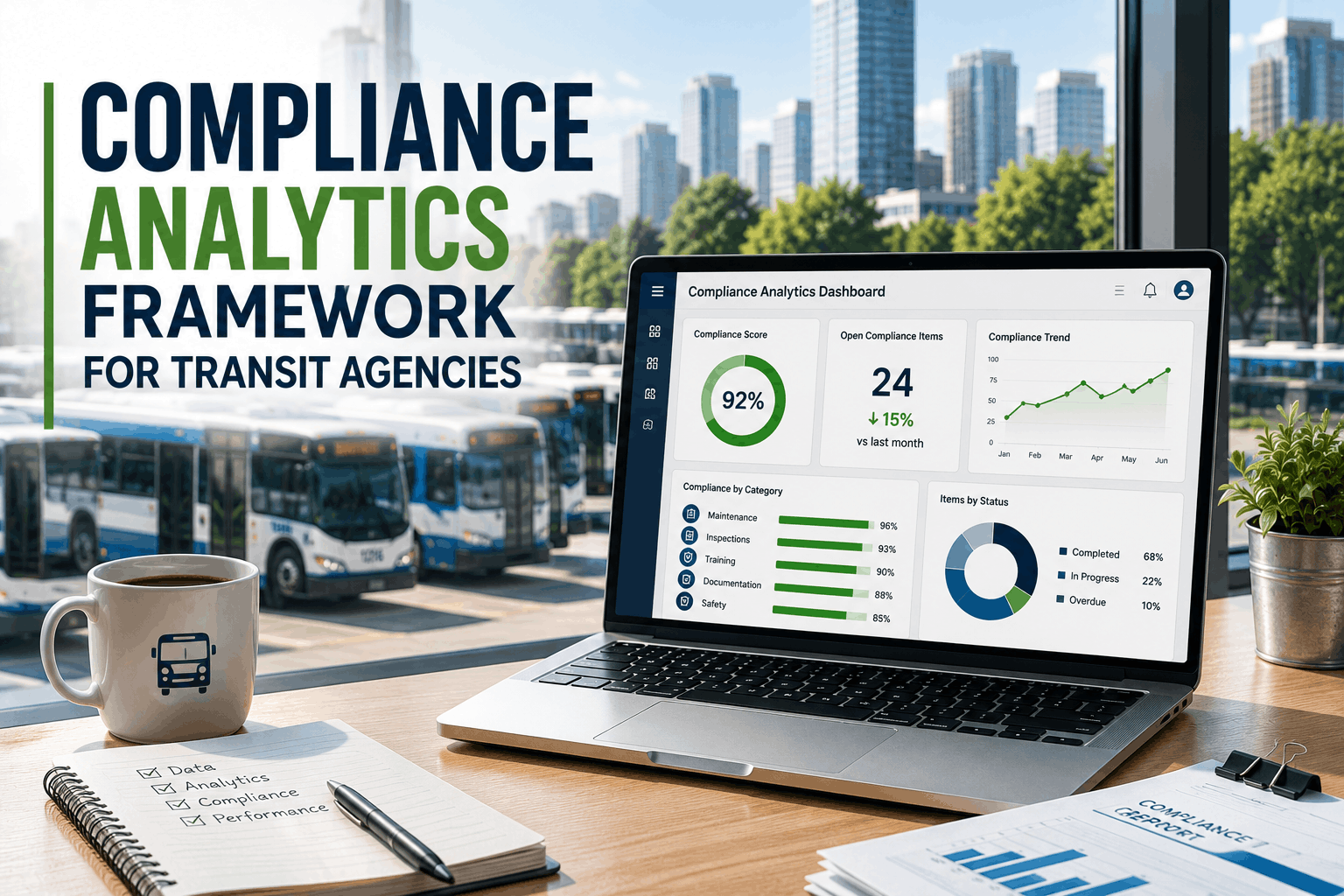
Transit agencies operate under a complex web of compliance requirements from the FTA, FMCSA, state DOTs, and local authorities. Each agency requires different reports, different formats, and different submission deadlines. Without a structured compliance analytics framework, agencies struggle to produce accurate documentation on demand. Reports are late. Data is inconsistent. Auditors find gaps. A compliance analytics framework transforms this chaos into clarity. It centralizes data from maintenance, driver files, drug/alcohol testing, and vehicle inspections into a single source of truth. It automates report generation for each regulatory body. It provides dashboards that show compliance status in real time. This guide explains the technology, processes, and reporting metrics required for effective compliance analytics across bus operations.
Understand the technology, processes, and reporting metrics required for effective compliance analytics across bus operations.
A compliance analytics framework is the structured combination of technology, data standards, reporting templates, and review processes that enable a transit agency to produce accurate compliance documentation on demand. It answers three questions: What needs to be tracked? How is it tracked? How is it reported? The framework must cover vehicle maintenance (inspections, DVIRs, repairs, PM compliance), driver qualifications (CDL, medical cards, training records, hours of service), safety (accident reports, incident investigations), drug and alcohol testing (Clearinghouse queries, random test tracking), and environmental compliance (emissions, fuel storage). A mature framework integrates these data sources into a single CMMS, automates report generation, and provides real-time compliance dashboards. Agencies without a framework rely on siloed spreadsheets, paper records, and manual compilation — a recipe for audit findings.
To build an effective compliance analytics framework, agencies must track specific metrics across each compliance domain. For vehicle maintenance: PM compliance percentage, DVIR completion rate, 90-day exit inspection compliance, annual inspection due dates, and repair certification status. For driver qualifications: medical card expiration dates, CDL and endorsement expiration dates, annual MVR review completion, and prior employer inquiry status. For drug and alcohol testing: Clearinghouse pre-employment and annual query dates, random test selection and completion rates, and return-to-duty documentation status. For safety: accident investigation completion, corrective action closure, and training compliance. These metrics should be visible on real-time dashboards accessible to compliance staff, maintenance supervisors, and leadership.
Compliance analytics depends on data quality. If medical card expiration dates are recorded inconsistently, expiration alerts are unreliable. If DVIR completion dates are not timestamped, compliance reports are inaccurate. If work order repair certifications are missing, vehicle maintenance compliance cannot be proven. Connected CMMS systems improve compliance analytics by enforcing data completeness at the point of entry: mandatory expiration date fields, timestamp capture for all compliance events, document attachment requirements, and role-based access to prevent unauthorized changes. The result is compliance dashboards that managers and auditors can trust.
Compliance analytics improves when managers review the right metrics on a consistent schedule. Daily reviews focus on vehicle availability and safety defects. Weekly reviews focus on medical card expirations, DVIR completion, and PM compliance. Monthly reviews focus on driver file completeness, random test completion, and annual inspection status. Quarterly reviews focus on comprehensive compliance assessments and audit preparation.
Most compliance analytics failures come from data gaps, not bad analysis. Missing expiration dates make alerting impossible. Inconsistent document naming makes retrieval difficult. Missing timestamps make audit trails unreliable. The fix is not more spreadsheets — it's enforcing data standards at the source. A CMMS that requires expiration dates for all medical cards, timestamps every compliance event, and enforces document naming conventions creates clean data that compliance analytics can trust.
A compliance analytics framework transforms transit agency compliance from reactive audit panic to proactive routine management. The framework requires technology (CMMS with automation), data standards (consistent formats, complete records), reporting templates (on-demand generation), and review processes (daily, weekly, monthly). Agencies that implement a mature framework reduce audit preparation time by 85-95%, cut audit findings by 60-80%, and improve data accuracy from 85% to 98%. The investment in a CMMS and process design typically pays for itself in the first audit cycle.
Building a compliance analytics framework requires technology, data standards, and consistent review processes. The essential components are vehicle maintenance compliance tracking, driver qualification management, drug/alcohol testing compliance, and safety/environmental reporting. Weekly KPI reviews catch problems before they become violations. Connected data systems ensure compliance analytics accuracy by enforcing data completeness at the source. Transit agencies that make this transition reduce audit preparation time by 85-95%, improve data accuracy, and strengthen audit readiness.