A rider catches a toe on a worn first step, grabs for a handrail that's gone loose, and goes down in the doorway — the single most common place a boarding injury happens. Steps, thresholds, and handrails take the most foot and hand traffic on the whole vehicle, and they wear quietly. A real bus step inspection checklist catches that wear before it becomes a fall, and a BusCMMS demo shows how each defect gets logged and repaired.
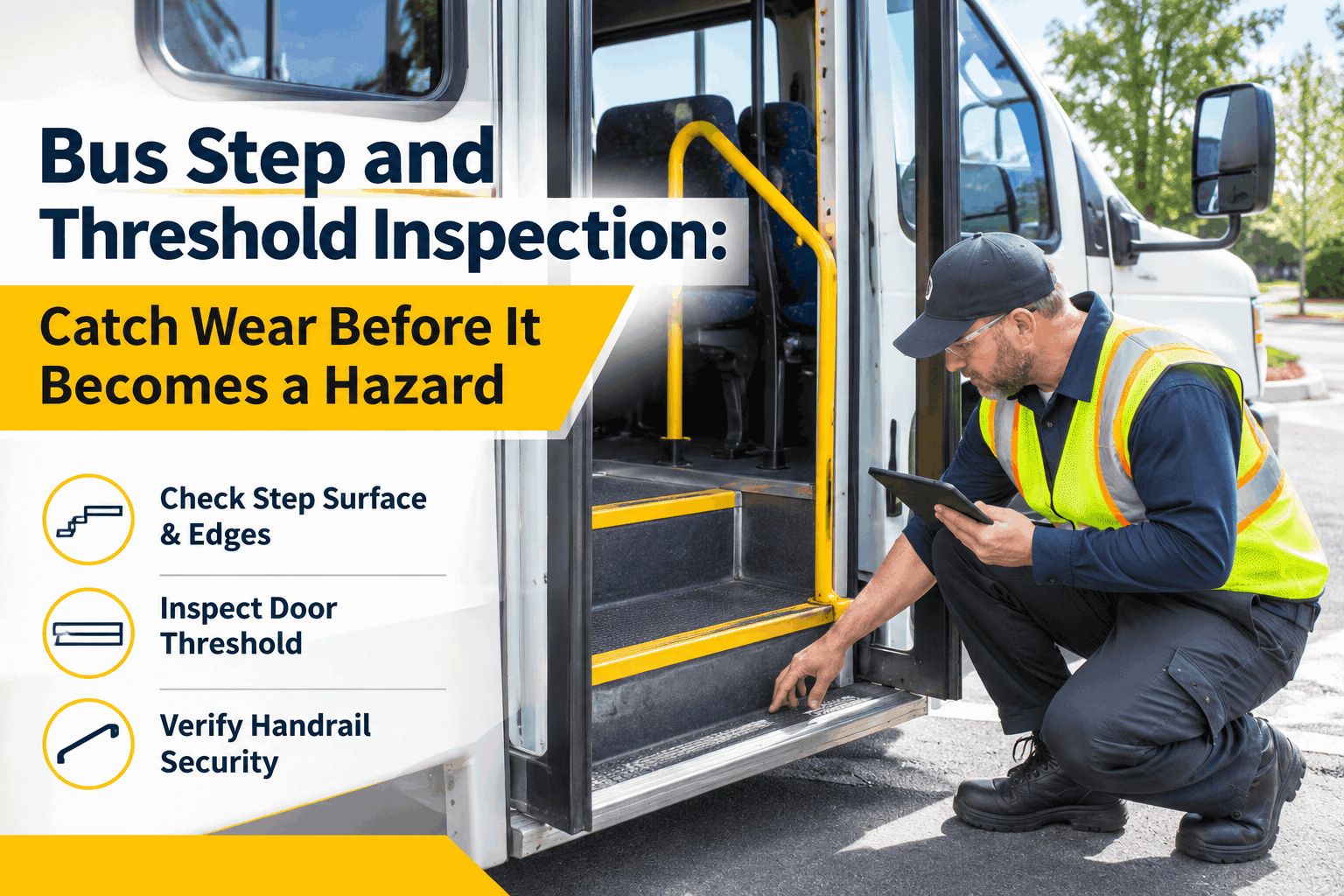
Bus Step and Threshold Inspection: Catch Wear Before It Becomes a Hazard
Worn treads, faded edge stripes, a raised threshold, a handrail with play — the boarding hazards riders meet first and inspectors skip most. Here is exactly what to check, and how to log it.
What a Bus Step Inspection Checklist Has to Cover
Boarding safety isn't one check — it's three surfaces that wear in different ways and fail with different consequences. Inspect each on its own terms, with a clear line between "repair soon" and "take it out of service" — and a demo shows how each surface becomes a tracked inspection line.
Steps & treads
Check the tread surface for worn, smooth, or missing slip-resistant material, and that the full-width edge contrast band is still visible.
Out of service: no slip resistance or a cracked, broken tread.Door threshold
Look for a lifted, cracked, or loose threshold plate and any raised edge that catches a toe or a mobility-aid wheel on the transition.
Out of service: a raised or broken edge that trips or catches.Handrails & assists
Grab and push: the rail should be solid, securely mounted, with all hardware present and no play, sharp edges, or gaps that snag.
Out of service: loose, missing, damaged, or a snag hazard.The Nut-and-String Test Every Inspector Should Know
A handrail can look fine and still snag a drawstring or a bag strap — the exact failure that has pulled children under boarding buses. The NHTSA nut-and-string test is a cheap, fast way to catch it, and it belongs on your inspection.
Tie a 1/2-inch hex nut to a drawstring at least 30 inches long — a pull of 10 pounds shouldn't separate it.
Standing outside the bus, drop the nut between the handrail and the stepwell wall, the way a rider exits.
Draw it through the full path. If the nut snags or hangs up anywhere, the handrail has a catch hazard to fix.
Any snag is a defect worth logging with a photo, not a note to remember. See how BusCMMS records a handrail defect and opens a repair in a demo.
Your Bus Step and Threshold Inspection Checklist
Run this on every van on a set rhythm. The CRITICAL items are take-out-of-service conditions; the PLAN items are repair-soon wear that becomes critical if ignored.
-
Treads slip-resistant, not worn smoothNo bald, polished, or missing non-skid surface on any step — the first thing a wet shoe meets.CRITICAL
-
Handrails solid, mounted, hardware presentPush-tests firm with no play — and passes the nut-and-string test for snag points.CRITICAL
-
Threshold flat, sealed, no raised edgeNo lifted plate or broken edge that catches a toe or a mobility-aid wheel on entry.CRITICAL
-
Step-edge contrast band visible full widthThe light-on-dark or dark-on-light edge stripe is intact, so riders can judge each step.PLAN
-
Stepwell lighting worksThe step and doorway light up when the door opens — riders can't judge a step they can't see.PLAN
-
Defects photographed and work-orderedAnything flagged gets a photo and a repair work order on the spot — not a mental note.PLAN
If a CRITICAL item fails, the van comes off the road until it's fixed — no exceptions on a boarding surface. Start logging step and threshold defects free.
From a Checklist Finding to a Closed Repair
A checklist only prevents a fall if the defect it finds actually gets fixed. The difference is whether a worn tread or loose rail becomes a tracked work order — photographed, assigned, and closed — or just a line someone meant to follow up on.
A photo turns "the rail feels loose" into a defect a tech can act on. BusCMMS records the step, threshold, or handrail issue during inspection, attaches the photo, opens a work order, assigns it, and keeps the repair history — so a boarding hazard is closed, not carried. You can start capturing step and handrail defects free and keep every fix on record.
A Paper Note vs. a Tracked Boarding Defect
The difference between a prevented fall and an incident report is whether the checklist finding becomes a record that gets closed.
Swipe sideways to see all columns →
"A handrail that passed a glance failed the nut-and-string test — there was a gap a strap could catch. On a route full of kids, that's the one you don't want to miss. Now the test is on the checklist and the defect opens a work order itself."
The Short Version on Step & Threshold Safety
The doorway is where falls happen
Steps, thresholds, and handrails take the most traffic and wear quietly — the first step is the top injury spot.
Three surfaces, three checks
Treads, the threshold, and handrails each wear differently — inspect each with its own out-of-service line.
The nut-and-string test catches snags
A rail that looks fine can still snag a strap — a cheap, fast test belongs on every inspection.
A checklist only works if it's logged
A photo and a work order turn a finding into a fixed defect — and a retained record for the audit.