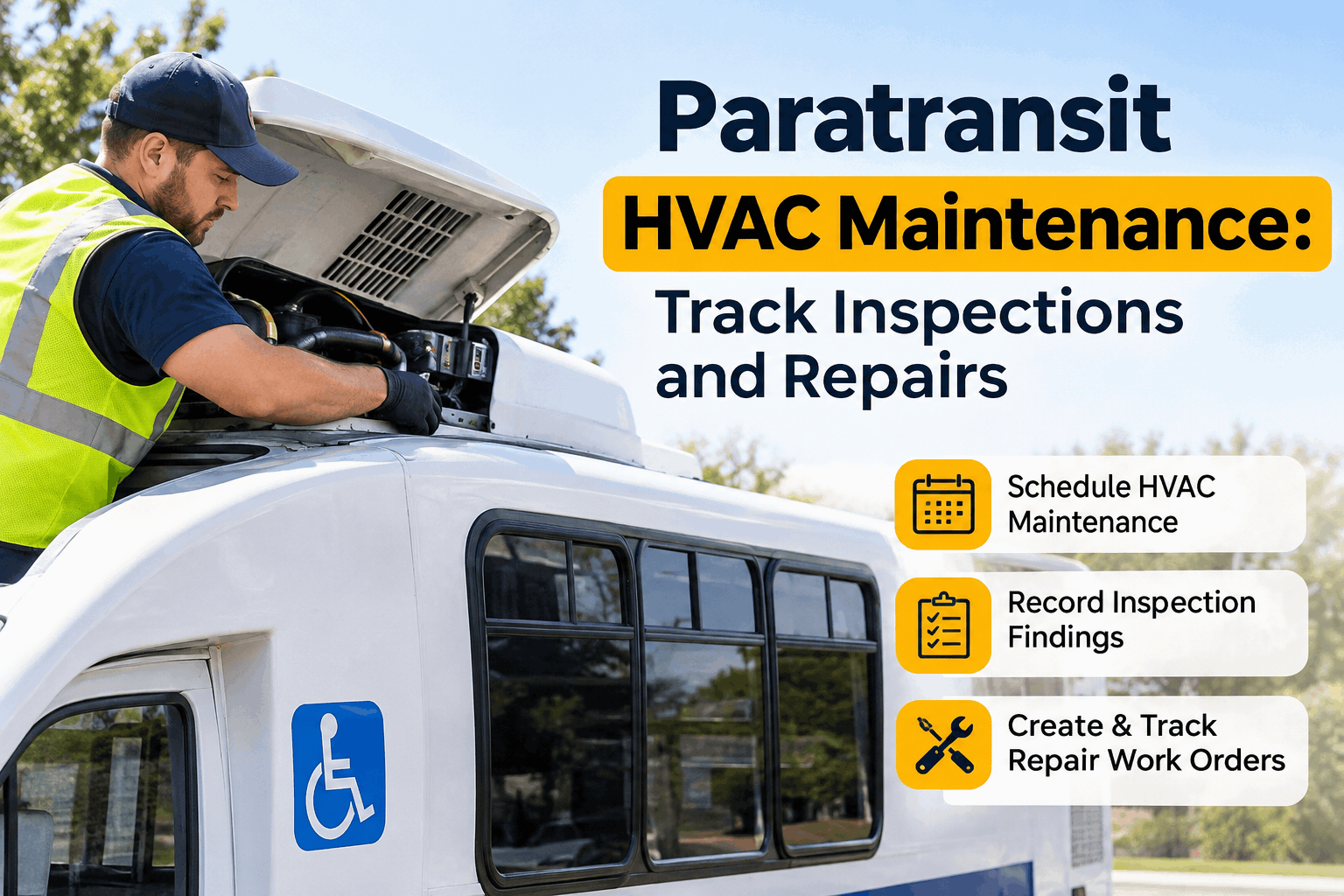
On a 95-degree afternoon, a cutaway's air conditioning quits with a medically fragile rider aboard — and what looked like a comfort feature is suddenly a health emergency. For heat- or cold-sensitive passengers, climate control is a safety system, not a nicety. Reliable paratransit HVAC maintenance keeps it from failing on the wrong day, and a BusCMMS demo shows how to schedule it and track every repair.
Paratransit HVAC Maintenance: Track Inspections and Repairs
Compressor, condenser, evaporator, blower — a chain where one weak link leaves a vulnerable rider too hot or too cold. Here is how to inspect it, service it on a seasonal rhythm, and log every defect.
On Paratransit, HVAC Maintenance Is a Safety Job
A late bus is an inconvenience on most fleets. On a paratransit run carrying seniors and riders with disabilities, a cabin that's too hot or too cold is a medical risk — which is exactly why climate control gets treated like a safety system, not a comfort upgrade.
Riders are heat- and cold-sensitive
Many passengers are medically fragile — a failed AC risks dehydration or heat exhaustion, a dead heater risks cold stress.
A failure can pull the bus
Many agencies treat a dead AC as a take-out-of-service condition in hot climates — so an HVAC fault costs you a vehicle.
Longer rides, higher exposure
Demand-response trips wander and wait, so a rider sits in that cabin far longer than a fixed-route passenger.
It strains other systems
A struggling HVAC leans hard on the alternator and electrical system — a small fault that snowballs into a bigger one.
HVAC sits alongside lifts and securements as core paratransit upkeep — see how it fits the wider paratransit and ADA fleet maintenance picture, then put it on a schedule.
The HVAC Parts That Fail, and What to Inspect
HVAC rarely dies all at once — it degrades at known points. Inspect each on its own, and most "sudden" failures show up as a catchable symptom weeks earlier.
Compressor & belt
Check belt tension and wear, clutch engagement, and for oil or refrigerant weep. A slipping belt is the classic slow failure.
Condenser & coils
Look for bent or clogged fins and road debris blocking airflow — a dirty condenser quietly kills cooling capacity.
Refrigerant & leaks
Verify charge level and scan for leaks at fittings and hoses. Low refrigerant is the single most common cooling complaint.
Blower & filters
Replace cabin and return-air filters, check blower motor and ducts for weak airflow and the mold or odor a clogged filter breeds.
Heater & coolant
Test heater core output, hoses, and the auxiliary heater before cold months — the half of HVAC that's easy to forget in summer.
Controls & thermostat
Confirm the controller holds the set temperature and the sensors read true — a bad thermostat fakes a system fault.
Each part is a separate inspection line with its own photo and defect. See how BusCMMS captures an HVAC defect and opens a repair in a demo.
HVAC Maintenance Runs on Two Seasons, Not One
The mistake that strands riders is treating HVAC as a once-a-year check. Cooling and heating fail in opposite seasons, so readiness has two peaks: get the AC ready before summer, and the heat ready before winter — and you can set both schedules per van for free.
Calendar-based PM is exactly what a CMMS is for. BusCMMS schedules the pre-summer AC service and the pre-winter heat service per van, so neither season catches the fleet unready.
Your Paratransit HVAC Maintenance Checklist
Run this on every van on the seasonal rhythm above. The CRITICAL items decide whether a vulnerable rider is safe in the cabin today; the PLAN items keep the system from drifting toward a failure.
-
AC cools to target in a timed pulldownThe cabin reaches a safe temperature in a reasonable time — the test a heat-sensitive rider depends on.CRITICAL
-
Heat and defrost work before winterHeater core, auxiliary heater, and defrost all deliver — cold stress and a fogged windshield are both safety issues.CRITICAL
-
Compressor, belt, and refrigerant soundBelt in spec, clutch engaging, charge correct, no leaks — the core of the cooling chain.CRITICAL
-
Filters replaced, airflow strongCabin and return-air filters changed on schedule — weak airflow and odor both point here.PLAN
-
Condenser and coils clear of debrisFins clean and unbent, airflow unblocked — a clogged condenser silently cuts cooling capacity.PLAN
-
Defects photographed and work-orderedAnything flagged gets a photo and a repair work order on the spot — not a note for later.PLAN
If a CRITICAL item fails in peak season, that van carries a health risk, not just a comfort complaint. Start scheduling HVAC PM and logging defects free.
From a Weak-Cooling Complaint to a Closed Repair
A driver reports "the AC isn't keeping up." Whether that becomes a documented fix or a recurring summer headache depends on whether it turns into a tracked, photographed work order.
A photo of a leaking fitting beats "AC seems weak" every time. BusCMMS records the HVAC finding, attaches the photo, opens and assigns the work order, tracks it to done, and keeps it in the van's service history for the next technician.
A Summer Scramble vs. a Scheduled System
The difference between a fleet that's cool on the first hot day and one scrambling for parts is whether HVAC lives on a schedule with a record — a demo walks through both on your own fleet.
Swipe sideways to see all columns →
"We used to find the AC problems in June, with everybody calling at once. Now the pre-summer service is scheduled on every van in April, and a weak-cooling note is a work order with a photo — not a sticky on my monitor until something fails."
The Short Version on Paratransit HVAC
HVAC is a safety system here
For heat- and cold-sensitive riders, a failed cabin is a medical risk — treat climate control like a core safety component.
Failures start at known points
Compressor, condenser, refrigerant, blower, heater, controls — inspect each and most "sudden" failures show early.
Service on two seasons
AC before summer, heat before winter — a single annual check leaves one half unready when its season hits.
Log it or repeat it
A photo, a work order, and a service history turn a weak-cooling note into a closed repair instead of a yearly headache.