Electric bus grant programs and funding mechanisms represent the critical financial infrastructure enabling fleet electrification across North America. Federal, state, and local grant programs in 2026 provide unprecedented funding opportunities, with billions in available capital supporting bus procurement, charging infrastructure, and operational transformation. Understanding grant eligibility requirements, application timelines, and funding mechanisms is essential for fleet managers planning electrification strategies. Navigating the complex landscape of EPA programs, FTA funding, state incentives, and manufacturer rebates requires comprehensive knowledge of program specifics, documentation requirements, and strategic timing. This complete guide examines every electric bus grant program available in 2026, eligibility criteria, funding amounts, application processes, and strategies for maximizing grant support to reduce fleet electrification costs. BusCMMS fleet management software integrates grant tracking, incentive documentation, and funding analysis enabling strategic electrification planning with optimized financial support.
Funding Guide 2026
Electric Bus Grants & Funding
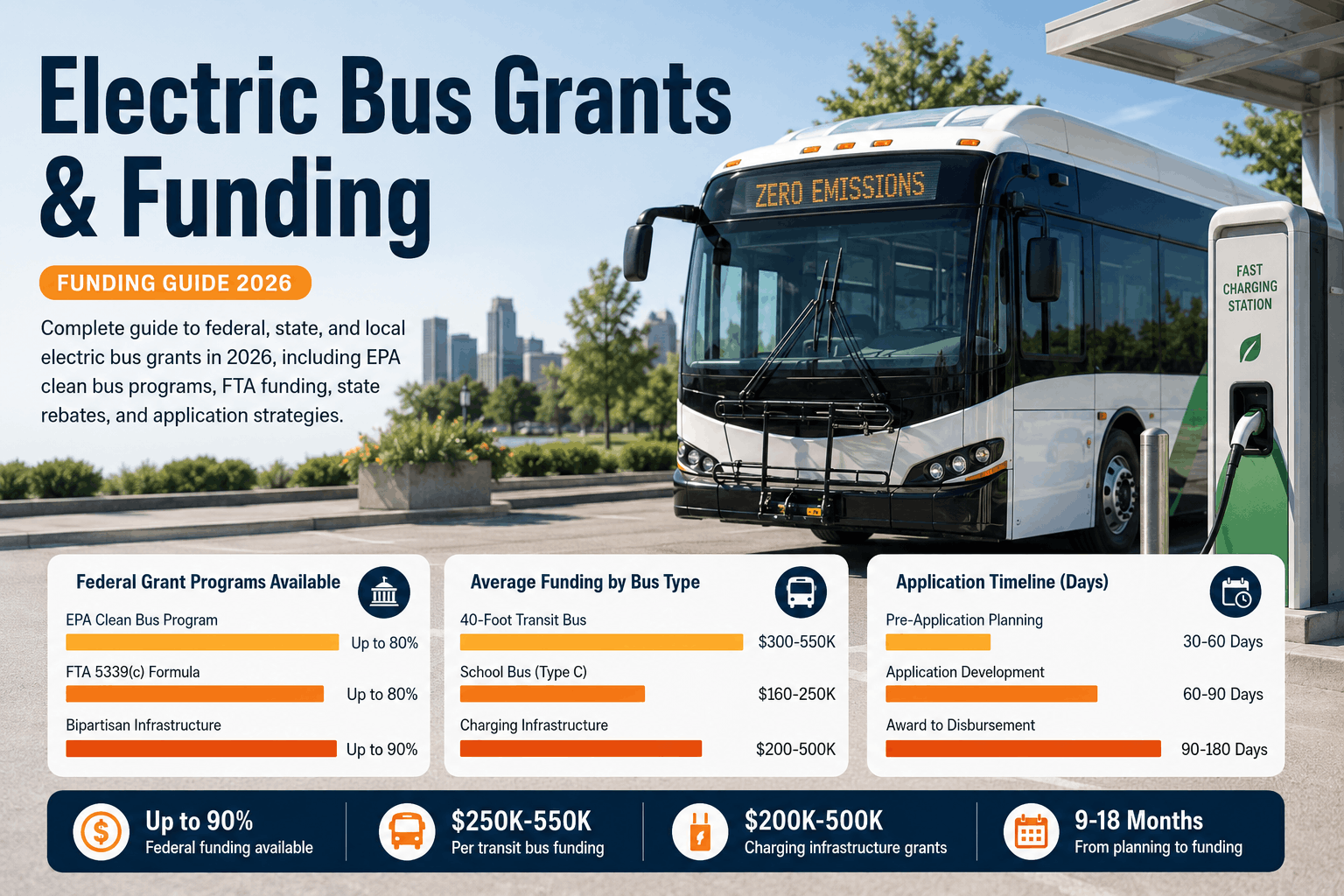
Complete guide to federal, state, and local electric bus grants in 2026, including EPA clean bus programs, FTA funding, state rebates, and application strategies.
Federal Grant Programs Available
Average Funding by Bus Type
Application Timeline (Days)
1
Federal Electric Bus Grant Programs: EPA, FTA, and Infrastructure Funding
Federal programs provide the largest funding opportunities for electric bus acquisition: The Environmental Protection Agency (EPA) administers the Clean Bus Program offering up to $5 billion through 2026 supporting 100% electric bus purchases and charging infrastructure. Transit agencies can receive up to 80% funding for bus procurement with 20% local match. The Federal Transit Administration (FTA) provides Formula funding through Section 5339(c) distributing $1.5 billion annually to urbanized areas. FTA Competitive funding through Section 5339(d) supports innovative projects including electric bus fleets with 80% federal share. The Bipartisan Infrastructure Law allocated $5 billion specifically for zero-emission transit buses through FTA programs with enhanced funding percentages reaching 90% federal share in certain geographic areas. Electric school buses receive dedicated funding through EPA's School Bus Replacement Program offering up to $1 billion. Applicants must be government agencies or transit authorities; private operators must partner with public entities for grant eligibility.
Funding amounts vary by program and bus configuration: EPA Clean Bus Program provides $250,000-$550,000 per 40-foot transit bus depending on battery capacity and charger specifications. School bus grants average $160,000-$250,000 per vehicle. Charging infrastructure funding ranges from $200,000-$500,000 per charging station depending on power level and installation complexity. Fast chargers (150+ kW) attract higher infrastructure grants than slow chargers. Applicants can stack multiple funding sources: combining FTA bus funding with EPA charging infrastructure grants enables comprehensive electrification financing. Strategic layering of state incentives, manufacturer rebates, and utility incentive programs can further reduce net fleet costs to near-zero after applying all available funding.
Grant eligibility requires specific operational and geographic criteria: Public transit agencies, regional transit authorities, and municipalities operating transit systems qualify for federal grants. Schools operating their own bus fleets qualify for school bus programs. Private transit operators cannot directly receive federal grants but can partner with public agencies through joint applications. Geographic eligibility varies: rural areas receive prioritized funding through certain programs with enhanced matching percentages (70% instead of 80%). Agencies must demonstrate financial capacity to manage federal funds, maintain required insurance, and comply with federal reporting requirements. Environmental justice considerations increasingly influence award decisions, with funding prioritized for transit-dependent communities and underserved areas.
2
State Electric Bus Incentive Programs and Rebate Mechanisms
State programs supplement federal funding with additional incentive mechanisms: California's state incentive portfolio provides the most comprehensive support: CalEnviroScreen grants offer $100,000-$300,000 per bus for transit agencies in low-income communities, California Air Resources Board (CARB) programs provide $50,000-$200,000 rebates per bus, and Community Bus Program offers additional $50,000-$100,000 per vehicle. New York's Clean Transportation program offers $150,000-$300,000 per transit bus. Massachusetts provides $200,000-$400,000 rebates for school buses. Texas grants $75,000-$150,000 per electric bus through state air quality programs. Oregon offers rebates covering 25-40% of incremental electric bus costs. Illinois provides matching funds up to $500,000 per applicant. Colorado incentivizes both transit and school bus electrification with $100,000-$250,000 per vehicle rebates. Most states stack state funding on top of federal grants, enabling applicants to achieve high total funding percentages.
State grant application processes and timelines vary significantly: Most states operate rolling application periods (applications accepted year-round) rather than single annual deadlines. California programs typically process applications within 60-90 days. New York applications require 120-150 days for approval. Application complexity varies: some state programs require only basic fleet information and purchase documentation, while others demand detailed feasibility studies, maintenance plans, and environmental impact assessments. States increasingly coordinate with federal programs, recognizing federal awards before releasing state funding to avoid duplication. Applicants should submit state applications simultaneously with federal applications to optimize total funding.
School bus-specific incentive programs address transportation transformation: EPA School Bus Replacement Program provides up to $375,000 per school bus nationwide. California school bus program offers additional $75,000-$150,000 per vehicle. States including New Jersey, Connecticut, and Vermont offer school bus-specific incentives recognizing air quality benefits to children. School bus grants often include funding for required professional driver training and charging facility installation. Rural school districts receive enhanced funding percentages recognizing infrastructure cost challenges. Federal and state programs often combine for school buses: total funding can cover 80-90% of incremental electric bus costs for school districts.
3
Grant Application Strategy, Timeline Management, and Success Tactics
Strategic planning precedes successful grant applications: Pre-application planning (30-60 days) should establish agency readiness: identify funding sources, assess local match capacity, determine eligible buses and charging infrastructure, and prepare required documentation. Application development (60-90 days) requires assembling comprehensive proposals: detailed project narratives explaining operational benefits, technical specifications documenting vehicle and charging systems, financial projections showing operational savings, environmental benefits documentation, and community benefit statements. High-quality applications clearly articulate how electrification supports agency strategic goals, reduces operating costs, improves air quality, and benefits communities. Applications should emphasize innovative aspects: depot design improvements, charging technology advancements, workforce training programs, or new operational models attract higher scoring. Agencies should hire grant writers experienced in transit electrification: professional applications significantly improve award probability and funding amounts.
Timeline management prevents missed funding opportunities: Federal programs operate on fiscal year cycles (October-September) with application deadlines typically 4-6 months before program year start. FTA applications close in spring (March-April) for funding beginning October. EPA programs vary: Clean Bus Program applications close in early fall, School Bus Program applications close in early winter. State programs often have rolling deadlines but announce annual funding releases in spring. Agencies should develop 18-month planning timelines: identify funding sources 12 months before desired procurement, submit applications 6-9 months before procurement, and anticipate award notifications 4-5 months before procurement. Early submission provides time for potential clarifications and resubmission if needed. Agencies pursuing multiple funding sources should coordinate timelines: submissions typically occur 2-3 weeks apart to manage review cycles.
Success tactics increase award probability and funding amounts: Emphasize local match capacity: agencies committing 25-30% local funding demonstrate financial commitment and receive more favorable review scoring. Demonstrate readiness: completed site plans, identified bus vendors, established charging system designs, and driver training programs show implementation capacity. Build political support: resolutions from city councils, boards of supervisors, or school boards strengthen applications. Document community benefits: air quality improvements, job creation, long-term cost savings, and equity benefits resonate with grant reviewers. Include letters of support from utility companies, environmental organizations, and community groups. Submit applications early: early submissions allow staff time to address reviewer questions, while late submissions provide no opportunity for clarification. Track all submissions: maintain databases of submitted applications, funding amounts, timelines, and award status to optimize strategy.
Electric Bus Grant Readiness Checklist
Frequently Asked Questions: Electric Bus Grant Programs
What is the EPA Clean Bus Program and how much funding does it provide?
EPA Clean Bus Program provides up to $5 billion through 2026 supporting zero-emission bus purchases and charging infrastructure. Funding covers up to 80% of bus costs and 80% of charging infrastructure. 40-foot transit buses typically receive $250,000-$550,000 depending on battery capacity. School buses typically receive $160,000-$250,000. Applications are accepted year-round on rolling basis with typical award timeline 60-90 days from submission.
Can school districts apply for electric school bus grants without partnering with municipalities?
Yes. EPA School Bus Replacement Program, state school bus programs, and manufacturer school bus incentives allow school districts to apply directly. EPA provides up to $375,000 per school bus and covers charging infrastructure. State programs provide additional $75,000-$150,000 per bus in many states. School districts should apply to both federal and state programs to maximize total funding availability.
How much local match funding is required for federal electric bus grants?
FTA programs typically require 20% local match (80% federal share). EPA Clean Bus Program allows 20% local match. Bipartisan Infrastructure funding enables up to 90% federal share in certain geographic areas reducing local match to 10%. Rural applicants often receive enhanced percentages. Agencies should confirm specific match requirements for their selected programs.
What is the typical timeline from application submission to grant award and funding disbursement?
Pre-application planning: 30-60 days. Application development: 60-90 days. Award notification: 60-120 days after submission deadline depending on program. Disbursement after award: 90-180 days typically. Total timeline from initial planning to receiving funding: 9-18 months. Applicants should begin planning 18 months before desired bus procurement to align with grant cycles.
Can private transit operators receive electric bus grants directly?
No. Federal programs require public agency applicants (transit authorities, municipalities, schools, regional transportation agencies). Private operators can participate indirectly: establishing partnership agreements with public agencies allowing joint applications where public agency serves as grant recipient with private operator as implementation partner.
Which states offer the most generous electric bus incentive programs?
California offers most comprehensive state incentives: CalEnviroScreen ($100-300K per bus), CARB rebates ($50-200K per bus), Community Bus Program ($50-100K per bus). New York: $150-300K per transit bus. Massachusetts: $200-400K per school bus. Oregon, Illinois, Colorado offer strong state-level programs. Applicants in these states can stack state funding on top of federal grants for highest total funding.
Are charging infrastructure costs covered by electric bus grants?
Yes. EPA programs cover up to 80% of charging infrastructure costs ($200-500K depending on charger type). FTA programs provide infrastructure funding through project applications. Most state programs include charging infrastructure in eligible costs. Depot upgrades, electrical work, and grid improvements are generally included. Some programs have separate charging infrastructure grant streams distinct from bus purchase grants.
What documentation do agencies need to prepare for successful grant applications?
Required documentation: detailed project narratives, technical bus and charging system specifications, financial projections showing cost savings, environmental benefits analysis, community impact statements, letters of support from elected officials and organizations, depot site plans, utility coordination documentation, driver training program outlines, and maintenance facility plans. Comprehensive documentation demonstrates readiness and increases award probability and funding amounts.
Maximize Your Grant Funding Today
Strategic electrification planning coordinating federal, state, and local funding sources can reduce net fleet costs to near-zero. BusCMMS fleet management software integrates grant tracking, incentive documentation, and funding analysis enabling fleets to optimize financial support while executing operational excellence.