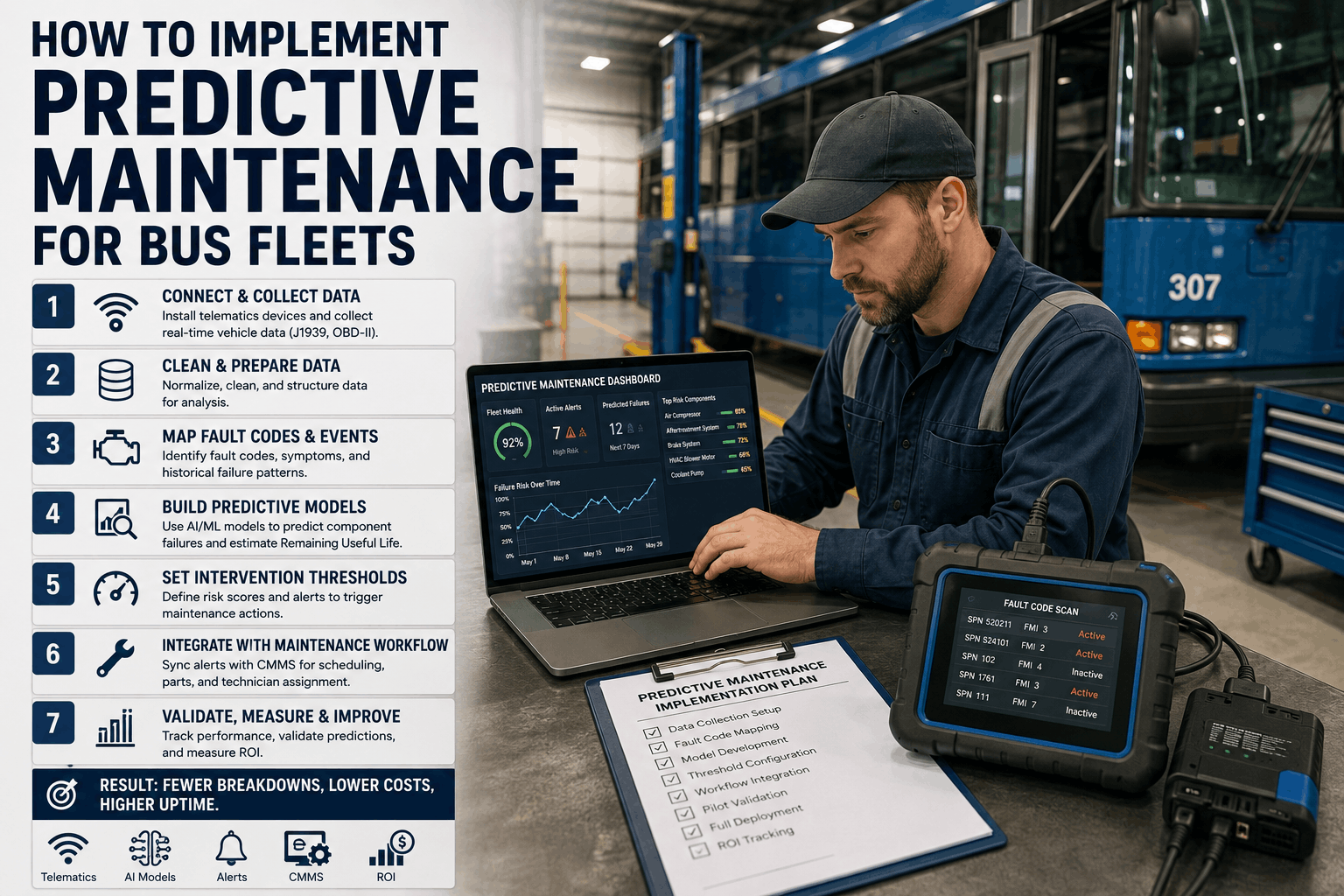
Predictive maintenance represents a fundamental shift in how bus fleets manage vehicle reliability — moving from scheduled or reactive repairs to data-driven interventions that occur precisely when component wear indicates an impending failure. For transit agencies, school districts, and motorcoach operators, implementing predictive maintenance (PdM) means connecting telematics data, fault code mapping, AI-driven analytics, and carefully defined intervention thresholds to create a maintenance program that reduces unplanned downtime, extends component life, and optimizes maintenance budgets. This guide provides a practical roadmap for implementing predictive maintenance for bus fleets, from data collection and model development through validation and ROI tracking. Fleets that successfully deploy PdM programs report 20-40% reductions in unplanned downtime and 15-30% lower maintenance costs.
Implement Predictive Maintenance for Your Bus Fleet
BusCMSS connects telematics data, fault codes, and maintenance history to deliver predictive insights — reducing unplanned downtime and optimizing your maintenance program.
Core Components of a Predictive Maintenance Program
A successful predictive maintenance program integrates multiple data sources and analytical capabilities to predict component failures before they occur. The core components include vehicle telematics data collection, fault code mapping and diagnostics, AI and machine learning models for pattern recognition, and clearly defined intervention thresholds that trigger maintenance actions. Each component must work in concert to deliver accurate, actionable predictions that maintenance teams can trust and act upon.
Telematics Data Collection and Integration
Collect real-time data from vehicle sensors including engine parameters, transmission performance, brake system metrics, and environmental conditions. Data streams must be normalized, cleansed, and structured for analytical processing.
Fault Code Mapping and Diagnostics
Map diagnostic trouble codes (J1939 and other standards) to specific component conditions. Develop a fault code library that connects codes to failure modes, severity levels, and recommended interventions.
AI and Machine Learning Models
Develop predictive models that analyze historical data to identify patterns preceding component failures. Train models on labeled data that correlates sensor readings with actual maintenance outcomes.
Intervention Threshold Definition
Establish clear thresholds that trigger predictive maintenance alerts. Define the probability score, confidence level, and urgency rating required before a maintenance action is generated.
Maintenance Workflow Integration
Connect predictive alerts to maintenance work order systems. Ensure that predictions automatically generate work orders, assign priorities, and notify maintenance teams with clear action instructions.
Validation and ROI Tracking
Track prediction accuracy, maintenance cost reductions, and uptime improvements. Compare actual outcomes against predictions to refine models and demonstrate the business value of the PdM program.
Step-by-Step Guide to Implementing Predictive Maintenance
Implementing a predictive maintenance program requires a phased approach that builds capability incrementally while delivering measurable value at each stage. The following steps outline the proven methodology for moving from reactive to predictive maintenance in a bus fleet environment.
Data Collection and Telematics Infrastructure
Foundation Phase
Deploy telematics devices across the fleet to capture engine, transmission, and component data. Ensure that data is collected at appropriate frequencies (typically 1-5 seconds) and transmitted reliably. Integrate telematics data with existing maintenance records to create a unified data foundation. Standardize data formats and establish data quality checks to ensure consistency across vehicles.
Timeline
2-4 months
Key Deliverable
Unified fleet data repository
Success Metric
95% data coverage
Fault Code Library Development
Diagnostic Foundation
Build a comprehensive fault code library that maps each diagnostic code to specific failure modes, severity levels, and recommended actions. Include OEM-specific codes, common failure patterns, and historical maintenance outcomes. This library becomes the diagnostic backbone of the predictive system, enabling accurate interpretation of real-time sensor data.
Timeline
2-3 months
Key Deliverable
Fault code mapping database
Success Metric
Code coverage > 85% of common codes
AI Model Development and Training
Analytics Phase
Develop and train predictive models using historical vehicle data. Use supervised learning approaches that correlate sensor readings and fault codes with actual maintenance outcomes. Train models on multiple failure modes including brake wear, engine performance degradation, transmission issues, and cooling system problems. Validate models using test data and refine with ongoing feedback.
Timeline
4-6 months
Key Deliverable
Trained predictive models
Success Metric
Prediction accuracy > 80%
Intervention Threshold Definition
Decision Framework
Define the threshold conditions that trigger predictive maintenance alerts. For each component or failure mode, establish probability thresholds, confidence levels, and urgency ratings. Determine how far in advance of anticipated failure an alert should be generated — typically 5-30 days depending on component type and failure progression characteristics.
Timeline
2-4 weeks
Key Deliverable
Threshold and decision matrix
Success Metric
False positive rate < 15%
Workflow Integration and Alert Management
Operational Rollout
Integrate predictive alerts with existing maintenance workflows. Configure systems to automatically generate work orders when alerts reach defined thresholds. Establish notification protocols for maintenance managers, including alert severity, recommended actions, and urgency. Provide training to maintenance teams on interpreting and acting on predictive alerts.
Timeline
1-2 months
Key Deliverable
Integrated alert system
Success Metric
Alert-to-work-order conversion > 70%
Performance Monitoring and Model Refinement
Optimization Phase
Track prediction accuracy, maintenance cost reductions, and uptime improvements. Compare actual outcomes against predictions to identify where models can be refined. Incorporate feedback from maintenance teams on alert accuracy and useful lead time. Continuously update models with new data to improve prediction quality over time. Document and communicate ROI to stakeholders.
Timeline
Ongoing
Key Deliverable
ROI dashboard
Success Metric
Downtime reduction > 20%
Predictive Maintenance Implementation: Maturity Journey
The path to predictive maintenance maturity follows a progression from reactive maintenance through condition monitoring to full predictive capability. The following chart illustrates the typical journey of fleets implementing PdM programs, highlighting the activities and outcomes at each stage.
Reactive — Repair after failure
Stage 1
Preventive — Scheduled maintenance intervals
Stage 2
Condition-Based — Sensor-triggered maintenance
Stage 3
Predictive — AI-model-driven interventions
Stage 4
Prescriptive — Automated action recommendations
Stage 5
Predictive Maintenance ROI and Performance Metrics
Measuring the business impact of predictive maintenance is essential for program justification and ongoing optimization. The following table summarizes key ROI metrics and performance indicators that fleets should track throughout their PdM implementation.
| Metric Category | Key Metric | Target Improvement | Measurement Method | Reporting Frequency |
|---|---|---|---|---|
| Uptime | Unplanned downtime reduction | 20-40% reduction | Compare pre/post PdM downtime | Monthly |
| Maintenance Cost | Cost per vehicle per period | 15-30% reduction | Track total maintenance spend | Quarterly |
| Component Life | Mean time between failures (MTBF) | 20-50% increase | Track component replacement intervals | Quarterly |
| Prediction Accuracy | Correct predictions / total alerts | > 80% accuracy | Compare predictions to outcomes | Monthly |
| Maintenance Efficiency | Labor hours per vehicle | 10-20% reduction | Track maintenance labor records | Monthly |
How BusCMSS Supports Predictive Maintenance Implementation
BusCMSS provides the infrastructure needed to implement predictive maintenance across bus fleets of any size. The platform integrates telematics data, fault code libraries, AI analytics, and maintenance workflows into a single system that delivers actionable insights. By centralizing data and automating the predictive maintenance process, BusCMSS helps fleets reduce unplanned downtime, optimize maintenance spend, and extend vehicle life.
Telematics Data Integration
BusCMSS connects to vehicle telematics systems to capture engine, transmission, and component data in real time — building the data foundation for predictive analytics.
Fault Code Mapping and Analytics
BusCMSS maps diagnostic trouble codes to failure modes, provides severity scoring, and generates actionable insights that maintenance teams can trust and act upon.
AI-Powered Predictive Models
BusCMSS applies machine learning algorithms to identify patterns in vehicle data, predicting component failures before they occur and recommending preventive actions.
Automated Work Order Generation
BusCMSS automatically generates work orders when predictive alerts reach defined thresholds, streamlining the transition from prediction to actionable maintenance.
Predictive Maintenance Implementation Steps
Assess Current Maintenance Capabilities
Review existing maintenance processes, data sources, and technology infrastructure to identify gaps and establish a baseline for predictive maintenance implementation.
Define Predictive Maintenance Objectives
Establish clear goals for the PdM program including targeted downtime reduction, cost savings, and component life extension. Align objectives with organizational priorities.
Select Technology Partner and Platform
Choose a platform that provides telematics integration, fault code management, AI analytics, and workflow integration — with a roadmap for ongoing model refinement.
Build Data Foundation and Fault Code Library
Deploy telematics devices, cleanse historical data, and build a comprehensive fault code library that maps to failure modes and recommended interventions.
Train Models and Define Thresholds
Develop and train predictive models using historical data. Define alert thresholds, confidence levels, and urgency ratings that guide maintenance decision-making.
Pilot, Validate, and Scale
Run a pilot program on a subset of the fleet, validate prediction accuracy, and refine models before scaling across the entire fleet. Track ROI continuously. Book Demo to see BusCMSS's predictive maintenance capabilities.
Frequently Asked Questions
What is predictive maintenance for bus fleets?
Predictive maintenance uses telematics data, diagnostic fault codes, and AI analytics to predict component failures before they occur. The system alerts maintenance teams to take specific actions based on actual component condition rather than fixed schedules.
What data is needed for predictive maintenance?
Key data includes engine parameters (RPM, temperature, oil pressure), transmission performance, brake wear indicators, fault codes, and maintenance history. The data must be normalized and structured for AI analytics to identify patterns.
How accurate are predictive maintenance models?
With quality data and properly trained models, prediction accuracy of 80-90% is achievable. Accuracy improves over time as models are refined with actual maintenance outcomes and feedback from maintenance teams.
Can BusCMSS support predictive maintenance implementation?
Yes, BusCMSS provides telematics data integration, fault code mapping, AI model development, and automated work order generation — enabling a comprehensive predictive maintenance program across any bus fleet.
What ROI can a fleet expect from predictive maintenance?
Fleets typically achieve 20-40% reduction in unplanned downtime, 15-30% lower maintenance costs, and 20-50% extended component life. ROI is typically realized within 12-18 months of implementation.
Transform Your Fleet with Predictive Maintenance
BusCMSS gives you the data foundation, AI analytics, and workflow integration needed to implement predictive maintenance — reducing downtime, controlling costs, and extending vehicle life.