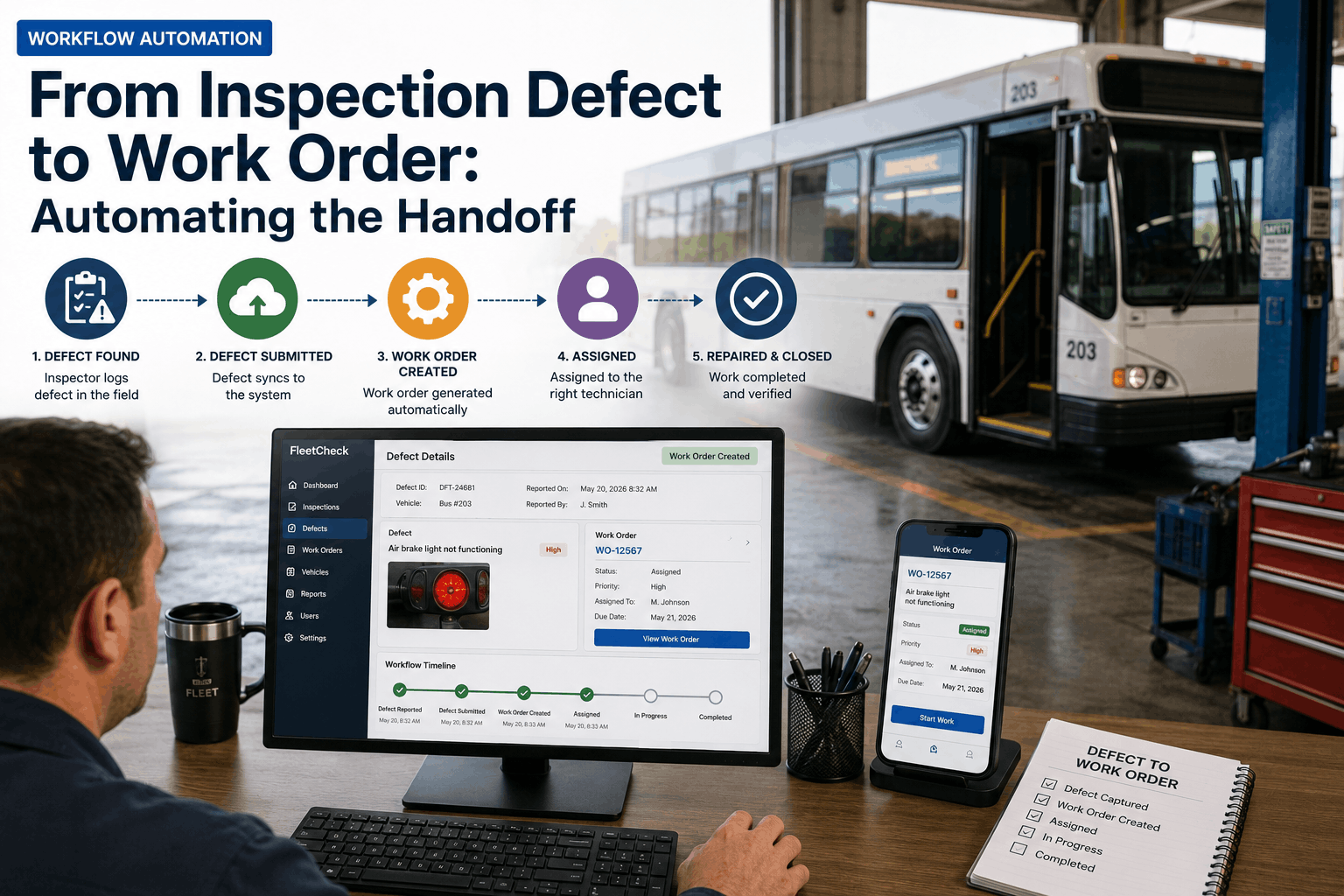
A transit agency in Texas discovered a brake defect during a morning pre-trip inspection. The driver marked the defect on a paper DVIR form and handed it to the dispatcher. The dispatcher placed the form in a stack on the maintenance supervisor's desk. The supervisor saw the form three hours later and assigned it to a mechanic. The mechanic found the form six hours after that. By the time someone located the bus, verified the brake issue, ordered parts, and completed the repair, the bus had been out of service for three full days. Three days for a brake inspection that should have taken two hours. The gap between defect detection and repair initiation cost this agency thousands in lost service hours, overtime labor, and passenger complaints. The problem wasn't the mechanic's skill or the driver's attentiveness. The problem was the handoff. Every manual step between defect flag and work order creation introduced delay, error, and friction. After implementing automated defect-to-work-order workflows, the same agency reduced defect-to-repair time from 72 hours to 4 hours. This guide explains how transit agencies can automate the handoff from inspection defect to work order and eliminate the costly gaps in between.
Inspection Automation 2026
From Inspection Defect to Work Order: Automating the Handoff
Close the gap between a flagged defect and a fixed bus. See how automated defect-to-work-order workflows cut repair lag from days to seconds and eliminate manual data entry errors.
The Hidden Cost of Manual Defect Handoffs
Every manual step between defect detection and repair initiation adds time, creates opportunity for error, and increases operational cost. Transit agencies underestimate how much these handoff delays impact fleet availability and maintenance budgets. The data shows the true cost of manual processes.
72 Hours
Average defect-to-repair time with paper handoffs vs 4 hours with automation
37%
Defects lost or never assigned to mechanic with manual routing systems
$18K
Annual cost per bus in lost service hours from unaddressed defects
The Defect-to-Work Order Journey: Manual vs. Automated
Understanding the defect journey from driver detection to mechanic repair reveals where automation provides the greatest value. Each step in the manual process represents an opportunity for delay, miscommunication, or complete loss of the defect record.
1
Driver Detects Defect
Manual: Driver writes defect on paper form. Automated: Driver selects fail on digital form, camera opens automatically, voice describes issue. Data captured instantly at source without re-entry.
2
Defect Routing to Maintenance
Manual: Paper form travels through multiple hands, often lost. Automated: Digital defect triggers immediate notification to maintenance supervisor with priority classification. Zero delay.
3
Work Order Creation
Manual: Supervisor manually transcribes defect to work order. Automated: Work order auto-generated from defect data. Technician assignment based on skill set and availability.
4
Parts Reservation and Repair
Manual: Mechanic finds defect, walks to parts room, hopes part in stock. Automated: System checks inventory, reserves parts, schedules bay, assigns mechanic. Repair starts minutes after defect flagged.
Automation Rules That Transform Defect Workflows
Not all defects are equal. A flat tire requires different handling than a cosmetic interior tear. Intelligent automation rules classify defects by severity, assign appropriate priority, route to correct technician skill levels, and trigger parts reservation automatically. These rule types create the intelligence behind automated defect-to-work-order systems.
Critical Safety Defect Rules
Trigger: Brake, steering, tire, lighting failures
Auto-assign highest priority. Notify maintenance supervisor and operations director. Flag bus out-of-service immediately. Escalate if not assigned within 30 minutes. Reserve parts automatically.
Mechanical Defect Rules
Trigger: Engine, transmission, cooling system issues
Assign to certified diesel or EV technician based on bus type. Create work order with estimated labor hours. Check parts availability. Schedule based on technician calendar availability.
Cosmetic and Comfort Defect Rules
Trigger: Seat tears, interior damage, non-critical issues
Lower priority. Batch with similar defects. Assign to general maintenance. Schedule during off-peak hours. No immediate out-of-service flag. Deferrable up to 7 days.
Recurring Defect Rules
Trigger: Same defect on same bus within 30 days
Auto-escalate to senior technician. Flag for root cause analysis. Notify maintenance manager. Previous repair records attached automatically. Prevent band-aid fixes on chronic issues.
EV-Specific Defect Rules
Trigger: HV battery, thermal management, charger issues
Route only to HV-certified technicians. Flag high-voltage safety requirements. Reserve specialized tools. Notify safety officer. Require second technician for HV work per safety protocols.
Warranty Defect Rules
Trigger: Vehicle under warranty, specific component types
Flag work order for warranty claim. Attach defect photos and description. Route to warranty administrator before repair. Track warranty recovery percentage automatically.
The Automation Workflow: From Driver Tap to Mechanic Fix
End-to-end automation transforms the defect journey from a fragmented multi-day process into a streamlined hour-long workflow. Each phase builds on the previous one, eliminating handoff delays and manual data entry.
Phase 1 (0-30 Seconds)
Defect Capture at Source
Driver selects fail on digital inspection form. Camera automatically opens to capture defect photo. Voice-to-text records description. GPS captures bus location. Timestamp records exact moment of detection. All data captured before driver moves to next inspection item.
Phase 2 (30 Seconds - 2 Minutes)
Intelligent Routing and Prioritization
System evaluates defect against automation rules. Critical safety defects escalate immediately to maintenance supervisor and operations. Non-critical defects queue for next available technician. Parts availability checked against inventory. Estimated repair time calculated from historical data.
Phase 3 (2-5 Minutes)
Work Order Generation and Assignment
Auto-generated work order includes defect description, photos, location, priority, and parts required. System assigns to appropriate technician based on skill certification, current workload, and physical location. Technician receives mobile notification with all defect details.
Phase 4 (5 Minutes - 2 Hours)
Parts Reservation and Bay Scheduling
System reserves required parts from inventory. If part not in stock, auto-generates purchase order to supplier. Schedules repair bay based on estimated duration and bay availability. Updates dispatch with bus out-of-service time estimate.
Phase 5 (During Repair)
Real-Time Status Tracking
Technician updates repair status through mobile device. Operations views live repair progress. Estimated completion time auto-calculates and updates. Parts used logged automatically. Labor hours tracked against work order.
Phase 6 (Repair Complete)
Quality Verification and Closure
Defect resolution confirmed. Repair photos uploaded. Quality check performed. Work order closed with parts, labor, and time records. Bus returned to available status. Defect history updated for future reference and trend analysis.
Comparison: Manual Handoff vs. Automated Workflow
The performance gap between manual defect handoffs and automated workflows appears in every operational metric. Transit agencies implementing automation see measurable improvements within 30 days.
Metric
Manual Handoff Process
Automated Defect-to-Work Order
Defect to Work Order Creation Time
6-24 hours (paper routing)
2-5 minutes (instant)
Defects Lost or Never Assigned
30-40% (paper forms lost)
0% (digital tracking)
Technician Assignment Time
2-4 hours (manual matching)
Seconds (auto-routing)
Parts Availability Check Time
30-60 minutes (walk to parts room)
Seconds (inventory integration)
Mean Time to Repair (MTTR)
48-96 hours (administrative lag)
4-12 hours (automated routing)
Bus Out-of-Service Days per 100 Buses
180-250 days annually
40-60 days annually (-70-80%)
Administrative Time Processing Defects
15-20 hours weekly per supervisor
2-3 hours weekly (-80-85%)
Key Metrics for Defect Workflow Performance
Transit agencies must measure defect workflow performance to identify bottlenecks and quantify automation benefits. These KPIs provide visibility into handoff efficiency and repair effectiveness.
Mean Time to Assign (MTTA)
Time from defect detection to technician assignment. Manual: 6-24 hours. Automated target: under 15 minutes. Critical defects should assign within 5 minutes for immediate action.
Mean Time to Repair (MTTR)
Time from assignment to repair completion. Includes parts procurement, technician travel, and actual repair. Automation reduces MTTR by eliminating administrative delays before repair starts.
Defect-to-Work Order Conversion Rate
Percentage of inspection defects generating work orders. Manual processes convert 60-70 percent due to lost forms. Automation achieves 98-100 percent conversion with digital tracking.
First-Time Fix Rate
Percentage of defects resolved without repeat repair. Automation improves this by providing complete defect data including photos and descriptions to mechanics before they start work.
Defect Aging by Priority
Track time defects remain open by priority level. Critical defects should age less than 4 hours. Non-critical less than 7 days. Aging reports identify workflow bottlenecks.
Recurring Defect Rate
Percentage of defects recurring on same bus within 30 days. High recurrence indicates inadequate repair or missed root cause. Automation flags recurrence automatically for investigation.
Real Customer Review: Automation Success Story
"Our manual defect process was killing our fleet availability. A driver would write a defect on paper. That paper would sit on a desk for hours sometimes days before anyone entered it into our system. We had mechanics walking around looking for work because they didn't know what defects existed. After implementing BusCMMS automated defect-to-work-order workflow, everything changed. Driver flags a defect. Within 30 seconds, a work order exists. Within two minutes, the right mechanic gets a notification on their mobile device. Parts reservation happens automatically. Our mean time to repair dropped from 52 hours to 7 hours. We recovered the equivalent of 12 additional buses in service time within the first year. The automation paid for itself in four months."
Key Capabilities for Defect Automation Platforms
Not all maintenance software includes robust defect-to-work-order automation. Transit agencies evaluating platforms should verify these specific capabilities before selection.
Real-Time Defect Notification
Supervisors and mechanics receive instant alerts when driver flags defect. No polling or checking required. Configurable notification rules by defect type and priority.
Conditional Work Order Creation
System creates work orders only when specific conditions met. Prevent duplicate work orders. Batch similar defects. Schedule based on maintenance calendar and technician availability.
Skills-Based Technician Routing
Route defects to technicians with correct certifications. EV defects to HV-certified techs. Engine defects to diesel specialists. AC defects to HVAC-certified techs. Optimize first-time fix rate.
Parts Inventory Integration
Auto-check part availability when defect created. Reserve parts for work orders. Generate purchase orders for out-of-stock parts. Eliminate mechanic trips to parts room for availability checks.
Mobile Technician Interface
Technicians view assigned defects on mobile device. Update repair status. Log parts used. Capture repair photos. Clock labor hours. Close work orders from the bay without walking to office.
Audit Trail and Compliance
Complete history of defect from detection to repair. Timestamps for every action. Electronic signatures. FMCSA-compliant record retention. Audit-ready reports available instantly for inspections.
Frequently Asked Questions: Defect Automation
What is defect-to-work-order automation?
Automated workflow that creates maintenance work orders instantly when driver flags defect during inspection. Eliminates manual data entry and handoff delays between driver, supervisor, and mechanic.
How much time does defect automation save per defect?
Manual defect handoff takes 30-90 minutes of administrative time per defect plus 6-24 hours of waiting between steps. Automation reduces total defect-to-repair time by 80-90 percent on average.
Can automation differentiate between urgent and minor defects?
Yes. Automation rules classify defects by severity based on inspection item type, bus type, and configurable thresholds. Critical safety defects escalate immediately. Cosmetic issues route to lower priority queues.
How does automation handle parts that are out of stock?
System checks inventory in real-time. If part unavailable, auto-generates purchase order to supplier, notifies purchasing department, and places work order on hold pending part arrival with estimated delivery date.
Do mechanics need special training for automated defect workflows?
Minimal training required. Most technicians learn mobile interface in 15-30 minutes. Interface designed for minimal typing. Photo capture, one-tap status updates, and voice notes reduce friction for shop floor users.
What happens to defect data if internet connection drops?
Enterprise platforms include offline mode. Defects captured offline sync automatically when connectivity returns. Work order creation and routing process once sync completes. Critical defects cached for priority sync.
How does BusCMMS defect automation integrate with existing systems?
APIs connect with parts inventory, accounting, telematics, and existing maintenance systems. Defect data flows bi-directionally. Work orders sync with external systems. Parts consumption updates inventory automatically.
What ROI can transit agencies expect from defect automation?
Typical ROI includes 70-80 percent reduction in mean time to repair, 60-70 percent reduction in bus out-of-service days, and 80-85 percent reduction in administrative time processing defects. Most agencies recover software cost within 4-8 months.
Stop Losing Hours Between Defect Detection and Repair
Every minute between defect flag and work order creation costs your agency money and reduces fleet availability. BusCMMS automates the entire handoff from driver inspection to mechanic repair, eliminating manual data entry, lost paper forms, and administrative delays. See defect-to-work-order automation in action.