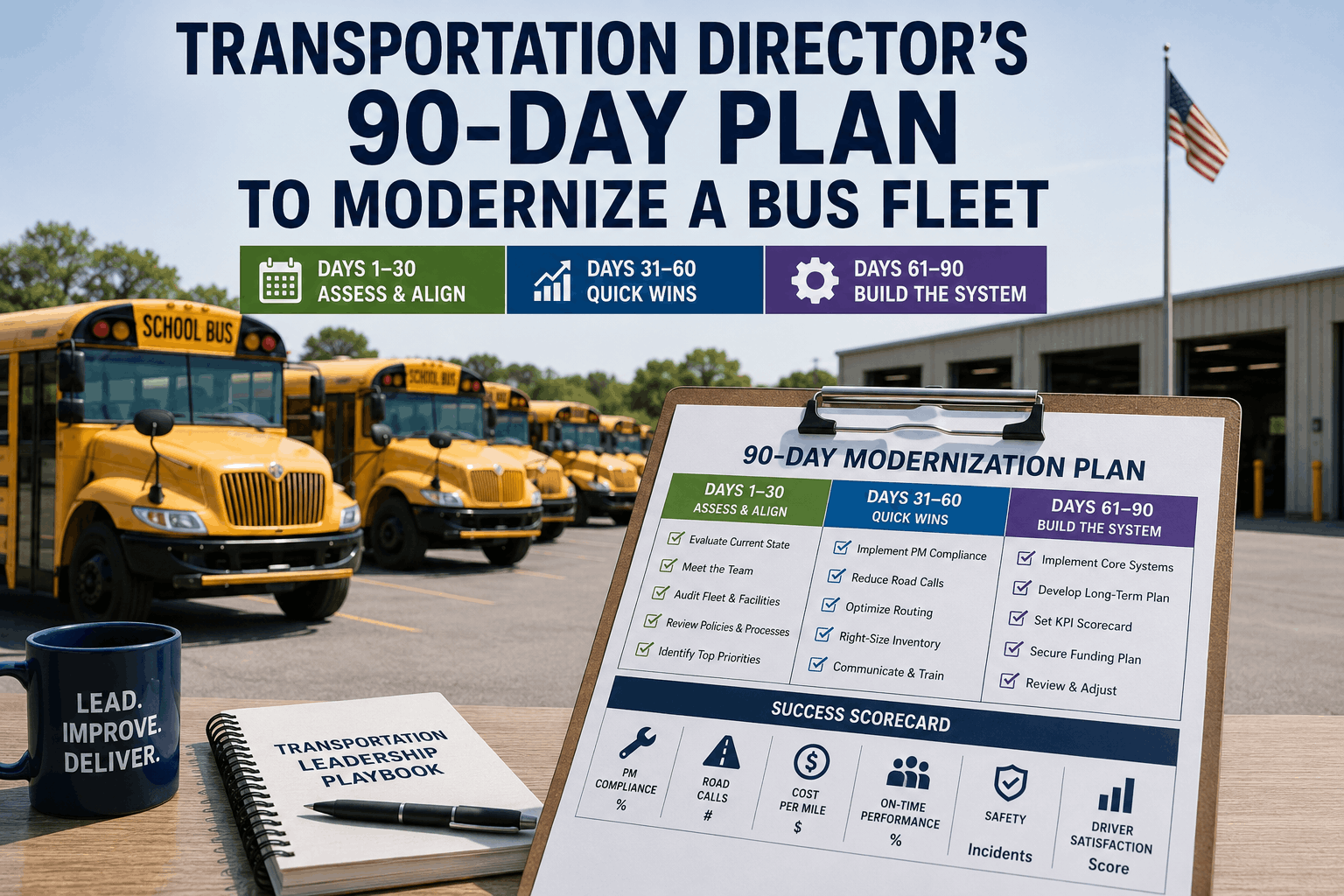
A new transportation director inherits whatever the previous team built, a mix of manual logs, aging vehicles, deferred maintenance, and tribal knowledge held by mechanics who have been there longer than any system has. The difference between a director who transforms a fleet in 90 days and one who spends the year firefighting is a structured assessment plan executed in three phases. Start Trial to see how BusCMMS gives new transportation directors the fleet data, PM compliance records, and operational dashboards needed to move from assessment to modernization without losing momentum.
Go From Assessment to Modernization in 90 Days
BusCMMS gives new transportation directors a single platform to assess fleet condition, execute quick-win PM compliance improvements, and build the operational system their department needs long-term.
Why the First 90 Days Define a Transportation Director's Success
A transportation director who spends the first 90 days reacting to daily operational problems instead of executing a structured assessment never builds the baseline data needed to prove improvement to leadership. Directors who Book Demo with BusCMMS discover how fleet condition, PM compliance rate, and maintenance cost-per-vehicle combine into a starting scorecard that makes every subsequent improvement measurable. Executing this three-phase plan consistently is what separates a director who modernizes a fleet from one who simply manages it.
Fleet Condition Assessment Dashboard
BusCMMS surfaces deferred maintenance, overdue PMs, and open inspection findings across the entire fleet in one view for immediate triage.
PM Compliance Baseline Reporting
Current PM completion rate is calculated from existing work order history, giving the director a measurable starting point within the first week.
Maintenance Cost-Per-Vehicle Trending
Cost per vehicle over the prior 12 months identifies which assets are consuming disproportionate resources and where to focus quick-win interventions.
Driver and Route Assignment Visibility
BusCMMS links driver records, route assignments, and vehicle dispatch history so operational patterns that drive maintenance demand become visible.
Modernization Scorecard Generation
A 90-day modernization scorecard tracks PM compliance, downtime rate, and cost-per-vehicle from day one, showing leadership what changed and why.
Leadership Reporting Templates
Monthly and quarterly reporting templates export fleet condition, compliance trends, and cost improvement for board, district, or agency review.
The 90-Day Transportation Director Modernization Playbook
01
Days 1–10: Fleet Condition Audit and Data Capture
Assessment Phase
The first ten days must produce a complete picture of vehicle condition, deferred maintenance volume, PM compliance rate, and maintenance cost-per-vehicle. Without this baseline, every subsequent improvement is unmeasurable. BusCMMS ingests existing work order history, current vehicle status, and PM schedules in the first implementation session, producing the fleet condition dashboard a new director needs to brief leadership within the first two weeks.
Target: Full fleet data capture by Day 10
Outcome: Baseline scorecard ready
02
Days 11–20: Identify Top-10 Problem Assets
Triage Phase
Sort the fleet by corrective work order frequency, maintenance cost, and downtime rate to identify the ten vehicles producing the majority of operational pain. Prioritizing these assets for immediate PM catch-up and root cause review produces the fastest measurable wins. BusCMMS ranks vehicles by failure frequency and cost so the top-ten problem list is generated automatically, not built manually from spreadsheets.
Target: Top-10 list finalized by Day 20
Outcome: Priority repair queue set
03
Days 21–30: Brief Leadership With Evidence-Based Scorecard
Stakeholder Alignment
Present a 30-day findings report to leadership that includes fleet condition score, PM compliance rate, top-10 problem assets, and a 60-day improvement plan. This brief establishes the director as data-driven from day one and aligns stakeholder expectations before the modernization phase begins. BusCMMS exports this report in board-presentation format without requiring additional data preparation.
Target: Leadership brief delivered Day 30
Outcome: Budget and mandate secured
04
Days 31–60: Execute Quick-Win PM Compliance Acceleration
Quick-Win Phase
Move PM compliance from its current rate to 90 percent or above across the fleet by clearing all deferred PMs and establishing a digitized scheduling system in BusCMMS. PM compliance acceleration produces visible results within 30 days through reduced reactive work order volume and fewer road calls. BusCMMS tracks compliance improvement week by week, giving the director a running scorecard to show progress in the weekly leadership update.
Starting compliance 67%
Day-60 compliance 91%
05
Days 61–90: Build the Long-Term Operating System
Modernization Phase
Digitize every PM schedule, driver inspection record, and work order workflow in BusCMMS so the department operates from a single system of record rather than a collection of paper logs and shared spreadsheets. This phase converts the quick wins of days 31 to 60 into a durable operational model the director can hand to a deputy or present to leadership as a transformed department. The 90-day scorecard showing PM compliance, downtime, and cost trends becomes the evidence of transformation.
Paper-based processes 0%
Digitized workflows 94%
06
Day 90: Present Transformation Scorecard to Leadership
Results Presentation
A 90-day scorecard showing measurable improvement in PM compliance, cost-per-vehicle, and downtime rate is the deliverable that converts a new director from provisional to established. This presentation should show starting versus current state across every tracked metric, the estimated financial value of improvements made, and the 12-month roadmap for continued fleet performance improvement. BusCMMS generates this report automatically from tracked operational data.
Baseline established Day 1
Transformation proven Day 90
90-Day Modernization Milestones: Quick Reference
Scroll for more
| Phase | Days | Primary Deliverable | BusCMMS Tool | Success Signal |
|---|---|---|---|---|
| Fleet Audit | Days 1–10 | Fleet condition baseline | Vehicle status dashboard | All assets in system |
| Triage and Prioritize | Days 11–20 | Top-10 problem asset list | Cost and failure ranking | Priority queue active |
| Leadership Brief | Days 21–30 | 30-day findings report | Board-format export | Budget aligned |
| Quick Wins | Days 31–60 | PM compliance above 90% | PM compliance tracker | Reactive WOs declining |
| System Build | Days 61–90 | Fully digitized operations | Workflow digitization | Zero paper processes |
How BusCMMS Accelerates the 90-Day Plan
A 90-day modernization plan only works if data is available fast enough to drive daily decisions, and BusCMMS gets a new transportation director from zero to fleet-wide visibility within the first implementation session. When PM compliance is rising, cost-per-vehicle is trending down, and the leadership scorecard is exportable on demand, that is the evidence base that gives a new director credibility through the entire first year. Directors can Start Trial and begin building their 90-day scorecard from the first vehicle logged in BusCMMS.
Day-One Fleet Visibility
BusCMMS surfaces vehicle condition, deferred maintenance, and PM compliance from existing data in the first session.
Problem Asset Ranking
Vehicles are ranked by failure frequency and cost automatically, giving the director a triage queue without manual spreadsheet analysis.
Weekly Compliance Tracking
PM compliance improves week by week and is tracked visually, giving leadership a real-time progress update without a director-prepared report.
Board-Ready Scorecard Export
The 90-day transformation scorecard exports automatically with before/after metrics, cost savings, and a forward roadmap for leadership review.
Your 90-Day Modernization Checklist
01
Ingest Full Fleet Into BusCMMS by Day 3
Get every vehicle, current status, and available PM history into BusCMMS immediately so data-driven decisions start from day one, not week four.
02
Calculate PM Compliance Baseline by Day 7
Establish the current PM completion rate from historical work orders to set the measurable starting point for 60-day improvement tracking.
03
Identify Top-10 Problem Vehicles by Day 14
Rank the fleet by corrective work order frequency, maintenance cost, and downtime to focus the first improvement interventions where they matter most.
04
Deliver Leadership Brief With Data by Day 30
Present fleet condition score, PM compliance rate, and a 60-day improvement plan backed by BusCMMS data to establish early credibility with stakeholders.
05
Achieve 90% PM Compliance by Day 60
Clear all deferred PMs and implement digitized scheduling in BusCMMS to move compliance above the threshold where reactive work order volume begins to drop.
06
Export 90-Day Transformation Scorecard
Generate the full before/after scorecard from BusCMMS data and present it to leadership as the documented proof of fleet modernization progress.
Frequently Asked Questions
What should a new transportation director prioritize in their first 30 days?
Fleet condition assessment, PM compliance baseline measurement, and identification of the top-10 highest-cost or most-failure-prone assets, followed by a leadership briefing backed by data.
How does BusCMMS help a new director get fleet visibility quickly?
BusCMMS ingests existing PM and work order history and calculates fleet condition, compliance rate, and problem asset rankings in the first implementation session.
What is a realistic PM compliance improvement in 60 days?
Most fleets can move from 60-70 percent compliance to above 90 percent within 60 days through PM catch-up and digitized scheduling, with reactive work orders beginning to decline by week eight.
How should a 90-day modernization scorecard be presented to leadership?
The scorecard should compare starting-state and current-state metrics across PM compliance, cost-per-vehicle, downtime rate, and reactive work order volume, with an estimated dollar value of improvements made.
What comes after the 90-day modernization plan?
The 90-day plan establishes the operational baseline. The 12-month plan focuses on sustained compliance, reliability growth tracking, and fleet renewal strategy built on the data foundation.
Build the Fleet Your Predecessor Couldn't
BusCMMS gives new transportation directors the fleet data, compliance dashboards, and leadership-ready scorecards to modernize a department in 90 days and prove it with numbers.