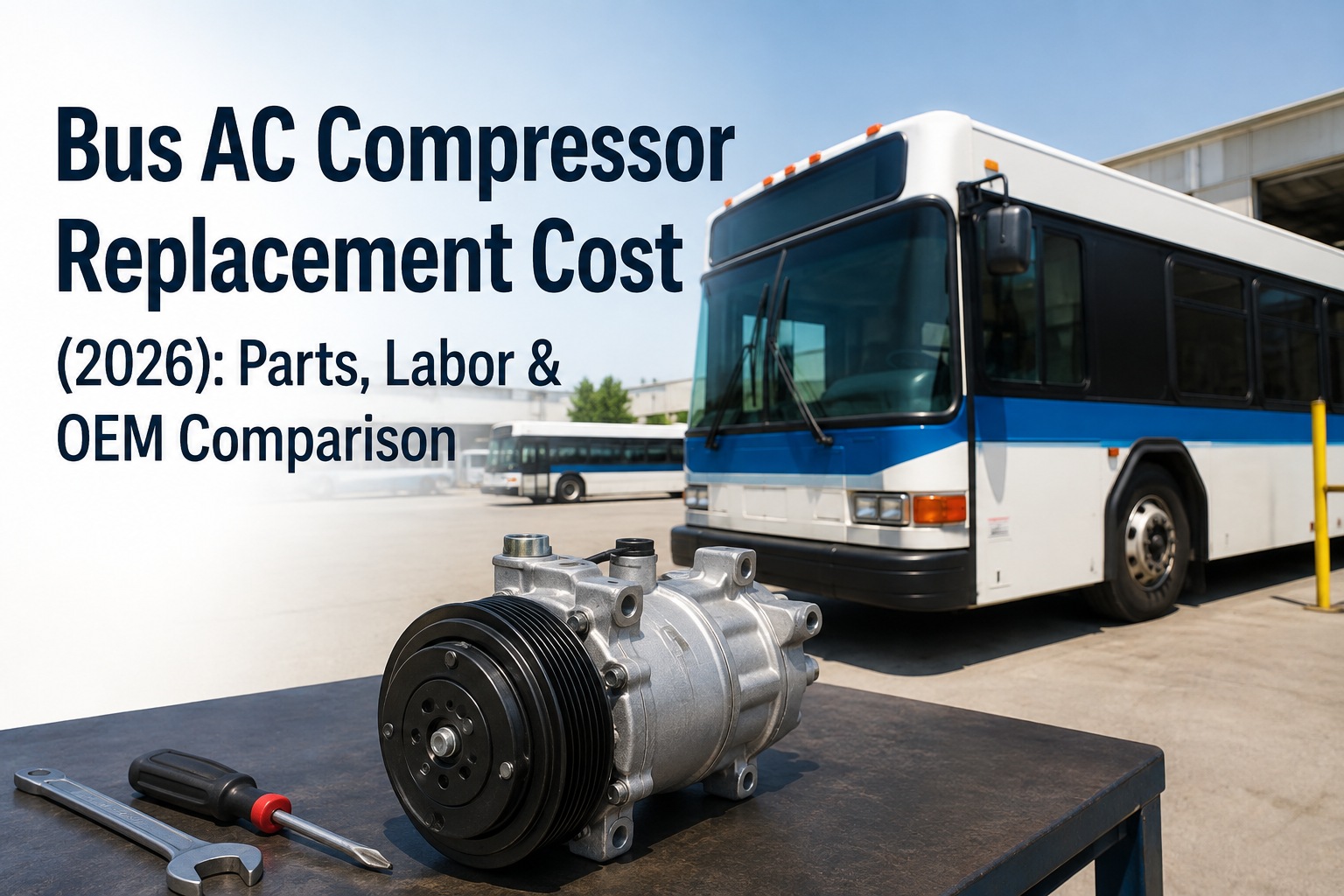
A bus AC compressor failure in July is not a maintenance problem, it is a route problem. Kids melting in the back seats, parents calling the office by 8:30 a.m., and a shop invoice that lands between $2,500 and $8,500 depending on whether the failure is caught early or catches you in a heat wave. This is the straight 2026 walkthrough of what the replacement actually costs across Bock, Bitzer, Thermo King, and Carrier Sutrak platforms, why the refrigerant type doubles the bill, and the PM cost that prevents 70% of these calls in the first place. See how BusCMMS auto-schedules HVAC PM per bus → book a 20-min demo.
Bus AC Compressor Replacement Cost
Real 2026 replacement ranges by brand, the refrigerant tax on newer buses, and the PM math that stops 70% of failures.
Compressor Cost by OEM Brand
Four brands cover 90%+ of bus HVAC compressors on the road.
Bock (FK40 / FK50 series)
Yutong · Konvekta · Sutrak OEMCommon on 8-12m buses. 4-cylinder swash-plate. Popular Yutong OEM fit.
Bitzer (4NFCY / 4PFCY / F400Y)
MOST COMMON · TRANSIT + COACHDouble-decker + coach standard. 647cc displacement. Strong reman market.
Thermo King X430 / S616
North American transit fleet OEMWidely deployed on North American transit and school bus AC units.
Carrier Sutrak
Coach · motorcoach premiumPremium motorcoach standard. Prevost, MCI, Van Hool coach OEM.
The part is only one line on the invoice. Labor + refrigerant + supporting parts usually double it. See BusCMMS log AC parts and warranty per VIN → book a demo.
What's Actually on the $5,000 Invoice
Compressor cost is line 1 of 5. Here's where the rest goes.
Compressor (OEM new)
Bitzer, Bock, or Thermo KingLabor R&R
6-8 hrs at $175/hr avg shop rateRefrigerant recharge (R-134a)
8-10 lbs at $40/lb + recoverySupporting parts
Receiver-drier, expansion valve, O-ringsSystem flush + oil
Required when metal shavings presentCatastrophic failure adds $600–$1,800: When a compressor seizes and pushes metal debris through the system, the condenser often can't be flushed effectively and must be replaced. That single line item can push the total past $6,500.
The Refrigerant Tax: R-134a vs R-1234yf
Post-2018 buses cost meaningfully more to recharge. This is why.
R-134a
- Buses built before ~2018
- System holds 6-14 lbs
- Total recharge: $180-$840
- Existing recovery equipment
- Widely available at any HVAC shop
R-1234yf
- Buses built ~2018 and newer
- System holds 6-14 lbs (same)
- Total recharge: $540-$2,520
- Requires yf-rated recovery machine
- EPA low-GWP mandate compliance
The math on a 40ft transit bus: R-134a full recharge on a 12-lb system runs about $480. R-1234yf on the same size system runs about $1,620. Same job, same shop, same time -- $1,140 more just because of the refrigerant. That difference matters when you're comparing quotes on buses of different vintages in your fleet.
Tag every bus with its refrigerant type before the quote conversation, not after. See refrigerant-per-VIN tracking in BusCMMS → book a demo.
Catch It Early: The Repair Tier Ladder
Every AC failure has a warning window. The tier you catch it in decides the bill.
Clutch or Belt Only
Warning sign: Clutch won't engage, squealing belt, intermittent cooling on hot days.
Fix: Clutch coil, pulley, or belt replacement. System stays sealed. 1-2 hrs labor.
Recharge + Leak Fix
Warning sign: Cooling gradually gets weaker over 2-4 weeks. UV dye reveals leak.
Fix: Repair the O-ring, hose, or line. Recover, vacuum, recharge. Compressor stays.
Component Replacement
Warning sign: Head pressure high, oil pressure low, compressor cycling too fast.
Fix: Expansion valve, receiver-drier, condenser fan motor. Preserves compressor.
Full Compressor Replacement
Warning sign: Grinding, seized clutch, metal in oil, no cold air at all.
Fix: Full R&R + supporting parts + system flush + recharge. Nothing salvaged.
The 25× window
A $150 belt catch at Tier 1 becomes a $3,800+ full replacement at Tier 4. Fleets running weekly HVAC checks and monthly refrigerant leak-dye inspections catch 70% of failures at Tier 1 or 2. Fleets that wait for driver complaints hit Tier 4. The bus was telling you the whole time.
Log every driver AC complaint against the bus VIN. The pattern always shows up before the seizure. See BusCMMS build the fault pattern per bus → book a demo.
Bus HVAC PM: The $300 That Saves $5,000
The 5 preventive checks that decide whether summer breaks the fleet or not.
Belt Tension + Wear
Slipping belt = clutch overworked = compressor seized in 90 days. Quick manual check catches it.
Refrigerant Leak Dye
UV dye added at recharge highlights slow leaks weeks before cooling drops. $40 job. Catches Tier 2 failures.
Condenser Wash
Bugs, dust, road film restrict airflow. Compressor works harder, oil breaks down faster. 15-minute job.
Cabin + Return Air Filters
Clogged filters raise head pressure. Head pressure kills compressors. $30-$80 per filter set per bus.
Oil Pressure & Temp Log
Low oil pressure = compressor about to fail. Trend logged per bus reveals the pattern early.
Payback ratio: 17 to 1
$300 of quarterly HVAC PM prevents a $5,000+ compressor failure on average. On a 50-bus fleet, that math scales to $150,000-$250,000 in prevented AC replacements across a 5-year window. The compressor is not the expense. The missed PM is.
Every check above has to happen at the right interval per bus. That is what a CMMS actually does. See BusCMMS schedule bus HVAC PM per VIN → book a demo.
Where BusCMMS Fits Your HVAC Program
Six ways the summer never breaks your fleet again.
HVAC PM Auto-Schedule
Belt, refrigerant leak dye, condenser wash, filters, oil pressure -- each on its correct interval per bus. Spring pre-season runs auto-fire before heat wave.
Refrigerant Type Per VIN
R-134a vs R-1234yf tagged per bus. Recharge quotes always reflect the correct refrigerant cost. No spring-of-2018 surprises.
Failure Warning Log
Driver complaints (weak cool, clutch grind, water leak) log to the bus history. Pattern emerges before compressor seizes.
Warranty Window Tracking
OEM compressor warranty (12-24 months typical) tracked per unit. Alerts 60 days before expiration to catch late claims.
Vendor Performance
Which shop's compressors last longest per your fleet. Real data replaces vendor sales pitches at next procurement.
AC Spend Per Bus
Total HVAC cost per VIN over the bus's life. Board-ready reports proving PM budget is the cheapest line on the P&L.
Two summers ago we had six compressor failures in July -- $34,000 in reactive repairs and a lot of angry parents. Every one traced back to belt slip or refrigerant loss that could have been caught in April. We moved HVAC PM into BusCMMS with spring pre-season triggers, quarterly belt checks, and UV dye at every recharge. Last summer: two failures, both under warranty. The AC didn't get more reliable. The schedule finally did.
Summer coming? The belt catch this month prevents the compressor call in July. Sign up free and log your first HVAC PM today →
Frequently Asked Questions
How much does it cost to replace a bus AC compressor in 2026?
A typical R-134a bus AC compressor replacement runs $2,500-$5,500 total for parts and labor. OEM compressors from Bock, Bitzer, Thermo King, and Carrier Sutrak run $1,400-$3,500 depending on brand and model. Labor is 5-10 hours at $125-$225 per hour ($625-$2,250). R-134a refrigerant recharge on a bus system holding 6-14 lbs runs $180-$840. Supporting parts (receiver-drier, expansion valve, O-rings) add $400-$1,000. Newer buses (~2018 and later) use R-1234yf refrigerant, which is 3-4x more expensive per pound and can push the total to $5,000-$8,500. Catastrophic failure with metal contamination adds $600-$1,800 for a condenser replacement and full system flush.
Which bus AC compressor brand is best - Bitzer, Bock, Thermo King, or Carrier Sutrak?
All four are premium OEM brands used across major bus manufacturers. Bock (FK40/FK50 series) is standard on Yutong, Konvekta, and Sutrak OEM installs and typically runs $1,400-$2,400 new. Bitzer (4NFCY, 4PFCY, F400Y) is the most common on transit and coach applications with strong reman availability and runs $1,800-$3,200 new. Thermo King (X430, S616) dominates North American transit and school bus AC units at $2,000-$3,500 new. Carrier Sutrak is the premium coach standard on Prevost, MCI, and Van Hool at $1,200-$2,200 new. The "best" is usually whatever your bus was built with -- swapping brands often requires bracket and hose modifications that add hundreds in labor. Match the OEM unless the reman market for that OEM is dry in your region.
Why does R-1234yf refrigerant cost so much more than R-134a?
R-1234yf is an EPA-mandated low-GWP (global warming potential) refrigerant that replaced R-134a in most new vehicles from 2017-2018 onward. It costs $90-$180 per pound wholesale versus $30-$60 per pound for R-134a -- 3-4x more expensive. It also requires a yf-rated recovery machine (older R-134a equipment is not compatible). On a bus AC system that holds 6-14 lbs of refrigerant, that difference alone can add $400-$1,700 to a recharge job. Bus fleets with mixed vintages should have refrigerant type tagged per VIN so quotes reflect the right cost from day one. The EPA transition is one-way -- older R-134a stock is being phased down and is projected to keep climbing in price through the decade.
How can I tell if my bus AC compressor is failing?
Four warning tiers, each caught earlier saves 3-10x on the repair. Tier 1 ($150-$400): Clutch won't engage, squealing belt, intermittent cooling on hot days. Tier 2 ($400-$1,200): Cooling gradually weakens over 2-4 weeks -- indicates a refrigerant leak that a UV dye check will find. Tier 3 ($1,500-$2,500): Head pressure high, oil pressure low, compressor cycles too fast -- component failure of expansion valve, receiver-drier, or condenser fan. Tier 4 ($3,800-$8,500+): Grinding noise, seized clutch, metal shavings in oil, no cold air -- full compressor replacement required. Fleets running quarterly belt checks and biannual UV dye leak inspections catch 70% of failures at Tier 1 or Tier 2 rather than Tier 4.
How does BusCMMS help prevent AC compressor failures?
BusCMMS auto-schedules the five HVAC PM checks that catch 70% of compressor failures early: belt tension and wear (every 3 months), refrigerant leak dye at recharge (every 6 months), condenser wash pre-season (spring), cabin and return air filters (every 6 months), and oil pressure and temperature log at every PM. Each check triggers per bus, tagged with the correct refrigerant type (R-134a vs R-1234yf) so quotes and recharges reflect the right cost. Driver complaints (weak cool, clutch grind, water leak) log to the bus history so patterns emerge before compressor seizure. OEM warranty windows (12-24 months) alert 60 days before expiration to catch late claims. One 52-bus Texas school district reported dropping from six July compressor failures to two after moving HVAC PM into the system, a $30,000+ swing in reactive repair cost.