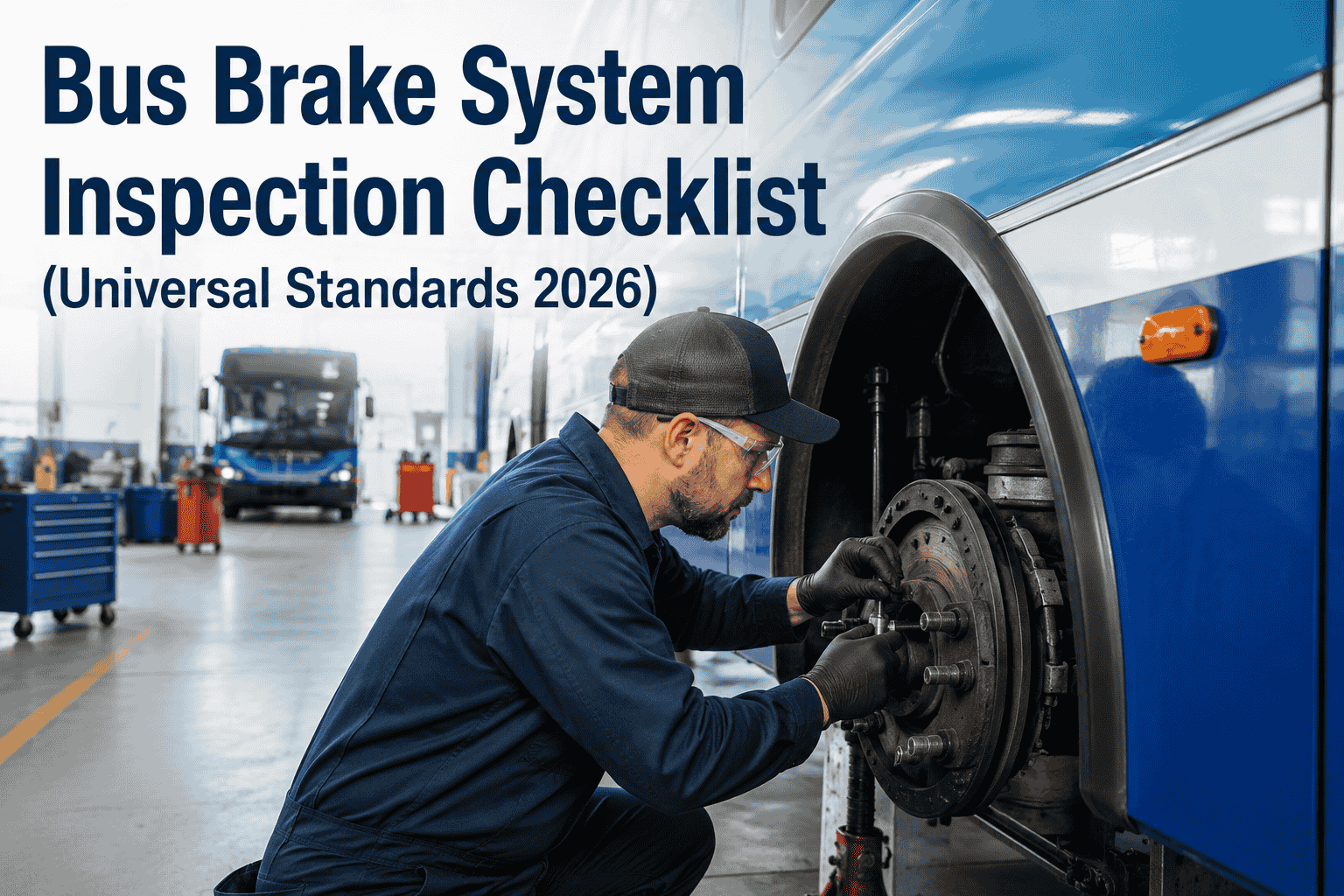
Brake system failures are the #1 cause of out-of-service violations during roadside inspections, accounting for nearly 30% of all commercial vehicle OOS orders. A bus with defective brakes is not just a compliance risk—it is a safety hazard that puts passengers, drivers, and the public at risk. This comprehensive bus brake inspection checklist covers everything your technicians need to check: air brake systems, hydraulic brakes, drum and disc brakes, stroke measurement, leak tests, and the specific out-of-service triggers that FMCSA and state inspectors look for. Use this as your standard operating procedure for brake PM inspections, pre-trip checks, and annual DOT inspections.
Universal Brake Standards 2026
Bus Brake System Inspection Checklist
Complete bus brake inspection workflow. Air brakes, hydraulic brakes, drum and disc, stroke measurement, leak tests, and out-of-service triggers explained.
Why Brake Inspections Are Critical: The Out-of-Service Reality
Brake violations consistently top the list of out-of-service reasons in CVSA International Roadchecks. In 2025, brake systems accounted for 26.8% of all vehicle out-of-service violations. The most common brake violations include: brake lining or pad wear below minimum thickness, air brake system leaks exceeding allowable limits, pushrod stroke exceeding adjustment limits, and brake drum or rotor cracks. Each of these violations is detectable during a proper pre-trip inspection. Each is preventable with consistent PM compliance.
The financial impact of brake-related breakdowns is severe. A single roadside brake violation can result in a $16,000+ civil penalty, out-of-service order, towing costs, and reputational damage. More importantly, brake failures cause accidents. FMCSA data shows that brake-related issues contribute to approximately 22% of all large bus and truck accidents. A structured brake inspection process is the most effective way to prevent these outcomes.
Brake System Types: Air vs. Hydraulic
Most transit buses, school buses, and motorcoaches use air brake systems. Air brakes use compressed air to apply braking force through a series of chambers, slack adjusters, and pushrods. Hydraulic brakes, common on smaller buses and cutaway chassis, use brake fluid and master cylinder pressure. The inspection procedures differ significantly.
Air Brake Systems
Air compressor, governor, air dryer, reservoirs, brake chambers, slack adjusters, S-cam or disc calipers, pushrod stroke, air lines, and valves. Requires air pressure build-up test, leak-down test, and low-air warning test.
Hydraulic Brake Systems
Master cylinder, brake fluid reservoir, wheel cylinders or calipers, brake lines, and ABS system. Requires fluid level check, leak inspection, pedal feel test, and brake fluid condition evaluation.
Air Brake Inspection Checklist: Step-by-Step
This 12-point air brake inspection sequence follows FMCSA inspection standards and should be completed during every brake PM and annual DOT inspection.
Air Compressor & Governor — Compressor builds to governor cut-out (120–140 psi). Governor maintains pressure without excessive cycling. No unusual noise or oil leaks.
Air Dryer — Dryer cycles properly. Desiccant cartridge replaced per manufacturer schedule. No oil or moisture in air system.
Air Reservoir Drain — Drain each reservoir daily. No excessive water or oil accumulation. Automatic drains functioning.
Air Pressure Build-Up — Engine at idle: pressure builds from 0 to 100 psi within 3 minutes. If slower, inspect compressor and governor.
Static Leak-Down Test — Engine off, parking brake released, service brake firmly applied. Air pressure drop ≤3 psi in 1 minute. If exceeds, locate and repair leaks.
Low-Air Warning Test — Fan down service brake to reduce pressure. Warning buzzer/light activates before pressure drops below 60 psi. If not, system requires immediate attention.
Spring Brake Activation — Continue fanning service brake. Spring/parking brakes must automatically engage between 20–45 psi. If not, adjust or repair system.
Brake Chamber and Pushrod Inspection — Chambers not cracked or damaged. Pushrod stroke measured with tape measure. Maximum allowable stroke: Type 30 = 2.25", Type 16 = 2.0", Type 20 = 2.0", Type 24 = 2.25", Type 36 = 2.5". Exceeding these limits = out-of-service violation.
Slack Adjuster — No broken or missing components. Automatic slack adjusters functioning. Manual adjusters are not allowed on most commercial vehicles (FMCSA regulation).
Brake Linings and Drums — Linings inspected through inspection slot. Minimum lining thickness: 1/4" or wear indicator. Drums checked for cracks, scoring, or out-of-round condition. Any crack through drum = out-of-service.
Brake Hoses and Lines — No chafing, abrasion, or cuts. Proper routing with adequate clearance. No leaks at connections. No bulges or soft spots indicating internal failure.
Parking Brake Test — Parking brake engaged on a grade. Vehicle should not move. Also test on flat surface: attempt to move in low gear—vehicle should not move.
Hydraulic Brake Inspection Checklist
For fleets operating hydraulic brake-equipped buses, use this inspection sequence during brake PM and DOT inspections.
Brake Fluid Level and Condition — Fluid at proper level in master cylinder reservoir. Fluid color is clear or light amber (not dark brown or black). No contamination or water absorption.
Master Cylinder and Booster — No external leaks. Booster vacuum or hydraulic assist functioning. Brake pedal has consistent feel and height.
Brake Lines — Steel lines: no rust, pitting, or leaks. Flexible hoses: no cracks, bulges, or chafing. All lines properly secured and routed.
Brake Pad and Rotor Inspection — Pad thickness measured through caliper. Minimum thickness: 1/8" above rivets or wear indicator. Rotor thickness measured with micrometer. Minimum rotor thickness stamped on rotor.
Brake Caliper and Wheel Cylinder — No fluid leaks from caliper seals or wheel cylinder. Caliper slides freely. No binding or sticking.
ABS System — ABS warning light functions (illuminates at startup, extinguishes after self-test). Wheel speed sensors secured and undamaged.
Out-of-Service Brake Violations: Know the Triggers
FMCSA and state inspectors use specific out-of-service criteria for brake systems. Any of these findings means the bus cannot operate until repaired. Inspectors will place the bus out-of-service immediately.
Pushrod Stroke Exceeds Limit
If pushrod stroke exceeds the maximum for its chamber type, the brake is out-of-adjustment. This is the #1 brake OOS violation. Measured at 80–90 psi applied pressure.
Lining Thickness Below Minimum
Steer axle linings below 4/32". Drive axle linings below 2/32". Any lining worn to wear indicator or rivets exposed. Measured at thinnest point.
Air System Leak Exceeds 3 PSI/Min
Air pressure drop greater than 3 psi in 1 minute with service brakes applied. Indicates leaks in chambers, hoses, or valves.
Low-Air Warning Fails to Activate
Warning buzzer or light fails to activate before pressure drops below 60 psi. This indicates a failed warning system—immediate OOS.
Brake Drum or Rotor Cracked
Any crack visible on drum or rotor surface. Crack through the drum face or rotor surface = OOS. Inspect drums/rotors for heat checking and scoring.
Automatic Slack Adjuster Failure
Any missing, broken, or disconnected automatic slack adjuster. Manual adjusters on commercial vehicles = OOS under FMCSA regulations.
Brake Measurement Guide: What to Record
Accurate brake measurements are the foundation of effective brake PM and compliance. Technicians should record all brake measurements during every brake inspection. This builds a historical record showing wear patterns and identifying components needing replacement.
Pushrod Stroke (Air Brakes)
Measure from the center of the clevis pin to the face of the brake chamber at 80–90 psi applied. Record in inches or millimeters.
Lining Thickness (Drum Brakes)
Measure through inspection slot using brake lining gauge. Record at thinnest point on each shoe. Minimum: 1/4" or wear indicator.
Pad Thickness (Disc Brakes)
Measure pad thickness through caliper access hole. Record in millimeters. Minimum: 1/8" above rivets or backing plate.
Drum/Rotor Thickness
Measure drum or rotor thickness with micrometer at multiple points. Record minimum thickness and compare to manufacturer spec.
"We implemented this brake inspection checklist as our standard PM procedure for all 67 buses. In the first six months, we caught 14 pushrod stroke violations, 3 cracked drums, and 11 lining wear cases during scheduled PM—before they became roadside violations. Our brake-related out-of-service rate dropped to zero in 2025. The checklist gives our technicians a consistent process, and the measurements create a wear history that helps us predict brake replacement needs 2–3 months in advance."
Digitize Your Brake Inspection Process
BusCMMS guides technicians through every brake inspection point, captures pushrod stroke measurements, documents lining thickness, flags out-of-service conditions, and auto-generates work orders for repairs. No skipped steps. No measurement gaps.
Bus Brake Inspection FAQs
What is the maximum allowable pushrod stroke for air brakes?
Maximum stroke depends on chamber type: Type 30 = 2.25", Type 16 = 2.0", Type 20 = 2.0", Type 24 = 2.25", Type 36 = 2.5". Exceeding these limits is an out-of-service violation. Always measure stroke with service brakes fully applied at 80–90 PSI.
How often should bus brake inspections be performed?
Full brake inspections should be performed during every preventive maintenance service (typically every 15,000–20,000 miles or 6 months). Annual DOT inspections require comprehensive brake inspection. Pre-trip inspections include basic brake checks daily. BusCMMS auto-schedules brake PM intervals based on mileage and time.
What is the minimum brake lining thickness for a bus?
Steer axle linings: minimum 4/32". Drive axle linings: minimum 2/32". Any lining worn to the wear indicator or with exposed rivets is out-of-service. Always measure at the thinnest point. Replacing linings before they reach the minimum extends drum life and prevents costly emergency repairs.
What are the top brake violations found in roadside inspections?
According to CVSA Roadcheck data: pushrod stroke out-of-adjustment (most common violation), brake lining/pad wear below minimum, air system leaks exceeding 3 PSI/min, and cracked drums or rotors. All are preventable with consistent brake PM inspections.
Can BusCMMS track brake measurement data across inspections?
Yes. BusCMMS stores all brake measurement data (stroke length, lining thickness, drum thickness) with timestamps and bus identification. This creates a wear history that helps predict when components need replacement and provides audit-ready documentation for DOT inspectors.
What is the difference between S-cam air brakes and disc air brakes?
S-cam air brakes use a rotating S-cam to push brake shoes against the drum. Disc air brakes use air pressure to apply calipers against a rotor. Disc brakes typically have better performance and require less adjustment but may have different inspection points and wear patterns.
How do I verify automatic slack adjusters are working?
FMCSA requires automatic slack adjusters on most commercial vehicles. Verify during inspection: apply the service brake fully (80–90 PSI), measure pushrod stroke. Repeat 3 times. The stroke should return to the same measurement each time. If stroke varies significantly, the slack adjuster may be malfunctioning.
The Bottom Line
A bus brake system inspection is not just a compliance exercise—it is a safety obligation. This checklist provides the step-by-step procedure your technicians need to catch brake defects before they become roadside violations or accidents. When you combine this checklist with BusCMMS digital inspections, every measurement is recorded, every out-of-service trigger is flagged, and every repair is work-ordered. Your fleet stays compliant. Your passengers stay safe. Your buses stay on the road.