First heat wave of the year, a full load of kids aboard, and the dash gauge is creeping past where it should sit. Bus cooling system maintenance is what stands between that creeping needle being a non-event and a $6,000 engine job on the shoulder. Here is the pre-summer routine — and you can see it scheduled across your fleet in a demo.
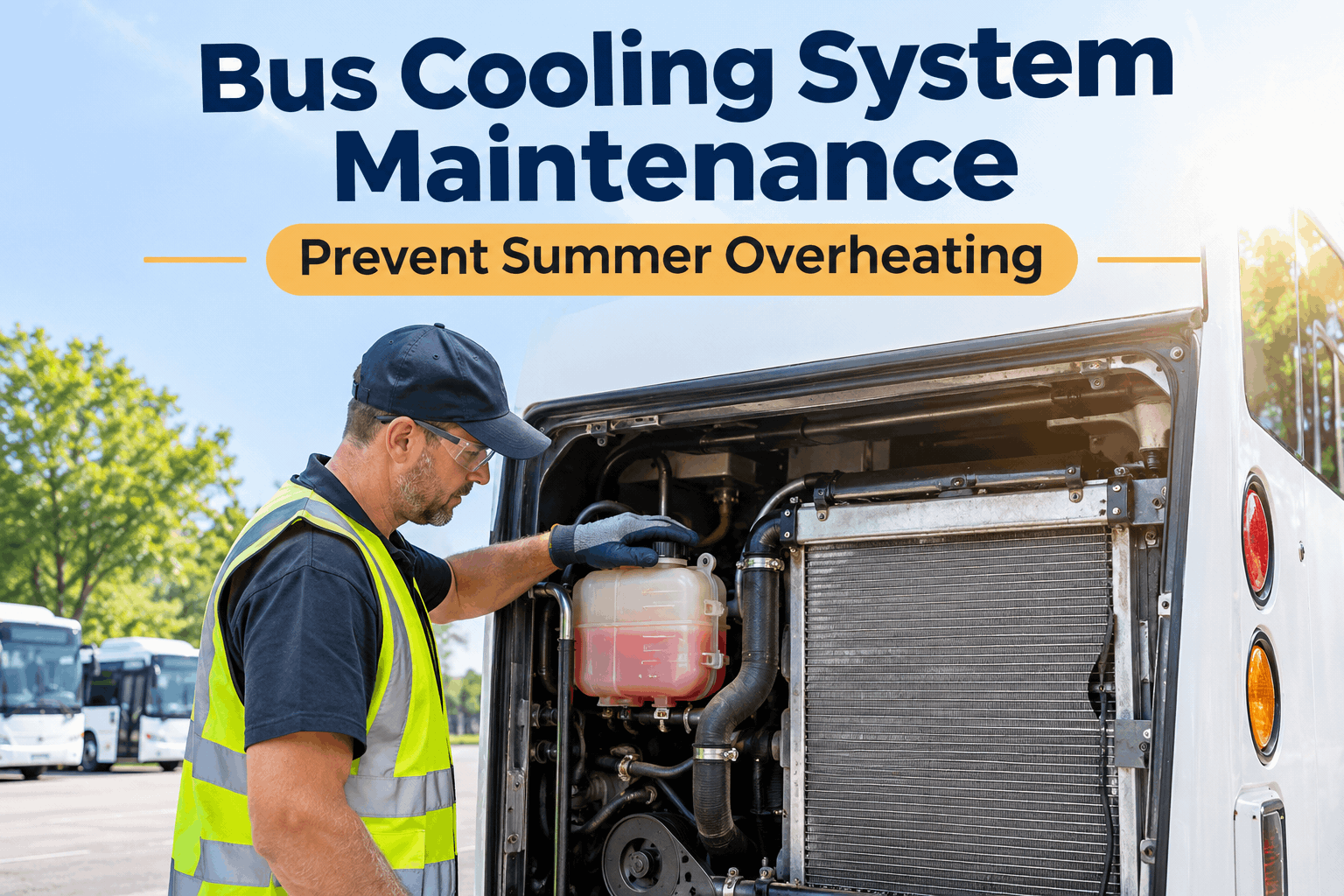
Bus Cooling System Maintenance: Prevent Summer Overheating
Heat does not break a cooling system on its own — a neglected one fails under heat it should have handled. Here is the pre-summer routine that keeps your gauge out of the red and your buses on the road.
Why Summer Exposes a Cooling System You Thought Was Fine
A cooling system that coped all winter can fail in July, because summer stacks three loads at once: higher ambient air, a packed bus with the A/C pulling on the engine, and stop-and-go routes where there is no airflow across the radiator. The weak part that was hiding finally gets found — on a route, with passengers aboard.
The air is hotter
The radiator sheds heat by the gap between coolant and outside air. On a 95°F day that gap shrinks, so the same system runs hotter for the same work.
The A/C adds load
A full bus runs the A/C hard, and that compressor and condenser pile extra heat onto the engine exactly when the cooling system already has the least margin.
Stop-and-go kills airflow
Idling at stops and crawling through traffic means almost no ram air through the radiator, so the fan is doing all the work — and a tired fan clutch shows up here first.
Industry maintenance reporting has long held that roughly 40% of engine downtime traces to cooling-system problems — and that nearly all of it is preventable with routine checks. Summer just moves the failure date up.
The Six Parts That Actually Overheat a Bus
"Overheating" is a symptom, not a cause. It almost always comes back to one of six components. Knowing which part fails how helps you inspect with intent instead of just topping off coolant and hoping.
Radiator
Bugs, dust, and road film plug the fins so air cannot pass. A clogged core overheats a system that is otherwise healthy.
Hoses & clamps
Heat and age make hoses soft, swollen, or brittle. A hose that lets go on a hot route dumps coolant in seconds.
Water pump
A weeping seal or worn bearing drops flow. Less coolant moving means heat is not carried away fast enough.
Thermostat
Stuck shut and the engine cooks; stuck open and it never reaches temp. Cheap to replace, expensive to ignore.
Coolant
Old coolant loses its additives and protection. Low level, wrong mix, or degraded fluid all raise operating temp.
Fan & fan clutch
At idle and low speed the fan is the only airflow. A slipping clutch overheats exactly in stop-and-go traffic.
Spot the wear early and most of these are a $40 hose or a $120 thermostat. Miss them and they become an engine. You can sign up free and log every cooling check per bus so a soft hose gets caught at inspection, not on the shoulder.
How Fast a Neglected System Climbs Into the Red
The scary part of summer overheating is the speed. A maintained system holds a flat line all run; a neglected one climbs steadily and crosses the overheat threshold mid-route — and the window to catch it on the gauge and shut down before damage is narrow.
The fix is not a better driver watching the gauge — it is catching the degraded part before the run, at a scheduled inspection, so the climb never starts.
Warning Signs, and What Should Happen Next
A driver or tech spotting a warning sign is only useful if it turns into action. On paper, a noted sign gets lost; on a digital DVIR, it routes straight to a work order before the bus goes back out.
Gauge creeping up, sweet smell, white steam, low coolant, or a puddle under the bus
Logged on the digital inspection with a photo, tied to that bus and that driver — not a note that vanishes
Auto-created and assigned to the shop, so the defect is fixed before the bus is cleared for its next route
That hand-off from a noticed sign to a scheduled repair is where most overheats are actually prevented. A demo walks the DVIR-to-work-order path end to end on a real cooling defect.
Your Pre-Summer Cooling System Checklist
Run this on every bus before the heat arrives, not after the first overheat. The red items strand a bus if they fail mid-route; the amber ones quietly raise operating temp until a red item tips over.
- Pressure-test for leaks and check the capPressurize the system cold to find seeping hoses, the pump, and the core; a weak radiator cap drops the boiling point.CRITICAL
- Squeeze and inspect every hose and clampReplace anything soft, swollen, cracked, or brittle; re-torque clamps. Hoses are the most common hot-route failure.CRITICAL
- Clean the radiator core and condenserBlow out bugs, dust, and debris so air actually passes. A plugged core overheats a healthy system on the hottest days.CRITICAL
- Test coolant mix, level, and conditionConfirm a correct 50/50 mix, top off, and replace coolant that is degraded or past interval so protection is intact.PLAN
- Check the fan clutch and beltsVerify the fan engages and belts are tight and uncracked — this is the part that strands buses in stop-and-go heat.PLAN
- Log it against each bus in the systemRecord the check per unit with date and reading, so the next inspection and any trend are tracked, not re-discovered.PLAN
Start with the three critical items — leaks, hoses, and a clean core — because those are the ones that end a route. You can see this checklist run as a scheduled fleet-wide PM in a demo.
How BusCMMS Keeps the Cooling System Out of the Red
BusCMMS will not flush a radiator for you — but it makes sure the flush gets scheduled, the inspection gets done, and a failed check never slips through. The cooling checklist above becomes a tracked, repeatable routine instead of a spring intention.
Scheduled cooling PM
A pre-summer cooling inspection triggers by date or mileage on every bus, so no unit misses its check before the heat.
DVIR to work order
A coolant or temp flag on the digital DVIR auto-creates a work order, so the defect is fixed before the next route.
Temp trends from telematics
With a telematics link, a rising engine-temp fault code can auto-create a work order before the gauge ever hits the red.
The result is a cooling program you can prove ran on every bus — useful at a DOT inspection and better for the fleet you serve. Book a demo and bring your fleet size.
A Shop Foreman's Take
Key Takeaways on Preventing Summer Overheating
Bus cooling system maintenance is a spring job that pays off all summer. Four things to hold onto.
Heat finds the weak part
Summer does not break a good system; it exposes the neglected one. Fix the weak part before the heat.
It comes back to six parts
Radiator, hoses, pump, thermostat, coolant, fan clutch — inspect with intent, not just a top-off.
A noticed sign must become a work order
A DVIR flag that auto-routes to the shop is what actually prevents the overheat.
Schedule it, do not remember it
A pre-summer cooling PM on every bus beats hoping someone checks in time.
Treat the cooling system like the safety item it is — a scheduled, logged, fleet-wide check before the first heat wave — and summer stops being breakdown season. The parts are cheap; the stranded route with kids aboard is not.