7:41 AM. Bus 12 is idling at the depot with the check engine light on and "DEF FLUID QUALITY BAD" flashing on the dash. The scan tool pulls P207F and P20EE. In four operating hours the ECM will derate the engine to 25 mph. In three days, if the fault is not cleared, the bus will not start at all. Now the shop has to solve an SCR problem before the driver even walks in. A real bus DEF (AdBlue) system inspection routine is what keeps that 7:41 AM from ever happening.
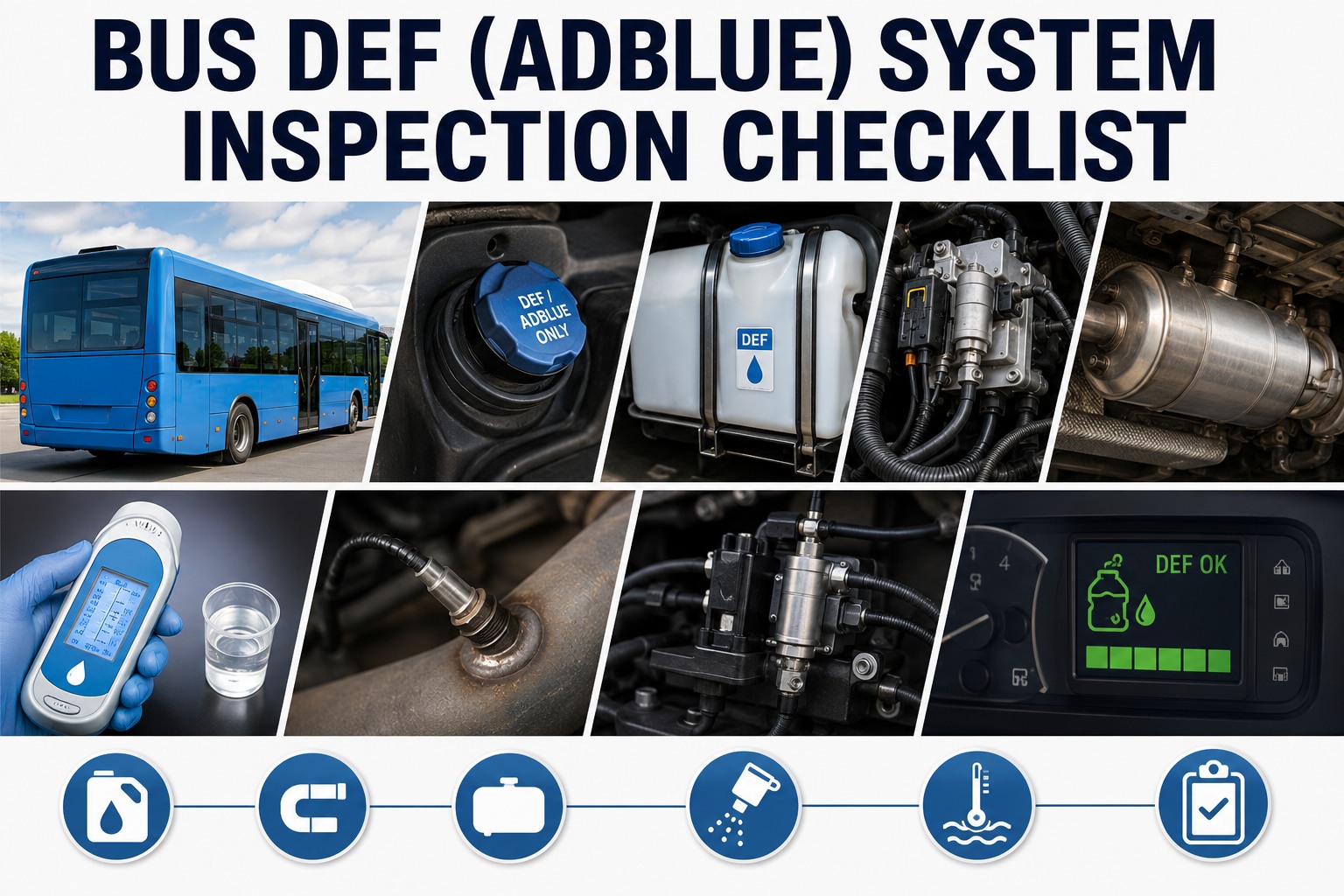
Bus DEF (AdBlue) System Inspection Checklist: SCR Health & Fluid Quality
The complete inspection routine for diesel bus emissions systems -- tank, dosing injector, NOx sensors, SCR catalyst, DEF quality testing, and fault codes that decide whether a bus makes tomorrow's route.
- Refractometer testing
- NOx sensor checks
- Crystallization prevention
What an Unaddressed DEF Fault Actually Costs
Under EPA regulations that have applied to every new diesel bus engine since 2010, the SCR system is not optional -- and the ECM enforces it. When the DEF system faults, the engine does not just throw a warning light and let you keep driving. It stages a derate that ends with a bus that will not move. For a school district or transit agency, that means routes disrupted before the day starts.
- Stage 1 Warning light + inducement message on dash
- Stage 2 Engine derate -- typically 25 mph max speed
- Stage 3 Bus will not start after next key cycle
- $1.5K-$5K Repair range: sensor swap to full SCR rebuild
The urban bus duty cycle -- constant stops, short routes, heavy idling -- happens to be exactly the operating pattern that makes SCR systems most vulnerable to crystallization and NOx sensor failure. Which is why a bus DEF system needs stricter, not looser, PM than a highway truck. Book a demo to see automated DEF fault tracking for your fleet.
How the SCR System Actually Works
Understanding the flow tells you exactly where to inspect. DEF is not a fuel and it is not a lubricant -- it is a precisely metered reagent injected into hot exhaust to convert NOx into harmless nitrogen and water vapor. Every stage in that flow has a failure mode.
-
01
Engine Combustion
Diesel combustion produces NOx as a byproduct. Upstream NOx sensor measures raw output.
-
02
DEF Dosing
Pump pressurizes DEF from tank. Injector sprays a precisely metered dose into the exhaust stream.
-
03
Vaporization
Heat vaporizes water; urea decomposes to ammonia. SCR needs 200°C minimum -- ideal 360-450°C.
-
04
SCR Catalyst
Ammonia reacts with NOx on the ceramic catalyst. Up to 90% of NOx converts to N2 and water.
-
05
Downstream Sensor
Second NOx sensor verifies output. If NOx is still high, ECM flags P20EE and starts the derate clock.
Every stage above is a potential failure point that a routine inspection catches early. Book a demo to see SCR system health tracked per bus across your fleet.
The Complete DEF System Inspection Checklist
Below is the working checklist organized by the five inspection zones a bus SCR system actually breaks down into. Every item ties to a failure mode you have seen -- or will see -- on urban duty cycle buses. Sign up free and load this as an auto-triggered emissions PM template.
-
01 Any techDEF Tank & Fluid
Every fuel-up + monthly · ~5 min
- DEF level checked, refill from sealed container only
- Tank cap seal intact, no contamination pathway
- Tank heater function verified in cold weather
- No white crystal deposits around fill neck
-
02 Diesel techDosing Injector & Lines
Monthly · ~15 min per bus
- Injector nozzle inspected for crystallization
- Spray pattern test with scan tool actuation
- DEF supply lines free of kinks, cracks, or crystal buildup
- DEF pump pressure test within OEM spec
-
03 Diesel techNOx Sensors (Up & Downstream)
Every oil change · ~10 min
- Upstream sensor NOx reading matches expected engine output
- Downstream sensor confirms SCR conversion >80%
- Sensor tips free of soot, oil, or crystal contamination
- OEM parts verified -- avoid failure-prone aftermarket sensors
-
04 Diesel techSCR Catalyst & Housing
Every PM-C or 36,000 mi · ~30 min
- SCR conversion efficiency read from ECM (should be >90%)
- Exhaust temperature sensors reading correctly
- Housing clamps and gaskets sealed, no exhaust leaks
- EGR system serviced (soot contributes to catalyst load)
-
05 CriticalDEF Quality & Diagnostics
Every 10,000 mi + on any fault · ~10 min
- Refractometer test -- urea concentration 31.8-33.2%
- Full DTC scan for P203F, P204F, P207F, P20E8, P20EE, P218F
- DEF quality sensor calibration verified
- Storage container audit -- no expired or cross-contaminated DEF
The DEF Quality Test: Refractometer, Every 10,000 Miles
DEF is a chemical solution, not just a liquid. It has to sit within a narrow concentration window to work -- and it degrades if stored wrong, mixed with contaminants, or left in a hot tank across seasons. The refractometer test is the fastest, cheapest way to catch bad fluid before it damages a $3,000 catalyst.
Refractometer Reading Guide
Handheld tool, one drop of DEF, 20 seconds
- Pass 31.8 - 33.2% Within ISO 22241 spec. Return to service.
- Marginal 31.0 - 31.7% Investigate source. Retest next PM cycle.
- Fail Outside range Drain tank, flush system, refill with sealed DEF.
The #1 cause of a fail reading is not bad DEF from the supplier -- it is district-level storage. A drum left in direct sun, an open jug, a shared funnel that touched diesel -- any of those contaminates the tank and produces a fault code inside 2,000 miles. Book a demo to see DEF quality logs tracked per bus.
DTC Reference: Reading SCR Fault Codes
Every DEF-related fault throws a standardized OBD-II code. Learn the six that account for most SCR shop visits and you can pre-diagnose the bus before it even hits the bay.
Common DEF / SCR Fault Codes
Bus diesel engines · verify against OEM service info
-
P203F
DEF Level Low
Tank near empty. Fastest to fix -- refill and clear.
-
P204F
Reductant System Performance
Dosing fault. Check injector, pump, and DEF supply lines.
-
P207F
Reductant Quality Performance
DEF quality out of spec. Refractometer test required.
-
P20E8
DEF Pressure Fault
Pump or line pressure out of range. Test pump output.
-
P20EE
SCR NOx Efficiency Below Threshold
Catalyst not converting. NOx sensors, DEF quality, or spent SCR.
-
P218F
Reductant No Flow Detected
Injector or line blocked -- almost always crystallization.
P20EE is the code that decides the shop's day. It can be a $150 NOx sensor or a $3,000 catalyst -- and the diagnostic sequence matters. Skip the DEF quality check and you replace a good catalyst. Book a demo to see DTC-linked workflow guidance for your techs.
A Shop Foreman's Take on DEF System PM
Ninety percent of the SCR trouble we see is not the SCR. It is bad DEF. A driver tops off from an open jug that has been sitting in the yard for three months, tank concentration drops half a point, and two weeks later that bus is in derate with a P207F. When we started refractometer-testing every bus at oil change, the SCR call rate on the fleet dropped in half inside a quarter. Cheapest tool we own.
That is the pattern across most fleets: DEF quality control lives upstream of the shop, in how the district or agency stores and dispenses fluid. If you fix storage and testing, most SCR problems never make it to the scan tool.
How BusCMMS Tracks DEF System Health
A DEF checklist on a shop wall gets skipped when the day gets busy. A checklist that fires at mileage, syncs fault codes from Samsara or Geotab, and logs refractometer readings per bus -- that is a program that actually catches SCR problems at the storage jug, not the tow truck.
-
01
SCR-Specific PM Templates
Pre-loaded emissions PM for Cummins, Detroit, and International engines.
-
02
DEF Quality Logs
Refractometer readings per bus, per test date. Trend catches storage drift.
-
03
DTC Auto-Sync
P20EE, P207F, and P218F codes from telematics auto-create WOs in real time.
-
04
Derate Countdown Alerts
Time from Stage 1 warning to Stage 2 derate flagged per bus. No surprises.
-
05
DEF Inventory Tracking
Storage log with expiration dates. Prevents old drum contamination cycles.
-
06
Diesel Tech Routing
SCR work orders route only to qualified diesel techs -- not any mechanic.
How often should a bus DEF and SCR system be inspected?
A full DEF/SCR inspection combines four intervals. Every fuel-up: check DEF level and inspect around the fill neck for crystal deposits. Every oil change: NOx sensor visual check and DTC scan for any pending SCR codes. Every 10,000 miles: refractometer test on DEF for urea concentration (must be 31.8 to 33.2 percent per ISO 22241). Monthly: dosing injector spray pattern test and full DEF supply line inspection for crystallization. Every PM-C (36,000 miles): SCR conversion efficiency read from ECM plus full system pressure test. Urban bus duty cycles need the tighter end of every interval.
What causes DEF to crystallize in a bus SCR system?
Crystallization happens when DEF (32.5 percent urea in deionized water) dries out or degrades inside the system. Urban buses are especially vulnerable because short routes and heavy idling prevent the SCR from reaching its optimal operating temperature (360 to 450 Celsius), so urea does not fully vaporize before hitting the catalyst. Other causes include contaminated DEF from open storage containers, tank heater failure allowing freeze-thaw cycles, and extended bus parking between routes. The result is white crystal buildup on the dosing injector nozzle, blocking spray patterns and triggering P204F or P218F fault codes.
What are the most common DEF/SCR fault codes to know?
Six codes cover most shop visits. P203F is DEF level low -- refill and clear. P204F is reductant system performance -- typically a dosing injector fault. P207F is DEF quality performance -- test with a refractometer immediately. P20E8 is a DEF pressure fault, usually the pump. P20EE is SCR NOx catalyst efficiency below threshold, which can be a bad NOx sensor, bad DEF, or a spent catalyst -- diagnostic sequence matters here. P218F is reductant no flow detected, almost always crystallization in the injector or line.
How does a refractometer test for DEF quality work?
A handheld refractometer measures the refractive index of a fluid, which correlates directly to urea concentration in DEF. A single drop is placed on the prism, the calibrated tool reads through daylight, and the concentration displays in percent. A pass reading is 31.8 to 33.2 percent, matching the ISO 22241 spec. Marginal readings between 31.0 and 31.7 percent warrant investigation of storage practices. Anything outside the pass window means the tank must be drained, the system flushed, and refilled with sealed, in-spec DEF. The test takes under a minute and the tool costs about a hundred dollars -- the cheapest possible defense against a catalyst replacement.
How does a bus CMMS help prevent DEF and SCR failures?
A bus-specific CMMS reduces SCR failures in five ways. First, SCR-specific PM templates fire on mileage triggers so refractometer tests and injector inspections do not slide. Second, DEF quality logs trend per bus over time -- a bus whose readings drift downward signals a storage problem before it becomes a P207F. Third, telematics integration from Samsara or Geotab syncs SCR fault codes in real time and auto-creates work orders. Fourth, derate countdown alerts flag any bus in Stage 1 warning so the shop can intervene before Stage 2. Fifth, work orders route only to qualified diesel technicians, protecting warranty and repair quality.