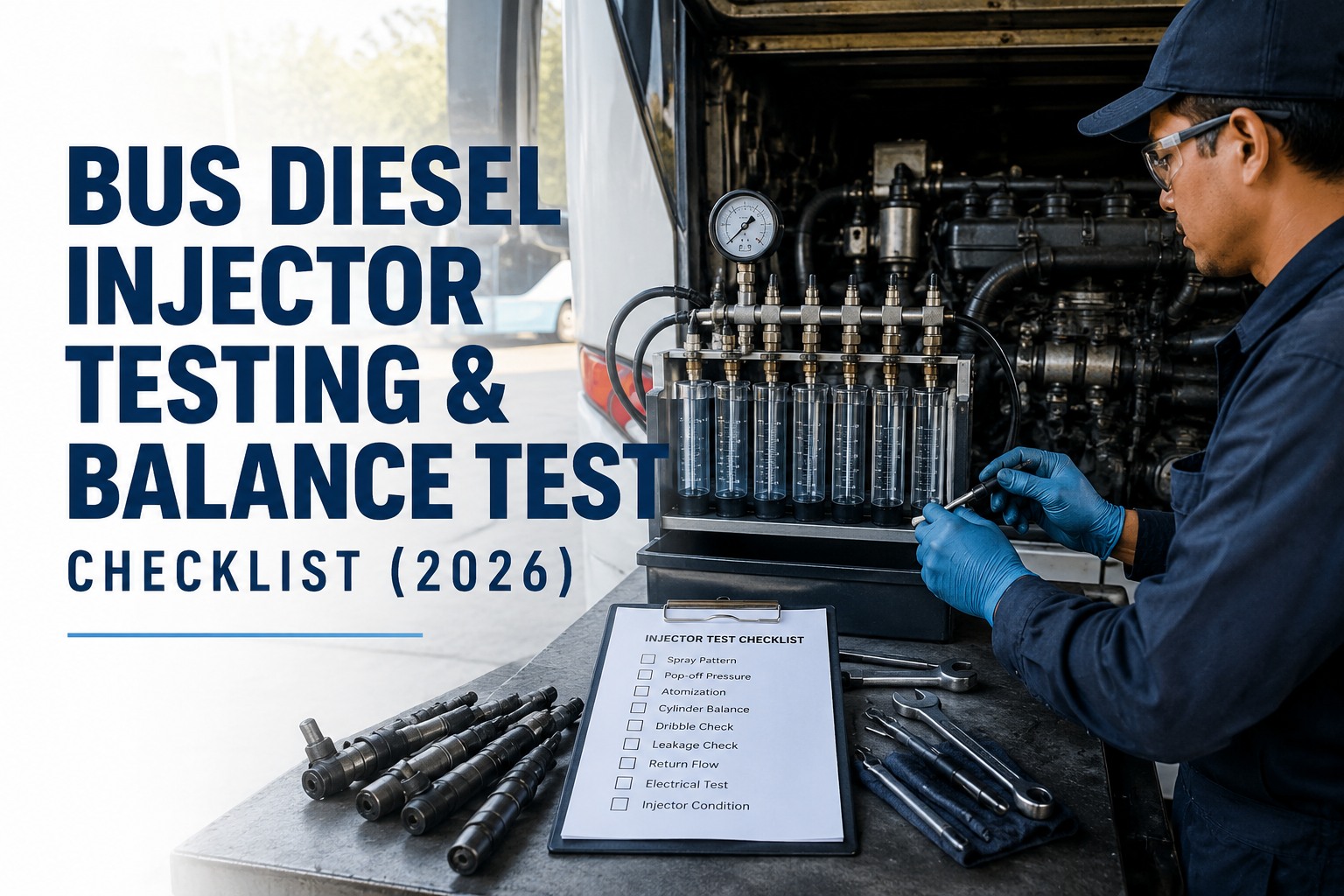
An injector that pops at 3,300 PSI in a set spec'd for 4,500 PSI will overfuel its cylinder, blow black smoke, drag down MPG, and eventually wash the cylinder wall with unburned diesel. One weak injector on a 6-cylinder Cummins ISL costs $300 in extra fuel a month and $8,000 in premature reman if it takes down the piston. This is the 2026 bench-test and cylinder-balance checklist -- 5 standard tests, pop-off pressure references by engine, spray pattern visual guide, and the fault-symptom map every bus shop should have at the diesel bay. See BusCMMS log injector test results per bus per cylinder → book a 20-min demo.
Bus Diesel Injector Testing & Balance Checklist
The 3 injector generations found on bus fleets, the 5-test bench workflow, cylinder balance procedure, and the fault-code shortcuts every diesel tech should have taped to the bay wall.
Mechanical Injectors
Electronic Unit Injectors (EUI)
High-Pressure Common Rail (HPCR)
The 5-Test Bench Workflow Every Injector Should Pass
Miss any one and you have not tested the injector. Miss all five and you have not tested the set.
Bench-testing a diesel injector is a 5-part check. Pop-off pressure comes first because it is the easiest failure mode to detect and the most impactful on fuel burn. Spray pattern is the second most important because the correct pattern is what allows the fuel to burn cleanly across the piston bowl. Chatter, dribble, and cylinder balance round out the diagnostic set. Every injector shop that certifies work on Bosch and Delphi products runs the same 5 tests in the same order.
- 1
Pop-Off (Opening) Pressure
HAND PUMP TESTERProcedure: Hand pump raises pressure until injector opens. Watch gauge for pressure at the moment of opening.
Pass criteria: Reading matches OEM spec within ±50 PSI across the full injector set. Uniform is more important than absolute value.
Fail signs: Reading below spec = overfueling, black smoke, EGT spike. Reading above spec = late injection, low power, hard start.
- 2
Spray Pattern & Atomization
CRITICAL · VISUAL INSPECTIONProcedure: Pump to pop-off pressure repeatedly and inspect spray cone from all nozzle holes (typically 4-8 orifices).
Pass criteria: Conical, well-atomized fog. All orifices spray equally. Fine mist, no droplets.
Fail signs: Solid stream, off-angle spray, uneven cone, missing hole, or heavy droplets = worn nozzle, replace immediately.
- 3
Chatter Test
RAPID PUMPINGProcedure: Pump rapidly at approximately 1 stroke per second. Listen for sharp "crack" or "scream" as the pintle rapidly opens and closes.
Pass criteria: Sharp, consistent chatter across all injectors in the set.
Fail signs: No chatter = stuck/gummed pintle. Uneven chatter across set = balance problem.
- 4
Dribble / Seat Leakage Test
10-SECOND HOLDProcedure: Pump to approximately 200-300 PSI below pop-off pressure and hold for 10 seconds. Watch nozzle tip.
Pass criteria: Nozzle tip stays dry for the full 10 seconds. No droplet formation.
Fail signs: Any drip, dribble, or wet tip = worn nozzle needle/seat. Replace. Do not return to service.
- 5
Cylinder Balance Test (Engine Running)
INSITE / DDDL / CAT ETProcedure: Connect ECM diagnostic tool (Cummins INSITE, Detroit DDDL, or Cat ET). Command cylinder cutout one at a time. Measure RPM drop.
Pass criteria: Consistent RPM drop across all cylinders. Balance rates within OEM spec.
Fail signs: Weak RPM drop on a cylinder = weak injector OR compression issue. Diagnose further with compression test before condemning injector.
Never return an injector to service that failed the dribble test. A dribbling injector washes the cylinder wall with raw fuel every stroke. See BusCMMS log every bench test result per injector position → book a demo.
Pop-Off Pressure Reference by Engine
Always confirm against current OEM spec first. These are the working starting values every bus shop should know.
Reading the correct target pressure off memory saves 10 minutes of manual-flipping per injector. Below are the standard opening pressures for the mechanical and EUI-generation injectors still running under most school bus and transit fleets in service today. Common rail HPCR does not use pop-off pressure the same way -- it uses ECM-commanded pressure at the rail, tested via return flow measurement.
Set-to-set variance matters more than absolute pressure. Two injectors 50 PSI apart run smoother than six injectors right on spec but 200 PSI apart from each other. See BusCMMS track injector spec history per bus → book a demo.
Spray Pattern Visual Guide: PASS vs FAIL
Four patterns to recognize. Only one returns to service.
Spray pattern is the second most diagnostic test in the workflow because it reveals nozzle condition instantly -- long before pop-off pressure drifts far enough to be visible on the gauge. A worn nozzle can still pop at the correct pressure while producing a spray pattern that will not burn cleanly across the piston bowl. The four patterns below are what every tech should be able to identify at a glance.
Conical Fine Mist
Symmetric cone, all orifices spraying evenly, fine atomized droplets throughout. Ready for cylinder service.
Solid Stream
Solid liquid stream instead of atomized cone. Nozzle severely worn or plugged. Do not return to service.
Off-Angle / Uneven Cone
Heavy droplets to one side, weak or missing spray from opposite orifices. Plugged nozzle holes or bent pintle.
Dribble / Wet Tip
Fuel forming droplet at tip below opening pressure. Worn needle/seat. Washes cylinder wall raw fuel.
Ability to identify these four patterns at 6 feet is the difference between a $200 nozzle swap and a $12,000 top-end rebuild. See BusCMMS log spray pattern ratings per injector per bench event → book a demo.
Failure Symptom Map: What the Bus Tells You Before the Bench Does
Every symptom below points back to one or more of the 5 tests. Match the complaint, run the test.
Drivers report symptoms in the language of driving. Techs translate to the language of the injector. Six patterns cover most of the injector-related road calls that come into a bus fleet shop -- and each maps back to a specific test in the 5-test workflow above. This is the shortcut between the driver's complaint and the tool in the box.
Rough Idle / Miss at Low RPM
Most likely: Uneven pop-off pressure across set OR one weak injectorTest first: Cylinder balance test via INSITE/DDDL. Then pop-off if EUI/mechanical.Black Smoke Under Acceleration
Most likely: One or more injectors popping BELOW spec, or stuck openTest first: Pop-off pressure on all injectors. Any reading 200+ PSI below spec = overfueling that cylinder.White Smoke at Cold Start
Most likely: Poor atomization from worn nozzles. Unburned fuel exits as vapor.Test first: Spray pattern inspection. Look for solid stream or heavy droplets.MPG Drop 10-20% Over 3 Months
Most likely: Slow injector wear. Pop-off drift + spray degradation.Test first: Full 5-test bench work on suspect injectors during next PM.Fuel in Engine Oil (Rising Level)
Most likely: Leaking injector return, dribble at seat, or cracked injector bodyTest first: Dribble/seat test at 10 seconds. Any wet tip = replace.Rail Pressure Fault Codes (HPCR)
Most likely: P0087 low rail, P0088 high rail, P0201-P0208 injector electricalTest first: ECM injector balance rates. HPCR bench flow test if balance rates outside spec.
Six symptom patterns. Six shortcut paths from complaint to test. The right diagnostic first cuts labor hours in half. See BusCMMS route symptom to test automatically → book a demo.
Where BusCMMS Fits Your Injector Service Program
Six ways the injector paper trail becomes daily discipline instead of scattered bench sheets.
Test Results Per Cylinder Per Bus
Every injector's pop-off, spray pattern, chatter, dribble, and balance test logged by cylinder position. Trend visible over multiple service events.
Set Balance History
Set-to-set variance calculated automatically. Alerts when any injector drifts more than 50 PSI from set average.
Engine-Specific Spec Library
Cummins ISX, ISB, ISL, Detroit DD13, DD15, Cat C13 specs stored per bus. Right target pressure surfaced automatically at intake.
DTC Code History Per Bus
Injector fault codes (P0201-P0208, P0087, P0088) logged with resolution notes. Recurring codes surface pattern data fast.
Reman + Warranty Log
Every rebuilt or replaced injector tracked with vendor, warranty window, and cylinder position. Warranty defense ready.
Symptom-to-Test Decision Tree
Driver complaint intake maps to the correct bench test. No wasted diagnostic time chasing the wrong symptom.
We had a transit bus dropping 22% MPG over eight weeks and nobody could figure out why. Compression tested fine. Turbo tested fine. Fuel filter clean. Finally pulled all six injectors on the ISL and pop-tested the set. Five were within 40 PSI of each other, sitting at 4,650. The sixth was at 3,880 -- 770 PSI below the rest of the set. That one injector was overfueling its cylinder continuously and dragging the whole engine's average burn efficiency down. Rebuilt the injector, popped the whole set again, torqued them back in. MPG returned to 6.9 within a week. Now every bus in the fleet has a bench-test record in BusCMMS per cylinder per injector, so drift shows up months before it becomes a road call.
770 PSI off across one injector cost 22% MPG. Per-cylinder logging catches it in weeks. Sign up free →
Frequently Asked Questions
What is the 5-test injector bench workflow every bus shop should run?
The standard bench workflow is five sequential tests, each isolating a specific injector failure mode. Pop-off (opening) pressure comes first -- use a hand pump tester with a 0-400 bar (0-5,800 PSI) gauge, raise pressure until the injector opens, and confirm the reading matches OEM spec within plus-or-minus 50 PSI across the full injector set. Set-to-set uniformity matters more than absolute value. Spray pattern is second -- pump repeatedly to opening pressure and visually inspect the cone from all 4-8 nozzle orifices. Pass criteria is a symmetric conical fine mist with all orifices spraying evenly. A solid stream, off-angle spray, or heavy droplets means replace immediately. Chatter test is third -- pump rapidly at about one stroke per second and listen for sharp consistent chatter as the pintle rapidly opens and closes; no chatter means a stuck or gummed pintle. Dribble or seat leakage test is fourth -- pump to approximately 200-300 PSI below pop-off and hold for 10 seconds; the nozzle tip must stay dry. Any drip means worn nozzle needle or seat and the injector cannot go back to service. Cylinder balance test is fifth and runs with the engine running via Cummins INSITE, Detroit DDDL, or Cat ET -- command cylinder cutout one at a time and measure RPM drop. Consistent drop means balanced injectors; a weak drop on one cylinder means either a weak injector or a compression problem, which requires a compression test before condemning the injector.
What are the pop-off pressure specs for common bus diesel engines?
Always confirm against current OEM factory service manual first -- specs change per model year and calibration -- but these are the working starting values every bus shop should know. Older Cummins VE-pump mechanical injectors typically pop at 245 bar (3,553 PSI). Cummins P-pump mechanical (B, C, L-series older applications) typically pop at 260 bar (3,770 PSI). Cummins 5.9L 24-valve, the most common older bus setting, targets 300-310 bar (4,500-4,750 PSI) per the Cummins Factory Service Manual. Detroit Diesel Series 60 electronic unit injectors run in the 4,500-5,000 PSI range with balance testing via DDDL preferred over pure bench work. Caterpillar 3406E and C13 electronic injectors sit in the 4,000-5,000 PSI range and require solenoid electrical testing plus fuel flow measurement via Cat ET diagnostic tool. Modern high-pressure common rail engines (Cummins ISX, ISB, ISL; Detroit DD13, DD15) do not use the same pop-off pressure test -- they operate at 25,000-30,000+ PSI at the rail and require specialized $50,000+ HPCR test benches. For HPCR injectors, ECM-based injector balance rates plus return flow measurement replace traditional bench pop-testing.
How do I recognize a bad diesel injector spray pattern?
A pass spray pattern is a symmetric conical fine mist -- all 4-8 nozzle orifices spraying evenly, well-atomized fine droplets throughout, no visible stream, no heavy droplets, no missing orifices. This is what allows the fuel to burn cleanly across the entire piston bowl at combustion. Four failure patterns show up in bus shops. First, solid stream: a straight liquid column instead of an atomized cone. Cause is severely worn or plugged nozzle. Fuel does not atomize and cannot burn efficiently. Second, off-angle or uneven cone: heavy droplets to one side with weak or missing spray from opposite orifices. Cause is plugged nozzle holes or a bent pintle. Fuel concentrates on one side of the piston bowl instead of distributing evenly. Third, dribble or wet tip: fuel forming a droplet at the tip below opening pressure or dripping after pop-off. Cause is worn needle and seat. This one is the most damaging -- the injector washes the cylinder wall with raw unburned fuel every combustion stroke, thinning the oil film and accelerating cylinder wear. Fourth, no chatter during rapid pumping combined with weak spray. Cause is a stuck or gummed pintle. All four fail patterns mean the injector does not return to service.
How do I run a cylinder balance test on a bus diesel engine?
The cylinder balance test is run with the engine at operating temperature and idling. Connect the appropriate ECM diagnostic tool -- Cummins INSITE for Cummins ISX, ISB, ISL, and older CELECT engines; Detroit DDDL for Detroit Series 60 and DD-series; Cat ET for Caterpillar 3406E, C10, C12, C13, C15. Navigate to the cylinder cutout or balance test function. Command the ECM to cut fuel to one cylinder at a time and measure the RPM drop as each cylinder is disabled. Consistent RPM drop across all cylinders means balanced injectors. If one cylinder produces significantly less RPM drop than the others, the injector on that cylinder is producing less power -- but that could be either a weak injector or a compression issue on that specific cylinder. Always run a compression test on the flagged cylinder before condemning the injector. For HPCR engines, INSITE, DDDL, and Cat ET also report per-injector fuel balance rates -- these show how much the ECM is trimming fuel delivery on each injector to compensate for wear. Balance rates outside the OEM tolerance envelope (typically plus-or-minus 3-5 mm3/stroke depending on engine) indicate injector wear. Combine cylinder balance with balance rates and bench pop-testing for a complete diagnostic picture. Log both the raw RPM drop values and the balance rate percentages per cylinder per bus so drift shows up over time.
How does BusCMMS help manage diesel injector testing across a bus fleet?
BusCMMS logs every injector bench test result per bus per cylinder position -- pop-off pressure, spray pattern rating, chatter test result, dribble test result, and cylinder balance RPM drop are captured at every service event. Set-to-set variance is calculated automatically after each pop-off test, and alerts trigger when any injector drifts more than 50 PSI from the set average -- catching drift before it shows up as an MPG or smoke complaint from the driver. An engine-specific spec library stores Cummins ISX, ISB, ISL, Detroit DD13, DD15, and Cat C13 pop-off targets per bus so the correct target pressure surfaces automatically when the tech opens the injector service work order -- no factory service manual flipping. DTC code history (P0201-P0208 injector electrical, P0087 rail pressure low, P0088 rail pressure high) logs per bus with resolution notes, so recurring codes surface as pattern data instead of one-off tickets. Every rebuilt or replaced injector is tracked with the vendor, warranty window, and cylinder position so warranty defense is complete when a claim gets filed. A symptom-to-test decision tree at driver complaint intake maps rough idle, black smoke, white cold-start smoke, MPG drop, fuel-in-oil, and HPCR rail codes to the specific bench test that should run first -- cutting diagnostic time on the wrong test. One 54-bus Ohio Valley transit agency reported catching a single overfueling injector 770 PSI below spec on an ISL by moving to per-cylinder pop-test logging in BusCMMS, restoring 22% MPG that had been lost across eight weeks of undiagnosed drift.