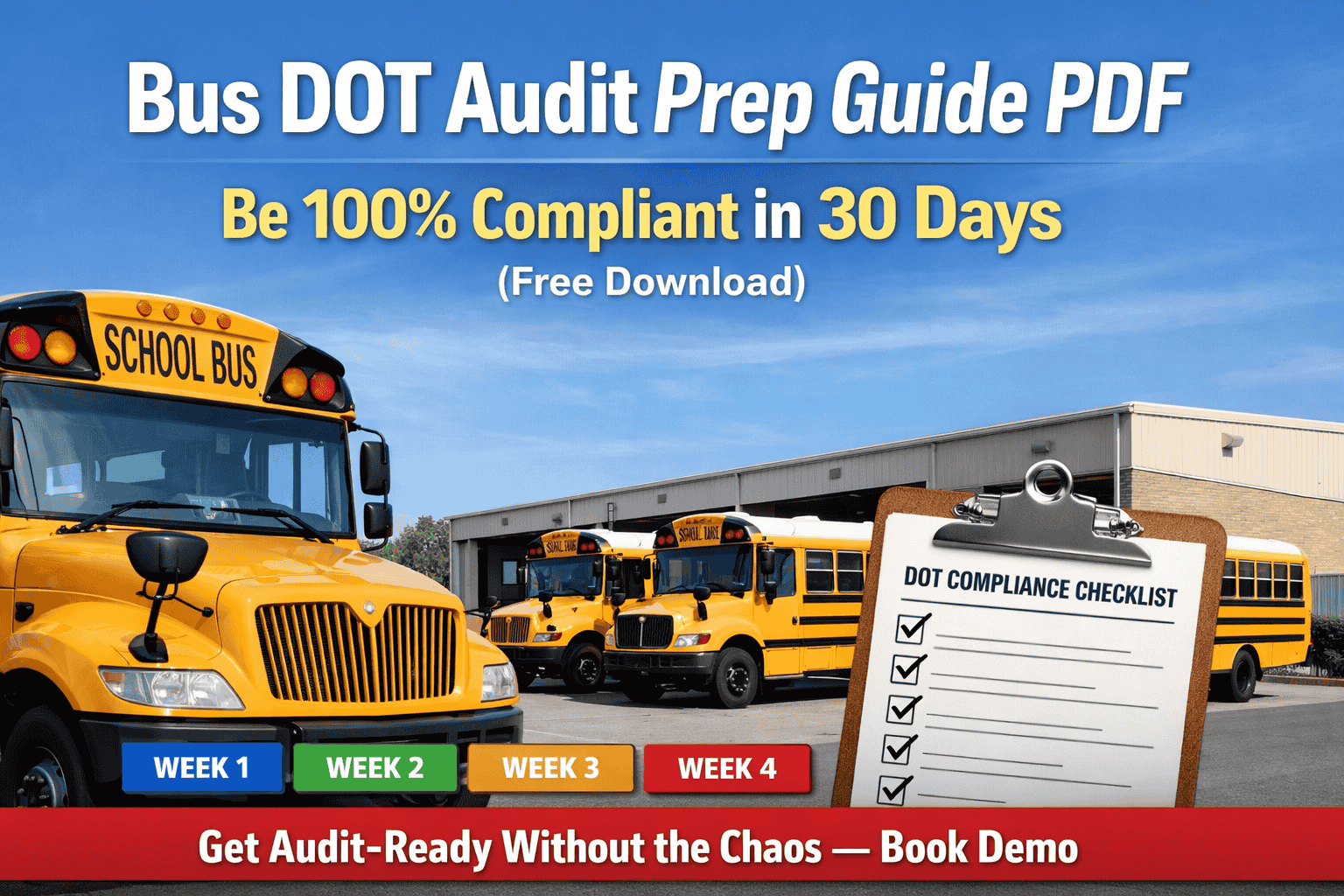
Only 7% of motor carriers pass a DOT audit without a single violation. The other 93% face fines up to $23,048 per incident, out-of-service orders, and CSA scores that affect insurance premiums for years. The difference isn't luck — it's preparation. This 30-day countdown guide walks you through exactly what to fix, what to document, and what to automate before the auditor arrives. Every step maps to a BusCMMS feature so you can go from scrambling to audit-ready in one month.
Free PDF via Demo
Bus DOT Audit Prep Guide: Be 100% Compliant in 30 Days
Week-by-week countdown built for school bus fleet managers facing audits
30-Day Countdown
6 Audit Categories
Zero Violations Goal
The 6 Categories Every DOT Auditor Checks
1
Driver Qualification Files
12% of all violations
2
Vehicle Maintenance Records
Largest category by volume
3
DVIRs & Inspection Reports
Most common bus audit trap
4
Hours of Service / ELD
Up to $16,000/violation
5
Drug & Alcohol Testing
Clearinghouse queries required
6
Insurance & Authority
First docs auditor requests
Missing documentation in any single category triggers a citation. Bus fleets must complete DVIRs on every trip regardless of whether defects are found — this is the #1 audit trap for school districts.
Week 1
Audit Your Records (Days 1–7)
Find the gaps before the auditor does
BusCMMS does this: Pull any driver's complete qualification file, any bus's full maintenance history, or any date range of DVIRs in under 60 seconds — audit-ready format, one click.
Week 2
Fix the Gaps (Days 8–14)
Close every compliance hole you found in Week 1
BusCMMS does this: Defects auto-create work orders. Work orders track technician, parts, labour hours, and completion date. The full repair chain auditors look for is built automatically.
Book a demo to see how BusCMMS builds audit-ready records automatically
Week 3
Automate Compliance (Days 15–21)
Replace paper systems so gaps never form again
BusCMMS does this: Digital DVIRs with GPS timestamps, auto-PM scheduling, credential expiration alerts, and Samsara/Geotab fault-to-work-order automation. All included in the free trial.
Week 4
Mock Audit & Final Prep (Days 22–30)
Test your readiness before the real thing
BusCMMS does this: One-click audit reports organised by FMCSA compliance area. Pull any vehicle's full 12-month history for an auditor in under 60 seconds. No paper, no scrambling.
Sign up free and run your own mock audit using BusCMMS today
Audit Notice Already Arrived?
Most districts get 3–5 days warning before an onsite audit. BusCMMS generates audit-ready compliance packages in minutes — not the days it takes to assemble paper files. Districts typically reach full audit readiness within 30 days of signing up.
05
What Failing Costs: 2026 FMCSA Penalty Reference
$1,270
Per day for failing to complete required DVIRs
$12,700
For falsifying inspection reports ("rubber stamping")
$15,420
For dispatching a bus with known unrepaired defects
$23,048
Maximum fine for operating under out-of-service order
$1,544
Per day for recordkeeping violations
$33,252
For operating with unsatisfactory safety rating
Beyond fines, violations impact CSA BASIC scores, trigger additional audits, increase insurance premiums 15–25%, and create litigation exposure in crash cases.
Book a demo to see how BusCMMS prevents every one of these violations
06
What Districts Say After Using This Prep Guide
"After multiple DOT violations, we implemented digital DVIR and compliance tracking. Result: 100% inspection compliance for 24 consecutive months and zero violations at our last audit."
"We went from 82% DOT inspection pass rate to 100% in 6 months after switching to digital inspections. BusCMMS flags defects before they become violations."
Expert Verdict
The hardest part of DOT audit preparation isn't knowing what's required — it's having the documentation to prove it. Fleets using comprehensive CMMS implementations consistently achieve 12–18% lower maintenance costs while maintaining zero-violation compliance records. The districts that pass audits without citations aren't doing more work — they're using systems that build the audit trail automatically as they work.
30 Days From Now, You'll Be Ready
This guide gives you the complete 30-day roadmap: Week 1 audits your records, Week 2 fixes the gaps, Week 3 automates compliance so gaps never form again, and Week 4 runs a mock audit to verify readiness. Every step maps to a BusCMMS feature — so you can follow this guide on paper, or let the software do the heavy lifting.
The best time to prepare for a DOT audit is before FMCSA ever contacts you. The second best time is right now.
Get Audit-Ready Without the Chaos
BusCMMS builds audit-ready records as you work — DVIRs, work orders, PM history, credential tracking, and one-click compliance reports. Districts reach 100% audit readiness within 30 days. No paper. No scrambling. No violations.
Frequently Asked Questions
How much advance notice do you get before a DOT audit?
Typically 3–5 business days written notice for an onsite audit, though urgent safety situations can trigger immediate reviews. New entrant carriers receive a mandatory audit within 18 months of registration. Audits can also be triggered by poor CSA scores, crash history, citizen complaints, or random selection. The key takeaway: be audit-ready at all times, not just when notice arrives.
What's the most common reason school bus fleets fail DOT audits?
Incomplete DVIR documentation is the #1 audit trap for school bus fleets. Unlike trucking companies, passenger-carrying vehicles must complete DVIRs on every trip regardless of whether defects are found. Many districts only document defects and skip "no defect" reports — which is a violation. Driver qualification file gaps (missing medical certs, expired MVRs) are the second most common failure.
Are electronic DVIRs accepted during DOT audits?
Yes. FMCSA Rule FMCSA-2025-0115 (effective March 23, 2026) explicitly authorises electronic DVIRs. Digital records are fully compliant and actually create stronger audit documentation than paper — GPS timestamps, photo evidence, driver e-signatures, and automatic retention. FMCSA accepts electronic records as long as they're accessible, reproducible, and meet content requirements.
Can I prepare for a DOT audit in less than 30 days?
If your records are mostly intact and you just need to digitise and organise them, districts using BusCMMS report reaching audit readiness in 1–2 weeks. The 30-day timeline accounts for districts starting from paper systems with significant gaps. If you already have digital records but they're scattered across systems, BusCMMS consolidates everything into audit-ready format within days.
What happens if we fail the DOT audit?
Consequences depend on severity. Minor violations result in corrective action plans and fines ($1,270–$16,000 per violation). Serious violations can trigger conditional or unsatisfactory safety ratings — which affect insurance premiums (15–25% increase), shipper contracts, and can ultimately result in operating authority revocation. An unsatisfactory rating carries a maximum fine of $33,252 and requires immediate corrective action to avoid shutdown.