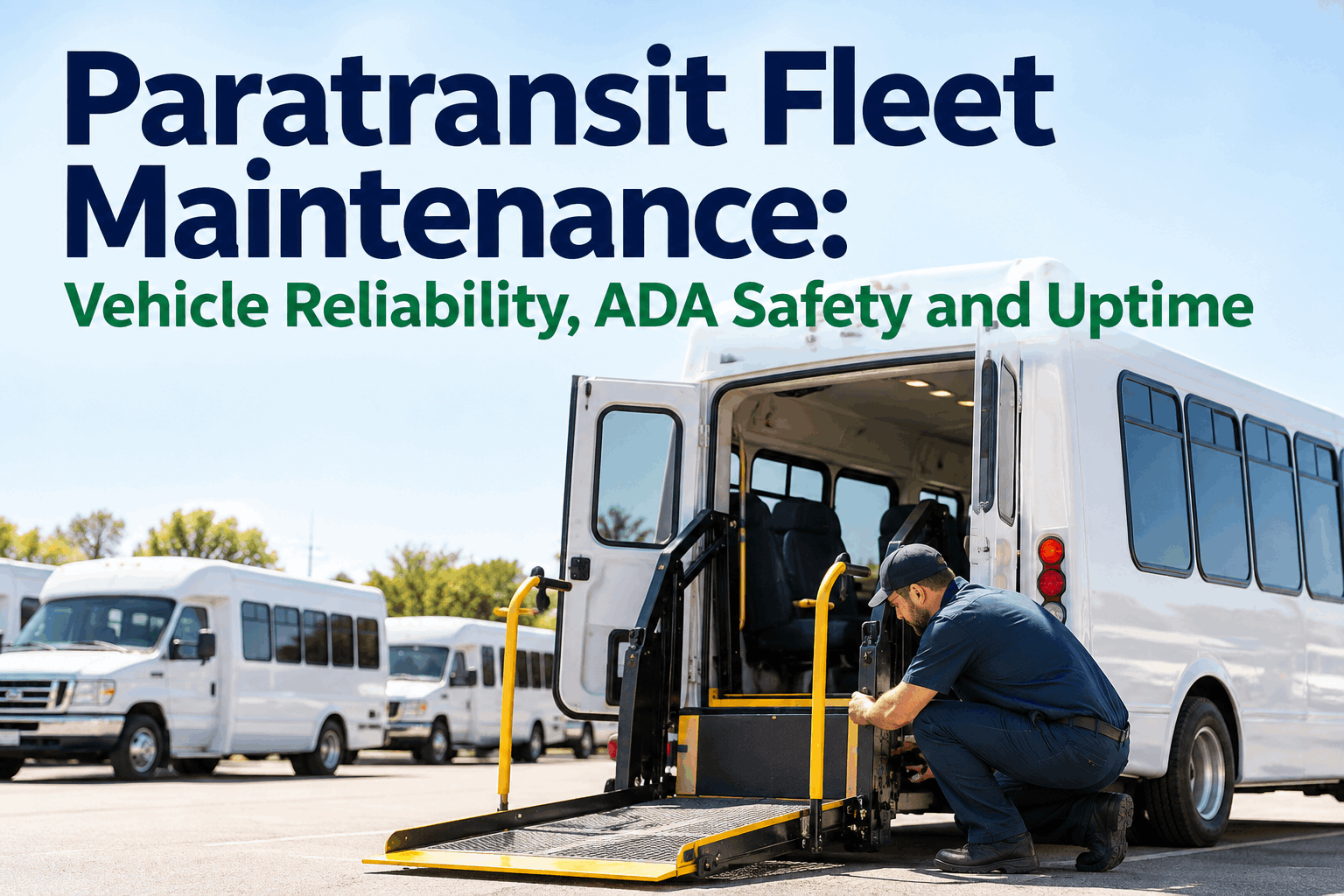
A thorough 44-point walk-around takes 7–10 minutes. A rubber-stamped paper form takes 30 seconds — and misses the brake hose, the cracked mirror, and the dead tail light that a roadside inspector catches 2 hours later. This checklist follows the physical walk-around sequence: front → engine → driver side → rear → passenger side → cab interior → bus-specific. Not alphabetical. Not random. The order you actually walk. Use it on paper today, or load it into BusCMMS for guided digital inspections with photo capture, defect-to-work-order routing, and the 3-signature chain that DOT auditors check first.
FMCSA Compliant · 2026 eDVIR Ready
Bus Driver Daily Walkaround Checklist 2026 (44-Point)
Organized by physical walk-around sequence. Every item a roadside inspector checks. Free to use — or go digital with BusCMMS.
Zone 1: Front Exterior (7 Points)
Start at the front bumper. Work left to right across the front face of the bus:
- 1Headlights — high and low beam operation, lens condition, alignment
- 2Turn signals — amber front, flash rate, lens cracks
- 3Clearance / marker lights — all lit, correct color (amber front)
- 4Windshield — cracks, chips, wiper blade condition, washer fluid spray
- 5Front bumper — secure, no damage, reflectors present
- 6Crossing gate / arm — deploys fully, retracts fully (school bus)
- 78-light flasher system — amber + red sequencing correct (school bus)
Zone 2: Engine Compartment (6 Points)
Open the engine compartment. Check fluid levels and mechanical condition:
- 8Engine oil level — between min/max on dipstick, no leaks below
- 9Coolant level — visible in overflow tank, no leaks on hoses/connections
- 10Power steering fluid — at proper level, no leaks
- 11Belts — tension, cracks, fraying (serpentine, alternator, AC)
- 12Hoses — no bulging, cracking, rubbing, or leaking connections
- 13Battery — terminals tight, no corrosion, cables secure, hold-down in place
Turn this checklist into a guided mobile walk-around — sign up free
Zone 3: Driver Side (6 Points)
Walk down the driver side from front to rear:
- 14Driver-side tires — tread depth (4/32" steer min), pressure, sidewall damage, lug nuts
- 15Driver-side mirrors — flat, convex, crossover. Secure, clean, properly adjusted
- 16Fuel tank — cap tight, no leaks, tank secure
- 17Body panels — no damage, compartment doors latched, no fluid drips underneath
- 18Emergency exit windows — operate freely, alarm sounds when opened
- 19Exhaust system — no leaks, hangers secure, no contact with wiring/brake lines
Zone 4: Rear Exterior (5 Points)
Stand at the rear and check everything visible:
- 20Tail lights — brake lights, turn signals, reverse lights, all functioning
- 21Rear clearance / marker lights — all lit, correct color (red rear)
- 22Rear emergency exit door — operates freely, alarm buzzer sounds, marking light works
- 23Rear bumper — secure, reflectors present, ICC bar if applicable
- 24License plate — visible, illuminated, current registration
Zone 5: Passenger Side (5 Points)
Walk the passenger side from rear to front:
- 25Passenger-side tires — tread depth, pressure, sidewall damage, lug nuts
- 26Passenger-side mirrors — secure, clean, properly adjusted
- 27Service door — opens/closes fully, steps clean, handrail secure
- 28Stop arm — deploys fully, retracts fully, lights function (school bus)
- 29Emergency exit windows (passenger side) — operate freely, alarms sound
See how BusCMMS guides drivers through this exact sequence on their phone — book a demo
Zone 6: Cab Interior & Controls (9 Points)
Sit in the driver's seat. Start the engine. Test every control:
- 30Parking brake — holds vehicle stationary on grade
- 31Service brakes — firm pedal, no pull, stops straight
- 32Air brake system — builds to operating pressure, no >3 psi/min drop, low-air warning activates before 60 psi
- 33Steering — no excessive play (>10° freeplay on 20" wheel), no grinding/binding
- 34Horn — sounds clearly
- 35Dashboard gauges — oil pressure, temperature, voltage, air pressure all in normal range
- 36Warning lights — no active MIL, check engine, ABS, or air bag warnings
- 37Heater / defroster / AC — functioning, adequate airflow
- 38Two-way radio / communication — operational and clear
Zone 7: Safety Equipment & Bus-Specific (6 Points)
Final checks — the items that are unique to passenger-carrying vehicles and the items DOT inspectors look for first:
- 39Fire extinguisher — charged, gauge in green, secure mount, accessible, inspection tag current
- 40First aid kit — stocked, sealed, accessible
- 41Reflective triangles / warning devices — 3 triangles present, in good condition
- 42Seatbelts (driver + passenger if equipped) — buckle, latch, retract properly
- 43Child check / reminder system — activated, alarm functional (school bus)
- 44Body fluid cleanup kit — stocked and sealed (school bus)
That's 44 points in 7 zones. A thorough walk-around takes 7–10 minutes. A rubber-stamped paper form takes 30 seconds — and misses the brake hose, the cracked mirror, and the dead tail light that a roadside inspector catches 2 hours later. Go digital. Run this exact 44-point walk-around on your driver's phone. Sign up free.
"Paper DVIRs reported defects on 2% of inspections. Digital walk-arounds report defects on 11%. Same buses. Same drivers. In 90 days we caught 34 defects paper missed — including 3 emergency exit alarms that weren't working. On school buses carrying kids. Our next DOT audit: zero DVIR findings for the first time ever."
Every day a driver rubber-stamps a paper checklist is another day a brake defect, a failed exit alarm, or a burned-out tail light rides your route. The digital version of this checklist costs nothing to set up and catches 450% more defects. Stop printing. Start catching. Book a demo.
Frequently Asked Questions
How long should a bus walk-around take?
A thorough 44-point walk-around takes 7–10 minutes. If it takes less than 5, items are being skipped. Digital guided checklists enforce proper pace because the driver can't skip zones or check all items from the seat.
Is this checklist FMCSA compliant?
Yes. All 11 FMCSA-mandated DVIR components (49 CFR 396.11) are included plus bus-specific items. Compliant with the 2026 eDVIR rule (FMCSA-2025-0115). Bus-only requirement: DVIRs must be filed even when no defects are found.
What's the difference between this and a DVIR?
A pre-trip walk-around (49 CFR 392.7) confirms the bus is safe before driving. A DVIR (49 CFR 396.11) documents the bus's condition at end of day. Both cover the same items. This checklist works for both — BusCMMS labels it pre-trip or post-trip based on time of completion.
Can I use this on paper?
Yes — print and use today. But paper has structural limitations: drivers can skip items, defects don't auto-route to the shop, and records are hard to retrieve for audits. Digital version in BusCMMS enforces completion, captures photos, creates work orders automatically, and stores records indefinitely.
What if I have different bus types in my fleet?
BusCMMS auto-loads the right checklist for each bus type. School buses get items 6, 7, 28, 43, 44 (stop arm, flashers, etc.). Transit buses get fare box and ADA items instead. Electric buses skip engine compartment oil/belt checks and add battery SOC/HV items. One platform, every bus type.