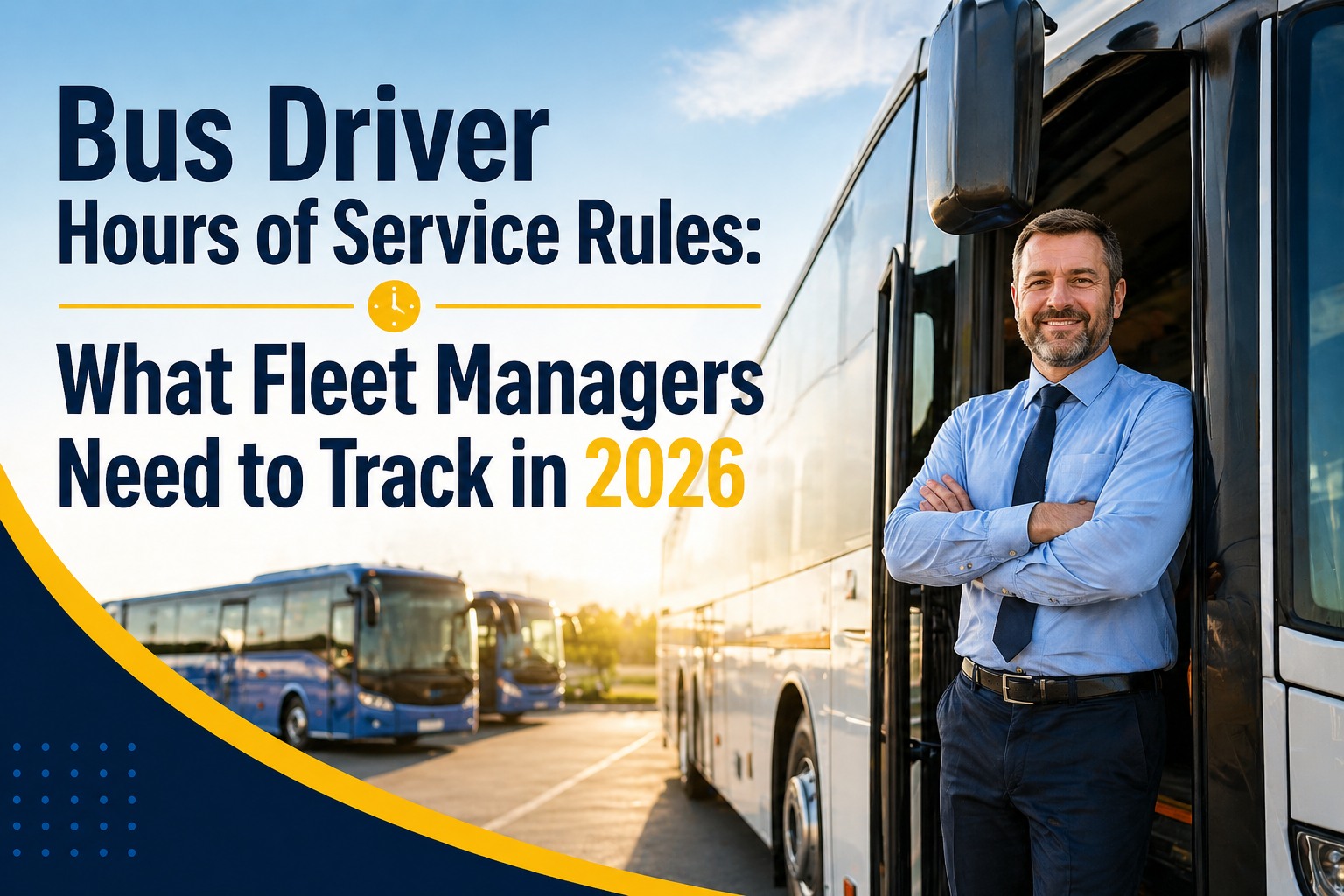
A fatigued bus driver is a dangerous bus driver. That's why FMCSA Hours of Service rules exist — and why violations cost fleets up to $19,246 per incident in 2026. But here's the real issue: most fleet managers are tracking HOS manually or not at all, creating compliance gaps that only surface during an audit or after an accident. This guide breaks down exactly what you need to track, the penalties you're risking, and how to automate compliance before it becomes a crisis.
2026 HOS Compliance Guide
Bus Driver Hours of Service Rules
What Fleet Managers Need to Track in 2026
Automate driver records before your next audit
01
Passenger vs Property: Bus Drivers Have Different Rules
FMCSA regulations split drivers into two categories — most fleet managers don't realize they're tracking the wrong limits
Passenger-Carrying (Buses)
Max Driving
10 hours
On-Duty Window
15 hours
Off-Duty Required
8 hours
Weekly Limit
60/70 hours
30-Min Break
Not required
VS
Property-Carrying (Trucks)
Max Driving
11 hours
On-Duty Window
14 hours
Off-Duty Required
10 hours
Weekly Limit
60/70 hours
30-Min Break
After 8 hrs driving
02
The 150 Air-Mile Short-Haul Exception
Most school bus drivers qualify — if you're tracking it correctly
Short-Haul Exception Qualifications
Operates within 150 air-mile radius of work location
Returns to same work location each day
Released from duty within 14 hours
Has 8 consecutive hours off-duty between shifts
Benefit: Exempt from ELD requirement and detailed logbooks. Just maintain time cards showing start/end times.
03
HOS Violation Penalties in 2026
The fines that keep fleet managers up at night — updated for inflation
$19,246
Per Violation (Carrier)
Maximum fine per HOS violation for motor carriers under 49 CFR Part 386
$4,812
Per Violation (Driver)
Maximum fine per violation assessed directly against individual drivers
$15,846
Falsified Records
Per falsified logbook entry — 42% of OOS orders during International Roadcheck
$23,647
OOS Violation
Allowing a driver placed out-of-service to continue operating
04
Top 5 HOS Violations for Bus Fleets
What auditors find most often — and how to prevent each one
1
Exceeding 10-Hour Driving Limit
Driver operates beyond the maximum 10 hours of driving time after 8 hours off-duty
Prevention: Automated alerts when drivers approach 9.5 hours driving time
2
15-Hour On-Duty Violation
Driving after being on-duty for 15 hours following 8 consecutive hours off
Prevention: Track total on-duty time including pre/post-trip inspections and fueling
3
60/70-Hour Weekly Limit Exceeded
Cumulative on-duty hours exceed 60 hours in 7 days or 70 hours in 8 days
Prevention: Rolling 7/8-day hour calculations with dashboard visibility
4
Insufficient Off-Duty Time
Driver returns to duty before completing 8 consecutive hours off
Prevention: Block scheduling that enforces minimum rest periods
5
Missing or Incomplete Records
Failure to maintain time cards or logs for required retention period (6 months)
Prevention: Digital time tracking with automatic retention and audit trails
05
What Fleet Managers Must Track
The complete driver record checklist for HOS compliance
Daily Records
Time driver reports for duty
Time driver is released from duty
Total hours on-duty each day
Duty status changes
Rolling Period
Total hours for preceding 7 days
Total hours for preceding 8 days
Time last relieved from duty
34-hour restart eligibility
Retention
Maintain records for 6 months
Available within 2 business days
Multi-employer driver statements
Supporting documents
06
Expert Insight
Why most bus fleets fail HOS compliance — and how to fix it
Frequently Asked Questions
Do school bus drivers need ELDs?
Most school bus drivers qualify for the 150 air-mile short-haul exception, which exempts them from ELD requirements. However, they must still maintain accurate time cards showing when they report for duty, when they're released, and total hours worked. If a driver exceeds the 150-mile radius or 14-hour window more than 8 times in 30 days, they must switch to an ELD.
What's the difference between driving time and on-duty time?
Driving time is only time spent operating the vehicle. On-duty time includes driving plus all other work activities: pre-trip inspections, fueling, loading/unloading passengers, paperwork, and any time you're required to be ready for work. Bus drivers can drive up to 10 hours but can be on-duty up to 15 hours — the 5-hour difference accounts for non-driving duties.
Do passenger-carrying drivers need a 30-minute break?
No. The mandatory 30-minute break requirement after 8 hours of driving applies only to property-carrying drivers (truckers). Bus drivers and other passenger-carrying vehicle operators are not required to take this break under current FMCSA regulations, though adequate rest is still recommended for safety.
How long must HOS records be retained?
Motor carriers must retain driver time cards and HOS records for a minimum of 6 months. Records must be available for inspection within 2 business days of a request. For drivers using the short-haul exception, this means keeping time cards showing report and release times for each day worked.
What triggers an HOS audit?
Common triggers include: roadside inspection violations that impact your CSA score, complaints filed against your carrier, accidents involving your vehicles, and random compliance reviews. A high Hours-of-Service Compliance BASIC score (above the 65th percentile) significantly increases your audit risk.